The Great Roger Bannister Has Died

A lifelong hero of mine, Roger Bannister, recently passed away at Oxford, England. This prompted me to mull the impact he has had on my life.

When I was barely eight years old, I recall his signature athletic accomplishment- breaking the four minute mile. At the time this feat was believed humanly impossible, simply beyond the level of human endurance.
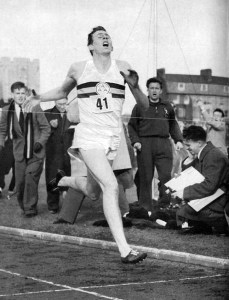
Bannister breaking the four minute mile

I was stunned by the magnitude of his phenomenal and near mystical accomplishment. Humans can push themselves beyond expected limitations.

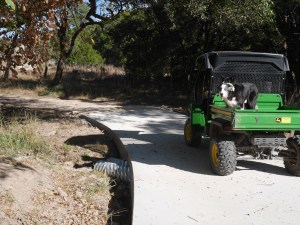
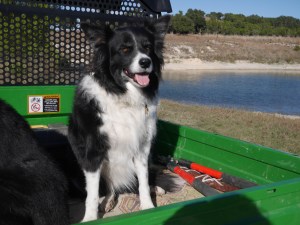
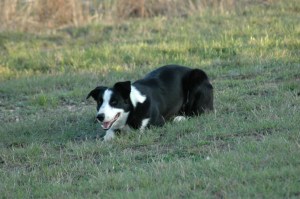
Bella: Hey Dad I can run a four minute mile too and even jump cattle guards

In 1954 Roger Bannister worked as  a medical student in London. On May 6, 1954 after putting in his usual shift at St. Mary’s Hospital, he caught an early train to Oxford, had lunch with friends, and met up with two trackmates: Christopher Chataway and Chris Brasher. Chataway and Brasher had been recruited as pacers to assist him in breaking the four minute mile. The day was damp and blustery, not conducive to be sure for going after a world record. Only about 1200 people showed up at Oxford’s Iffley track to watch Bannister’s effort, but an effort that soon would be heralded world-wide.

The gun went off and his valiant, gutsy attempt began. At one early point in the race, Roger Bannister tried to speed up Brasher’s pace but Brasher kept his head, maintaining the steady pace needed to achieve the ultimate goal. One lap, two laps, three laps passed.

Bannister was known for his great finishing kick so that when his pace man finally spun off at the beginning of the final lap, Bannister threw back his head, pumped his arms furiously, and ate up the remaining distance with his long strides. His finishing time turned out to be an astounding 3 minutes 59.4 seconds. He had done it! Following his incredible exertion Bannister collapsed into the arms of his teammates.

As a youth I loved to run and in fact had a habit of running everywhere. Bannister’s achievements later inspired my own less impressive track efforts. But I found after an active early youth, a strange thing happening.

Following an unusual illness rather than being able to run long distances any longer, I found myself running out of breath much too early. I had speed but no endurance. Oftentimes as a young boy, I would register a fit of coughing so severe as to collapse me to my knees. There I would stay until able to stabilize my heavy breathing and be able to regain my feet.

I didn’t understand why my stamina, particularly my respiratory function, was less than others and me previously. (Parenthetically I never was able to explain my lack of endurance to my college track coach who determined at the beginning of every track season to have me run a quarter of a mile. This always ended with me becoming sick following the ill conceived attempt.)

Years later when in medical school, I was skin tested and found to have suffered a Battey bacillus infection, an infection similar to pulmonary tuberculosis but not so infectious. I can only assume this sneaky little mycobacterium led to my lack of lung endurance.

It became clear early on that if I was to be a runner, it would not be at distance. I suppose that’s why I became a sprinter and a broad jumper, knowing that anything beyond an eighth of a mile simply wasn’t possible for me.

To the surprise of the world, shortly after setting the world record at the mile, Roger Bannister retired from the sport of track. I found his stepping away from track quite shocking. In retrospect he did so, I presume, to focus on what he valued more greatly than track, that is becoming a clinical and research neurologist. He simply walked away from distance running after having accomplished what he had set out to do. His willingness to focus on what he saw as most important in his life made a lasting impression on me.

Buddy: Looks to me as if all that running isn’t as nice as a good nap

I attended university and began my own premedical training. Although I had been recruited out of high school to run track in college, I had made the decision to focus my efforts entirely on my dream of becoming a doctor. A visit from the track coach at Texas Tech and his substantial urging along with the offer of a much needed athletic scholarship soon saw me back wearing track shoes. For the next two years I was fortunate to letter in track and field and help the Texas Tech team win some meets including second in the southwest conference meet. It was then I had to face a serious decision of my own.

During my junior year my premedical studies would require five afternoon science laboratories that didn’t even let out till past 5:00 pm. If I were to practice track, it would be on my own in the evenings working out when I needed to be studying for the following day’s classes. I faced a decision as to whether to change my curriculum or else give up track.

The decision was an easy one for me to make although not without causing a sense of loss for my lost sport and my teammates. In the same way that Roger Bannister had exemplified, I gave up track and plowed my efforts full on into becoming a physician, and yes, like Bannister a neurologist.

It was years later during several training stints at the National Hospital (Queen Square) in London that I came across Roger Bannister again and this time in person. He would occasionally provide a lecture in the musty old lecture halls of Queen Square on a neurological topic- various aspects of Multiple Sclerosis, as I recall. He came across as tall, austere, and frankly rather humorless individual. I later learned he was actually painfully shy. Little did he know that one of the nameless faces in that auditorium had admired him for so long and from so far away.
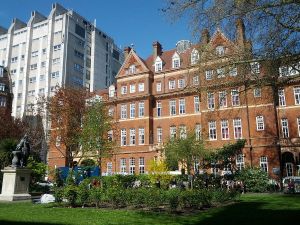
The National Hospital (Queen Square), London

My own career paralleled Bannister’s but in a less storied fashion. I too became a clinical and research neurologist. Like Bannister I was seduced by the mysteries of the brain and what all it was capable of performing. My special interests rather than relating to Multiple Sclerosis centered on Parkinson’s disease and Alzheimer’s disease.

The direct approach to understanding the mysteries of the brain

Perhaps the commonalities we shared with both track and neurology explain my sense of personal loss over Roger Bannister’s death. He provided for me inspiration in athletics and blazed a pathway into Neurology.

In your life Roger Bannister, you raced to the adulation of an entire world. You then performed the intellectual work of research into the mysteries of brain illnesses. You have now run your race and you ran it ever so well. It was at times a sprint and at others a distance run but always with good humor and respect for others. Thank you Sir Roger. God speed!
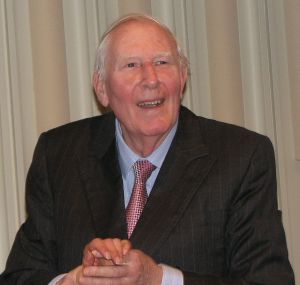
Roger Bannister

Of Buddy and Back Injuries

I don’t know if my absence from the blog has been noticed, but ‘I’ve been MIA for awhile, suffering from a slipped disc. Besides sapping any creativity, it is darned hard to write when lying on your belly in bed.

The offending item that resulted in my most recent aggravation of my back injury

My infirmity did cause me to think back 10 years when I first injured my back. For the six weeks during my recovery, my young Border collie, Buddy, stayed as if glued to my side. I knew he would have preferred to be out on the ranch herding or exploring, but stay with me he did. Because of his loyalty and devotion, his name became uncannily appropriate.

Buddy has of course, like me, aged in the last 10 years. He injured his own back years ago while jumping over a cattle guard, causing a thoracic disc to project out, contuse his spinal cord, and bring about a prolonged weakness of his hind legs. He is probably 70% recovered now and has continued to perform his ranch duties with a fierce determination.

Buddy when younger

Buddy is now an old dog. Of late when we’ve gone on a walk (always an activity he enjoyed immensely), he has tended to stay behind at the house while Bella and Little Jack walk off with me.

Seems to me Buddy is smart enough to know that the exertion will only aggravate his discomfort and we will, after all, return in short order.

Buddy sleeps more now following his injury

Since most of my time has been spent in my position of relative comfort, that is on my belly in bed, Little Jack and Bella have taken over Buddy’s prior close association. They bookend me on the bed while Buddy lays across the room on his dog bed or underneath my bed. He simply doesn’t have the oomph to jump up on the bed any longer. Instead he seems to delegate this position of responsibility.

Bella on the left and Little Jack on the right

Buddy seems able to accept  changes required by his age and back condition. This lesson is not lost on his pained human companion.

Injuries, such as mine, provide lots of time to think. My friends and family have been wonderfully supportive. This provides more solace than I ever would have imagined.

My dogs also provide wonderful companionship and are rooting for my recovery. While I await a visit with the neurosurgeon, I am closer than ever to achieving recovery from my injury. Loyalty is never sweeter than when it arrives at a time of special need- and on four paws with a wet nose.

In The Deep Freeze

Frozen Waterfall at Hidden Falls Ranch

Like most of our nation, Medicine Spirit Ranch has been really cold this past week. We have been  in the upper teens at night (I know this is nothing compared to the northern climes but cold for here). Whereas many folks around the country are tasked with shoveling snow, scraping windshields, and avoiding snowdrifts, at MSR the tasks that cold weather provokes differ.

My biggest challenge during a prolonged freeze is supplying water for the cattle and horse.  The lines taking water to the troughs soon froze. The cattle drank the available water. At this point I began hauling water and filled two water troughs.

Managed to fill two troughs with contents of this 210 water container

I then needed to chop ice on the water troughs twice a day to make the water available for the stock. I quickly realized as the ice got thicker that a better plan was needed. Pecan Creek flowed for several days providing water for the stock before it froze over. Fortunately our largest creek (Live Oak) continued to flow well.  I only needed to open certain gates to allow access for the stock, a strategy that seemingly always takes me awhile to figure out.

Our pool became a giant birdbath

My other need was to supply sufficient hay and protein supplementation for the animals. This requires moving 1000 pound round bales with the tractor and placing a bale in multiple hay rings. I also supply the cattle with range cubes (20% protein) and the horse with her high protein feed.

Trudy was feeling sorry for Fancy, our horse, as Fancy gazed longingly over the fence at the cattle. She has appeared lonely ever since Doc, our gelding, died months back. I opened the gate and allowed Fancy to herd up with the cattle. This works well with the exception that she likes to eat the cattle’s range cubes and the cattle like to eat her feed. Looks pretty comical to see half a dozen cows, head to head, eating out of a horse trough.

Fountain froze as well

I also opened up the barn for Fancy to go in at night. She hates to be locked up in a stall and would kick her way out so this option was out. Nevertheless, she leaves evidence that she goes into the open barn during the night and fortunately I’ve not found evidence that the cattle do.

Naturally during the coldest night of the year, two of our mama cows gave birth to two bull calves. How they survived being dropped wet during such freezing cold, I do not know. Nevertheless, both calves are doing well and scampering about. I think of the two calves as “Frosty” and “Ice Cube.”

So times have been challenging this week at Medicine Spirit Ranch. Am glad the temperatures have warmed. Fortunately we have made it through at least this cold spell with the animals surviving just fine and their rancher hoping for warmer weather.

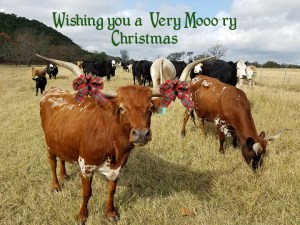
Happy Holidays

Our Holidays came early, as our married children will spend Christmas with their in-laws this year. One benefit of an early Christmas is that I can share with my readers a Christmas poem given to me by Ramsey Hutton. You may recall Ramsey is the official, cub photographer for Views From Medicine Spirit Ranch. She might also become poet laureate for this blog.

Her offering may sound uncannily familiar as follows:

Twas the night before Christmas, when all through the Ranch
Nothing was moving, not even a branch
The boots were set by the chimney with care
In hopes that St. Nicholas soon would be there

The calves were nestled all snug in the grass
While the moon in the sky just began to pass
And mama in her kerchief and I in my cap
Had just settled down for a long winter’s nap.

When out in the pasture there arose such a clatter
I sprang from my bed to see what was the matter
Away to the porch I flew with a flash
Called for the dogs and went outside with a clash

The moon on the water of the blue shiny pool
Made all of the ranch look like a jewel
When what to my wondering eyes was born
But a great big sleigh and eight huge longhorns

With a little old driver, so lively and quick
I knew in a moment it must be St. Nick!
More rapid than eagles his longhorns they came
He drew in a breath and called them by name

Now Dasher, Now Dancer, Now Prancer and Vixen
On Comet, On Cupid, On Donner and Blitzen
To the top of the hay, to the top of the barn
Dash away, dash away, dash away darn!”

So up to the housetop the reindeer soon flew
With a sleigh full of range cubes and St. Nicholas too
Down the chimney he came with a leap and a bound

All dressed in cowhide and his belly was round


He spoke not a word and went straight to his work

Filling the boots he turned with a jerk

And laying his finger aside of his nose

With a nod of his head up the chimney he rose


But I heard him exclaim as he flew out of sight

“Merry Christmas y’all and y’all have a good night!”

Bullying- In humans and Dogs

Bullying has become an important topic in our schools and society. This unfortunate behavior occurs usually when an older or stronger person seeks to intimidate or reduce the significance of another. By doing so the bully tries to achieve an increase in status or sense of worth. Bullying can be quite harmful for the person being bullied and may lead to depression, anxiety and acting out.

Unfortunately I’ve witnessed similar behaviors in my beloved dogs. The shame of it all!

Bella on left and Buddy on the right


Little Jack, “Who me bully?”

I’ll describe a few dog behaviors and compare to human bullying as strong similarities exist. Perhaps we may even learn from our canine friends.

I’ve noticed when one of my dogs crosses a cattle-guard that he will stop immediately on the other side, turn, and menace other dogs trying to cross. The dog attempting to cross must gingerly place paws on the metal pipe and concentrate on not falling through. The task requires rapt attention and during the crossing, the crossing dog is vulnerable to such menacing (bullying).

“You just try coming across this cattleguard”

Similarly when one of my dogs goes through a door, he (Bella doesn’t do this) tends to crouch just outside in order to intimidate the following dog. Again the second dog is vulnerable. Why do this at all?

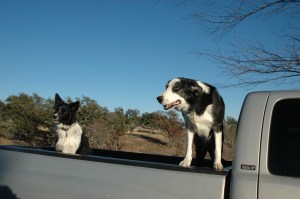
Whereas human bullying arises when the bully needs to establish dominance or elevate his/her often diminished self-esteem, I wonder if dogs are trying to improve their sense of worth or rank in the pack. In the picture below, Jack is trying to bite Buddy in the butt while Buddy is jumping into the pickup. This smacks of bullying if not outright sadism!

I’ve been pondering my observations. My first thought was that almost always a male dog bullies another male dog, and a female dog usually bullies another female dog. Gender plays a role here. Isn’t this gender specificity also true among humans?

When Little Jack or Buddy first cross the cattle-guard or first makes it through the door, the dog on the far side invariably will nip at the dog attempting to exit the house or cross the cattle-guard. By so doing the bully dog establishes primacy,  elevating its status. While this may be viewed as dominance, is it not also a form of bullying?

Likewise, I’ve witnessed Bella engage in bullying toward visiting, female dogs. In these instances the visitors are off their usual turf and appear initially tentative. Bella greets them on arrival by standing aggressively over them and growling at them. She’s not the welcoming hostess at all. The visiting female dog becomes submissive and even may demonstrate submissive peeing. Perhaps this submissiveness provides Bella reassurance that she will not be displaced by the visiting female dog.

Once dominance has been established, Bella appears friendly enough and ceases her earlier bullying behaviors. At this stage the two dogs usually play nicely together. The dogs Bella bullies are typically smaller than she. Here size makes a difference.

Early on in their interactions, I suppose Bella is trying to put them in their subservient places. If on the other hand, a visiting dog is substantially larger and more powerful than Bella, then bullying by Bella never becomes an issue. Makes sense to me and is also what we observe with humans. Certainly relative size of the animal being bullied is another relevant characteristic.

A third observation relates to the age of the dog doing the bullying. While Buddy was a bully early in his life, now in his advanced years he usually acts as if he couldn’t be bothered (except for Little Jack who is trying to displace Buddy). When visiting male dogs come to the ranch, Buddy now pays them little mind. Earlier in his life he would growl at the visiting dogs and do his best to intimidate them. It has been my experience that older dogs, for whatever reason, seem not to bully other dogs to the degree that do younger dogs.

“Okay, I’m not as young as I once was.”

This age factor may coincide with unwillingness to expend energy. It simply may not worth the expenditure of effort. In humans and with advanced age, self-worth has long before become established and secured and may explain the drop off in bullying. Might something like this also be at work with dogs? So perhaps age, size, and within gender bullying are characteristics of my dogs. It seems to me these are also characteristics that usually apply to human bullying as well.

I suppose this means young males and females, be they dogs or humans, must learn to become comfortable with themselves regarding status and rank. Lacking this, the chances for bullying remain. As humans we might wish to elevate the self-worth of a bully in the hope this will reduce the risk for a vulnerable, smaller person. Likewise if a younger person is under great stress, say family problems or personal trauma, an older person might help by counseling him/her or providing other assistance to mitigate the ego-deflating nature of the trauma.

As it relates to dogs, their human friends might be left with expressions of support for and acknowledgement of the worth of the bully dog. A big juicy bone might do the trick but also might precipitate a scuffle! I typically resort to lots of compliments and stroking my dogs in an attempt to signal each is a valued pet.

Do others have ideas in this regard. Are we left with only anti-bullying policies in humans? How can we reduce bullying in both dogs and humans? Would love to hear your thoughts. Please share.

Reflections on Getting Older

“Grow old along with me! The best is yet to be, the last of life, for which the first is made.”

As mentioned in an earlier post,  the meaning of Robert Browning’s famous saying for a long time of puzzled me.

Is it life satisfaction that increases with age? Or is it that our thinking processes somehow affect how we react?

Psychologists have grappled with changes in the way we think as we age. Raymond Cattell developed the concept that general intelligence consists of two types: fluid intelligence and crystallized intelligence. Its not that intelligence declines in older age (unless a dementing illness sets in), it’s that fluid intelligence declines while crystallized intelligence increases.

“Say what? What does this have to do with herding cows?”

Both types of intelligence increase throughout childhood and adolescence. Fluid intelligence, the ability to develop new problem solving strategies, peaks by age 40 whereas crystallized intelligence that comes from prior learning and experience doesn’t peak until the 60s or 70s.

Both types are important to overall intelligence. There is also some evidence that brain training games may benefit fluid intelligence.

The direct approach to understanding intelligence

Perhaps it is a greater reliance on crystallized intelligence that allows older people to better determine the veracity of an event/statement based on his/her longer experience. While this doesn’t always comport with what youngsters may believe or have experienced, it at least holds as a general rule.

“You better hope that your fluid intelligence and crystallized intelligence will outweigh your lack of smell and hearing.”
Photos by Ramsey

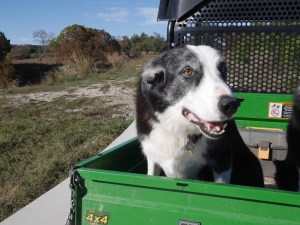
When considering aging in humans and dogs, one thing of which I am certain is that dogs can model positive aspects of aging. For example Buddy (pictured above) awakens in the morning stiff and sore. He and I both take awhile to get going. Nevertheless when Buddy heads for the truck and his ranch duties he pulls himself together and goes after life with an incredible zest. He’s not one to give into his infirmities.

Within reason this is a life characteristic that I and other humans should emulate. While our physical and mental capabilities may not be what they once were, we should continue to use what we have to the maximum.

Thanks Buddy for your example and we shall grow old together as the best is yet to come.

World’s Shortest Roads?

As Garrison Keilor was fond of saying on Prairie Home Companion, “it’s been a slow week” at the ranch, but then most weeks blissfully are. Recently we had concrete poured in two places at Hidden Falls Ranch. One wag on seeing the results of our concrete work harrumphed, “Looks to me like you have built two of the world’s shortest roads!”

Admittedly the concrete slabs measure only 36 and 55 feet in length, much too short certainly to qualify for roads. If you look carefully though you may be able to determine that these are really low water crossings.

World’s shortest road? No, actually a new low water crossing at Hidden Falls Ranch- Photos by Ramsey Hutton


   One of the slabs is where the outflow from our spring-fed stock tank (pond to those non-Texans reading this), and the other concrete slab allows traffic to pass unhindered over Sugar Creek. These low water crossings remain treacherous though if a flash flood occurs.

Generally these areas though are dry and easy to cross. Nevertheless, during a rainy spell, both can become muddy quagmires. Previously I’ve become stuck even when driving my four-wheel drive pickup or our John Deere utility vehicle. Thank goodness for a tractor and ranch hand to extract me from the muck.

Two 12-inch aluminum pipes traverse the concrete slab at Sugar Creek. This allows the water to flow under the slab and for the dogs and me to keep our paws (feet) dry.

Hopefully our efforts will prevent getting stuck in the mud and provide improvements at this our newest addition to the Hutton ranch.

Canine Cooperation

In an earlier blog piece, I wrote of wolves having been reported as smarter than dogs in a teamwork task. While wolves were superior at performing the pull test, I wondered if this degree of cooperation was true for other dog-dog cooperation tasks as well.

The standard pull task required animal teams of two wolves and two dogs (as well as pairs of other animals) to cooperate in order to earn a tasty reward. The experiment was reported in the New York Times. Viewing this video report made me wonder if my dogs ever meaningfully cooperated with each other or did they merely excel in cooperating with their humans.

Many examples of Border collie cooperation during herding tasks exist, some of which have been detailed here previously but these might well be viewed as examples of human/dog cooperation.

Buddy on left and Bella on right. Photo by Ramsey

Since writing an earlier piece about my dogs and how they cooperate with each other, I’ve found another good example. Bella, our female Border collie, has for some time worked as our nighttime door monitor.

What I mean by this is that Buddy will often go to the door at night but fail to bark to signal his desire to go out. Standing quietly at the backdoor, he often goes unnoticed by his sleeping humans. This is especially true as he goes to the room adjacent to our bedroom when Trudy and I are deeply asleep.

“My humans are so slow in sensing Buddy’s plight.”
Photo by Ramsey

On sensing Buddy’s need Bella’s response is to head for our bed and place her very cold, wet nose on the selected, sleeping face of one of her humans. Believe me, this proves quite alerting and motivating, waking one of us up from even stage IV sleep. Trudy or I will then find Buddy standing at the backdoor and let both Buddy and Bella out for Buddy to do his business. Bella will later bark when both are ready to come back inside.

In my opinion Bella’s door monitoring routine exemplifies dog-dog cooperation. She looks out for the best interests of an uncomfortable, bladder-distended Buddy, but also Bella benefits her human companions by helping avoid a large yellow puddle inside the house.

“And I really appreciate Bella’s help too.”
Photo by Ramsey

Have you too seen examples where dogs cooperate with each other? I would love to hear your stories. Let’s hear it for canine cooperation and doggy solidarity!

Cooperation says it all

Announcement- Photographer Ramsey Hutton Joins Blog

Ramsey Hutton- Ace Cub Photographer

Ramsey Hutton is now the official photographer for Views From Medicine Spirit Ranch. Yes, in case you’re wondering, Ramsey is my granddaughter and has a personal connection and warm feelings for our family ranch and its animals. She began coming to the ranch as an infant. She’s ridden through its pastures on her horse, Fancy, celebrated her birthday with friends, explored the hills, and enjoyed the scenic beauty of the Texas Hill Country. Ramsey is one with the ranch.

She assumes her role immediately and will, no doubt, improve my earlier attempts to visually represent that about which I write. Her Uncle Paul Plunket provided her camera and its a vast upgrade from her previous one.

Please welcome Ramsey to this blog. Her photographic skills should enhance the experiences for readers of Views From Medicine Spirit Ranch and my Facebook page.

Incidentally Ramsey Hutton has started her own blog. It’s entitled Ramsey’s Reality and is really quite good. Check it out!

Come visit me at Ramsey’s Reality as well as at Views From Medicine Spirit Ranch

Still More Praise For Carrying The Black Bag

An appreciative reader penned the review below for the Journal of Neurological Sciences. It has been accepted and is now in print online.

While the predominant audience for Carrying The Black Bag: A Neurologist’s Bedside Tales was thought to be a popular audience, the book has also been very well received by physicians, nurses, and allied health personnel.  This acceptance has proved most gratifying for the author as my book deals principally with a humanistic approach to medicine. The author of the book review, Dr. Steve Roach, got it! For this I am most grateful.

Carrying the Black Bag book

Makes a great Holiday gift and available online or favorite bookstore

Carrying The Black Bag makes a great Christmas (Hanukkah) gift and can be purchased from Amazon, Barnes & Noble, Texas Tech University Press, as well as your local independent bookstore.

Dr. Roach’s review is as follows:


Book Review

Carrying the Black Bag: A Neurologist’s Bedside Tales, by Tom Hutton, 240 pages. Texas Tech University Press, 2015. $27.95.

  1. Steve Roach, MD

Ohio State University

Columbus, Ohio

esroach@earthlink.net


Key words: humanism; history of medicine; Parkinson disease


Thomas Hutton is a retired neurologist whose career spanned four decades. During this time, he witnessed the introduction of computed tomography, magnetic resonance imaging, and numerous new medications. He experienced the dawn of the genetic revolution and the arrival of the electronic medical record. But this book is about people, not technology, so it is fitting that the metaphor Hutton selected for the title of his reminiscences is the traditional black physician’s bag.

Hutton is a master story teller whose patient sketches are reminiscent of those of A. R. Luria and Oliver Sachs. He studied with Luria and duly credits the influence of both men. Hutton intermingles his own story with those of his patients, telling of the football injury that led to his becoming a doctor and his days as a trainee with A. B. Baker. There is even an entertaining medical detective story about a man with repeated arsenic poisoning.

But the heart and soul of this book are the lovingly told patient stories. Never have I read a more poignant tale of love lost than Hutton’s account of Maggie and Ned, two poor migrant workers who had been life-long soul-mates until Maggie’s sudden death. One cannot help but smile at the elderly man who pleaded for relief after his girlfriend developed nymphomania due to her Parkinson disease medication. There is a sweet story about an elderly man who made sandwiches each afternoon for three dogs who came to play pinochle, a complex but pleasant hallucination resulting from his medication. Whether sad or funny, Hutton’s patient stories are respectfully told and never patronizing.

To practice humanistic medicine, one must be in touch with one’s own humanity. Clearly the author has a deep respect for people and a keen eye for the human condition. This is an entertaining book that most physicians will enjoy reading. It also offers an effective antidote for the technology overload of today’s medicine and a glimpse at what medicine once was and could be again.