Horse Sense

Dandy (on the left) and Fancy (on the right) at an earlier meal

Horse behavior like other animal behavior interests me. Usually the nature of horse behavior is self-protection from injury or threat. Such an example I witnessed today. I’ve always known the term “horse sense” but had not thought much about it until today.

The origin of horse sense is likely ancient but in 1870 the New York magazine The Nation offered the following description of horse sense as it applies to humans: “The new phrase, born in the west we believe, of horse sense which is applied to the intellectual ability of men who exceed others in practical wisdom.”

But how does the term apply to horses? This morning I delayed my ranch work today in order to complete my workout routine. I failed to notice the gathering of dark clouds and the freshening of the breeze. A storm had been predicted but arrived earlier than predicted. When I looked out the window of my house and saw the rain down in the valley, I tore out, jumped in my pickup, and drove to the pens to feed the horses. I struggled with my umbrella, as I made serial trips with scoops of feed from the feed sack in the back of my pickup to the horse trough. My umbrella kept getting turned up in the gusty wind.

Meanwhile I looked up and saw Fancy and Dandy, our two horses, standing together in a nearby pasture under a Post Oak tree. They followed my goings and comings with interest, as both perked up their ears and stared in my direction. Neither, however, moved even a single hoof toward the horse trough. Usually they see my approach at feeding time and come running.

I suspect they sensed that walking around in a thunderstorm was not a very good idea. Is this what is known as horse sense? While both love nothing better than chowing down on their daily meal, I learned in this instance that eating would just have to wait until after the storm.

I consider this an example of horse sense. Maybe the horses proved they have it and their human companion doesn’t. He was foolish enough to get out in the rain and presented a moving but tempting target for the lightning. The horses might have even thought themselves more intelligent than the rancher, something the Border collies at Medicine Spirit Ranch figured it out a long time ago.

Maybe W. C. Fields was right when he described horse sense as the thing a horse has which keeps him from betting on humans.

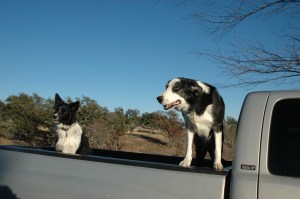
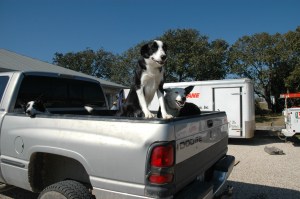
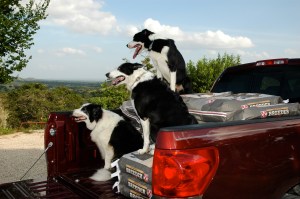
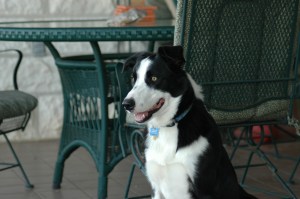
I sure know enough not to get out in a thunderstorm

So do I but these humans act pretty strange sometimes

Mea Culpa: Seeing Clearly

Okay, I was wrong this time, really wrong. Big time! I’ll admit it. Hear that, my lovely wife? Mea Culpa!

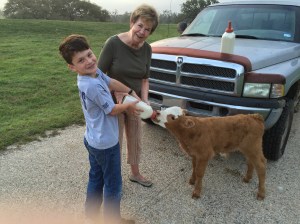
The ever diligent and loving Oma Trudy supervising  grandson Graham while he feeds a bottle calf

For sometime Trudy and I had disagreed on the color of my hair. We’ve even argued in the sort of emotionless way older couples argue. You see, I’ve always had light brown/blonde hair, but in recent years she’s claimed it had all turned gray. Nonplussed and unconvinced by her assertions, I would carefully steal into the bathroom and examine my hair in the mirror, inspecting it as if  examining the mysteries of the Rosetta Stone. I clearly saw blonde locks, perhaps mixed with a few gray hairs. Didn’t gray hair portend frailty, senility, and lack of relevancy? But I had no doubt whatsoever as to my hair colors- brown and blonde. My eyes wouldn’t deceive me.

To settle our long standing difference of opinion once for for all, I asked my hair cutter to decide this troublesome issue. Jennifer, who just happens to also cut Trudy’s hair, heard my lament and agreed to my request.

Well, Jennifer studied my hair slowly and methodically. She poked around on my head, moving aside shocks of hair as if leafy branches obscuring a bird’s nest. I beamed in anticipation, knowing I was about to hear unequivocal support for my blonde hair. I could soon boast a rare win over my always persuasive attorney wife. It was then the roof fell in. Jennifer calmly announced, “Your hair is gray.”

“Gray? You don’t see the blonde?”

“Nope.”

“Are you sure?”

“Yep”

“Not even blonde streaks?”

“Well, it all looks gray to me, but you do have lots of it.” I suppose with that comment Jennifer tried to lessen the heavy blow by pointing out that at least I hadn’t gone bald. At least not yet. Some solace that.

Gray! I was at that very moment staring into the mirror in front of her barber’s chair. I could clearly see  blonde amidst some dismal, dreary gray hair. My spirits sank. How can this be?

But then like the Phoenix of legend my defenses rallied and my resistance grew (some might call it rationalization and denial). Something funny was going on here. Thoughts of an estrogen conspiracy involving Trudy and Jennifer welled up within me. Perhaps Jennifer was part of some evil plot hatched by Trudy to put me in “the home.” Aha! There’s goes your tip Jen! What gives here anyway? Are you blind women?

Resolution to my existential dilemma came not long after. You see, my vision had worsened. Also glare made nighttime driving difficult. For this I sought the attention of my excellent eye doctor, Dr. Ann Plenneke. Several weeks later I underwent extraction of cataracts and lens replacements.

Alas, overnight my hair turned gray. Gray!!! Who would’ve thought the yellow tone to my hair had resulted from my own yellowed lenses? Mea Culpa, Dear wife, I was wrong, you were right. Tonight I’ll do the dishes.

I’ll admit this aging thing can be a bit tricky and is become increasingly challenging to negotiate. How does one do it gracefully? Now if a guy can’t believe what he sees, what’s he to believe?  Can I really trust my vision seen through new, store bought lenses that were almost certainly provided by the lowest bidder? What about my hearing that isn’t all that great either? Does this mean I shouldn’t believe anything I hear either? Ah, the nagging dilemmas that accompany an aging body.

“Well dogs if you won’t loan me your keen sense sense of hearing, then how about your outstanding sense of smell?”

Is it my loss of self-confidence in my own perceptions or merely an awareness that as I age my chances of being correct lessen? This is but one of many conundrums I’ve discovered with getting older. As a result I’ve learned to admit my mistakes and apologize quicker. I’ve found apologies now come with less difficulty, perhaps because I’ve become habituated to giving them.

On a more positive note, my rich stock of lifelong, accumulated experiences helps to lesson my sensory losses. My experiences place everyday challenges into greater perspective and usually diminishes their overall negative impact. This proves an advantage for me and i provides for greater emotional equanimity. Isn’t there something about wisdom growing with age? I sure hope so.

Perception, however, sadly slacks off. Everything diminishes in acuity. You name it- vision, hearing, smell, sensation. Sayanara, adios, auf wiedersehen! Why’s it wasted on my dogs who can hear a truck cross the cattle guard from half a mile away? Why’s their sense of smell denied to this human septuagenarian?

Hope my kids don’t read this. Admitting to flagging perceptual abilities could be a huge mistake. Think about it. My children, Andy and Katie, just wouldn’t get it. Think I’ll hide the car keys before their next visit.

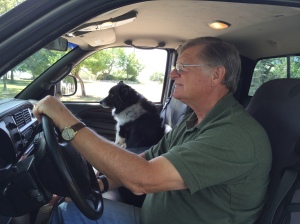
“Bella, don’t worry. We’ll hide the truck keys before the kids come.” Note me wearing glasses before the cataract surgery, something I no longer have to do. Bella’s vision however has remained remarkably good.


A Dandy Addition To Our Ranch

Dandy, newly arrived roan gelding

Recently we had a new horse arrive at Medicine Spirit Ranch. He’s a roan gelding that belongs to my ranch hand, Juan. A friend of Juan’s gave him the horse, but Juan had no land on which the horse could graze. He asked if he could leave it at Medicine Spirit Ranch. I’ll end up feeding and treating the horse, if the latter is needed, but in return Juan will take care of the hooves of both the roan and our Paint horse, Fancy.

I said yes as the big red horse will herd up with Fancy and replace our recently departed Doc. When the papers arrived we learned the horse’s name was Dandy. It’s around eight years old and is said to be rope trained. I assume at one time Dandy was a roping horse as is typical for many quarter horses.

Dandy (on the left) and Fancy (on the right) get along well.

Word is Dandy is a great riding horse but hasn’t been ridden in awhile. Without question Juan who is a skilled horseman will be first up on Dandy. Dandy is friendly and very gentle. He likes to  nuzzle me on the neck and be scratched. He loves carrots but surprisingly won’t eat apples.

Dandy is not afraid of Little Jack and Bella, two of our dogs, who despite our best efforts continue to strafe the horses. Dandy stands his ground, puts down his big head with the white blaze and star, and holds his ground. Like sensible animals, the dogs veer off and instead chase a fleeing Fancy.

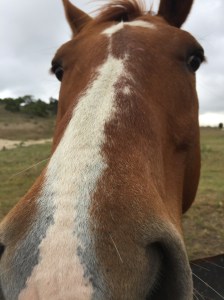
Dandy up close and personal

We look forward to getting to know Dandy. No doubt stories will follow as I observe his explorations of his new surroundings.

Let’s all welcome Dandy to Medicine Spirit Ranch.

Dread of Drought

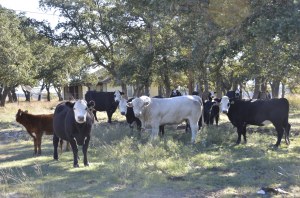
I peer into the northwest sky from where the elusive rain is said to come. The grass beneath my feet crunches as if walking on popcorn. The leaves on trees sag like the craggy faces of older people. Despite a  brave and collective denial of reality, an early drought has set in. The weatherman maintains hope by elevating rain predictions only at the last minute to reduce our chances.

Several years ago Central Texas suffered a drought of historical proportion. Our fields browned out, crops withered, and dust rode the winds like powder before a fan. Ranchers lost crops and failed to produce hay. Stocks of expensive hay had to be trucked in to maintain herds of cattle, sheep, and goats. Some ranchers along with their crops withered under the assault.

This year I maintain two barns full of hay, enough easily to tide me through an average winter. I am capable of one trial learning. Yesterday during one of our typically wettest months, I had to put out hay for my cows. I fear what lays ahead.

Creeks flow slowly or not at all. Stock tanks recede and algae spreads like kudzu. Bluebonnets appear slaked. Our hopeful Spring has given way to a dusty desperation.  We’ve taken to shaking rain sticks, a Caribbean superstition thought to summon rain. Why not engage in superstitions when all else has failed?

The rains may still come and rescue our land from early drought. I obsessively check weather reports. How fickle and cruel is Mother Nature. We remain hopeful as time exists for the skies to open forth with crop restoring, creek flushing, and pond filling rains. Time will tell. We wait.


One Day Later: It rained! Just after writing the piece above, the skies opened and half an inch of rain fell- hardly enough to break our drought but might it be the beginning of a much needed rainy season.

Already the fields have begun to green up. Amazing how fast the turnaround can be and how quickly the spirits of ranchers can improve.

Buddy’s Retirement- April 20, 2018

Buddy as a younger dog

It was inevitable, I suppose. Retirement is part of life isn’t it, that is if we live long enough. Buddy about whom you’ve heard much lately (Buddy- The Slacker) retired from his life’s work today. His retirement from herding came suddenly or at least it surprised me.

On request Buddy declined to jump out of the bed of the pickup to help herd the mama cow about which I recently wrote (A Sad Day On The Ranch). This job in the past would have been an easy one for Buddy, merely moving one cow through a couple of gates and into an adjoining pasture where the remainder of the herd grazed.

When I called to Buddy, he merely stared back at me. Has he suddenly gone deaf? What’s wrong with that dog!

After a few moments of reflection on the statue-like, immobile Buddy, I thought perhaps his bad back might be hurting him or else he had judged after twelve and a half years he’d accomplished his limit of herding cattle. Nevertheless, pushing one cow through a couple of gates and into another pasture has previously hardly been work for our Buddy who has lived to herd. But I know twelve and a half years makes for an old dog, especially for a Border collie.

He’s been the best herder I’ve ever had on the ranch. His exploits are legion, as I tried to indicate in the Slacker piece, his first herding experience. Nevertheless, lately he has been less invested and less enthusiastic about this effort. I maintain that in his place today he urged the younger Bella to help me. Surprisingly Bella did a fairly good job but not up to the standards set earlier by Buddy.

Buddy on left and Bella on right. Photo by Ramsey

Buddy has lately spent more time napping on one of his four beds (yes, can you believe it- four beds) that are scattered strategically around our house. He never has to take more than a few steps to find a doggie bed. If a bed is not immediately available, a low chair will do just fine.

While he still enjoys riding around in the pickup, he now seems anxious to return to the house and resume his doggie slumbers.

Perhaps his life’s arc from superb and indefatigable herding dog to his current “just don’t bother me” attitude is an expected part of normal aging thatis sure to affect us all. I’ll admit since retiring, I enjoy naps more.

Years ago when I asked my grandmother Hutton when she was quite elderly what it was like to get old, she replied, “Tom, you just slow up.” This observation must be as true for Border collies as it is for humans.

I hope Buddy reneges on his retirement for at least a brief period of time. What gives me hope is that Francisco, our ranch hand of seventy-five years old has retired at least five times. Each time after his announced retirement he came back to the ranch after having become thoroughly bored with watching TV and missing “his” ranch.

The animals, the beauty of nature, and the opportunity to make the ranch better proves for Francisco an incredibly strong draw. Might Buddy one day feel a spurt of new resolve along with a strong desire to herd- just one more cow? Time will tell.

By the way, what does one give a Border collie as a retirement gift? He has no use for a watch. Your thoughts?

Buddy, the retiree, taking one of his frequent naps

A Sad Day On The Ranch

We are well into Spring calving season but today unfortunately we lost a calf. One of our mama cows was found agitated and having great difficulty delivering a calf. The calf was large and although the cow had previously calved without difficulty, she couldn’t deliver this calf.   We were to learn the calf was hung up at the shoulder (referred to as shoulder dystocia) and was clearly dead when we found the distressed mama.

The vet and her assistant came in an emergency call. We pulled the calf, using what is a essentially a “come along”. Following this the mama was able to get to her feet although clearly exhausted from a night of labor. Currently she’s in the pen where I will be giving her, if needed, shots of oxytocin to assist her in pushing out the placenta.

I’m sad over the loss of the little bull calf. I suppose for me this is therapy via my keyboard. I know occasionally we’ll lose a calf and, rarely, even a mama cow, but it still bothers me greatly. The sensation recalls how i felt during my practice when I would lose a patient to death. While inevitable, it still hurts. I never got used to it while practicing and suspect I will never get used to it ranching.

Ironically I was about to pick up a spreader full of fertilizer (8000 pounds) and begin treating our hay fields. Instead of fertilizer bringing forth new life, we instead lost life in a birthing process. Such is ranch life, I suppose, and tomorrow I’ll return to fertilizing. Meanwhile I will ponder the life that wasn’t. Such is life on the ranch. Happier days will follow.

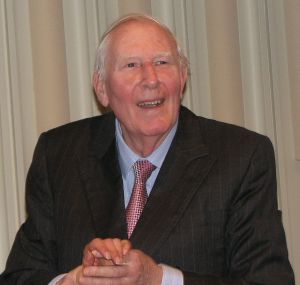
The Tragic Irony of Roger Bannister’s Death

Roger Bannister

Last month I posted a piece on the death of the great Sir Roger Bannister. I also shared some personal observations regarding how his example affected my life. His athletic accomplishments and lifelong efforts to cure chronic neurological diseases ended with the tragic irony of his own death due to one of those, Parkinson’s disease.

In his youth he broke the four minute mile- a feat previously thought impossible. Bannister had great flexibility of his arms and legs, possessed a long and graceful stride, and demonstrated amazing endurance. He also displayed profound determination. Despite these youthful gifts he ultimately died of a disease that stiffens the muscles, reduces the speed of movement, creates noxious tremor, and gives rise to balance and walking problems. Such a sad travesty to bear for a world class athlete.

The irony is doubly so when we consider how he spent his professional lifetime researching, writing, and lecturing on the nature of neurological disorders, among which was Parkinson’s disease.

Knowledge that Bannister suffered Parkinson’s disease came to me only after posting my earlier piece. This added dimension on his death required this additional retrospective.

One suspects Bannister recognized early on that he suffered Parkinson’s disease. Whether it began with the telltale slow hand tremor, lack of arm swing when walking, or some other feature of Parkinson’s disease, we may never know. Familiar as he was with the disorder, he almost certainly recognized not only what was insidiously happening to him, but also what was sure to come.

Sketch of a man with PD with the typical features

None of us can predict the future. Because of this we need live each day to its fullest, as we never know whether a serious disease or even death may overtake us and minimize or negate our previous skills.

Sir Roger we bid you a fond adieu for the way you lived your life, for your athletic prowess that showed us to never accept current accepted limitations, and for the grace with which you dealt with your terminal illness.

Depictions at the various stages of life


Are Race Relations a Verbal Agnosia?

The celebration of Martin Luther King Day along with several reader posts on my earlier blog piece, Greenville, Texas: The Blackest Land and the Whitest People, have made me think more deeply about race relations. Let me share a definition and then coin a new term that hopefully will contribute to racial understanding.

Agnosia: Loosely defined, it’s a perceptual state of looking but not seeing, or hearing the sounds but not hearing the meaning.

   Prosopagnosia, for example, is a neurological condition in which a person looks at a face but is unable to recognize the person, even when it is a close friend or relative.

Let me introduce a new phrase, verbal agnosia.

(What did you expect with a neurologist writing this blog. Hang in there, I’ll get around to making my point.)

From comments made regarding my earlier blog piece, the same word “whitest” from the famous sign in Greenville has different perceived meanings from either black or some white commentators.

Now, I realize some folks are unalterably racist and beyond redemption.  Some other folks, no matter how much progress toward racial harmony has been made, will always feel aggrieved. These are not the people about whom I use my recently minted term, verbal agnosia.

I instead refer to people who are simply unable to perceive the term “whitest” has any racial overtones whatsoever and who fail to see how it might offend others black members of their community. Alternatively others are unable to appreciate that some folks use the term in a non-racial, highly regional form. I know some who are not racist but merely verbally agnostic to the negative perception of this term. I suspect the black residents of Greenville have all heard the benign interpretation of the sign but may remain unconvinced. Might honest communication fix this state of affairs and enhance understanding?

A number of comments from white Greenville residents exist on my blog. I believe they honestly believe “whitest” refers to honest, true, or best. Indeed, growing up in Texas, I heard this word used in this very way. But one only has to research the development of the usage of “whitest” before coming across its origin in a very racist society where white clad Ku Klux Klan rode unhindered and lynchings of black men occurred.

Outside of Greenville, Texas my brother-in-law, a native to Greenville, discovered he could not find a person of either race who thought the term anything but offensive. So too thought the then Governor of Texas, John Connally, when he asked the City Fathers of Greenville to remove the famous (infamous) banner that hung across Main Street. It was taken down “for repair” and never put back up. This “for repairs”, I suppose, was a necessary euphemism as many white Greenville citizens were verbally agnostic to the offensive way the sign was perceived by many others.

Only through communication can we become aware of the verbal sensitivities of others. We simply may not recognize what we say or how we say it, may be offensive to others.

Simply waiting and hoping that things will eventually get better, merely delays the understanding necessary to reduce racial prejudices and delays getting over our miscommunications. I have been criticized for writing about the banner, an old and negative aspect of Greenville (an adopted city I love), that some would choose to keep buried. The Chamber of Commerce undoubtedly would not be keen on resurrecting remembrance of the banner., yet it needs the sanitizing effect of daylight.

Good folks who hold different perspectives on this famous sign or on other flashpoints of race relations need to communicate in calm, rational voices. Might discussions over civil war statues fall into this category? Let’s have interracial discussions. Hopefully my blog pieces on this topic have offered an opportunity to do just this.

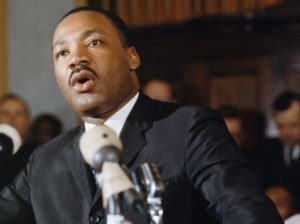
Through our improved understanding we can begin to make the progress called for by the great Martin Luther King, Jr. I remain inspired by so many of his appeals to our better natures including the following which is one of my personal favorites:

I have a dream that my four little children will one day live in a nation where they will not be judged by the color of their skin, but by the content of their character– Martin Luther King, Jr.

Buddy- The Slacker

Authors Note: In my last blog piece (A Sense Of Place), I referenced an old story. Slacker, that on reflection I might not have ever posted. My apologies, if I am repeating. The piece is a bit long especially the lead in. but I encourage you to stick with it. A very young Buddy surprised both Trudy and me with the greatest feat of herding I have personally ever witnessed. This is where in “gangsta” terms, he “made his bones.”

Buddy’s potential for becoming a phenomenal herding dog suddenly becomes evident. Now that Buddy has become an old dog and a risk adverse dog and with his best herding days far behind him, recollection of his early herding prowess fills me with pride. I hope you enjoy this reflection.- JTH
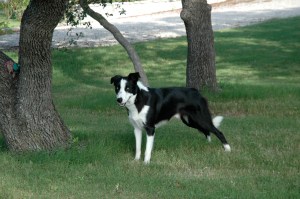
A young Buddy posing

Wire mesh panels hung askew from the thick steel cable. What had breached this water gap was immediately evident to me, as our bull had proved to be a breakout artist and an all-too-frequent explorer of Live Oak Valley. I pulled out my cell phone and dialed, reluctantly. “Guess what? Bull’s missing.”

“Oh shit, not again?” my wife shouted into the phone.

I flinched. Then I heard a long sigh followed by a pause before Trudy responded, “Be there in a few.”

Fifteen minutes later Trudy and I hiked the dank creek bottom at our Texas ranch. It smelled of decaying vegetation and heady juniper. I also had a sense of my own building desperation. Trudy’s glare described her lack of enthusiasm for another bull chase. She hesitated near the destroyed blowout fence, shook her head and pivoted to face me.

“Can’t believe the damned bull’s out again.” Her eyes were slit-like, her arms crossed, and her lips held tightly together. “What’s it Francisco calls him?” By reminding me, she had already inflicted a verbal wound.

Hamburguesa,” I whispered, careful to avoid locking gazes.

“Ah yes, Hamburguesa,” she boomed. “And why, pray tell, why did he call him that?”

I gave a mental shrug. “Well, Francisco grumped that the next time he met the bull, he wanted him between two buns at McDonald’s.”

Trudy’s hand shot up, jabbing the air emphatically, “Yeah, sounds good to me too, make mine a double bull burger and hold the cheese! After all, I’m watching my calories, you know.”

She gave a brief, tension mitigating smile. I nodded and bent low beneath the creek-spanning steel cable. When a flash flood occurs—a fairly regular occurrence in the Texas Hill Country, the incredible force of the raging water tears the wire panels away from their metal fence posts. This allows the panels to swing back and under the cable so that limbs, trees, and other flood-related detritus can flow under the panels rather than rip out the entire fence line. As useful as these water gaps are, they are  the weakest point in the fence line and where lusty bulls typically break out.

With careful steps Trudy and I trudged along the creek bank as my gaze glanced into the stream, unable to resist the urge. Growing up in Texas, I’d heard many stories about poisonous snakes. Standard fare at Boy Scout campfires, almost as common as consuming s’mores, had been stories of wriggling water moccasins boiling up from the depths of a creek and pulling down an unfortunate person to a slithering, agonizing death. While no real proof existed for this often-repeated tale of woe, we Scouts were convinced such horrible occurrences must have happened.

Trudy’s pace hesitated, distracting me from my obsessive serpentine thoughts. She turned toward me. “Why is it, COW-BOY, after countless breakouts, you haven’t sold that roaming ruminant and bought a bull with instincts more akin to a homesick prairie dog?”
Ouch, I recognized a practiced soliloquy when I heard one. She must be seething.

Charolois bull in a less distracted state


I felt Trudy’s frustration as fully as did she. In the past we’d scoured the hills and valleys of neighboring ranches, searching for our missing bull. We’d navigated treacherous arroyos, advanced through nearly impenetrable stands of juniper, and skittered down rocky embankments on our pained backsides, all of which had inevitably left us sore, scraped, frustrated, and barely speaking.

I had not missed her enunciation of “COW-BOY” and her sharpness of tone. While stinging, I was relieved my lawyer/wife had used it, rather than one of her scatological, so-called “legal terms of art.”

“Well Trudy, he was expensive, out of a champion line. And he throws great calves.” This is your final foray, big guy. It’s a one-way trip for you to the auction barn.

She paused to speak but before she could argue further, her foot slipped off a wet rock and she splashed into the shallow creek bottom. I heard her emit a grunt and saw her face develop a scowl worthy of Ivan the Terrible during a bad toothache.

“Yikes, this water’s arctic!“

“You okay?”

“You ask me, this freakin’ bull’s got the lineage of a bulldozer crossed with a race horse!” Frustration basted her voice, as she scrambled out of the icy, spring-fed creek.
This isn’t going to be fun.

Desperate for Trudy’s help, I felt mollifying her was a must, as teamwork would determine our already limited chances for success. “Well, we may need to sell the big guy. His episodes are getting more frequent and he’s learned to outsmart us.”

My good friend and neighbor, Tom, his three young grandchildren, Trudy, Francisco, and I had chased the bull on multiple occasions. Tom’s grandchildren, careening about the neighboring ranches in Tom’s four-wheel ranch utility vehicle, had relished the pursuits to a much greater extent than had we. Tom’s grandchildren once had even pleaded, “Grandpa, next time we’re at the ranch can we pleeeease chase the bull again?”

But in this instance “Colonel Tom,” as we called him, and his young charges were unavailable and Francisco was away from the ranch for the weekend. The task of rounding up our wayward bull fell solely to Trudy and me. We were feeling clearly over-matched. But we had little choice but immediately to take action, as the bull had escaped in the direction of a ranch known for its prize-winning Angus. A white calf amid a herd of Black Angus stood out like a beacon, as with great embarrassment I had once before experienced.

While all marriages have disagreements, often over money, sex, or how best to raise children, our marriage had matured to the banal stage where these bull chases represented the principal challenge to our marital bliss. Okay bull, this time it’s gonna be you or me.

I had left Buddy, our nine-month old Border collie back inside the pickup with the windows partially down for ventilation. Before heading down the creek, my parting glimpse of the young dog was of him perched in the back seat with his left ear standing up and his right ear flopped over. Buddy had never been able to elevate his right ear, a maturational quirk I assumed, but one that imparted a comical and eternally youthful appearance.
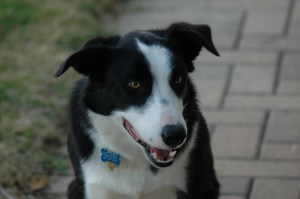
Buddy when a little older and after bringing his ear under control

Trudy and I continued down the creek bank. Here we are busting our butts, chasing the bull while our lazy dog snatches a snooze in the pickup. What good is a working dog that just sleeps in the pickup? What a worthless slacker he is! Maybe I should get rid of him at the same time I get rid of the bull?

Trudy and I rock-hopped our way down the shaded creek bottom where slivers of sunlight created silvery streaks in the rolling creek water. We ducked beneath bowing branches of live oaks, dodged flickering cottonwoods, and pushed through pungent juniper whose needles clawed at our exposed skin.

Trudy’s hair became disheveled with twigs tangled within her neck length, curly russet locks. The burbling creek and rustling leaves of the cottonwood trees seemed to hint at what an impossible challenge lay ahead for us.

A quarter of a mile into the adjacent ranch, in an area overgrown with clinging brush and waist high native grasses, we discovered the neighbor’s cattle. This occasion also revealed the location of our bull. Cool Spirit, our peripatetic bull, stood in the middle of a scraggly herd of mixed breed cattle, languidly licking the neck of an old, skinny cow whose bones bulged out under her hide like a hastily built stork’s nest. The old saw came to mind how women in the bar get better looking after midnight, and I wondered if a similar sentiment might also hold true for horny bulls.

Of all the forms of love, lust seems the easiest to dispense with as it simply defies logic. Hillary Clinton once described her husband, Bill- America’s best-known philanderer, as too often thinking solely with his little head. This implies the sexual urge is a strong, an even overpowering one at times. After all our bull had charged through seven-stranded barbed wire fences, accepting untold cuts to be with an intoxicating, pheromone-secreting cow. Bill Clinton also had paid his public penance as a result of his libidinous escapes.

Just then something jarred my thoughts back to reality.
“You see that big bull over there?” Trudy said.

I shifted my gaze. “Good Lord,” I croaked, my voice cracking like a teenager. Apprehension shot through me like a jolt of electricity. By then the red bull before me had lowered its head and was advancing in the direction of our Charolais bull. Our bull had already spotted him, and had shifted his attention from the homely target of his desire toward the threat of the approaching bull. Our bull in turn lowered his white, curly topped head. The two bulls glared, snorted, and scraped hooves at each other from a distance of less than thirty yards.

Each bull weighed well over a ton. I felt my worry rocketing higher. Oh my god, we sure ‘nuf don’t need a bullfight.

Unfortunately our approach seemed to act like a starter’s pistol. Just as Trudy and I crept forward, both bulls became determined to establish their dominion over the scraggly herd. They began pawing in earnest at the ground with their huge cloven hooves, throwing sprays of brown dirt under their massive, bulging bellies.

Their aggressive displays, fearful as they were to us, deterred neither bull and soon gave way to full, all out combat. The bulls, like two race cars off the starting line, ran at each other, crashing head on. Locked head to head with  their muscles rippling, they strained to drive the other into a compromised position. The bulls continually emitted loud and fearsome sounds like preternatural beasts from Hades. Their ruckus kicked up a thin cloud of dust that carried on it their rank aroma.

Locked in combat their heated battle raged back and forth across the shallow creek bed. The bulls’ massive blows caused the very ground under my feet to shudder. Their enormous bodies knocked over small trees, as if broomsticks, and they splashed through the rocky creek bottom with a dull clattering of their hooves.

Appalled by this brawl, Trudy and I scrambled to find safety behind a large Live Oak tree. We cautiously peered around its trunk and observed the ongoing fight. I felt powerless to intervene, having by then lost any hope of driving our bull back to our ranch.

I felt thoroughly dejected. The escalating circumstances had outstripped my limited capacity for retrieving our bull. Just on reaching this emotional low point, a flicker of movement caught my attention. I swiveled my head and caught sight of a black and white form flash by.

Recognition set in a second later, as both Trudy and I gasped in unison. Young Buddy, ignoring our shouted, desperate entreaties, raced headlong into the midst of the horrific bullfight.

“God, he’s going to be killed,” yelled Trudy, her cry barely rising above the din of the mêlée. Trudy turned and slumped down next to the tree, no doubt fearful for what was likely to follow- the killing of our half grown dog.

The bulls, focusing fully on their fight, paid no heed to the yapping dog. With the bulls locked in a violent head-to-head embrace, Buddy circled behind our Charolais. Relinquishing further attempts to intimidate with his high-pitched barking, Buddy instead gave the Charolais’ tail a vicious chomp. Startled by the attack and from an unanticipated direction, our white bull momentarily broke off the fight and took a hesitant step backward.

Our neophyte herder, sensing an opportunity, then circled and sped between the narrowly separated bulls. He charged maniacally at the red Shorthorn bull with his teeth bared. With a bite, as quick as a mongoose, Buddy gashed the red bull’s broad, dark nose. Blood flowed.

By biting him, Buddy had startled him and backed him off. Feigning a direct charge, Buddy was able to turn the Shorthorn slightly away from the Charolais. Then to my amazement, our young Border collie began to arc back and forth behind the Shorthorn moving him up a nearby hill.  At the same time, Buddy was able to gather the remainder of the herd and drive the lot of them out of the creek bed and up the hill.

I whispered to Trudy, “Oh my god! Would never have ever believed it, if I hadn’t seen it with my own eyes.”

“Is that vicious animal the same sweet puppy that licks my face first thing in the morning?”

When seemingly satisfied by the degree of separation between the two warring bulls, Buddy turned and loped back down the hill. He then made a kamikaze-like assault on our somewhat bewildered appearing Charolais, breaking it off at the last instant. This forced the bull to retreat several steps. Then after a series of charges, nips, and barks Buddy succeeded in turning him away from the retreating Shorthorn bull and ran the white leviathan along the winding creek bottom in the direction of our ranch.

“Come on, let’s trail him,” I urged, pulling Trudy from her sitting position to her feet.

Trudy and I scrambled out of our protected site and followed at a safe distance. We saw Buddy expertly drive the Charolais along the creek and into a copse of trees. When lost to sight, the ripping sound of breaking limbs along with Buddy’s urgent barks identified their location. Soon the bull emerged from the trees, hurried on by our overachieving, young canine. Buddy stayed after him providing constant herding pressure, hastening his always forward movement and in the direction of our ranch. The pair, bull and herder, soon passed through the broken fence line and back into our pasture.

I yelled to Trudy who trotted along creek bank, “How can a barely forty pound dog, too young to train, manage to break up a bullfight?” She shrugged her shoulders and turned her palms upward. I wondered where within Buddy’s DNA resided the knack for such shepherding? To this day, I stand in awe of the nascent abilities of Border collies.

Trudy approached me, her head down as if penitent. On nearing me she raised her head and flashed a warm smile and a coy head tilt. I noticed she now moved with greater fluidity and in a more relaxed, willow-like manner.

We did not know it then, but never again when the bull would break out of our ranch, would we encounter difficulty returning him- thanks to Buddy. On spotting our oncoming Border collie, our wayward bull would immediately reverse course and beeline it back toward our ranch— such was the respect the Charolais had for Buddy.

With newfound spring in my step, I headed for my pickup parked near the water gap. Nearby I spotted Buddy sitting on his haunches, intently staring in the direction of our grazing bull.

“Just look, that dog’s grinning like a fat man at a smorgasbord,” said Trudy.

Buddy bore an unmistakable snout-wrinkling doggie smile. She reached for my hand and gave it a warm, gentle squeeze. We stood hand-in-hand for several minutes, gazing upon our cattle and admiring our collie.

I would soon make the necessary repairs to the blowout fence, but first I wanted to savor the success of Buddy’s achievement along soaking up my wife’s affection. With my idle hand I leaned down and stroked Buddy’s soft, furry head. He was panting, his tongue bobbing up and down like a pink yo-yo. His amber eyes sparkled with excitement.

Over the next several minutes I sensed his adrenaline rush ebb away. As I stroked his silky fur, he laid back his ears, turned his head, and evidenced a satisfied gaze.

The bond between man and dog is like no other between animal and man. The empathy and understanding of a dog can slow the anxious human heart. The love of a dog remains steadfast, providing affectionate licks to the hand that may lack food to offer. That day I felt the loving bond between man and dog like I had never felt it before.

“Now that looks like one happy dog,” said Trudy. She moved closer, and we hugged.
“I’m sorry for being so cross earlier. You know I love you.”

Author with Buddy who was born to herd

“Forget it, perfectly understandable. You know, this dog of ours might just work out.”

Trudy’s face split in an endearing smile and I heard her emit a giggle, as warm as a toasted bun.

Buddy had not only herded massive animals that day, but also my lop-eared canine had herded my wife’s disposition from sour to mellow. I couldn’t decide which feat was the more impressive.

I did realize that love, like good wine and I Love Lucy reruns, only improves with time.
That memorable day left me with two thoughts that still resonate. The first is that love presents itself in unique ways be it intoxicating lust, the security of mature love, or the incredible and unique bond between man and dog. Love of many kinds empowers the soul and warms the heart.

The second consideration is that help can arrive, when least expected, and charge in on four paws and have a wet nose.

The Importance Of Place

Have you ever noticed how comfortable you feel at home?  Each of us has a certain comfort zone and a sense of place. I’ve often wondered about this?

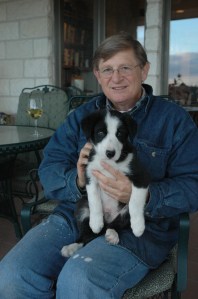
Buddy as a puppy. “Say this lap feels pretty natural”

This feeling of belonging, belonging to a certain geographical place affects us all- a place that feels right, looks right, smells right and provides comfort and mitigates the travails of the world. Whether it’s early imprinting, as occurs with baby chicks, or some combination of the sounds, smells, sights, and memories (an overall gestalt for an area), I am not entirely sure. Nevertheless, for many who have lived away from their special places know the strength and durability of the homeward draw. It’s like a magnetic force and can be almost overpowering.

Buddy:Being in this pickup truck just feels right

Trudy and I lived for ten years in Minnesota while I trained in Neurology. Our two children were born there and we have wonderful memories of Minnesota. We met some lovely, lifelong friends, enjoyed the incredible 10,000 pristine lakes, and delighted in many novel experiences (have you ever tried lefsa or lutefisk?).

Nevertheless, both Trudy and I felt a nascent longing to return to Texas, our native home. When offered the opportunity to join the faculty of the new Texas Tech School of Medicine in Lubbock, Texas, we quickly determined to leave our adopted State of Minnesota and head homeward.

What is it that makes a place comfortable for us? I’d lived in Texas during my formative years. Trudy had always lived in Texas. We both missed the gratuitous friendliness and expansiveness of spirit that is Texas.

Minnesotans were in no way unfriendly but seemed not as overtly warm and forthcoming as we’d come to expect from growing up in Texas. Plus we admittedly missed the Mexican food and Bar-B-Que along with the independent mindedness and largeness of spirit in Texas.

A friend of mine in Fredericksburg, Texas recently told me of having his grandchildren visit from New York City. Wishing to introduce his grandchildren to the wide, open spaces of Texas, he drove his grandchildren to The Big Bend Area. There with their recently purchased packs, canteens, and hiking boots, they set off on a well marked park trail to explore the grandeur of the Big Bend National Park.

After some time had passed, one grandchild developed a quizzical look on his face, looked around with an expression of perplexity, and said in a panicky voice, “Grandfather, we are lost!”

The grandfather asked in a calm voice, “what makes you think we are lost?”

The grandson replied, “Well, there are no people here, we must be lost!”

“I feel right at home in my pack.”
Buddy stands tall above Mollie and Bandit


The lack of people, the lack of built environments, and absent din of traffic noise was not “home” for the grandson. It was clearly different from New York City. No doubt the solitude struck the boy as unnerving and frightening. The grandfather shared that he strove to introduce an alternative sense of place to his grandchildren, one closer to nature than is New York City.

As I’ve mentioned previously, I’ve learned a lot about animal and human behavior by simply watching our furry, four-footed friends. This includes the importance of a sense of place.

Buddy, our now senior Border collie, was born in my bedroom closet.

Daughter-in-law Alissa holding Buddy shortly after his birth

With rare exception Buddy has never ventured much beyond the outer fence of our ranch. Oh he frequently rides along on trips to the feed store and has on occasion gone on a wild bull chase throughout neighboring, overgrown ranches (see an earlier post, Slacker), but he is most definitely a home dog.

Buddy crouched and ready to herd

Once and only once, Trudy and I drove him to our daughter’s home in central Dallas. Buddy absolutely hated it. The loud sounds and strange smells were, I suppose, not what he was used to. He let his displeasure known by wetting on the floor, whining, pacing, scratching at the door, and at the end of the visit most eager to jump into the car and return to the ranch. We’ll never make that mistake again. Buddy is not and never will be a city dog.

Once when our ranch house was undergoing remodeling, we had to move about an eighth of a mile and live for several days in our guest house. Buddy, despite the short distance from our home, absolutely hated it.

We had packed a few things and loaded up the dogs for our stay at the guest house (The Yellow Rose). When the sun began to set, Buddy began scratching at the door of the Yellow Rose to go out. When later I went to call him in, I couldn’t find him. Buddy had gone home. I had to return to our main house, gather him from the back porch, and haul him back to the guest house.

Buddy: “Just thought I’d wait for you here on the porch at home while you dawdled  at that other place”

This sequence  of futility repeated several times before I wised up and closed the yard gate to the guest house so that Buddy could not leave. Needless to say, our dog spent a few restless nights at the guest house while the remodeling proceeded.

I learned from Buddy’s escapes that a sense of place proved more important than for him than did human companionship. His preference for place over person proved a little humbling but informative as to what was most important in Buddy’s canine world.

Like Buddy we all share a feeling of comfort when at home and mild discomfort when away from home.  A sense of place may go a long way to explaining homesickness, an emotion we have all felt.

While we may not understand why others feel comfortable in radically different places than our own and with different looks, smells, and accents than what we are used to, we can perhaps understand the comfort that comes to others with residing in their own familiar places.

“Why look elsewhere when I am already home”

A final thought regarding a sense of place deals with the impact of age. As Buddy gets older, he’s developing an even stronger love of home and dislike of travel. He is the first  to return to the pickup when we work on the ranch. Buddy is the first dog to want to go inside when spending time on the patio or in the yard. He is the least likely of the dogs now to participate in a deer chase or challenge a cow.

Perhaps as an older dog, Buddy feels more vulnerable. Home is comforting for him. Are there parallels in humans? As humans age, it strikes me we also develop an increased awareness of our frailties and have an increased love of home place. Don’t many older people, like Buddy, appear less willing to travel, explore, and seek out new adventures?

Our sense of place seems as important for humans, as it is for our canine companions. Perhaps our sense of place which is lifelong may even strengthen with age as it does for my four-footed friend.