Happy Holidays

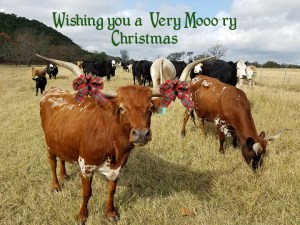
Our Holidays came early, as our married children will spend Christmas with their in-laws this year. One benefit of an early Christmas is that I can share with my readers a Christmas poem given to me by Ramsey Hutton. You may recall Ramsey is the official, cub photographer for Views From Medicine Spirit Ranch. She might also become poet laureate for this blog.

Her offering may sound uncannily familiar as follows:

Twas the night before Christmas, when all through the Ranch
Nothing was moving, not even a branch
The boots were set by the chimney with care
In hopes that St. Nicholas soon would be there

The calves were nestled all snug in the grass
While the moon in the sky just began to pass
And mama in her kerchief and I in my cap
Had just settled down for a long winter’s nap.

When out in the pasture there arose such a clatter
I sprang from my bed to see what was the matter
Away to the porch I flew with a flash
Called for the dogs and went outside with a clash

The moon on the water of the blue shiny pool
Made all of the ranch look like a jewel
When what to my wondering eyes was born
But a great big sleigh and eight huge longhorns

With a little old driver, so lively and quick
I knew in a moment it must be St. Nick!
More rapid than eagles his longhorns they came
He drew in a breath and called them by name

Now Dasher, Now Dancer, Now Prancer and Vixen
On Comet, On Cupid, On Donner and Blitzen
To the top of the hay, to the top of the barn
Dash away, dash away, dash away darn!”

So up to the housetop the reindeer soon flew
With a sleigh full of range cubes and St. Nicholas too
Down the chimney he came with a leap and a bound

All dressed in cowhide and his belly was round


He spoke not a word and went straight to his work

Filling the boots he turned with a jerk

And laying his finger aside of his nose

With a nod of his head up the chimney he rose


But I heard him exclaim as he flew out of sight

“Merry Christmas y’all and y’all have a good night!”

Bullying- In humans and Dogs

Bullying has become an important topic in our schools and society. This unfortunate behavior occurs usually when an older or stronger person seeks to intimidate or reduce the significance of another. By doing so the bully tries to achieve an increase in status or sense of worth. Bullying can be quite harmful for the person being bullied and may lead to depression, anxiety and acting out.

Unfortunately I’ve witnessed similar behaviors in my beloved dogs. The shame of it all!
Bella on left and Buddy on the right


Little Jack, “Who me bully?”

I’ll describe a few dog behaviors and compare to human bullying as strong similarities exist. Perhaps we may even learn from our canine friends.

I’ve noticed when one of my dogs crosses a cattle-guard that he will stop immediately on the other side, turn, and menace other dogs trying to cross. The dog attempting to cross must gingerly place paws on the metal pipe and concentrate on not falling through. The task requires rapt attention and during the crossing, the crossing dog is vulnerable to such menacing (bullying).

“You just try coming across this cattleguard”

Similarly when one of my dogs goes through a door, he (Bella doesn’t do this) tends to crouch just outside in order to intimidate the following dog. Again the second dog is vulnerable. Why do this at all?

Whereas human bullying arises when the bully needs to establish dominance or elevate his/her often diminished self-esteem, I wonder if dogs are trying to improve their sense of worth or rank in the pack. In the picture below, Jack is trying to bite Buddy in the butt while Buddy is jumping into the pickup. This smacks of bullying if not outright sadism!

I’ve been pondering my observations. My first thought was that almost always a male dog bullies another male dog, and a female dog usually bullies another female dog. Gender plays a role here. Isn’t this gender specificity also true among humans?

When Little Jack or Buddy first cross the cattle-guard or first makes it through the door, the dog on the far side invariably will nip at the dog attempting to exit the house or cross the cattle-guard. By so doing the bully dog establishes primacy,  elevating its status. While this may be viewed as dominance, is it not also a form of bullying?

Likewise, I’ve witnessed Bella engage in bullying toward visiting, female dogs. In these instances the visitors are off their usual turf and appear initially tentative. Bella greets them on arrival by standing aggressively over them and growling at them. She’s not the welcoming hostess at all. The visiting female dog becomes submissive and even may demonstrate submissive peeing. Perhaps this submissiveness provides Bella reassurance that she will not be displaced by the visiting female dog.

Once dominance has been established, Bella appears friendly enough and ceases her earlier bullying behaviors. At this stage the two dogs usually play nicely together. The dogs Bella bullies are typically smaller than she. Here size makes a difference.

Early on in their interactions, I suppose Bella is trying to put them in their subservient places. If on the other hand, a visiting dog is substantially larger and more powerful than Bella, then bullying by Bella never becomes an issue. Makes sense to me and is also what we observe with humans. Certainly relative size of the animal being bullied is another relevant characteristic.

A third observation relates to the age of the dog doing the bullying. While Buddy was a bully early in his life, now in his advanced years he usually acts as if he couldn’t be bothered (except for Little Jack who is trying to displace Buddy). When visiting male dogs come to the ranch, Buddy now pays them little mind. Earlier in his life he would growl at the visiting dogs and do his best to intimidate them. It has been my experience that older dogs, for whatever reason, seem not to bully other dogs to the degree that do younger dogs.

“Okay, I’m not as young as I once was.”

This age factor may coincide with unwillingness to expend energy. It simply may not worth the expenditure of effort. In humans and with advanced age, self-worth has long before become established and secured and may explain the drop off in bullying. Might something like this also be at work with dogs? So perhaps age, size, and within gender bullying are characteristics of my dogs. It seems to me these are also characteristics that usually apply to human bullying as well.

I suppose this means young males and females, be they dogs or humans, must learn to become comfortable with themselves regarding status and rank. Lacking this, the chances for bullying remain. As humans we might wish to elevate the self-worth of a bully in the hope this will reduce the risk for a vulnerable, smaller person. Likewise if a younger person is under great stress, say family problems or personal trauma, an older person might help by counseling him/her or providing other assistance to mitigate the ego-deflating nature of the trauma.

As it relates to dogs, their human friends might be left with expressions of support for and acknowledgement of the worth of the bully dog. A big juicy bone might do the trick but also might precipitate a scuffle! I typically resort to lots of compliments and stroking my dogs in an attempt to signal each is a valued pet.

Do others have ideas in this regard. Are we left with only anti-bullying policies in humans? How can we reduce bullying in both dogs and humans? Would love to hear your thoughts. Please share.

Reflections on Getting Older

“Grow old along with me! The best is yet to be, the last of life, for which the first is made.”

As mentioned in an earlier post,  the meaning of Robert Browning’s famous saying for a long time of puzzled me.

Is it life satisfaction that increases with age? Or is it that our thinking processes somehow affect how we react?

Psychologists have grappled with changes in the way we think as we age. Raymond Cattell developed the concept that general intelligence consists of two types: fluid intelligence and crystallized intelligence. Its not that intelligence declines in older age (unless a dementing illness sets in), it’s that fluid intelligence declines while crystallized intelligence increases.

“Say what? What does this have to do with herding cows?”

Both types of intelligence increase throughout childhood and adolescence. Fluid intelligence, the ability to develop new problem solving strategies, peaks by age 40 whereas crystallized intelligence that comes from prior learning and experience doesn’t peak until the 60s or 70s.

Both types are important to overall intelligence. There is also some evidence that brain training games may benefit fluid intelligence.

The direct approach to understanding intelligence

Perhaps it is a greater reliance on crystallized intelligence that allows older people to better determine the veracity of an event/statement based on his/her longer experience. While this doesn’t always comport with what youngsters may believe or have experienced, it at least holds as a general rule.

“You better hope that your fluid intelligence and crystallized intelligence will outweigh your lack of smell and hearing.”
Photos by Ramsey

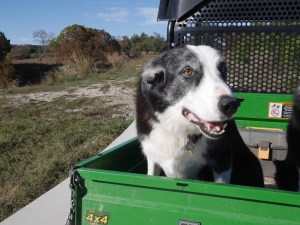
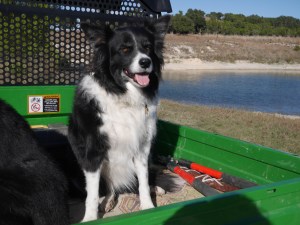
When considering aging in humans and dogs, one thing of which I am certain is that dogs can model positive aspects of aging. For example Buddy (pictured above) awakens in the morning stiff and sore. He and I both take awhile to get going. Nevertheless when Buddy heads for the truck and his ranch duties he pulls himself together and goes after life with an incredible zest. He’s not one to give into his infirmities.

Within reason this is a life characteristic that I and other humans should emulate. While our physical and mental capabilities may not be what they once were, we should continue to use what we have to the maximum.

Thanks Buddy for your example and we shall grow old together as the best is yet to come.

World’s Shortest Roads?

As Garrison Keilor was fond of saying on Prairie Home Companion, “it’s been a slow week” at the ranch, but then most weeks blissfully are. Recently we had concrete poured in two places at Hidden Falls Ranch. One wag on seeing the results of our concrete work harrumphed, “Looks to me like you have built two of the world’s shortest roads!”

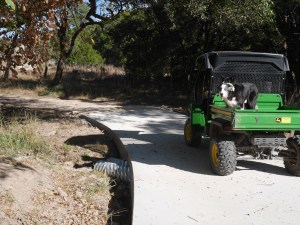
Admittedly the concrete slabs measure only 36 and 55 feet in length, much too short certainly to qualify for roads. If you look carefully though you may be able to determine that these are really low water crossings.

World’s shortest road? No, actually a new low water crossing at Hidden Falls Ranch- Photos by Ramsey Hutton


   One of the slabs is where the outflow from our spring-fed stock tank (pond to those non-Texans reading this), and the other concrete slab allows traffic to pass unhindered over Sugar Creek. These low water crossings remain treacherous though if a flash flood occurs.

Generally these areas though are dry and easy to cross. Nevertheless, during a rainy spell, both can become muddy quagmires. Previously I’ve become stuck even when driving my four-wheel drive pickup or our John Deere utility vehicle. Thank goodness for a tractor and ranch hand to extract me from the muck.

Two 12-inch aluminum pipes traverse the concrete slab at Sugar Creek. This allows the water to flow under the slab and for the dogs and me to keep our paws (feet) dry.

Hopefully our efforts will prevent getting stuck in the mud and provide improvements at this our newest addition to the Hutton ranch.

Canine Cooperation

In an earlier blog piece, I wrote of wolves having been reported as smarter than dogs in a teamwork task. While wolves were superior at performing the pull test, I wondered if this degree of cooperation was true for other dog-dog cooperation tasks as well.

The standard pull task required animal teams of two wolves and two dogs (as well as pairs of other animals) to cooperate in order to earn a tasty reward. The experiment was reported in the New York Times. Viewing this video report made me wonder if my dogs ever meaningfully cooperated with each other or did they merely excel in cooperating with their humans.

Many examples of Border collie cooperation during herding tasks exist, some of which have been detailed here previously but these might well be viewed as examples of human/dog cooperation.

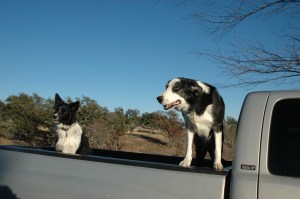
Buddy on left and Bella on right. Photo by Ramsey

Since writing an earlier piece about my dogs and how they cooperate with each other, I’ve found another good example. Bella, our female Border collie, has for some time worked as our nighttime door monitor.

What I mean by this is that Buddy will often go to the door at night but fail to bark to signal his desire to go out. Standing quietly at the backdoor, he often goes unnoticed by his sleeping humans. This is especially true as he goes to the room adjacent to our bedroom when Trudy and I are deeply asleep.

“My humans are so slow in sensing Buddy’s plight.”
Photo by Ramsey

On sensing Buddy’s need Bella’s response is to head for our bed and place her very cold, wet nose on the selected, sleeping face of one of her humans. Believe me, this proves quite alerting and motivating, waking one of us up from even stage IV sleep. Trudy or I will then find Buddy standing at the backdoor and let both Buddy and Bella out for Buddy to do his business. Bella will later bark when both are ready to come back inside.

In my opinion Bella’s door monitoring routine exemplifies dog-dog cooperation. She looks out for the best interests of an uncomfortable, bladder-distended Buddy, but also Bella benefits her human companions by helping avoid a large yellow puddle inside the house.

“And I really appreciate Bella’s help too.”
Photo by Ramsey

Have you too seen examples where dogs cooperate with each other? I would love to hear your stories. Let’s hear it for canine cooperation and doggy solidarity!

Cooperation says it all

Announcement- Photographer Ramsey Hutton Joins Blog

Ramsey Hutton- Ace Cub Photographer

Ramsey Hutton is now the official photographer for Views From Medicine Spirit Ranch. Yes, in case you’re wondering, Ramsey is my granddaughter and has a personal connection and warm feelings for our family ranch and its animals. She began coming to the ranch as an infant. She’s ridden through its pastures on her horse, Fancy, celebrated her birthday with friends, explored the hills, and enjoyed the scenic beauty of the Texas Hill Country. Ramsey is one with the ranch.

She assumes her role immediately and will, no doubt, improve my earlier attempts to visually represent that about which I write. Her Uncle Paul Plunket provided her camera and its a vast upgrade from her previous one.

Please welcome Ramsey to this blog. Her photographic skills should enhance the experiences for readers of Views From Medicine Spirit Ranch and my Facebook page.

Incidentally Ramsey Hutton has started her own blog. It’s entitled Ramsey’s Reality and is really quite good. Check it out!

Come visit me at Ramsey’s Reality as well as at Views From Medicine Spirit Ranch

Still More Praise For Carrying The Black Bag

An appreciative reader penned the review below for the Journal of Neurological Sciences. It has been accepted and is now in print online.

While the predominant audience for Carrying The Black Bag: A Neurologist’s Bedside Tales was thought to be a popular audience, the book has also been very well received by physicians, nurses, and allied health personnel.  This acceptance has proved most gratifying for the author as my book deals principally with a humanistic approach to medicine. The author of the book review, Dr. Steve Roach, got it! For this I am most grateful.

Carrying the Black Bag book

Makes a great Holiday gift and available online or favorite bookstore

Carrying The Black Bag makes a great Christmas (Hanukkah) gift and can be purchased from Amazon, Barnes & Noble, Texas Tech University Press, as well as your local independent bookstore.

Dr. Roach’s review is as follows:


Book Review

Carrying the Black Bag: A Neurologist’s Bedside Tales, by Tom Hutton, 240 pages. Texas Tech University Press, 2015. $27.95.

  1. Steve Roach, MD

Ohio State University

Columbus, Ohio

esroach@earthlink.net


Key words: humanism; history of medicine; Parkinson disease


Thomas Hutton is a retired neurologist whose career spanned four decades. During this time, he witnessed the introduction of computed tomography, magnetic resonance imaging, and numerous new medications. He experienced the dawn of the genetic revolution and the arrival of the electronic medical record. But this book is about people, not technology, so it is fitting that the metaphor Hutton selected for the title of his reminiscences is the traditional black physician’s bag.

Hutton is a master story teller whose patient sketches are reminiscent of those of A. R. Luria and Oliver Sachs. He studied with Luria and duly credits the influence of both men. Hutton intermingles his own story with those of his patients, telling of the football injury that led to his becoming a doctor and his days as a trainee with A. B. Baker. There is even an entertaining medical detective story about a man with repeated arsenic poisoning.

But the heart and soul of this book are the lovingly told patient stories. Never have I read a more poignant tale of love lost than Hutton’s account of Maggie and Ned, two poor migrant workers who had been life-long soul-mates until Maggie’s sudden death. One cannot help but smile at the elderly man who pleaded for relief after his girlfriend developed nymphomania due to her Parkinson disease medication. There is a sweet story about an elderly man who made sandwiches each afternoon for three dogs who came to play pinochle, a complex but pleasant hallucination resulting from his medication. Whether sad or funny, Hutton’s patient stories are respectfully told and never patronizing.

To practice humanistic medicine, one must be in touch with one’s own humanity. Clearly the author has a deep respect for people and a keen eye for the human condition. This is an entertaining book that most physicians will enjoy reading. It also offers an effective antidote for the technology overload of today’s medicine and a glimpse at what medicine once was and could be again.

Wolves Beat Dogs in Teamwork Test

A video in the NY Times from Wednesday, November 8, 2017 got me thinking. The video produced by James Gorman made the provocative statement that wolves may be smarter than dogs. Could this be true?  More precisely the video claims wolves are smarter than dogs at learning the rope pull test. This task is where two animals of the same species have to work cooperatively to achieve success.

The rope pull test is commonly used test to determine cooperativeness among two animals and to compare among various species. The test consists of a tray around six feet long or so that has two tasty treats in plain sight but unavailable behind a screen. The two animals must simultaneously pull on a rope, at the ends of the slide, thus pulling out the sliding tray amd making the two treats available for consumption. As it turns out wolves learn this task quickly and work cooperatively. Dogs not so much. Other species able to perform the task include elephants, parrots, monkeys, and rooks (black birds). Dogs truly struggle with this task but can eventually learn it.

The explanation provided for dogs’ slowness to learn is that they are not used to working cooperatively with other dogs. Yes, dogs work with humans exceptionally well, such as with bomb sniffing, herding sheep, riding surfboards and skateboards, protecting homes, and sniffing out corpses in forensic investigations. But these are activities dogs do with humans, not in cooperation with other dogs.

Bella on the left and Little Jack on the right


Wolves, on the other hand, don’t work with humans but work with members of their pack for survival. If you think about it, this all makes pretty good sense, . Adaptability is after all important for survival. Dogs must adapt to their human companions and make them happy while wolves must adapt to their  pack and become successful hunters.

But this video in the NY Times got me wondering. Are my dogs capable of working together? If so, what can they do cooperatively with each other? I have shared over the years in this blog many examples of my dogs working with me to herd cattle. But this is a task they do in combination with me who is directing them to some extent (at least that is my illusion as de facto leader).

It didn’t take me long to find an example of my dogs cooperating with another dog. Not long after viewing the video I saw Bella, my female Border collie, and Little Jack, our “Texas brown dog” take off on a spontaneous hunting mission. You see, Jack is determined to save the world from what he must see as the scourge of armadillos and squirrels. Just moments before he had spotted an armadillo. After quite a chase, the dogs caught the armadillo. Jack tried to kill it on his own but the armadillo was too strong and pulled out of his bite. Jack held onto the tail of the armadillo and proceeded to ski behind the powerful animal, dragging Jack toward its burrow.

Bella then swooped in went after its head, trying to kill it. Together they managed a successful hunt that neither one of them alone could have pulled off. This hunting duo has killed at least four or five armadillos recently, making them highly effective hunters so long as they work cooperatively. Incidentally they act incredibly proud of themselves, showing extreme excitement and rapid panting after returning from a prolonged absence in which it becomes obvious had been a hunt.

This strikes me quite clearly as cooperation in my dogs. But is it not the only example. I’ve taken to going for a walk for my health most afternoons around 4:00. Not too surprisingly at around this time when usually working at my computer, two dogs will show up at my desk. It can be any two of them.  In tandem they will nose, scratch, whine, and otherwise manipulate me out of my chair. I am then herded unceremoniously toward the door and made available for their afternoon walk.

I have a theory as to why two come at me at a time.  When previously just one dog took on this task, I assumed he/she just needed to go outside to pee and I would promptly put the dog outdoors. They quickly learned a single dog strategy was ineffective.

Well there are two examples of my dogs working cooperatively with one another. There are others I will share in a later blog piece. Please dear readers share your examples. I plan a follow up piece and may be able to share your experiences with other blog readers. Let me hear from you!

What’s Happening At The Ranch

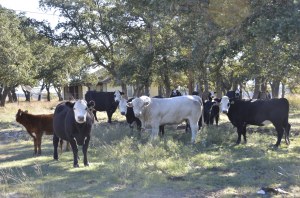
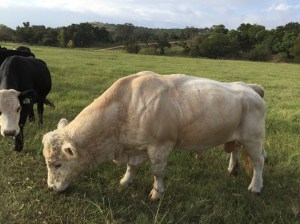
We have a new bull at the ranch. Meet Baron.

Baron Bull

Welcome Baron Bull

Every six years or so we retire our bull and bring in a a younger, harder working one.

I’ve come up with the name Baron Bull for him. This is easier to recall than his name from the American International Charolais Association which is MR 4M Freedom 185M.

Last week our waiting Black Baldy cows welcomed him to the ranch and he has fit in well. We can expect hybrid vigor with the Black Baldy and Charolais cross.

Baron as a name seems appropriate as Baron’s Creek that runs through Fredericksburg and was named after Baron von Meusebach, the founder of Fredericksburg. Also our new bull is out of the Behrend’s (pronounced the same as baron) line of Charolais , so it all seems to fit the big guy.

Trudy and I were mulling over his warm reception by our cows. Given the age difference with the bull being two years old and our cows being two to eight years older than Baron, Trudy and I wondered if we had “Cougar Cows.” But those are ruminations for a later time and after several glasses of wine.

The features most important to me in selecting a new bull are a gentle disposition, good conformation, and fertility. Baron possesses all three. Being gentle is a must as my grandchildren spend time on the ranch, and I am not nearly as swift of foot as I used to be. I checked his gentleness before purchasing him by walking close by him in a pen.  He made no aggressive moves and his prior owner spoke highly of his gentleness. Tick.

Good confirmation is important as we want his offspring to be thick and well conformed as they will sell better. He is muscular, has a straight back, and thick torso. Tick.

Good fertility is a must as the entire crop of calves will depend on it. Baron has been checked twice and found ready to breed. Tick. Results in nine and a half months and more of course will be of greater significance.

He is smaller than our last bull but likely will grow over the next several years. He is thicker than our last bull. Baron already shows wanting to “work” more  than did our old bull who was becoming rather indifferent. As an aside one wonders why it is referred to as “work” but such is the unusual nature of ranching vernacular.

So welcome Baron bull to the Hutton ranch. May your days be long and highly productive.

Guess What We Found On Leaving Our Ranch Recently?

The other morning Trudy and I spotted something unrecognizable on the cattle guard at the edge of our ranch. Approaching closer I could tell it was a newborn calf, actually a Longhorn/Charolais cross. The poor little heifer had all four legs stuck between the pipes of the cattle guard and was totally helpless as she lay across the pipes.

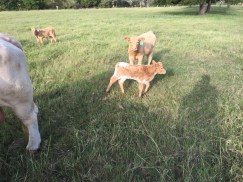
The calf a week later doing well in the pasture

One surprising thing about a Longhorn calf is how quickly they stand up as opposed to other types of calves. This little heifer apparently stood up while its mother was down pasture grazing, wandered to a nearby cattle guard, and slipped and had ts legs plunge through it.

Trudy and I jumped out of the car and working together pulled the calf’s legs out from between the bars and carried it to the nearby grass. There we stood it up and encouraged it to move down the pasture to where its mother grazed. She saw us coming and raced to her calf. When last we saw the calf, it was chowing down at the milk bar.

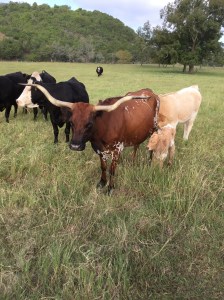
The proud mother with calf by her side

The proud daddy, a Charolais bull

The calf has done well ever since. Let’s just hope it has good one trial learning when it comes to why cattle guards  are there in the first place. I did notice a few days later when we vaccinated her for blackleg that she didn’t seem at all afraid of me. Might she have been appreciative or at least remember me? I’ll never know. Turned out to be a pretty good excuse, though, as to why we were running late for Sunday School.