I love Border collies. This statement will never be called into question by those who know me. Not only do they make great pets, they have proved valuable in herding our cattle at Medicine Spirit Ranch. Especially impressive have been feats of herding involving our well-traveled bulls to neighboring, overgrown ranches. Without Border collies, the bulls might still be AWOL.
The story that follows is about Buddy. Please give me your feedback as I plan to submit this piece either to a contest or possible publication. It needs to be as good as it can be.
In its initial form the story had a middle portion showing Buddy’s incredible herding abilities. In this shortened story, I skipped the middle portion in the present version in the belief it took away some of the punch. I look forward to your comments.
Buddy
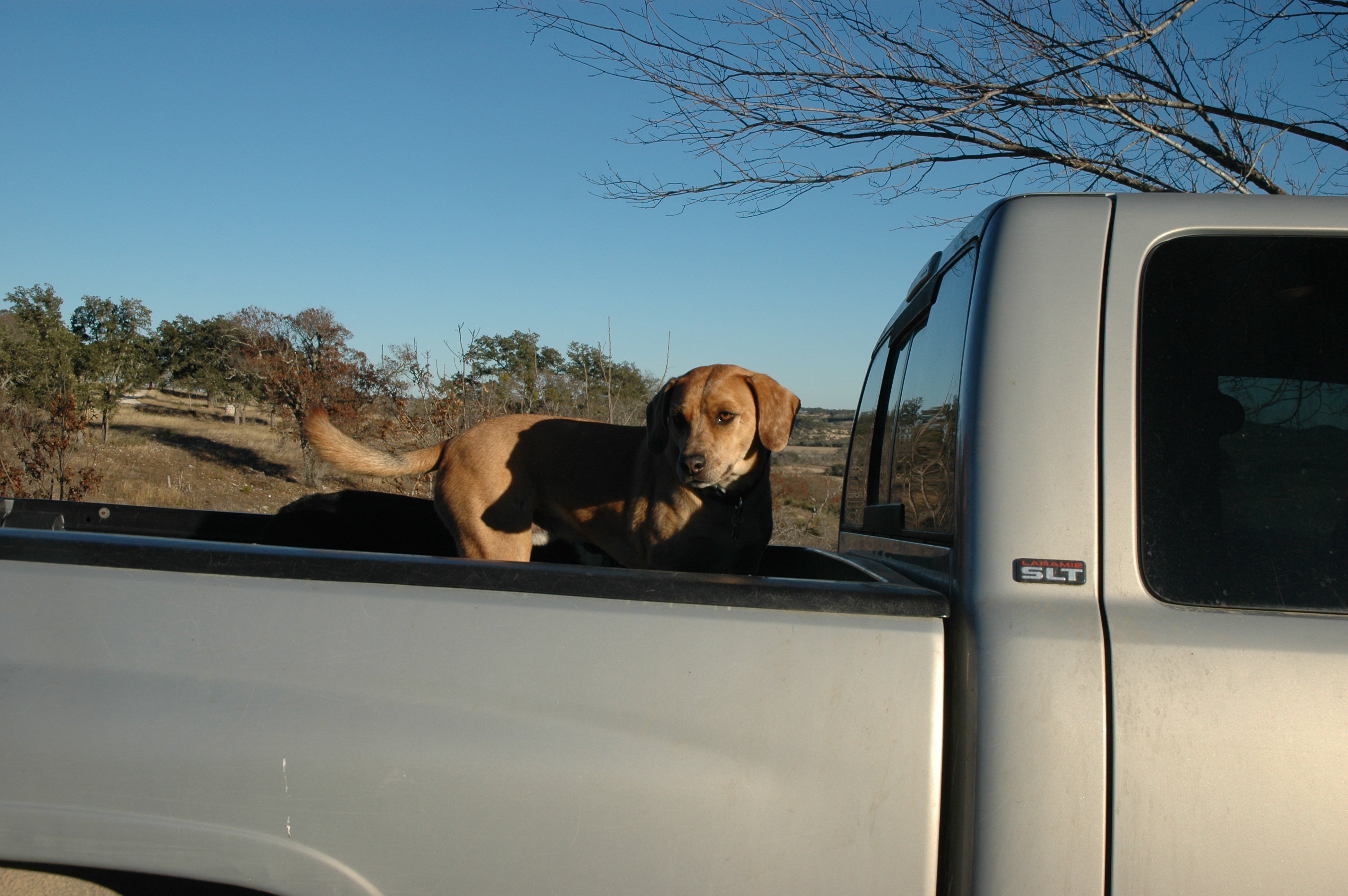
Impatiently, he waited for me to stop the pickup, piercing the night with excited, high-pitched yips. His succession of barks resounded up and down the hill through sheening groves of moonlit juniper.
Once the pickup had nearly stopped, I watched in the side-view mirror as my border collie burst from the bed of the pickup like a cannon shot. I pressed hard on the accelerator, attempting to outdistance Buddy to the garage a quarter of a mile ahead- a tiny victory, long sought after in this our nightly contest, but one not yet realized.
In the darkness, I could only make out the white “shepherd’s lantern” at the tip of Buddy’s tail. It appeared and quickly disappeared, as he sprinted through low brush, behind trees, and into gathering shadows.
I silently lauded his long strides as they gobbled up the gray ribbon of our ranch road. His youthfulness and agility made me a little envious as they contrasted with my increasing years and diminishing physical abilities. Age may have certain advantages but flexibility and speed are not among them.
The road bent away from the house in a semicircular direction while Buddy took a shortcut across a field of native grass. Before our paths diverged, I caught a glimpse in the headlights of the determined black and white collie, with ears back, charging confidently ahead. During this final sinuous stretch of ranch road, Buddy would typically overtake me, given his ability to out corner my hoary Dodge pickup. I galumphed over a rusty pipe cattle guard and plunged down the driveway toward the waiting garage and faux finish line.
Minutes later after parking the old truck, I looked for my competitive canine. I was surprised not to find Buddy waiting on the driveway with his usual smug look pasted across his muzzle. I waited a minute…. and then another, but he failed to arrive. I walked out onto the front lawn. The smell of newly mown grass and honeysuckle wafted over me. I breathed deeply, enjoying the scent. More minutes ticked by. My surprise became worry, giving way to eventual alarm.
I jogged awkwardly across the yard, searching the gloom of night for his familiar silhouette. What I spotted took several long moments to register. Slowly, like a photograph developing in a darkroom bath, it became clear, frighteningly clear to me. When it did, it filled me with an inky dread.
My normally agile Buddy moved oddly. I hurried closer to gain a better look. I was shocked by what I saw. My heart sank because Buddy with great effort was hauling himself along with his powerful forelimbs, his back legs lifelessly trailing behind. The significance crashed over me like a cataract over a broken dam. Oh my god, he’s paralyzed!
Within minutes I placed an urgent phone call to our veterinarian. Thankfully he responded immediately and said he was still working in his office and immediately to bring Buddy in. My wife, Trudy, and I gently lifted Buddy into the car and rushed back down the ranch road and across town. Red lights exasperated our progress, as did the sated, unhurried diners departing restaurants on Main Street. I felt additional tension welling up within me. On arrival at the one story, white stone veterinary clinic on the east side of town, I gathered Buddy in my arms and carried him through the double glass door Trudy held open. Within moments of Trudy ringing the bell on the counter, Dr. O’Neill appeared behind the main desk and proceeded to lead us down a darkened hallway to the first examination room. The clinic had a faint odor of wet dog mixed with an astringent smell.
Our vet flipped on the overhead light and asked me to place Buddy on the exam table. Following a quick examination of Buddy’s back, checking for movement in the limbs, and determining if Buddy felt a pinch to his hind foot, Dr. O’Neill gave an audible exhalation and said, “Mmm.”
“What do you think?” I asked.
“Well, Buddy needs an MRI–scan and may even need back surgery.” The weight of those words, while sympathetically uttered by the kindly, square-faced veterinarian, struck home like a hammer.
“Oh no!” Trudy cried out, her words echoing through the vacant halls of the clinic building.
The meaning of his words was all too clear, but I was flummoxed as to how Buddy had injured himself and what might be done to reverse it. “But, but what happened?” I asked while stroking Buddy, who lay quietly on the stainless steel examination table. His trusting, liquid eyes repeatedly searched our faces for an explanation for all this fuss.
“Sometimes these athletic dogs can explode a disc from their spinal column, causing weakness of the hind limbs,” Dr. O’Neill replied. He tenderly ran his hand over Buddy’s furry black and white head and gave his ears a fleeting scratch. “I’ll call ahead to an all night veterinary surgical center in San Antonio, let ‘em know you’re on your way and ask them to kick-start their MRI. Awfully sorry about Buddy, really am, he’s a fine dog. Sure hope they can help him.” His voice trailed off, containing traces of both hope and lament.
Shortly after and at high speeds, we hurtled southeastward through the deep Texas night on a winding U.S Highway 87. Overhead I viewed the blurriness of the Milky Way and Orion. Silvery moonlight fell between tree limbs and lay on the ground in shattered pieces. I switched the headlights to high beam to probe the uncertain darkness ahead of us.
We soon turned onto the four lane and divided Interstate-10 in the direction of San Antonio. I noticed eighteen-wheelers, heading at high speed in the opposite direction toward El Paso and, no doubt, the West Coast. Ahead of them lay over a thousand miles of desert with limited access to assistance should they break down. I, on the other hand, was headed east toward similar uncertainty. In the backseat Trudy cradled Buddy’s head in her lap, saying little.
On arrival at the San Antonio location, I hurried out of the car and opened the back door to gather Buddy into my arms. I rushed him across the asphalt parking lot into the nondescript emergency veterinary clinic. A diminutive and surprisingly young veterinarian approached us with a confident stride. She had high and well-defined cheekbones, a reassuring smile, light brown hair pulled back in a ponytail, and an air of quiet competency. After a brief exchange, she took Buddy, and with his added weight waddled away down the green tiled hallway.
I noticed Trudy had a frightened look on her face. I felt helpless to reassure her, fearing the worst possible outcome for Buddy. We lingered in the dimly lit waiting room that was filled with about a dozen worn, inexpensive chairs, a few marred wooden side tables, and a single TV that blared a documentary on the destructive nature of feral hogs. I tried to ignore the booming TV and paced restlessly, my mind full of thorns.
The petite veterinarian soon reappeared. Her green eyes darted about and her face expressed concern. “Dr. O’Neill was right. Looks like your dog herniated a disc fragment from his spine causing his paralysis. A disc can shoot out into the spinal canal like a bullet from a rifle. Your dog’s spinal cord received a pretty good wallop.”
“Can Buddy recover?” asked Trudy.
I saw the veterinarian drop her gaze and pause for several long moments before responding. She shrugged her shoulders, raised her head, evidencing a furrowed brow. “Time will tell. Whether the fragment still compresses the cord can be determined only by an MRI-scan. You’ll need to decide if that’s how you want us to proceed.”
If the disc still compressed the delicate cord, I knew de-compressive surgery would be required, and soon, to prevent permanent paralysis of Buddy’s back legs.
“I need to go check on a Labrador who decided to tangle with a pack of coyotes. The poor old boy got chewed up pretty good.”
I made a sympathetic comment regarding the Lab but my real concern lay with Buddy.
“Will check to make sure the MRI is free, that is if you decide to proceed that way. I’m leaving Farah here to answer any questions you may have,” said the veterinarian. She turned on her heel and with purposeful strides and ponytail bobbing strode away in the opposite direction. My gaze trailed the retreating veterinarian down the hallway like a lonesome puppy. I saw her pass through the door at the end of the hall and close it with such finality that it made me wonder if I would ever again see my collie alive.
Grief and fear overwhelmed me. Trudy’s cheeks glistened and I heard muffled sobs coming from her. We embraced, knowing not what else to do. The sad look on my wife’s face would have brought a tear to a glass eye.
The veterinarian had left behind a young, spherically built vet tech to answer questions. The plain-faced assistant appeared to have three chins and reminded me of the stolid, hardy pioneer women who, along with their men, had settled the Texas frontier in the 1800s.
What followed next was an unexpected and wholly different kind of trauma delivered by the no nonsense vet tech: “The cost of the MRI-scan is $2200 upfront,” Farah piped up in her flat, broad Texas drawl. “This is in addition, of course, to the afterhours clinic charge and veterinary expenses.” She said this while smacking her gum and fingering the stethoscope dangling from her side pocket. Farah had an unblinking expression, lacking in emotion or empathy.
Guess this is where she does the wallet biopsy to check our ability to pay.
She next rattled off costs for surgery including anesthesia, medicines, and rehabilitation. Exorbitant, I thought. Would Buddy really need weeks of pool therapy to recover? Somewhere in the conversation I confirmed her conjecture that Buddy had actually cost us nothing, being born to Mollie, our Border collie bitch.
This could end up running $3000, maybe $4000 even without the surgery! With surgery just no telling the final cost!
“Even with surgery, no guarantee this dawg’s ever gonna walk again,” she said. Her drawn out words seemed to hang in the air like a slowly dissipating puff of smoke.
I avoided her laser-like gaze by glancing out the window, viewing a faint glow in the east following the long and broken night.
The technician drew my attention back by saying, “Need to consider what kinda life a paralyzed dawg would have, especially a working dawg like your border collie.” I heard her talking but her words were slow to penetrate my thinking because of my great affection for Buddy.
“Might just wanna euthanize the dawg? Sure ‘nuf be a whole lot cheaper,” said the vet tech, impatiently looking back and forth at Trudy and me as if watching a lantern swinging in a windstorm. I noticed her cheeks and chins wobbled with the excursions of her head.
Neither Trudy nor I responded to her indirect advice, all gussied up and impersonating a question. I glanced at Trudy’s face, mirroring my own dismay. I slipped a supportive arm around Trudy, trying to steady both my wife and my own rocked emotions.
The course that the vet assistant advocated was, I knew, based on sound economics for a working dog. It was just as when a rancher makes treatment decisions based on price/expense ratios for his livestock. After all it didn’t make sense to do a thousand dollar surgery on a five hundred dollar steer. Wasn’t the same rationale also true for a working cow dog? To do otherwise invited financial loss in an already challenging vocation with a very narrow profit margin. I was new to this ranching bit, but I somehow felt differently about my dog. But I also knew the wrong decision could doom Buddy to a dreadful life of paralysis. My mind was dizzy with conflict. I felt a terrible resignation wash over me.
“So what you wanna do? Want us to just put the dawg down?” Each word struck like an icepick. Time passed as if in slow motion. Trudy took a step backward and slumped into a chair. She buried her face in her hands and sobbed. The TV assaulted my ears with its cacophony of inchoate sounds. I failed to respond to the technician’s awful query, my mind in fitful desperation having by then escaped to a fonder memory of Buddy during cheerier times.
Years later, it was I who suffered from a back injury. I lay prone in my bed with my right leg frog-legged out, suffering from a ruptured disc in my low back. For six weeks I had assumed this awkward position, popping pain pills as if they were popcorn, and dreading the real possibility of impending surgery. For hours on end through the window I watched the flitting and swooping of barn swallows. I saw them disappear under the eves to their protected nests with morsels in their beaks for their hatchlings.
Along with her usual workload, Trudy had assumed my routine ranch chores. Her activities required prolonged absences from the house and this along with the remoteness of our ranch house forced an unanticipated silence in my life.
No longer was the opportunity for introspection competing with the demands of vocation, meetings, or ranch responsibilities. Following my retirement from a hectic medical practice, Trudy and I, as if compelled by habit, had become immersed in ranch work, volunteering, getting a new home in order, and establishing our presence in a new community. We had sought a reordering of our lives in a community, ripe with exciting opportunities. All my activities had earlier been put on hold weeks due to my injury.
It occurred to me, as I lay there hour after hour and day after day, that my existence before the injury had been like standing mere inches from a TV screen, unable to clearly make out the flickering images. Only now during my inactivity was I able to back away and see what was really taking place.
My new mental and physical distance from the hectic life had also brought about a sharpened awareness as to what was truly important. While travel, work, and professional accomplishments were important and had offered a degree of satisfaction, what seemed really important were the personal relationships and the imprint that love in all its forms had firmly stamped upon my life.
I lay there recalling the exhilarating intoxication of amorous love, the assurance and satisfaction that accompanied mature love, the quiet wonder of family love with the caressing voices and company of openhearted children and grandchildren. I thought of the nurturing love that comes from expanded knowledge and from my personal search for wisdom. I pondered the spiritual and devotional love that relinquished self to a greater good. I also recalled the unconditional love between pets and their humans. When thinking of pets I thought of Buddy. Love with its many faces had invigorated my life, comforted me through challenging times, and had fed and nurtured my spirit.
While convalescing from my ruptured disc, I frequently recalled Buddy’s tragic back injury so many years earlier. I assumed his back injury had been as painful as my own, but he had braved his injury with great courage and without pain medicine. I relived the mental anguish over that night at the veterinary clinic in San Antonio when presented the persuasive but repugnant option of euthanizing him.
At least there hasn’t been any talk of euthanizing me. I chuckled out loud. My long-standing feelings of hurt over Buddy resurfaced once again- a sickening mental all-time low in my life that just then co-mingled with my back pain.
I remembered during the darkest nights at our new ranch, walking behind Buddy’s white tipped tail and him leading me home. Like a beacon his shepherd’s lantern had always stood out, signaling both his movement and the path I needed to take.
As if controlled by an alien force, my hand stole out behind me and blindly searched the bed covers. I felt the coolness of the cotton sheet as my hand swept from side to side like the pendulum of a grandfather clock. And there it was. I felt moist breath on my hand, followed by a distinctly wet nose, and whiskers that tickled my hand.
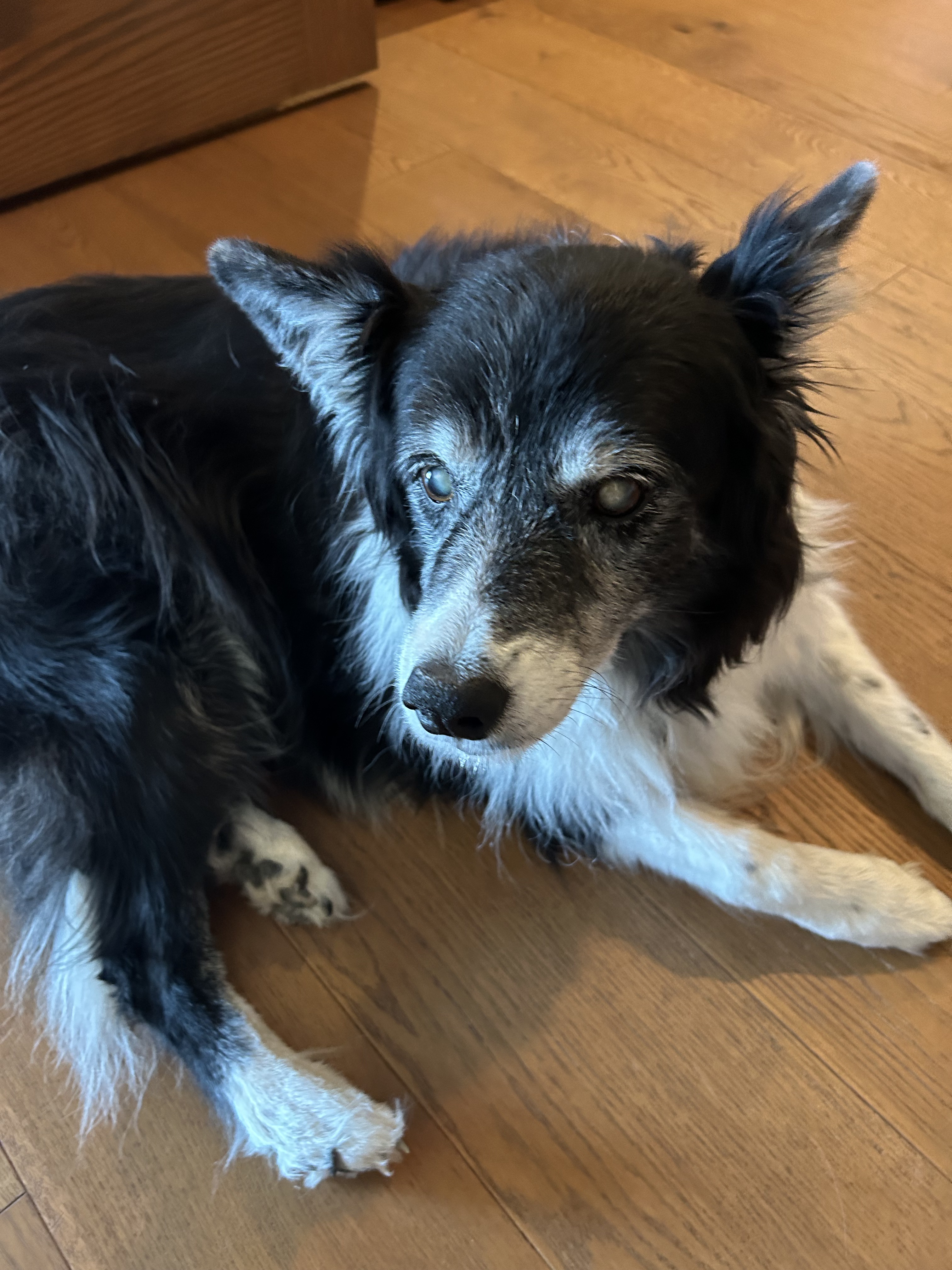
I scratched behind the soft, furry ears of my now elderly Buddy. His tail began to thump happily against the bed. I cocked my head around to see him gazing at me with expressive and soulful eyes, his head cradled on his paws. From his position of recline, he slowly and mechanically stood, his back abnormally humped. He gingerly approached me. Buddy then circled three times and he lay down. His gait and actions had slowed but he showed no hint of complaint or surrender to the circumstances life had dealt him. Buddy had not required surgery and with time and home therapy had largely regained his strength in his hind limbs.
Buddy’s life had been complete with joyful forays around the ranch. He had nimbly herded our cattle, frolicked in fields festooned with bluebonnets and Indian paintbrushes, and had cared for his humans. I had no doubt he felt contented.
For weeks Buddy and I had lain beside one another in the quiet bedroom. There we shared our common sense of community. How unifying it all seemed. We two beings had been apportioned a common fate– suffering similar infirmities and growing older together.
I found Buddy’s presence comforting. Having witnessed his defiance of his injury gave me both increased strength and augmented my limited store of patience. Buddy’s tolerance for his diminishing physical abilities had imparted a life lesson not soon forgotten.
Just then, as if to show thanks and demonstrate his devotion, Buddy gave my hand a languid, velvety lick.





 Views From Medicine Spirit Ranch