Tag Archives: Aging

What Pets Can Teach Us About Aging and Death

Our pets have shorter lives than humans, making it possible for us to observe their transitions across their aging spectrum. We can view them mature, grow old, and die. This can be instructive. For me, I’m staring at a formidable eighty years old at my next birthday and am sobered by the fact that by virtually anyone’s standard, I am now old. Despite physically feeling healthy and reasonably vigorous, I cannot completely shut out the concern about the not so stealthy approach of the old man.

As I stare into the formidable aging abyss, I find comfort from the actions and examples of my aging and deceased pets. Allow me to explain.

Mollie was a female Border collie that we acquired shortly before moving to the ranch almost twenty-five years ago. She was a Border collie from working stock and in her youth was a terrific herder. She could also run at an amazing clip. The latter trait was shown one day when I observed her run down a grown white tail deer. Molly had chased the white tail doe across a large pasture and was gaining ground on it when the deer in her panicked state attempted jumping a fence. Instead of clearing the fence, the deer trampolined off the barbed wire fence, landing in front of the paws of my semi-crazed, tongue wagging, blue eyed dog. Of interest to me was that Mollie made no attempt to attack the deer but merely waited for the deer to regain her feet. Soon the all out chase was on again with my deliriously happy hound in fast pursuit.

I mention this anecdote, as it strangely reminded me of my own youth and my own ability to run fast. Watching Mollie brought back proud memories. Of course I was not able to run down deer but was sufficiently agile to be offered track and field scholarships for the sprints and broad jump. Now fast forward twelve years from Mollie’s youth to her older years when she had been diagnosed with cancer. I recall on her last day of life, she wanted to go for her walk even if it proved to be a short one. There was no “give up” in that dog. Mollie lived her life fully, squeezing out all the activity and pleasure she could.

The following night Mollie began as usual sleeping on the floor next to my side of the bed. Sometime during the night, she apparently got up, walked about thirty feet down the hallway, laid down, and peacefully died. I found her cold, lifeless body the next morning. She had stayed engaged with life up until the very end of her life. Is there not a lesson to be learned here?

I’ve been advised by friends on the verge of selling their property in the country and moving to town to consider the same. Another friend questioned my continued efforts in golf lessons and time spent on the practice range, as it was his opinion that our golf games were never likely to improve. He may have been right about the golf scores, but that is not how I roll. Mollie comes to mind. She didn’t roll that way either, so why should I?

Please understand that I am not in denial about getting older, but I’ll do everything I can to fully enjoy my late years. I’ve had cataracts taken off and lens implant placed with excellent results. No more glasses! Recently I suddenly lost most of the hearing in my right ear and required a hearing aid for my left ear and essentially a microphone for my right ear to transfer sounds to my left ear. While the result is far from perfect, it allows me to remain engaged with life. My stamina isn’t what it used to be. Actually it is no where near the same. A nap after lunch has transitioned from a rarity to a necessity. And by the way my loyal, two-year old dog, Duke, never fails to join me for a nap, despite his characteristic boundless energy.

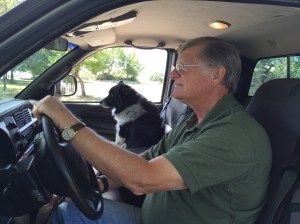
My current thirteen-year old and virtually blind Border collie, Bella, has also demonstrated graceful acquiescence to her aging. One difference in Bella is that when I now stop the pickup for a walk, she remains behind in the cab of the truck while young Duke and I go for a walk. She learned on her final walk several months ago that her limitations were simply too great and that she became too exhausted. Now Bella waits patiently in the truck for us to return, in the interim no doubt sneaking in an extra nap.

Bella has learned the extent of her physical abilities and has adapted to them with a sensible grace. She is accepting of those physical limitations that she can no longer perform. Doing so with calm acceptance and grace is what I’ve observed from my Bella and strive to learn. Yup! No more ladders for me!

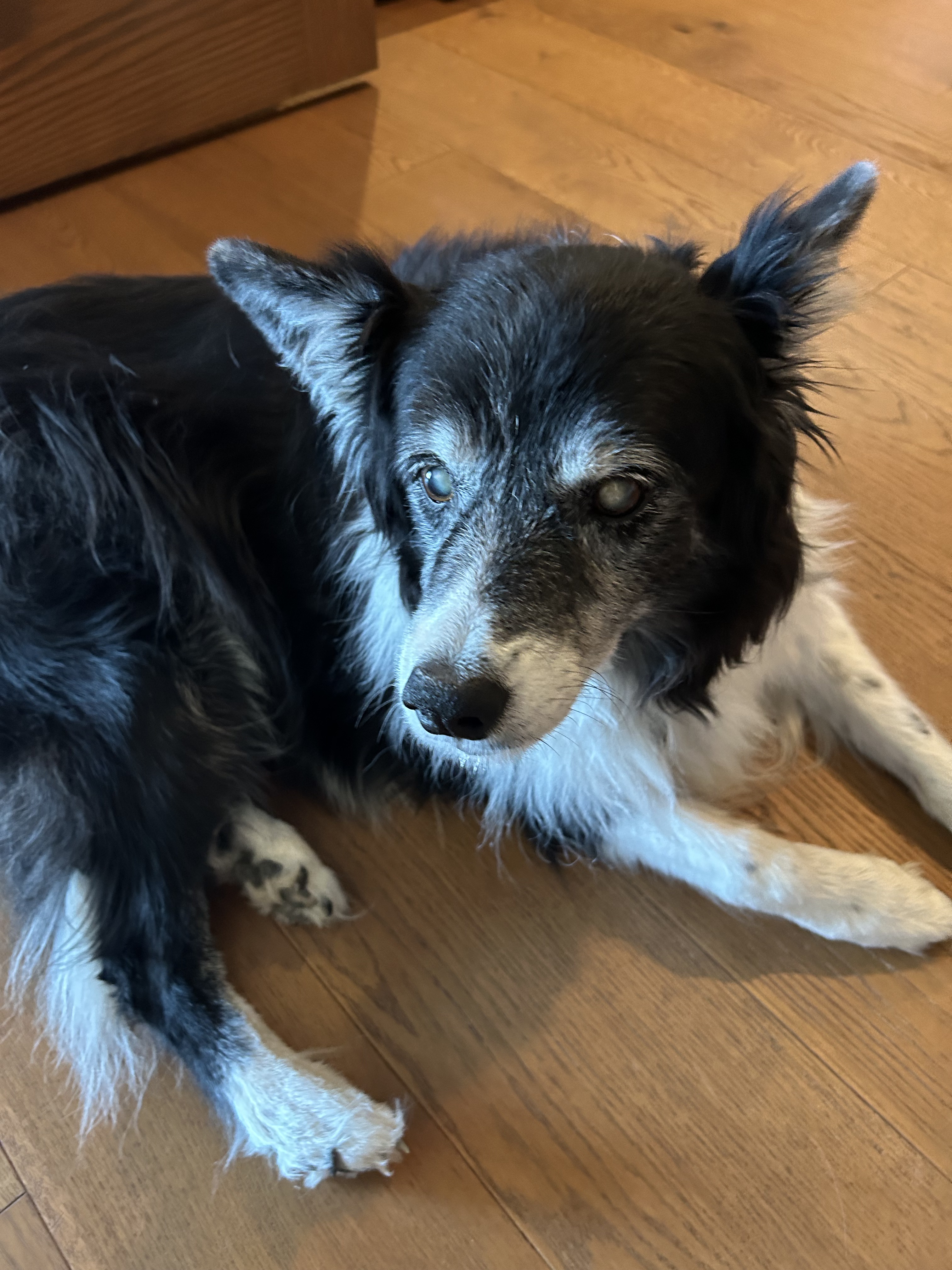
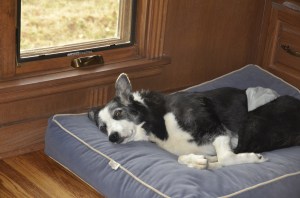
The top picture is of the mature Bella and the lower picture is of the old Bella

On that most uncomfortable of all subjects, death, I’ve also learned from my Border collies. Our first dog Bandit who proved responsible for transferring us from a hectic city life to a bucolic ranch life, became old, severely infirm, unable to walk, and finally compassion required that we put him down. He had dearly loved the ranch with its abundant wildlife, scenic views, and cattle to herd.

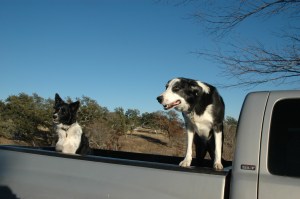
When finally we deemed it time to let our old Bandit die with his dignity still intact, I placed him in the bed of the pickup, a spot where he had spent so many happy hours. I strategically parked the pickup so that Bandit had a view from the top of the hill and could sense the cattle grazing below. On a warm day with the gentle breezes and amid the songs of birds, our veterinarian facilitated the peaceful passing of our noble Bandit dog.

While the moment was incredibly sad for me, and I bawled my eyes out, I can think of no better way for our beloved pets or we as humans to die than surrounded by natural beauty, memories of outstanding accomplishments, and surrounded by those he/she loved. I can only wish that a graceful ending of my life will occur and that we humans might become as accepting of the inevitable as were my Bandit and Molly.

Perhaps you have observed your pets and gained wisdom from them about life’s mysteries. If so, please let me know what you have learned and share here with other blog readers and pet lovers.

If you have not had the chance to read my latest book, Hitler’s Maladies and Their Impact on World War II: A Behavioral Neurologist’s View (Texas Tech University Press), I invite you to do so. The book explores an important aspect of the Hitler story and World War II that has not been well studied. Many of Hitler’s catastrophic errors including the premature invasion of the Soviet Union in June 1941, the slowness of German forces to counterattack at the Battle of Normandy in 1944, and the highly risky Battle of the Bulge in late 1944 into 1945, can be better understood, knowing the sizeable impact that Hitler’s physical and mental conditions had on these vital battles.

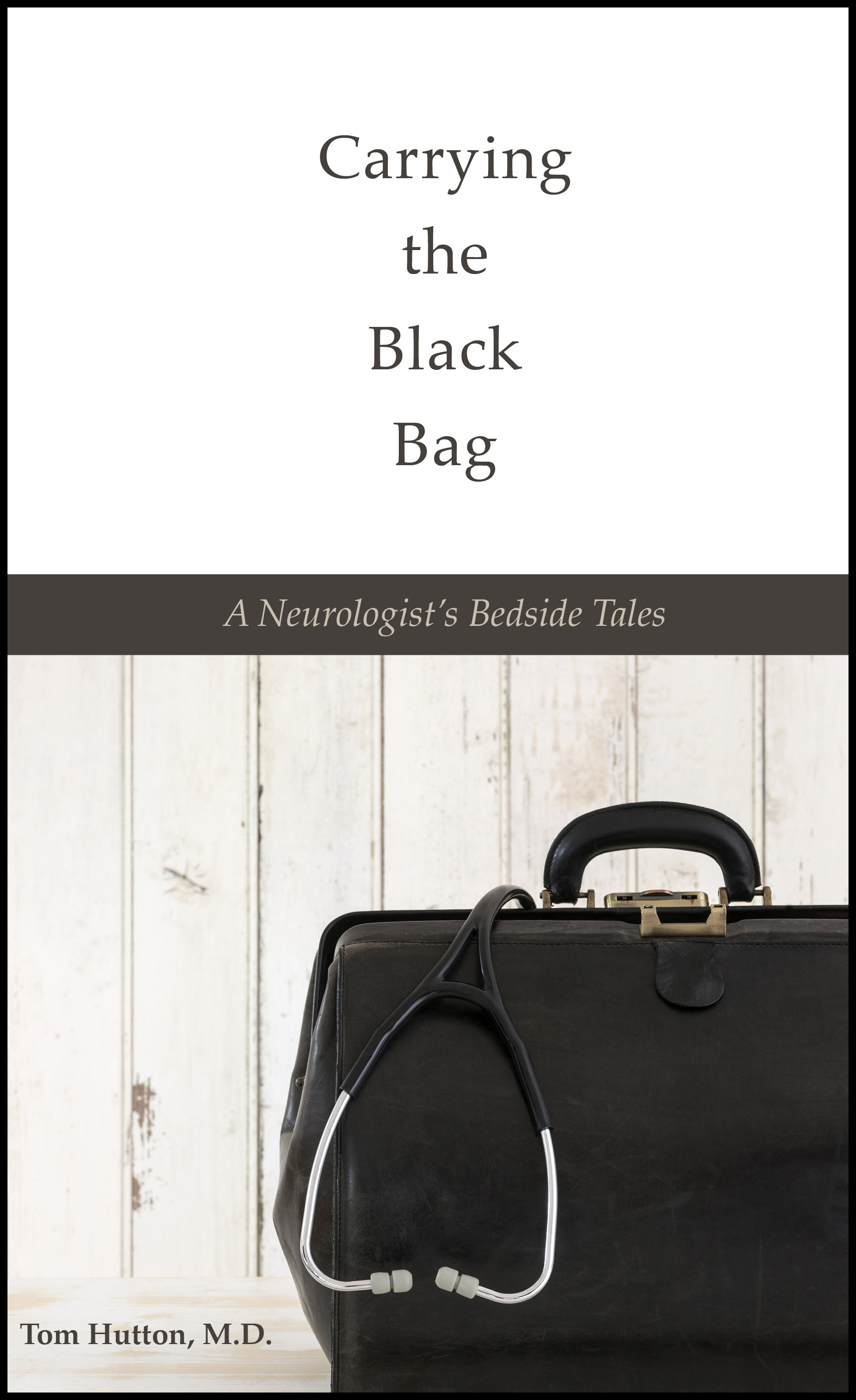
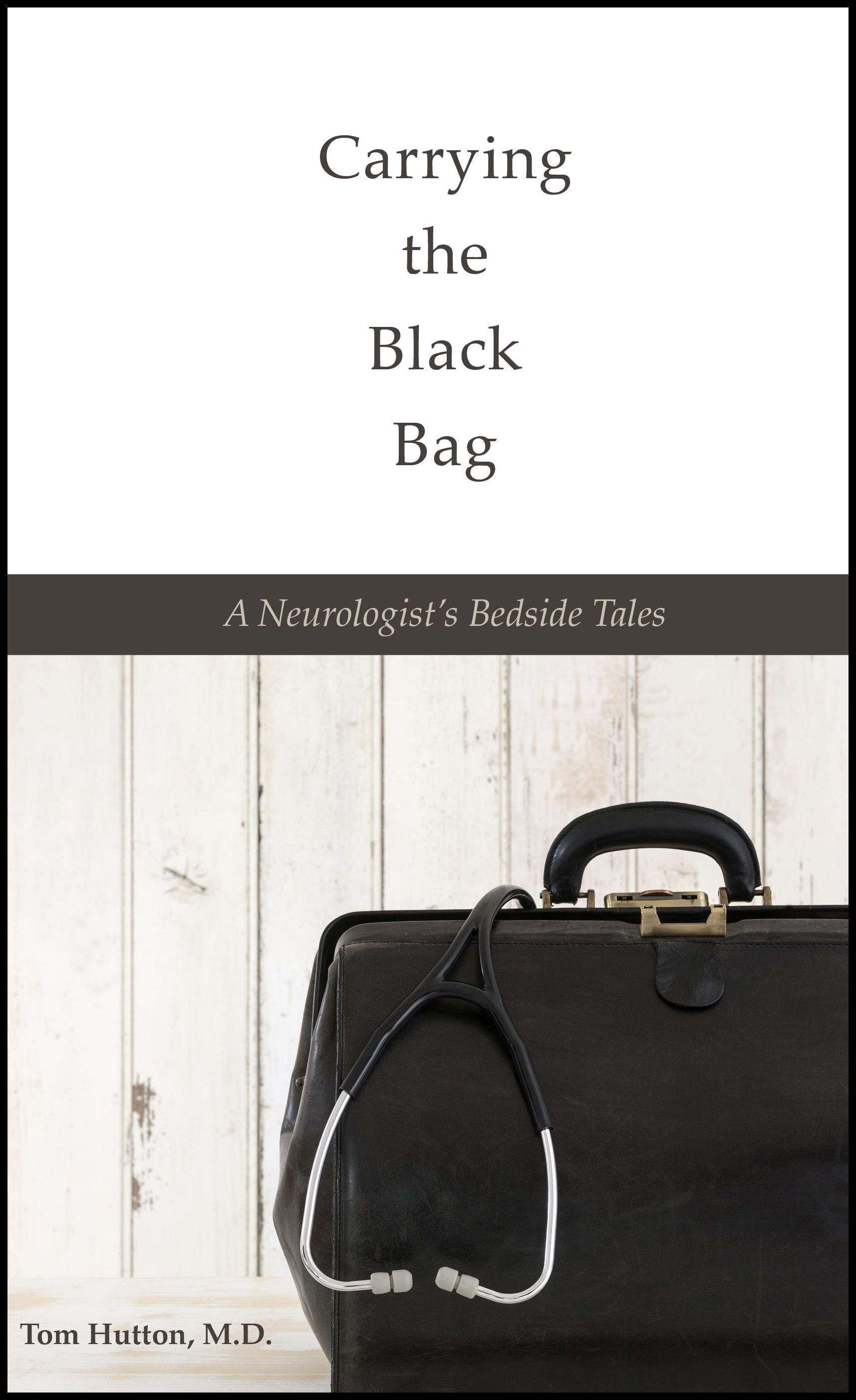
Also, consider picking up a copy of my earlier book, Carrying The Black Bag: A Neurologist’s Bedside Tales (Texas Tech University Press). Please join me on my personal journey as a physician and meet my patients whose reservoirs of courage, perseverance, and struggles to achieve balance for their disrupted lives provide the foundation for this book. But step closely, as often they speak with low and muffled voices, but voices that nonetheless ring loudly with humanity, love, and most of all, courage.
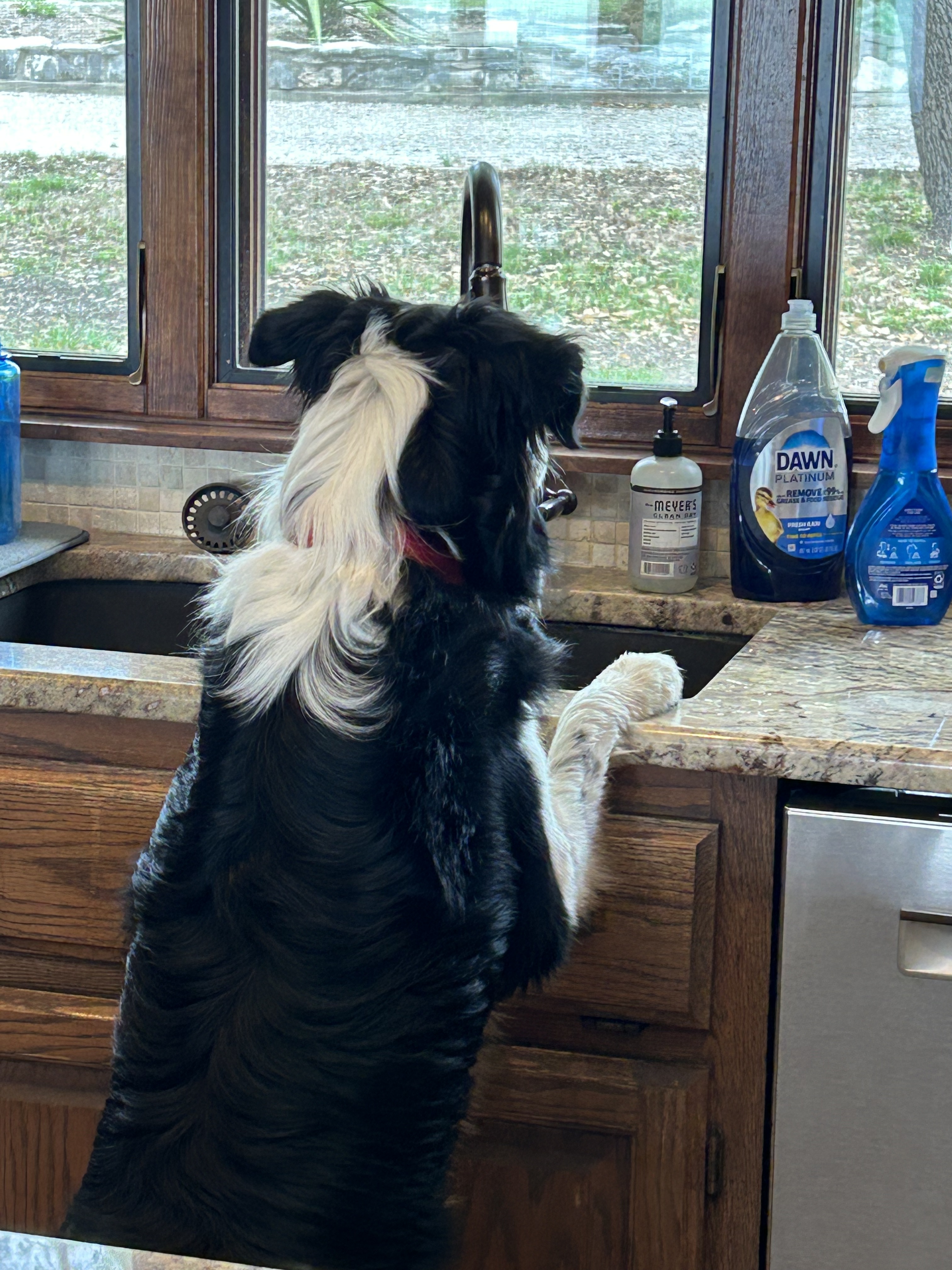
A Duke Reigns at Medicine Spirit Ranch

Like his royal name suggests, Duke came our home to visit and stayed and in the process anointed a painful emotional scar left by the forced departure of our earlier dog, Beau. Trudy and I had been grieving Beau’s loss for over six months when we received a phone call from our veterinarian’s office, informing us that they needed to re-home a Border collie. The dog in question had refused to stay cooped up in a small backyard located in a town some thirty miles away. The owners,the caller said, simply could no longer keep the escape artist and had given him up to Second Chances, a dog re-homing service. Would we be interested in meeting Duke? The question from the caller was the equivalent of kicking in an already opening door.

Not long after Trudy and I along with our twelve year old Border, Bella, arrived at the vet’s office where we met Duke. He was skittish but friendly. He immediately took to me, so much so that Trudy now refers to Duke as a Velcro dog. Of importance to us was Duke’s behavior toward Bella. He was curious about Bella, but in no way did he bully or harass our old, sweet, and largely blind Bella.

Duke at our first meeting at the vet’s kennel

We learned that Duke had been found wandering about the streets of Mason, Texas where he had been for an unknown length of time. He had weighed only 36 pounds when he had arrived at the vet’s office in Fredercksburg but had gained several additional pounds there. Evidently he had eaten poorly for some time while on the streets or at his prior home. His name had been given by his prior human parents so that we thought it best to maintain it. He was estimated to be around a year old. Duke seemed grateful for new parents, was housebroken, and had been neutered. The decision to keep Duke proved easy. Duke would come live with us at Medicine Spirit Ranch where he could run free.

On closer inspection Duke had a slightly different appearance from our earlier Border collies. He had larger and floppier ears that have proved an endearing feature. Also he sported brown patches over his eyes that we refer to as his eyebrows, something not seen in Border collies. Trudy through a GOOGLE search determined that his appearance fit perfectly for a Border collie/Australian shepherd cross.

Duke’s temperament is that of our prior Border collies, likely because Aussies and Borders are so closely related. He quickly learns tricks, possesses incredible energy, loves to chase jack rabbits and deer, and is protective of his human family. He quickly learns patterns of behavior such as when we dress differently to leave the ranch, he will lose interest. He also loves to take walks about the ranch, ranging far ahead or behind but returning quickly when called. Thus far he has not had close contact with our cattle but shows high interest in the large animals when staring at them through the windshield of the pickup. Once fully settled in, Duke’s herding prowess will be tested when the need arises to move the cattle to different pastures.

To Trudy’s credit, she took Duke for a six week obedience school. He shined in the class, quickly learning the stay, heel, sit, and down commands. He also largely ignored the twenty other dogs. His initial ravenous appetite has settled somewhat, but Duke has gained up to around fifty pounds and has added additional height as well.

Perhaps his greatest pleasures have been two fold. First, he loves to stand on the sink cabinet and watch the birds outside at the bird feeders. He watches them intently, never barking or shooing them.

Secondly, he loves to chase armadillos. For the most part, he simply enjoys herding them. On rare occasion he has grabbed the armadillo in his large mouth and carried it about as a trophy. But Duke has usually released them on command. Unfortunately, he has killed a few armadillos but for the most part seems content to chase, herd, and scare them back into their burrows. For reasons I know not, armadillos are plentiful on our ranch this year. Duke routinely will chase from four to ten on every walk.

Earlier today after Duke prodded me to take a walk on a blustery, cold day, Duke developed great interest near a large water drainage pip running under the “road” on our ranch. I approached to see what had captured his attention. As I peaked over the edge of the hill, I saw a large snake that I estimated to be five to six feet long. It was silvery in color. I became alarmed when it reared up, cobra-like, flicking out his tongue at Duke and me. Its head appeared far too triangular for my satisfaction, although it did not fit the description of any of the four poisonous snakes that live in Texas. On command Duke backed off the snake. The large snake dropped back to the ground and went one way, and Duke and I went the other.

I am in awe of Duke’s agility and speed. To watch him bound across a field of tall grass, zigging and zagging, and bouncing upward while searching for armadillos gives me pleasure. His kinetic energy is nature’s poetry. I find myself recalling my youth when I too could run virtually effortlessness. To see his keen look, excitement, and with his tongue dangling allows me vicariously to enjoy his athleticism and my own long lost ability to run. How often human dog parents must enjoy the abilities of their pets or recognize the modeling of various behaviors common to mankind. We have a truly special bond with our dogs.

So welcome to the ranch Duke. Make yourself comfortable. We have a lot of ground to cover.

If you have not had the chance to read my latest book, Hitler’s Maladies and Their Impact on World War II: A Behavioral Neurologist’s View (Texas Tech University Press), I invite you to do so. The book explores an important aspect of the Hitler story and World War II that has not been well studied. Many of Hitler’s catastrophic errors including the premature invasion of the Soviet Union in June 1941, the slowness of German forces to counterattack at the Battle of Normandy in 1944, and the highly risky Battle of the Bulge in late 1944 into 1945, can be better understood, knowing the sizeable impact that Hitler’s physical and mental conditions had on these vital battles.

Also, consider picking up a copy of my earlier book, Carrying The Black Bag: A Neurologist’s Bedside Tales (Texas Tech University Press). Please join me on my personal journey as a physician and meet my patients whose reservoirs of courage, perseverance, and struggles to achieve balance for their disrupted lives provide the foundation for this book. But step closely, as often they speak with low and muffled voices, but voices that nonetheless ring loudly with humanity, love, and most of all, courage.
Age and Wisdom

When recently  feeding out a steer (a Longhorn/Charolais cross), I decided to put his Longhorn grandmother, Bell, with him for company. This was to calm the calf that for the first time was separated from its mother and herd, and in addition to pamper Bell who was the first cow on our ranch and for whom I remain sentimental. She is now north of 25 years of age and in recent years has been becoming progressively skinny and competing poorly for food with the larger herd of Black Baldies.

Over the three months of fattening, like the calf, Bell gained weight and began to look much healthier. She relished the daily feedings of grain. When she would see me approach in the pickup, she would head straight away to the food trough with the steer following closely behind. When the calf was eventually fattened, loaded into the trailer, and taken to be processed, I opened the gate to reunite Bell with the herd.

But it seems Bell had developed an appetite for the finisher feed. Whenever I passed her for the next several days, she tended to track me hopefully with her plaintive brown eyes. I also observed her not feeding well on the still short Spring  grass, nor could she compete successfully when I doled out supplemental protein cubes. In short, she was once again dwindling.

I tried to feed her extra, but proved unsuccessful due to the other stronger cows showing up and running her off. This morning this unfortunate scenario reoccurred. I felt bad that Bell was unable to obtain more than a mouthful of grain before being driven off by the other cows and the bull. After my unsuccessful attempt I went about my ranch chores but continued to ponder if there was another strategy to supplement Bell’s diet. I eventually headed  back up the hill to where the herd resided.

But halfway up the hill, I found Bell standing alone. She seemingly had placed herself in this prominent position where I couldn’t miss seeing her but also located out of sight from the remainder of the herd.  I stopped and gave her a large portion of grain. She ate with gusto and without being molested by the other pushy cows, calves, or bull.

By guile and experience, Bell has found a way to obtain her extra feeding. I must admit being older myself, that I gained satisfaction at seeing the old girl outsmart the rest of the herd. Animals sense when another is slipping and afford them little succor. This old Longhorn had always been the smartest cow in the herd and for many years, despite not being the largest cow, served as the Bell Cow. When she eventually had to give up her rank in the herd, her daughter, also a Longhorn, took over as the Bell Cow. The Longhorns being smarter always led the Black Baldies to where the grass was best and the water plentiful.

Watching Bell this morning reminded me of the old saying that experience and guile can beat out the enthusiasm and vigor of youth. Once again, Bell the aged Longhorn proved this aphorism to be true.

Buddy’s Place In The Sun

Many years ago I read The Good Earth. Pearl Buck wrote this magnificent book in the early 1930s and won a Pulitzer prize in 1932 for it and received a Nobel in 1938. The story covers multiple generations of a Chinese family- a family that had to struggle against all types of external and internal challenges. Particularly vivid in my memory is the book’s ending where the old Chinese grandfather, who having run his race, retires to his comfortable chair, occupying his richly deserved place in the sun. He sits remembering and enjoying a deep sense of satisfaction from his long efforts.

I am reminded of this daily when I observe my thirteen-year-old Border collie, Buddy, and his aging behaviors. Due to infirmity he wisely retired from herding cattle over a year ago. I wrote the story, Buddy- The Slacker early on but did not get around to posting it until March 30 of 2018. In the story Buddy is only a half-grown dog but amazingly manages to break up a ferocious fight between two huge bulls. After so doing, he ran the neighbor’s bull off and then returned our bull unassisted through a forest and around rocks and streams to our ranch. This proved to be the single best herding achievement by a dog that I’ve ever witnessed. After witnessing this event, I no longer referred to the half-grown Border collie as Slacker.

One days several years later I was unaware of a Longhorn cow sneaking up on me while I fiddled with a difficult gate. Buddy saw the approaching cow and easily could have sped off. Instead he stood his ground, short canines against very long, heavy horns. The cow thumped me many times before Buddy helped to drive her back. I can think of no better example of Buddy’s loyalty.

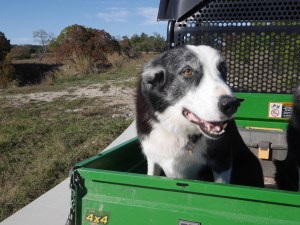
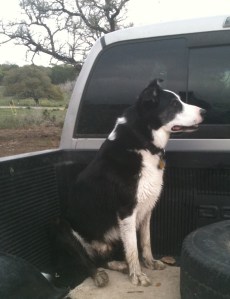
While Buddy no longer herds, he still enjoys riding around the ranch in the back of my pickup. I must lift Buddy up and into the bed of my pickup to gain his rightful place of honor. His old gray snout becomes animated when riding in the back of the pickup and surveying his ranch. His ears perk up, his dull eyes become livelier and dart from object to object, and he stands erect and proud as if for a few moments his joints no longer pain him. He points his nose into the air and listens as intently as his old ears allow.

It’s my ranch and I still look out for it.

Because of his advanced age, Buddy has largely stopped going on walks with Bella, Little Jack, and me. He will usually await our return while waiting patiently beside my pickup that in the driveway. The effort to take a walk on his painful limbs must have simply become too great, I suppose, and he has taken this commonsense approach.

Buddy has multiple beds in the house which is only appropriate because the majority of his day is spent napping. He has a doggie bed in the study where he keeps track of me while I distractedly click away on my computer. Buddy has another bed “in his office” located in a corner behind a screen where he monitors the goings on in the living room. Buddy also has a doggie bed in our bedroom where he catches many a daytime nap.

Enjoying the warmth of the sun and a good nap

Buddy frequents all of his sleeping spots at various times during the day. These spots have something in common; each allows him to soak his aging bones in the warm sunlight streaming through nearby windows. Buddy migrates from spot to spot to capture the healing sunlight. I like to think this warmth provides pain free rest periods. These doggie beds, I believe, are Buddy’s places in the sun.

Hey, don’t forget I also like to lay in the sun.

I sometimes observe Buddy dreaming with his legs making running movements. His whiskers shake and shiver. I, of course, have no idea what he dreams about, but I hope Buddy is reliving his best herding memories and summing up his many adventures. I know that at age 13 (or 91 in dog years), Buddy won’t be around much longer. i can hardly bear to think about losing him.

Buddy was born on the ranch (actually in my bedroom closet) and has barely left the outer reaches of the ranch. He models stoicism and provides more unconditional love than we can ever hope to return.His loyalty and desire to protect his people goes beyond question.

During this wonderful holiday season, the thought occurs to me that God’s love for all his creatures is, in small part, represented by our dogs love for their humans. For this let us give thanks and offer in return unconditional love.

Dream on Buddy, my loyal companion. You’ve earned your place in the sun.

Mea Culpa: Seeing Clearly

Okay, I was wrong this time, really wrong. Big time! I’ll admit it. Hear that, my lovely wife? Mea Culpa!

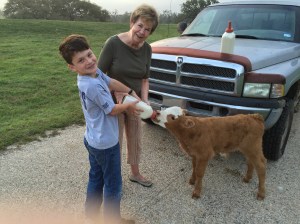
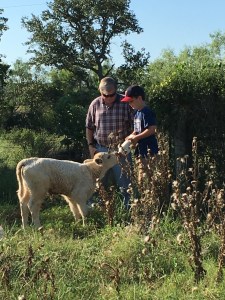
The ever diligent and loving Oma Trudy supervising  grandson Graham while he feeds a bottle calf

For sometime Trudy and I had disagreed on the color of my hair. We’ve even argued in the sort of emotionless way older couples argue. You see, I’ve always had light brown/blonde hair, but in recent years she’s claimed it had all turned gray. Nonplussed and unconvinced by her assertions, I would carefully steal into the bathroom and examine my hair in the mirror, inspecting it as if  examining the mysteries of the Rosetta Stone. I clearly saw blonde locks, perhaps mixed with a few gray hairs. Didn’t gray hair portend frailty, senility, and lack of relevancy? But I had no doubt whatsoever as to my hair colors- brown and blonde. My eyes wouldn’t deceive me.

To settle our long standing difference of opinion once for for all, I asked my hair cutter to decide this troublesome issue. Jennifer, who just happens to also cut Trudy’s hair, heard my lament and agreed to my request.

Well, Jennifer studied my hair slowly and methodically. She poked around on my head, moving aside shocks of hair as if leafy branches obscuring a bird’s nest. I beamed in anticipation, knowing I was about to hear unequivocal support for my blonde hair. I could soon boast a rare win over my always persuasive attorney wife. It was then the roof fell in. Jennifer calmly announced, “Your hair is gray.”

“Gray? You don’t see the blonde?”

“Nope.”

“Are you sure?”

“Yep”

“Not even blonde streaks?”

“Well, it all looks gray to me, but you do have lots of it.” I suppose with that comment Jennifer tried to lessen the heavy blow by pointing out that at least I hadn’t gone bald. At least not yet. Some solace that.

Gray! I was at that very moment staring into the mirror in front of her barber’s chair. I could clearly see  blonde amidst some dismal, dreary gray hair. My spirits sank. How can this be?

But then like the Phoenix of legend my defenses rallied and my resistance grew (some might call it rationalization and denial). Something funny was going on here. Thoughts of an estrogen conspiracy involving Trudy and Jennifer welled up within me. Perhaps Jennifer was part of some evil plot hatched by Trudy to put me in “the home.” Aha! There’s goes your tip Jen! What gives here anyway? Are you blind women?

Resolution to my existential dilemma came not long after. You see, my vision had worsened. Also glare made nighttime driving difficult. For this I sought the attention of my excellent eye doctor, Dr. Ann Plenneke. Several weeks later I underwent extraction of cataracts and lens replacements.

Alas, overnight my hair turned gray. Gray!!! Who would’ve thought the yellow tone to my hair had resulted from my own yellowed lenses? Mea Culpa, Dear wife, I was wrong, you were right. Tonight I’ll do the dishes.

I’ll admit this aging thing can be a bit tricky and is become increasingly challenging to negotiate. How does one do it gracefully? Now if a guy can’t believe what he sees, what’s he to believe?  Can I really trust my vision seen through new, store bought lenses that were almost certainly provided by the lowest bidder? What about my hearing that isn’t all that great either? Does this mean I shouldn’t believe anything I hear either? Ah, the nagging dilemmas that accompany an aging body.

“Well dogs if you won’t loan me your keen sense sense of hearing, then how about your outstanding sense of smell?”

Is it my loss of self-confidence in my own perceptions or merely an awareness that as I age my chances of being correct lessen? This is but one of many conundrums I’ve discovered with getting older. As a result I’ve learned to admit my mistakes and apologize quicker. I’ve found apologies now come with less difficulty, perhaps because I’ve become habituated to giving them.

On a more positive note, my rich stock of lifelong, accumulated experiences helps to lesson my sensory losses. My experiences place everyday challenges into greater perspective and usually diminishes their overall negative impact. This proves an advantage for me and i provides for greater emotional equanimity. Isn’t there something about wisdom growing with age? I sure hope so.

Perception, however, sadly slacks off. Everything diminishes in acuity. You name it- vision, hearing, smell, sensation. Sayanara, adios, auf wiedersehen! Why’s it wasted on my dogs who can hear a truck cross the cattle guard from half a mile away? Why’s their sense of smell denied to this human septuagenarian?

Hope my kids don’t read this. Admitting to flagging perceptual abilities could be a huge mistake. Think about it. My children, Andy and Katie, just wouldn’t get it. Think I’ll hide the car keys before their next visit.

“Bella, don’t worry. We’ll hide the truck keys before the kids come.” Note me wearing glasses before the cataract surgery, something I no longer have to do. Bella’s vision however has remained remarkably good.


Reflections on Getting Older

“Grow old along with me! The best is yet to be, the last of life, for which the first is made.”

As mentioned in an earlier post,  the meaning of Robert Browning’s famous saying for a long time of puzzled me.

Is it life satisfaction that increases with age? Or is it that our thinking processes somehow affect how we react?

Psychologists have grappled with changes in the way we think as we age. Raymond Cattell developed the concept that general intelligence consists of two types: fluid intelligence and crystallized intelligence. Its not that intelligence declines in older age (unless a dementing illness sets in), it’s that fluid intelligence declines while crystallized intelligence increases.

“Say what? What does this have to do with herding cows?”

Both types of intelligence increase throughout childhood and adolescence. Fluid intelligence, the ability to develop new problem solving strategies, peaks by age 40 whereas crystallized intelligence that comes from prior learning and experience doesn’t peak until the 60s or 70s.

Both types are important to overall intelligence. There is also some evidence that brain training games may benefit fluid intelligence.

The direct approach to understanding intelligence

Perhaps it is a greater reliance on crystallized intelligence that allows older people to better determine the veracity of an event/statement based on his/her longer experience. While this doesn’t always comport with what youngsters may believe or have experienced, it at least holds as a general rule.

“You better hope that your fluid intelligence and crystallized intelligence will outweigh your lack of smell and hearing.”
Photos by Ramsey

When considering aging in humans and dogs, one thing of which I am certain is that dogs can model positive aspects of aging. For example Buddy (pictured above) awakens in the morning stiff and sore. He and I both take awhile to get going. Nevertheless when Buddy heads for the truck and his ranch duties he pulls himself together and goes after life with an incredible zest. He’s not one to give into his infirmities.

Within reason this is a life characteristic that I and other humans should emulate. While our physical and mental capabilities may not be what they once were, we should continue to use what we have to the maximum.

Thanks Buddy for your example and we shall grow old together as the best is yet to come.

May The Force Be With You

The well known statement from “Star Wars” that serves as the title for this piece has of late developed special meaning for me. Perhaps I am still under the emotional overhang of my father’s recent passing, but the ease by which he passed has meaning for me. Dad died at the age of 96-years peacefully and in his sleep. His force to live diminished in his final months to a point where he was no longer walking, then no longer chewing, and then even refusing to swallow liquid supplements. His life force slowly ebbed away.

Dad (John Howard Hutton) when his life force was strong

In juxtaposition with Dad’s dying process has been my observation of an unfortunate, recently born calf on our ranch. Now I am in no way equating the value of the two lives, only making a comparison of their life forces.

Newest bottle calf being fed by Trudy with his good-for-nothing, calf-stomping mother looking on

The calf was refused milk by his mother for reasons unknown. Not only that but she kicked the calf nearly to unconsciousness when he tried to nurse. Later the mother calf became spooked and backed up, stomping her calf. Frankly I thought she had killed it.

Nevertheless, the following morning the previous “calf carcass” took a full bottle of milk. What a surprise! He’s not developed normally but is still making slow progress. He has a left front leg injury, one of the several spots where his mother stepped on him. Our newest bottle calf refused to die and continues to gain weight and hobbles about to a limited degree. I sometimes have to provide extra lift for the calf for him to get onto his four wobbly legs. As he grows, this may become a serious problem.

Given his miraculous survival, we refer to him as Phoenix. He rose off the pasture where he was near death and now greets Trudy and me with his long eyelashes for which Madonna would be envious, lovely dark eyes, and enthusiastic sucking at the milk bottle that sustains his life.

Mythological Phoenix

He still is not guaranteed survival. It seems his legs are too weak at times to get him up or possibly too painful. His walking is unsteady and wobbly and Phoenix tends to fall on uneven ground.

Nevertheless, Phoenix possesses a strong life force. I suppose this has to do with his young age and strong survival instincts. Regarding my Father, I cannot help but believe that after 96-years and having lived a full life that his life force had diminished down to nothing.

Grandson Graham earlier today feeding a somewhat older Phoenix

I recall the answer my grandmother gave when I asked her as a child what it was like to get old. She said, “Tommy, you just get tired.” I think she was right. Increasing fatigue accompanies age and illness. In my experience as a physician, folks just kind of give up at some point and are ready to die. Age seems to have a lot to do with it.

In my recently published book, Carrying The Black Bag: A Neurologist’s Bedside Tales I tell the story of a little girl with Reye’s Syndrome who by all accounts should have died. Despite an absolutely horrible prognosis she lived and thrived. I believe her young age had much to do with her survival. The force was with her.

To my readers, “May the force be with you,” by which I imply continued strong life forces and may you enjoy vital life in the years ahead.

Dog Lessons On Living- Part 2

In my previous post I dealt with how two dogs modeled how to deal with serious illness and impending death. The two examples were from our current Border collie, Buddy, and our long deceased Shetland sheep dog (Sheltie), Taffy. Their love of life and passion for their favorite activities persisted despite their physical challenges.

If we abandon the arrogant notion that humans are somehow completely different from other animals and instead recognize our common genetics, anatomy, physiology, needs, and behaviors, then animal behavior can become a potential assist for our lives.

I am reminded of a story from my recent book, Carrying The Black Bag: A Neurologist’s Bedside Tales about Mary from Minnesota. This story, like many others in the concluding chapter of my book, took place aboard a fictitious cruise ship and demonstrated great perseverance of some physically handicapped folks in the face of adversity. The very real members of a group that Trudy and I accompanied had been organized by a national Parkinson’s Disease organization. Despite Mary’s advanced disease requiring  her to have a feeding tube, tracheostomy, urinary catheter, wheelchair, and and full-time attendant, she had demanded to go on the cruise.

Unfortunately Mary didn’t make it and passed away during the cruise. When speaking that evening by phone to her daughter in far away Minnesota, I learned to my surprise that the family had  expected Mary to die on the cruise. After recovering from my shock, I further learned that Mary had a lifelong habit of taking on great challenges. Despite her failing health Mary in recent years had undertaken skydiving, ridden a burro down into the Grand Canyon, and been strapped to a dogsled in Alaska. Mary refused to give in to her illness nor would she be prevented from trying new, exciting, and life changing thrills.

From Sailaway Chapter of Carrying The Black Bag

While Mary was only one of our passengers with Parkinson’s disease, all of them despite their balance issues dealt with the swaying of the deck and with the many challenges of shore excursions and beach activities. They also managed the dietary differences that at times limited the effectiveness of their medicines. None of these brave people shied away from the challenging experience, showing their zest for life and denying their illnesses control over their lives.

Now I know not all people with PD would make such a challenging journey. Indeed life is like a marathon and all of us hit the wall at times. Some persist and break through the wall while others are unable to do so.

Health and vibrant aging can be such a gift but persistence is also demanded

Both Buddy our Border collie, Taffy our Sheltie, and Mary refused to give in. All lived their lives to the greatest extent possible. I don’t know where Mary derived her zest for life, but she might have witnessed it in her pet. For whatever reason, Mary had learned to live her life as fully as she possibly could, believing that the quality of her life was more important than the number of days she lived.

Therein may lie a lesson for us all. Our challenge may be to garner as rich and full a life as possible. We all will likely be faced with challenges. Some of us will continue to strive and others will find an easier but less fulfilling way to live. Nothing is wrong with either approach, but our pets may have at least modeled the more courageous approach to life. Without it would we have even considered such a course of action?

Dog Lessons on Living

Forty years of practicing medicine and having lived long enough to acquire some gray hair have allowed me to observe people dealing with illness and impending death. These challenging periods prove difficult for sure , but I believe our pets can help to cope with and even model helpful behaviors that benefit their owners. The mindfulness of the pet owner becomes necessary in order to learn these pet-assisted lessons.

At our house we’ve had two experiences that I wish to share that have brought me to this conclusion. Our Border collie, Buddy, unfortunately injured himself many years ago while leaping over a cattle guard. I found him shortly after the accident, dragging his paralyzed hind limbs. We were to learn that Buddy had ruptured a disc that had extruded into the spinal canal and traumatized his spinal cord. After evaluation, treatment, and rehabilitation Buddy slowly recovered. He now has the reasonable use of his hind legs and moves about without any assistance. For this we are incredibly grateful.

Buddy had always loved to run and herd cattle. His racing around the ranch with his tongue flapping deliriously and with a goofy look plastered across his muzzle has for me defined unbridled enjoyment. With time he has regained the ability to both run and herd, although not with quite the same proficiency as prior to his injury. Nevertheless, Buddy still loves to ride in the pickup, watch the cattle, and when needed to jump out of the bed of the pickup and do a stint of herding.

It strikes me that Buddy during his convalescence never gave up on himself, nor did he permanently abandon his valuable role as chief herder on the ranch. Despite lingering weakness, he continues to carry out his job with typical Border collie passion and enthusiasm. A job for a Border collie is vital. As the old saying goes, “If a Border collie doesn’t have a job, he’s liable to become self-employed.” Trust me, when this happens it’s never a good thing!

Buddy sleeps more now following his injury

Our second pet-assisted experience resulted with our Shetland Sheep dog (Sheltie), Taffy, and occurred years ago when we lived in Lubbock. Taffy’s favorite activity and what she most anticipated was her evening walk. She would become so excited when we presented her leash for our walk. Unfortunately Taffy eventually fell ill and was diagnosed as having cancer. While we knew the cancer would eventually take her, we were given the encouraging, if incorrect, prognosis by her vet that she had at least weeks if not months to live.  Despite Taffy not feeling well, she still agitated quite demonstrably at the end of each day for her walk.

Taffy during her healthier days

I distinctly remember her recruiting us that last night. Trudy and I dutifully leashed up Taffy and began a slow trek around our block. Taffy seemingly sniffed  every tree we encountered and observed the goings-on in the neighborhood with her eyes glistening with excitement. Unfortunately despite her wanting to, her energy gave out a third of the way around the block. She simply was unable to muster the strength necessary to walk any further.

On recognizing this I reached down to gather our sweet dog in my arms and then continued our walk around the block. Taffy gazed out from the crook of my arm and noted the happenings of her final trip around the neighborhood. Later that night she died peacefully in her bed. I like to think Taffy died  happy having made one more glorious trip around her block.

The thing is, Taffy continued to do what she most enjoyed despite her serious illness. Her willpower and determination continued despite her substantial depletion of energy. It seems to me that a broader and more personal message exists for pet owners much like the messages both Buddy and Taffy have given us.

I will continue discussing this topic in a subsequent post and plan to give a few human examples. These people-related corollaries will come from my book, Carrying The Black Bag.

Please share your thoughts as to what you may have learned from your pet regarding illness or impending death.

TO BE CONTINUED


Reflections on Getting Older- Part II

Not long ago I had the pleasure of hearing Col. R.E. Cole recount his experiences as Jimmy Doolittle’s copilot as depicted in the book and movie, Thirty Seconds Over Tokyo. This was my favorite early war film. I like many others of my generation grew up steeped in heroic films about World War II. The movie starred Van Johnson as Captain Ted W. Lawson, Phyllis Thaxter as his wife Ellen, Robert Walker as corporal David Thatcher, Robert Mitchum as Colonel Bob Gray, and the inimitable Spencer Tracy as Lt. Colonel Jimmy Doolittle. Heroism was on full display and made you proud to be an American.

220px-thirtysecondsovertokyo-1

Colonel Cole is now 101-years of age and, while frail, is still sharp. I must assume the events depicted in the movie and book proved to be the signal event of his life.

A recent article, My Flight With a Doolittle Raider, was published in Texas Coop Power. In it the author, Matt Jolley, describes a day in 2010 when he and Colonel R. E. Cole strapped themselves into a World War II-era B-25 bomber and roared off the runway for a spin. Once in the air the owner of the plane  turned the controls over to Colonel Cole.

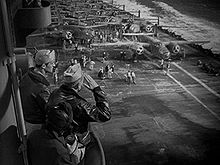
I believe Cole’s thoughts may have gone back to April 1942 when he and 79 other volunteers, only four months following Pearl Harbor, managed to take off from the swaying deck of the U.S.S. Hornet. They flew at the absolute outer fuel limits of their planes to drop a limited bomb load on Tokyo. While the physical damage was limited, the attack by Doolittle’s Raiders tremendously elevated American morale and diminished that of its enemy.

B-25 bombers awaiting takeoff from the deck of the Hornet

B-25 bombers awaiting takeoff from the deck of the Hornet

Imagine the satisfaction Colonel Cole must have experienced when he relived this event a few years ago. The author of the piece saw no boyish transformation in Cole, nor did he see a giant grin. What he witnessed was the quiet confidence of a man in full control of his airplane. I believe Cole must have felt a surge of satisfaction, reliving those seminal moments that has given his life such special meaning.

Colonel Cole is the last living Doolittle Raider. At his public speaking appearances, he is now attended closely by his daughter. He still loves to share his stories with others. With Veteran’s Day two days ago, it’s only fitting to remember and honor Colonel Cole and the other gallant men for their service and sacrifice to our nation.

But in another sense, what do events such as this one mean to the individual who experienced them. Wouldn’t it be marvelous if everyone who reaches old age could have the opportunity to re-experience their own signal  life’s event.  While this may not be possible, it suggests another option.

Why not allow an older person to reflect (tell their story). Our lives as story have such great importance for our own understanding. I only wish I had listened more closely to my grandparents’ stories. This inter-generational transfer of knowledge is good for both the listener and the speaker.

With the upcoming holidays, the opportunity exists to deepen understanding of the narrative of the older members of your family. I hope all will take advantage of this, not only to learn the stories, but to assist in the meaningful development of the aging process for your loved ones by allowing them to reflect deeply on what was important for their lives.

I would love to hear how this works for you.

To Be Continued