Category Archives: ranching

A Backward Glance–Part 2 by Paul Hayes, Guest Blogger

This is Part 2 of the piece written by Paul Hayes. Paul, like me, always had a hankering to be a cowboy but first had to have a paying job to afford to do so. For Paul it was a successful career as a land man for Marathon Oil and for me, a career in Neurology. It was worth waiting for!– Tom Hutton

Two Longhorn cows and calf

Two Longhorn cows and calf

Paul Hayes wrote the following:

COWS

While we didn’t have any horses or cows ourselves, we lived on a dirt road at the edge of a very small town. So farm animals were all around me. In fact, the family of one of my best buddies, Bobby White (I think he was named after a quail), had a farm just down the road, and they had lots of animals. One day, while playin’ at Bobby’s place, he came up with an idea for the ages. He thought it would be a really great idea if we went and roped a cow. “heck, yes” I exclaimed with enthusiasm. Did I mention that I was the brainy one in my group of friends?

We dashed out to their barn. Remember, if it weren’t worth runnin’ to, then it weren’t worth doin’. Bobby climbed up on a horse stall and pulled a rather stiff rope down from a rusty ol’ nail on the barn wall. He jumped down into a cloud of dust and we proceeded to the pasture.

Now, bein’ the smart boys that we were, we picked a young cow are our first target. Bobby had growed up on the family farm and actually knew how to rope. Not livin’ on a farm myself, the only rope that I had knowed was fer jumpin’. We walked as close as we could get to our victim, and Bobby took his stance. He swung that rope around a few times and throwed it in the direction of that cow. Much to my amazement, and Bobby’s too I suspect, the lasso went over that cows head. As the cow jumped, the rope tightened. Bobby screamed for me to help and I grabbed aholt of that rope. We dug our heels in as far as we could and pulled with all the might that two boys of six years of age could muster. After a few harrowin’ seconds, the cow calmed herself and all seemed quiet.

But, the really fun part started with my next question. “Well, that was excitin’. Now what do we do?” After a few brief seconds of thought, which, as luck would have it, was not sufficient time to come up with a reasonable plan, Bobby said that, while one of us holds the rope, the other will crawl under the cow. Yep, you heard me right. Again, what six-year-old boy wouldn’t want to have that on his resume. Since there were only two of us, and since Bobby was already holdin’ on to the rope, he said I could go first. With not nearly the hesitancy of my first horse ride, I willfully got down on the ground next to the small cow. As I approached, I saw the rope tighten and I saw Bobby dig in for whatever might come. Wantin’ a good view of the excitement, I got on my back and began scootin’ along the ground under the cow. I am directly under the cow when I discovered that a six-year-old boy does not possess the strength to hold even a small cow in place. The cow jumped, kicked like a mule and then ran out into the pasture – rope draggin’ behind. I, on the other hand, laid breathless on the ground with hoof prints on the portion of my white Sears tee shirt that covered the center of my chest.

I had followed up my horse lesson with an equally successful lesson about cows. I am not certain, but I may have been rethinkin’ this cowboy thang at this juncture.

GUNS

Paul Dennis Harris was a boy who lived across the pasture from my house. He was a year older’n me so I, quite naturally, believed that everythang he said was as gospel as Sunday preachin’. I would come to learn that there are two voices that we hear in our lives, one is the voice of God, the other is the voice of Paul Dennis Harris. On this particular day, as I peered out the kitchen winder, I could see Paul Dennis over in the pasture playin’ with somethin’. I just couldn’t see what it was. That situation required a prompt investigation. As I approached, Paul Dennis displayed a pistol that he told me his grandpa said he could play with. I later doubted that the ol’ man, not havin’ been afflicted with brain damage to the best of my knowledge, knew anythang about the pistol caper. At six years of age, I knew nuthin’ ‘bout guns, includin’ the fact that they could lift a boy’s skull from his head if pointed in the wrong direction.

I have no idea what the caliber of the gun was. But it was heavy, and it was real. Paul Dennis suggested that we shoot a target, so he proceeded to set a coke bottle on top of a fence post. While I knew that that coke bottle was worth three cents down at the local grocery store, I was willin’ to forego that income for a new experience. Bein’ the nice guy that he was, he even said that I could shoot first.

Are you hearin’ a repeatin’ theme in these stories?

Well, by this time, bravery was my middle name, and I happily accepted the offer. He loaded the revolver with six bullets – five more, as it would turn out, than I would need to complete the experience. He then handed me the gun, stood back and covered his ears.

I’m six years old. I have no idea how to use a gun. Ne’ertheless, I took the pistol in my hand and held it up to my cheek just below my right eye. Takin’ good aim at that bottle, I slowly pulled the trigger. I am not certain what hurt worse, the powder burn on my cheek, the damage to my eardrums or the butt beatin’ I got from my dad when he found out. I immediately dropped the gun to the ground and ran home cryin’ like a cat in a rockin’ chair factory.

I learnt a hard lesson that day from the likes of Paul Dennis Harris. Age, as it turns out, does not necessarily equate to wisdom.

COWBOY?

Though I survived the age of six, my parents decided to move to Dallas before I could learn any more lessons about life in a small country town. I became a city boy whose only exposure to cowboys from that point on were the ones who played football on Sundays. Now, at the age of 56, I find myself living back in the country. However, it is safe to say that I will live my life as a cowboy vicariously through you.

Thanks for your contribution to my longevity.

Paul

“Mama Duck-Me” Guest Blog by Trudy Hutton

How did I become Mama Duck? Earlier this summer we and our neighbors decided to raise some Rouen ducks for our pond (known in Texas as a “stock tank” or just “tank”.) We have raised ducks before—five or six years ago– but they have all disappeared through old age or predators and we decided we would enjoy them again.

The ducks are ordered from a breeder and come via mail at one day old. The post office calls first thing in the morning…and I mean first thing, usually about 6:00 a.m….that there is a cheeping box of birds to be picked up AS SOON AS POSSIBLE.

113-1388_IMG

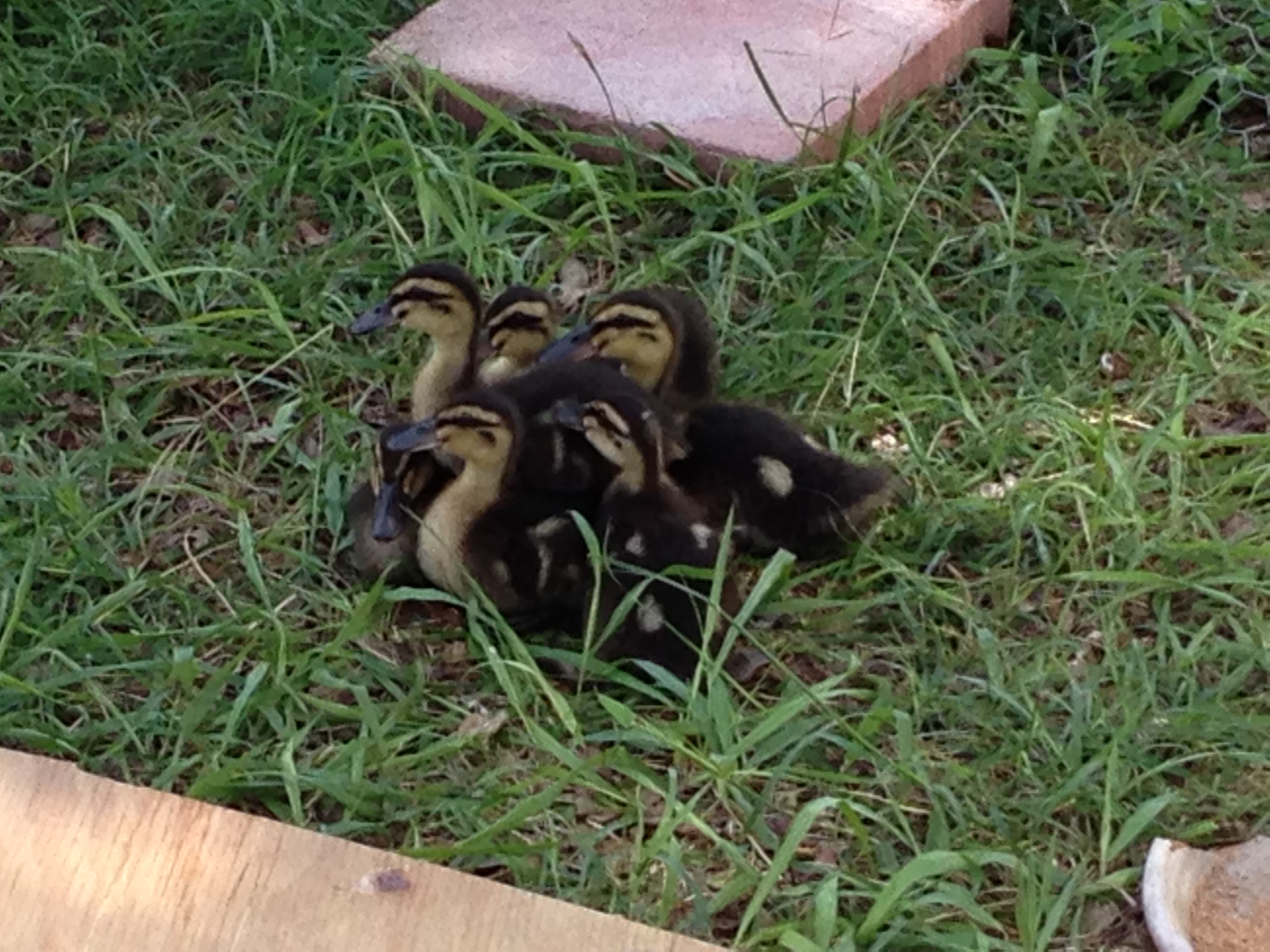
Our ducks, six cheeping handsful of down, lived for the first week in the laundry room in a large cardboard box. They had a heat lamp to keep them warm and we lined the box with newspaper to keep them semi-clean They are messy, smelly little things; the box needed to be cleaned daily, lined with fresh newspaper and food and water dishes refilled. Ducks like water. They really saw their water dish as a small swimming pool. Every morning about 4:30 they would begin cheeping for fresh water and food. Tom was the one who heard these early morning protestations and got up to fulfill their requests. Enough of that. The second week we moved them out to the shop and into an old poultry cage we had before used for our birds. Out of earshot and smell range (not to mention they were quickly outgrowing the box) we slept a little better.

We built a nice round chicken wire pen inside the fenced garden and filled a small wading pool for their swimming enjoyment.

IMG_1305

DSC_0167Although they were growing fast, we had to build “duck ramps” for them to be able to get into the water and we placed a rock “island” in the middle of the pool for them to rest on.

Every morning we gathered the ducks into a cardboard box and transported them to the outdoor pen. In the evening we rounded up the ducklings, after chasing them around the outdoor pen and putting them in the box to transport back to the poultry cage. (Making the outdoor pen round was not a good idea – no corners to catch them in.) They are very fast little devils! I would “quack, quack” to reassure them that it was Mama Duck, and hopefully convince them to follow me.

After the second week the ducks had outgrown the small wading pool, so we added a larger one and took down the chicken wire pen. They now have full roaming rights to the entire garden area.

IMG_1312

By the end of that week, they had the morning and evening routine down. We no longer have to transport them in a box between the garden and their night-time pen. Open the door to the shop and the cage door in the morning and I could lead the ducks out to the garden, quacking as we went. Tom says I flapped my wings, too, but I deny it.


After a few days I didn’t even have to do much as far as leading or herding. Now when we open the door to the poultry pen, out they march, in a close group, on their own.

About sundown we reverse the routine, usually following behind the ducks, as they seem to know it’s time for bed. They head straight into the shop and the evening safety of the poultry pen. A few nights ago, I was a bit late going out to bed them down and found they had already taken themselves inside for the night!

IMG_1314

As the ducks grow we may have to find a bigger swimming pool. But before too much longer they will be big enough to move down to the tank and be on their own. Rouen ducks are identical in coloring to Mallards, but unlike Mallards they cannot fly more than 20 or 30 yards. By the time they grow enough to move to the tank, they will be able to swim into the middle of the water for safety from predators.

I still “quack, quack” when I feed them daily in hopes that when they do make the move to the tank, it will only take a few “quacks” to call them up to feed. We’ll see how the transition to the tank goes. The last time we had ducks ready to move to the tank, I walked down to the tank, quacking as I went, with 6 mostly grown ducks behind me. However, I barely got back to the house when we heard them quacking at the back gate. They had not only followed me down to the tank, but evidentially thought Mama Duck wanted them to follow her home. Time will tell about these little quackers..

Hay’s In The Barn

How affirming those words, “hay is in the barn”.  Have you ever wondered how hay is cut and baled? We cut our hay fields this week and baled both round and square bales. Below I share the process of carrying out this important ranch activity.

Two months ago our fields were brown and dusty. After our lengthy drought the fact that we obtained a cutting at all is fortunate. The process began two months ago.The rains this year came at the right time, namely just after we had fertilized the fields and then subsequent rain was well spaced till harvesting.

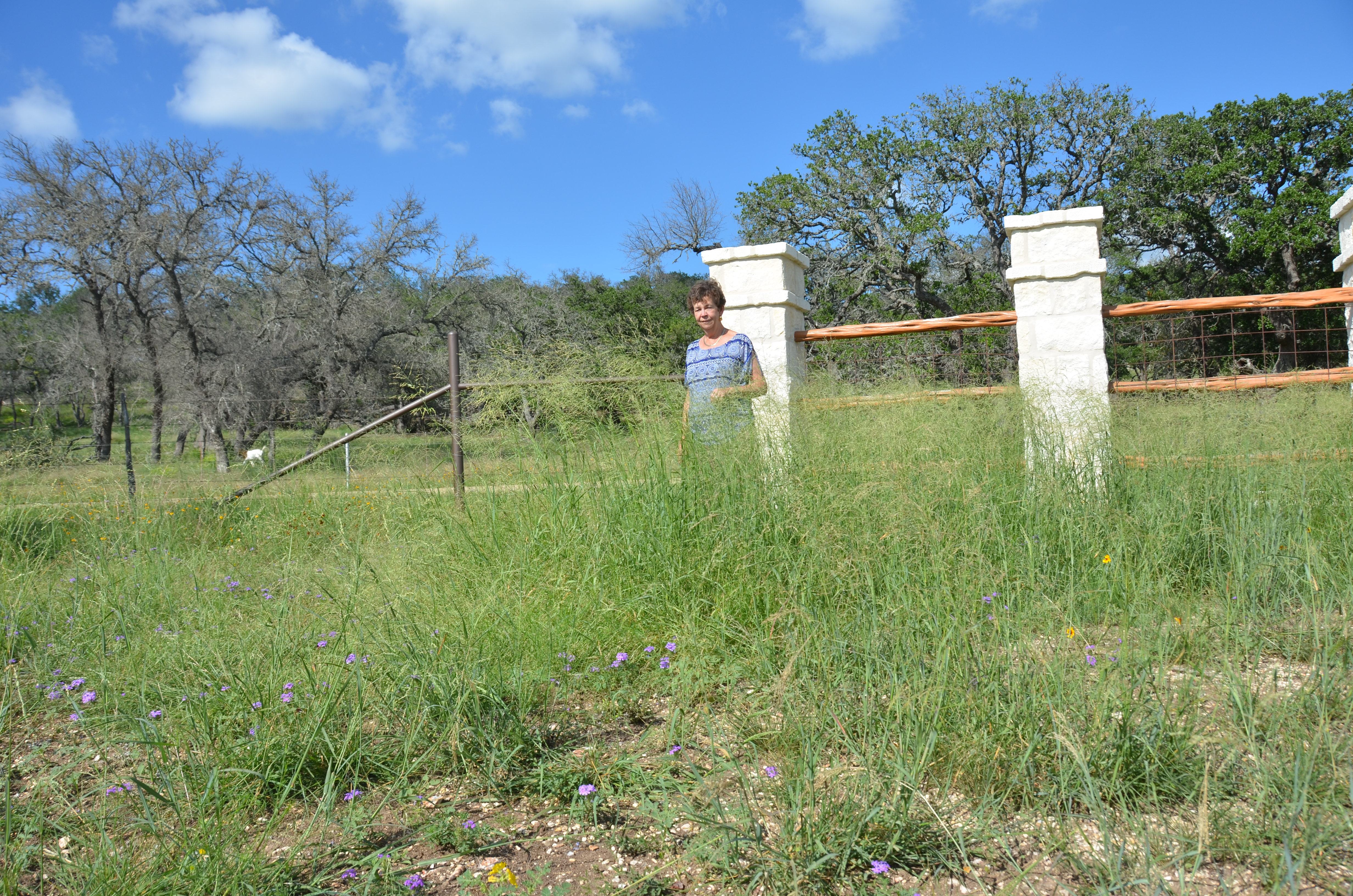
Trudy in Klein grass field

Trudy in waist high Klein grass field

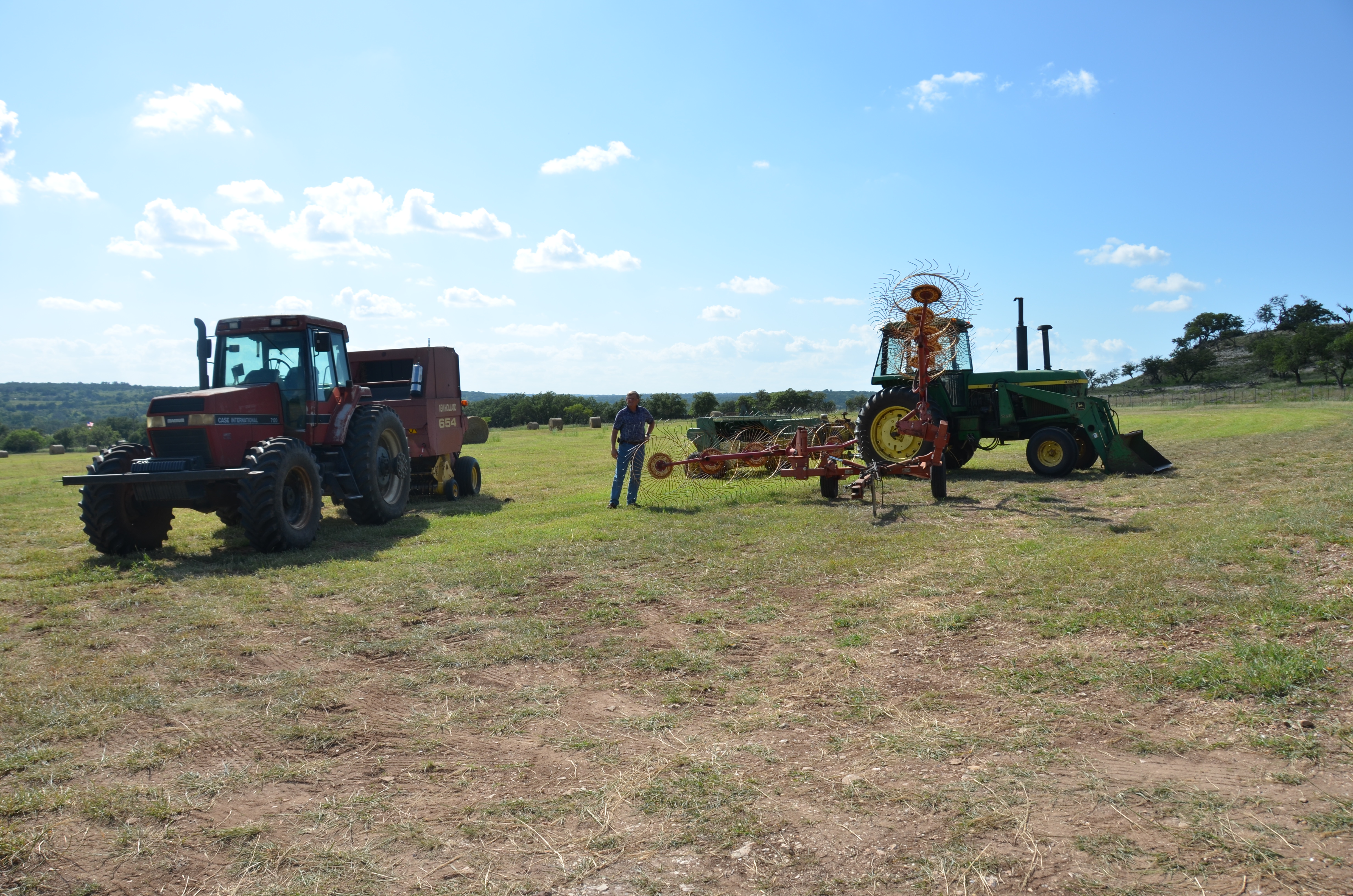
Being a small operator, we don’t own the cutting, raking, and baling equipment. Instead I hire someone with equipment and pay a per bale charge. The charge for cutting and baling our hay is substantially less than buying it, especially so during our recent drought years.

Yours truly with baling equipment

Yours truly with baling equipment

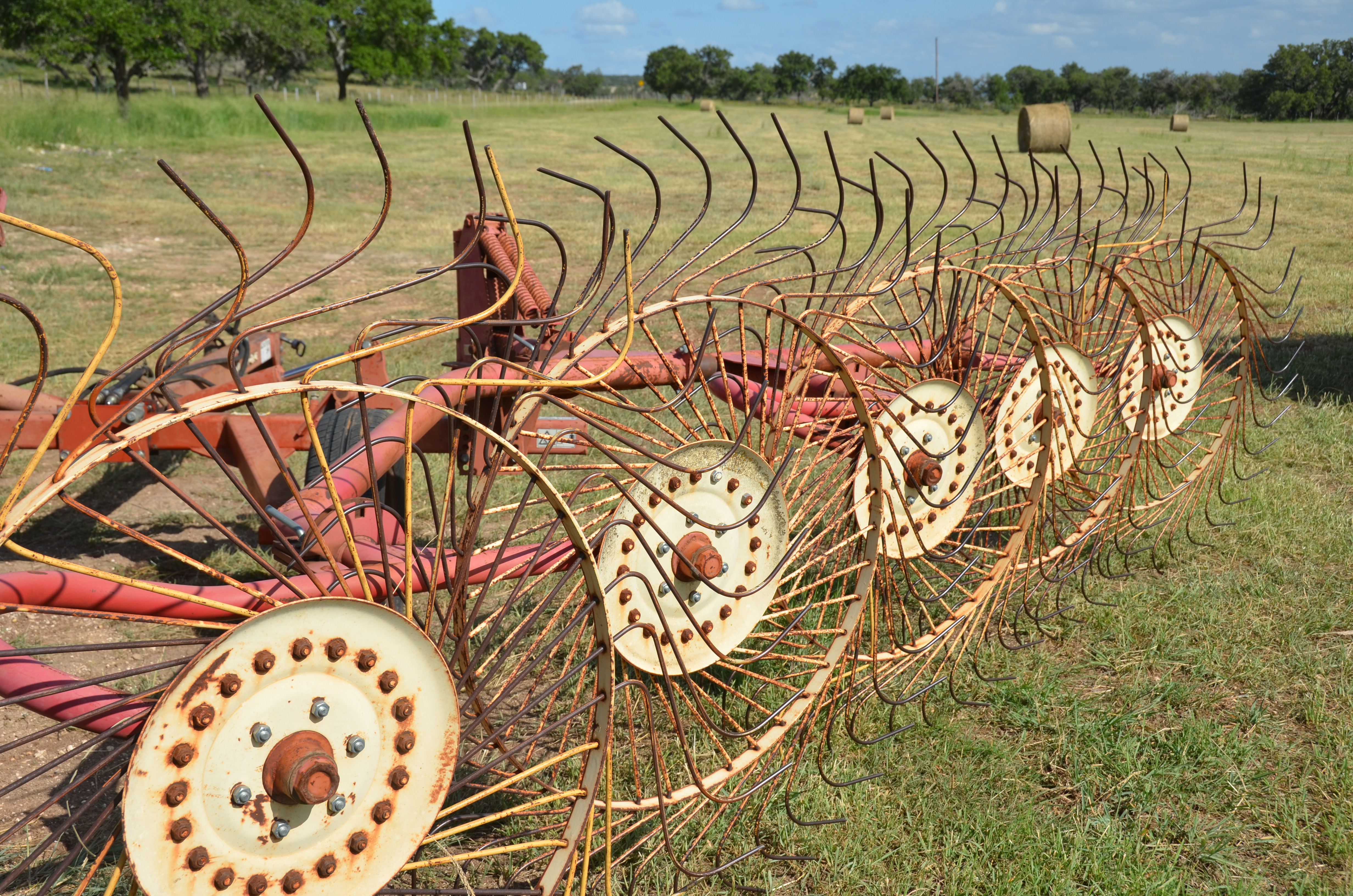
When the hay has grown and begun to head out, the tractor pulls the cutter through the fields and lays it down, much like a giant scythe. The hay then needs to dry for several days. Because of the threat of rain this year, we baled the Klein grass into bales before it had completely dried. Once the hay was cut and dried, the tractor pulled a giant rake through the fields, creating a large snake-like furrow of hay. Next the tractor pulled the baling machine through the field and picked up the rows of grass,  turning it into thousand pound round bales or sixty pound square bales. The machine amazingly ties the bale tightly with twine or wire to hold it in place.

Hay rake

Hay rake

Trudy with Hay bale

Trudy with Hay bale

Given the higher than normal moisture content of the grass this year, we will leave the bales in the field for a week or so to dry before moving them to the hay barn. This interval diminishes the chance for spontaneous combustion. Yes, instances have occurred where barns have burned down due to prematurely enclosed hay bales.

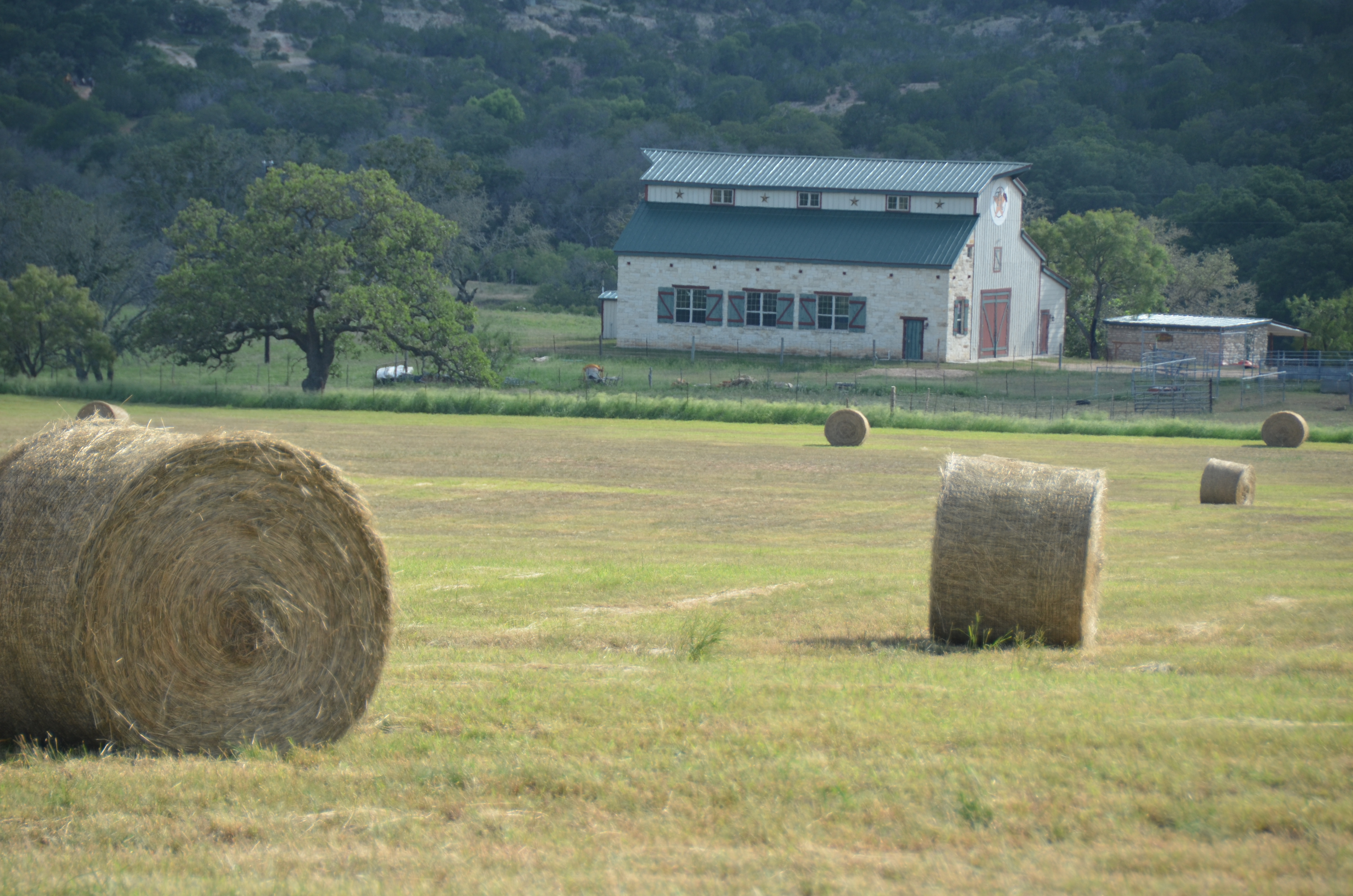
Hay bales and Hay Barn

Hay bales and Hay Barn in distance

Next week we will move the bales (both the large round ones for cattle and the smaller coastal square bales for horses) to the barn to store for the winter. Placing  the hay in the barn is a particularly satisfying time, knowing the animals will have ample hay during the non-growing season.

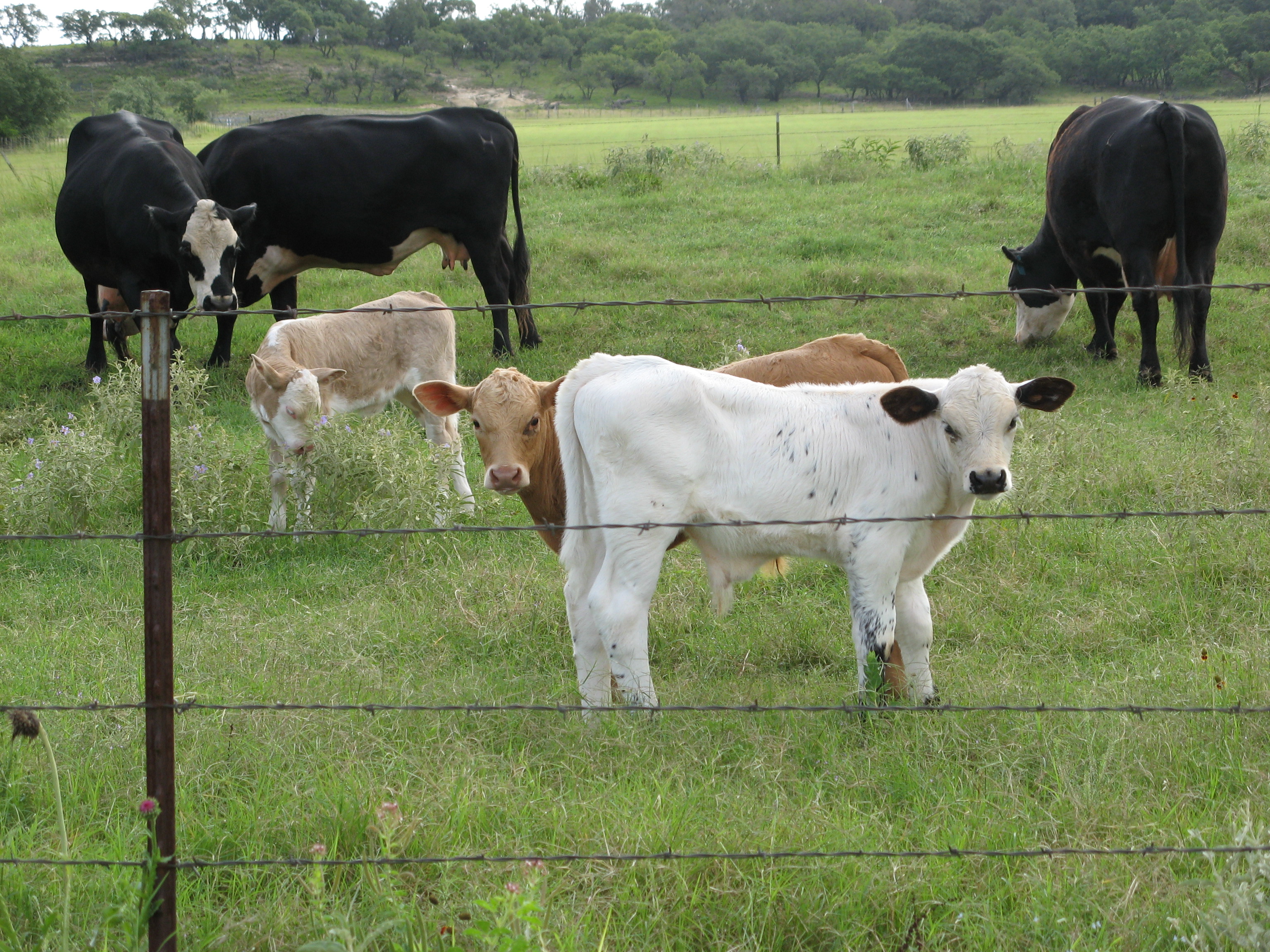
Prospective consumers of hay

Prospective consumers of our hay

Cattle Auctions

The date we sell our calves at auction is the best day of the ranch year–it is also the worst. How can this be?

As anyone knows who has been to the grocery store lately, beef prices are high. This reflects in the prices ranchers receive at the sale barn. Last week’s prices for a load of six calves were our personal best. We received about twice the usual price (this is a good thing as cattle ranching for a long time has not been profitable). The sale is the payoff for a year of raising the cattle, vaccinating them, castrating the bull calves, being a careful steward of the herd, putting out hay during the winter, carefully managing the pastures, and dealing with any veterinary problems that come up. The rancher obtains a bonus for quality as well as existing market conditions. We feel this year like we hit the jackpot!

Young Calves

Young Calves

CALVES IMG_0191 New calves

I enjoy hooking up the cattle trailer, loading the calves, donning my Stetson and proudly driving to the sale barn. This provides a fitting finale to the year’s hard work.

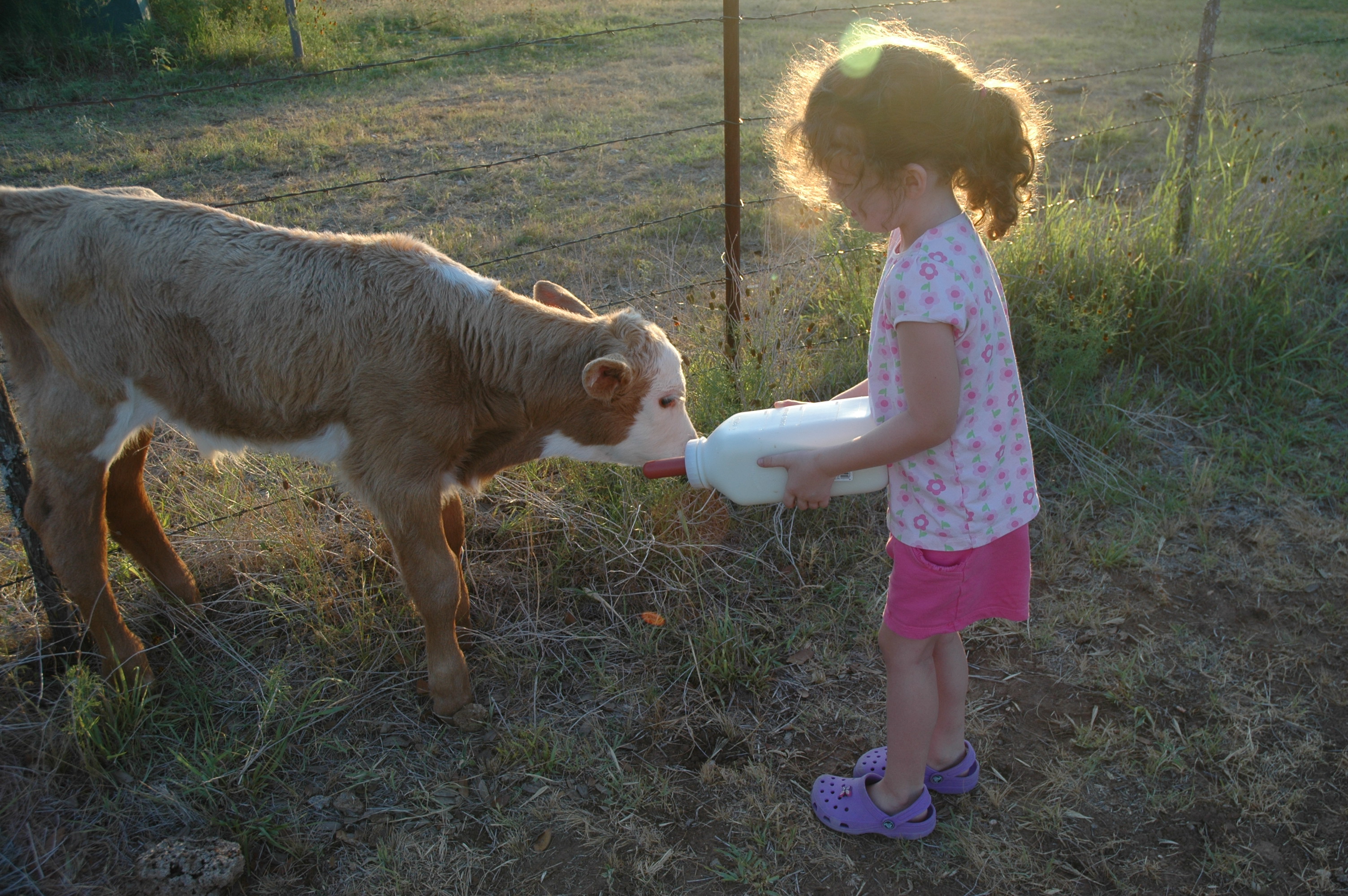
While sale day makes for the best day of the ranch year, parting with our calves is bittersweet. Frankly it hurts to send our critters away. After all, these are the baby calves that were once so cute, and we watched gain for the first time their wobbly feet. They entertained us with their joyful scampering, insatiable curiosity, and calf games. A few calves we have had to bottle feed when their mamas were unable or unwilling to act as the milk bar. Anyone who doesn’t bond with these hungry little fellas with their big brown eyes and who suck so vigorously at the bottle must, in my opinion, must have thwarted emotional development. There is something about their appreciative stares as they drain the giant milk bottles.GOT MILK 1

Granddaughter Ramsey bottle feeding a calf

Granddaughter Ramsey bottle feeding a calf

We remind ourselves at sale time what calves are raised for. They are not endangered species and are raised to feed people. As a ruminant, they have the amazing ability to convert grass into a nutritious meal. By the time we sell them, they have grown to 500-600 pounds and aren’t nearly as cuddly as they once were. This helps. Also assisting the separation is knowing they will go on to feedlots for another three to six months and eat all they want and fatten up before rendering up their steaks, hamburger, and fajita meat. Knowing others will benefit from the nutrition they provide and enjoy a tasty meal helps as well.

So sale day brings about mixed emotions for us. We appreciate the payday but suffer a tinge of sadness sending off our calves. We hope one day you will enjoy some exceptional beef from Medicine Spirit Ranch.


Till The Cows Come Home

And the cattle did come home this morning, but not in a way I had ever before witnessed.

Let me set the stage. Our new ranch (Hidden Falls) is less than a mile from our main ranch (Medicine Spirit). Our herd of cattle has been on Hidden Falls just three times but based on today’s performance clearly the cattle know their way home.

Today I opened the gate at the new ranch and witnessed the cattle RUNNING, yes RUNNING through it. I had to speed by them in the pickup even to catch up with them and act like I was leading them. Fortunately I had opened the gates at Medicine Spirit leading to my preferred pastures.

The question in my mind is why the cattle were so anxious to return. They had water and salt at the new ranch. The grass was running out but they were getting enough to eat there. While I had a bag of ranch cubes in the bed of the pickup, they have never before run to hasten a feeding. In fact you rarely will see a mature cow run at all unless a dog is chasing her. I am unaware of any predators such as coyotes or feral hogs on the new place.

My theory is this: I think the cattle were homesick! Yes, maybe I am anthropomorphizing a bit, but what else explains their unusual behavior. The cattle drive proved so easy that the Border collies never even got out of the pickup. My ranch hand, Francisco, followed along but did not have to push the cattle. His job was limited to closing the gates.

When last seen, the cattle grazed contently at Medicine Spirit Ranch and, dare I say it, seemed over their homesickness. Life is good on the ranch.

Intruder

The major transition points in life, e.g. retirement, have similarities to the boundaries of a ranch. It is at these dividing lines in life or geography that  stressful but often memorable events occur. The story below happened shortly after I retired from medicine  at the boundary fence of our ranch. The players are two rookie Border Collies, Bandit and Mollie, and one rookie, newly minted rancher, me. There is also one VERY large intruder. I hope you enjoy the story.

Intruder


For no apparent reason, my dogs’ ears suddenly pricked up. Their muscles tensed.  Mollie began to quiver and emit plaintive moans.  Wet snouts pressed forward, panting moist and warm on my neck. Just moments before Bandit and Mollie had been sitting in the backseat, calmly peering through the windows at the passing Texas Hill Country landscape.

We were traveling along a wash-boarded caliche road. The pickup shimmied down a steep hill, passed by a stock tank, and galumphed across a rusty cattle guard. Aggressive treads on sixteen-inch tires made crunching sounds on the limestone roadbed.

Twenty minutes earlier Bandit, our six year-old male Border Collie, had been relentlessly pestering me. His impatience had taken the form of mournful whimpering and pleading golden brown eyes. From a brief glance in the pickup’s rear view mirror, I thought I could detect a smug look across his whiskered muzzle.

From years of experience, I realized Bandit’s insistence could not be resisted for long. He had a history of inexorably wearing people down with his limitless canine shenanigans.  Nevertheless, a show of male gumption had seemed necessary on my part. As the steam rose from my coffee cup, I muttered to no one in particular, “What nonsense, it’s my ranch, I’m in charge, not that house demolishing, canine nut case!” Finally, as was typical and of no surprise to Trudy, my wife, Bandit succeeded in mobilizing me out of my chair and out of the house.

As we rode along that morning, Mollie applied furtive, staccato-like licks to my neck.  Was this her expression of appreciation?  In contrast to the more languid licking Bandit, Mollie, our three year-old, blue-eyed Border Collie demanded less attention and was far less demonstrative. While Bandit would nudge, paw, and connive to make his wants known, Mollie would usually sit a few steps away, studying every nuanced human behavior– Yoda-like through half closed eyes. 

Mollie loved to ride in the pickup. Mere mention of a trip would provoke frenzied barking and a skittering of paws on hardwood floors. Her fondness was largely anticipatory, as Mollie’s greatest delight in life was herding.

We had previously lived in the city of Lubbock where Mollie and Bandit, lacking livestock, had herded whatever moved. At times this had included groups of neighborhood children who chose to play in our yard, largely unaware cocktail party guests who surprisingly would realize they had all been rounded up in a tight knot, and most especially slow to move, human family members. An insatiable instinct to herd had over the centuries been bred into Border Collies and, as a defining characteristic of the breed, proved second only to an amazing intelligence.  I sensed Mollie had permanently tasked Bandit with the rallying of family members, a job Bandit seemed to relish even more than a juicy steak bone.

            My doggy road crew and I meandered along in the “Old Gray Goat”- a nickname Trudy and our two grown children had given my aging Ram pickup. After the dogs had alerted, they remained fixated on whatever excitement it was that lay ahead. I could see in my rearview mirror how their eyes stared at a distant spot, as if their gazes like matter were drawn into a black hole.  Then Mollie gave an ear-splitting yelp and began climbing into the front seat. 

While forcing Mollie back and navigating the Gray Goat around a clump of Live Oak trees, our herd of cattle came into view.  My growing concern began to gnaw more deeply, but I lacked an explanation for my anxiety. The dogs then became still more agitated and began to race back and forth in the backseat.  A disquieting sensation arose in my gut that something was very much amiss. But what was it?  After several moments of visually searching, the answer gradually became clear, like finally achieving focus with a pair of binoculars. 

“Awwwww shit,” I yelled to no one except my already aware canine companions. With my fist, I pounded the steering wheel in frustration.

He would have been hard to miss. The white bull was huge and contrasted sharply with my herd of smaller black cows.  He possessed a massive, shaggy head accented with black ears, black nose, and curiously black-rimmed eyes. In excess of a ton, the bull’s size alone would have made him stand out from the others, as he was at least twice the size of my Black Baldy heifers.

I looked for the small Black Angus bull that was supposed to breed the heifers but found him nowhere in sight.  Almost immediately I realized the behemoth before me would produce large and undeliverable calves. This mammoth bull had to be removed and the heifers protected, but how? 

Panic began to flow over me like a cold, breaking surf. The unfortunate reality was that the welfare of these young cows depended on me– a recently retired city guy and newly minted but largely clueless rancher.

I swung hurriedly out of the pickup and forcefully shoved two intensely interested Border Collies back into the truck cab. Unmistakable disappointment appeared on their muzzles. These rookie dogs, if unleashed, I thought, might cause a stampede and in any event would only be in the way.

I glanced to my left and spotted a mangled section of downed fence.  Barbed wire dangled from broken cedar posts that had snapped like matchsticks.  The ground nearby was gouged and scraped, as if by spring tilling. This area, I realized, was the scene of an unsuccessful defense put up by the smaller Angus bull.

In an attempt to learn something about ranching, I had read several books on the subject. What else would you expect of an educated city guy? Bulls, I had learned, were intensely territorial. The resident bull would usually confront an interloper at the fence line and ferociously defend his domain.  The gouged ground before me spoke to how the smaller Angus had made such a vain attempt, but given the size difference, he would have had no more chance to repel the huge white interloper, than would a destroyer pitted against a giant battleship.

On impulse I picked up a small limb and proceeded to strip off its smaller branches. I then pressed ahead in the direction of the great white bull. My hand repeatedly gripped the stick’s rough bark, as if milking it of a plan for expelling the pale intruder.

My intense concentration distracted me so that I failed to see an exposed tree root. My body hit the ground violently. As I landed, a hot, searing pain exploded down my leg and into my lower back. My head next hit, smacking into an unfortunately placed cow patty. I felt dazed and momentarily disoriented. As I gathered myself and slowly pushed myself up from the ground, the pungent smell of dung assaulted my nostrils.  My initial embarrassment was replaced by a seething rage that rapidly welled up within me. I distractedly scraped cow dung from cheek and glasses and began to limp onward, my anger overcoming the pain. 

“I’m coming to get you!  Can’t sneak onto my ranch!”

What I expected to accomplish by making such a patently hollow threat was unclear, but lacking a plan, bravado was all I could summon– outrage having swallowed common sense. As I saw it, the bull threatened my kingdom and challenged my role as protector of the yearling heifers.  Bulls, to be sure, were not the only territorial animals on the ranch that day. 

The herd grazed lazily in a nearby paddock about two hundred yards from my abandoned pickup. When my limp-along advance had closed to within thirty yards of the herd, the bull raised his massive head from his grazing and slowly turned to stare in my direction.  His baleful eyes bored into me, halting further progress.  The bull’s unblinking black eyes projected what I perceived as surly defiance.  I was especially taken aback by the size of his massive neck. It was huge–thicker than a man’s chest.  Steeling my resolve, I foolishly crabbed forward, my eyes measuring the distance to what I hoped was a safe retreat to nearby cattle pens.

The four-stomached herbivore lowered his massive head and began to repeatedly scuff a huge cloven hoof along the ground, throwing dirt up and under his enormous belly. The intent of the bull’s aggressive display was unmistakable and once again stopped my forward movement.  I was close enough to him to observe how his dirt-caked nose dripped, and how drool streamed out of his maw. He began to make a rumbling, low-pitched sound, as if from a bass speaker. The sound was so granularly deep; it was hard to imagine it coming from an animal, but rather more fittingly from some sinister subterranean chasm.   Evolution had designed this menacing warning to frighten away other bulls, predators, and no doubt foolish, beginner ranchers like me.

The bull mercifully did not charge or I likely would not be writing this piece.  Perhaps startled at seeing a yelling, flailing, idiotic man, carrying only a small limb, he chose instead to relish the entirety of the scene by falling back.  The novelty of my hobbling charge might have given the creature pause. Alternatively he may not have even viewed me as a threat, but more of an inconvenience, like a pestering swarm of black flies. 

For the next twenty minutes, I gamely attempted to separate the bull from the herd. I ran at him yelling wildly. I threw rocks at the bull and verbally berated him. I threatened him with my unimpressive stick. All my efforts proved useless.  Despite the coolness of the morning, I soon found my shirt soaked with sweat and my legs aching. My lungs began to burn and demand more oxygen, forcing me to bend over and rest my hands on my knees.

On one brief occasion I separated the bull from the heifers, only to have him rapidly circle me and rejoin the herd. Irritation and humiliation settled over me like a morning fog.  Bulls, I learned, could move surprisingly fast to be such massive animals.

Defeated, exhausted, and still smarting from my fall, I stumbled back toward the pickup. The sun had by then climbed high above the eastern blue hills but provided no illumination as to how to evict the trespasser from my ranch.

I turned back toward the surly creature and, and just in case any nosey neighbors happened to be watching from over the fence, shook my fist in the air and yelled, “Just you wait, I’ll make you the biggest meatloaf in history, make the Guinness Book of Records, you will!” 

Despite my bluster, I felt thoroughly and unequivocally diminished. A roving ruminant had outsmarted me. Heading toward the pickup, I heard my boots scraping along the ground. I felt ashamed because with all my years of advanced education, I had been outwitted by a dumb bovine. I was exhausted, stank of dung, and ached from my unsuccessful, sophomoric effort.

As I neared the pickup, I began to hear frantic but muted howling.  When I looked up from the caliche-strewn ground, I was surprised to see the pickup rocking from side to side. I heard Bandit and Mollie’s muffled wailing, obviously demanding their release from the cab. 

I could see that Mollie had jumped into the front seat and was careening from side to side. She banged into the doors, using her body like a small battering ram.  In his frenzy, Bandit had shredded the back seat upholstery. Shredded white seat stuffing made the interior resemble a winter snowstorm. A piece of the padding still crowned his black and white head, like snow atop a mountain peak. I stood dumbfounded, looking at the swaying truck and the havoc ensuing within. I learned a valuable but expensive lesson– never leave a Border Collie in the pickup when near the cattle herd.

My dogs seemed to be demanding their chance with the bull. But realistically, how could small, inexperienced dogs from the city confront this mammoth creature? Bandit and Mollie could be hurt or even killed. The risk seemed too great to consider.  I felt anguish, torn between by fear for my dogs’ health, yet equally tormented by feelings of responsibility for the well being of my heifers. 

Many good reasons for not releasing the dogs flitted through my mind: they could be kicked, stomped, or butted.  They could stampede the herd or run off in fear and become lost. But what other possibility did I have to protect the young cows from their reproductive fate? The dogs’ frenzied desire to participate, in what seemed their Border Collie birthright, struck me as compelling. 

I grasped the door handle, but still I hesitated. Should I really open it? I had no real chance of removing the bull on my own, having already failed miserably. Certainly the dogs could do no worse than my misadventure, which had driven the intruder still farther from the breached fence line. 

Peering through the window of the pickup, I asked the collies, “You guys wanna help?”

Deeply emotive howls erupted.  Their tails beat a staccato against the seatbacks. Their eyes demonstrated a burning intensity, and their bodies quivered, as if racked by fever. I tentatively pushed the button on the door handle, cracked the truck door ever so slightly, only to have it blown open, as two yelping Border Collies erupted like demons streaming out the gates of hell. 

“Go get the bull!  Get him!” I screamed after them, my voice full of desperation.  The dogs, like low flying cruise missiles, immediately sped off in the direction of the herd.

The two dogs charged pell mell across the pasture. Mollie, the younger and more recently acquired dog, was first to reach the vicinity of the bull.  She cut her stride, dropped her head, and began cautiously to circle the herd.  When an opening arose, Mollie darted between the bull and the cows.   There she crouched, fixing an unwavering Border Collie “eye” on the giant white bull.  The bull immediately alerted to her presence and froze in place.  Mollie then hunkered down about ten yards away from him, as if awaiting Bandit’s arrival. 

And this was not long in coming and consisted of a headlong, yapping, suicidal charge straight at the gigantic bull. Bandit’s kamikaze onslaught caused the giant bovine to spin around to face his reckless attacker.  But at the last instant, Bandit veered off, barely escaping a fierce head butt. This diversion of the bull’s attention, as if by signal, prompted Mollie to surge forward and repeatedly bite the bull’s hind legs. 

The bull appeared at first startled by the nips and then perturbed by them.  He twisted his massive body around to determine the source and focused his malice on Mollie. The bull clattered a huge hoof over the rocky ground.  He bellowed a loud, deeply pitched warning, turned, and retaliated with several ferocious kicks that narrowly missed her.  My spirits sank.  Landing one of these kicks would crush a dog’s skull. 

To my surprise, my dogs, usually docile pets, had been transformed into snarling, vicious predators. They fixed wolf-like stares on the bull with lips pulled back revealing their gleaming white canines. My fear for the safety of the dogs was by then mixed with an awed incredulity at their agility.  They repeatedly darted at the bull and, at the last instant, dodged his enormous flying hooves.  I felt loathing for this unwelcome intruder, threatening the well being of my heifers and my rookie herding dogs. My heart pounded so hard in my chest, I felt it might burst.

The bull shifted his stare frequently between Bandit and Mollie, his fury-filled eyes never leaving the dogs. Lifting his massive head, the bull, to my amazement, took a few tentative steps, backward. The dogs, seeming to sense his hesitancy, stepped up their swirling, frenetic attack, an assault that left the bull uncertain and bewildered.  While the dogs appeared to be dodging and diving haphazardly, soon it became apparent to me that the dogs, working in concert, were having a wanted effect.

By then I had moved close enough to the mêlée to smell the musky aroma of the bull and to hear the growling of the dogs.  I briefly studied the situation and then hurried to station myself on the far side of the bull, opposite the downed fence.   I brandished my stick– a stick that in the presence of the dogs garnered renewed respect. Together the dogs and I, ever so slowly, edged the stubborn bull across the pasture, away from the herd, and in the direction of the breach. 

After several more minutes of the dogs lunging and my wielding the stick, the dogs and I managed to move the bull about a hundred yards in the desired direction. Then near disaster struck. Circling at full stride from opposite sides and intent on watching the bull, the dogs collided with one another full force, sending both sprawling. For an instant, my Border Collies laid on the ground, legs splayed out awkwardly.

After a moment to assess the changing situation, the bull recognized his opportunity and whirled around. He then rambled back in the direction of the herd. The giant bull swept by me, ignoring my wind milling arms, leaving me standing helplessly in his wake. He had passed by so close that, had I been foolish enough to reach out, I could have run my hand down his broad, muscular back. I began to taste not only the dust he had kicked up but also imminent defeat.

The dogs soon reacted by groggily regaining their feet. Bandit stretched a hind limb and Mollie shook her head, causing a jingling of her collar tags. Then both dogs turned, and sped off toward the retreating bull and back into the fight.

 Mollie soon closed the distance between her and the bull. She arrived directly behind the bull where she chomped full force down upon his tail.  In the next instant, I saw Mollie, attached Bulldog-style, rocketing along behind the bull, like a miniature black and white caboose behind a huffing steam locomotive.  When the bull eventually slowed, Bandit circled him and charged head-on. This time Bandit did not dodge, instead biting down on the bull’s thick, pink snout. His bite left behind a bloody gash. Bandit’s attack had momentarily distracted the bull from the tenacious, tail-riding Mollie. 

The bull, now bleeding from his nose, appeared progressively flummoxed by the two tenacious dogs.  He took a few steps away from Bandit and then proceeded to buck like a rodeo bull, tossing the still tethered Mollie high into the air. She became detached from the bull’s tail, fell to the ground, and laid motionless some twenty feet away; her back pressed awkwardly against the side of a water trough. 

My heart sank. Was she dead? Was she hurt?  Would she recover? As if to answer, Mollie sprang up, shook herself, and sprinted back across the paddock to re-engage the bull. 

The collies had been able to outrun the bull prior to his rejoining the herd.  Now the bull with collies in pursuit turned unhappily toward the breached fence. The dogs, arcing from side to side, tailed the trundling, ghost-like, massive beast, urging him always onward. The bull thundered by my parked pickup, wheeled around the corner of the dilapidated corrugated aluminum barn and hurried across the crushed limestone ranch road. Now in full gallop with an occasional desultory kick at the pursuing dogs, as if to save face, the bull headed straight for the downed fence line. From the rear of the chase, I watched the bull jump through the yawning breach and hasten off into the pasture of the neighboring ranch.

Shortly thereafter I arrived at the boundary fence. Like two sentries Bandit and Mollie paced back and forth in front of the opening, still gazing in the direction of the retreating marauder. I collapsed to my knees, and sucked in vast quantities of air. I threw my arms around the furry necks of the collies and hugged them fiercely. I buried my face in their silky coats. Bandit and Mollie had accomplished what only minutes before had seemed impossible.

From deep within these untrained collies had come an instinct to separate the foreign bull from the herd and drive him to the broken fence line. The dogs, ferocious only moments before, had abruptly reverted to their gentle mode. Their eyes shone brightly and their tongues dangled haphazardly. Bandit and Mollie seemed to comprehend the magnitude of their accomplishment, appearing alive in a way I had never before witnessed. 

Still too winded to speak, I continued to embrace my dogs.  I scratched their ears and hugged their necks, feeling the softness of their soft fur against my cheeks and the warmth of their bodies.  I felt raspy tongues licking my face.  Pride swelled within me. I felt exultant, as one whose burdens had been miraculously lifted. Bandit and Mollie, my two brave Border Collies, had provided a gift, no doubt as valued in the giving as in the receiving. 

Now looking back at this, the first herding effort of the dogs and me, I chuckle over my own incompetence. I am thankfully aware of improvements since then, especially in my own stock handling ability.

Our capacity to herd together, in a larger sense, mirrors the development of the interdependent relationship between human and dog. From the earliest times, dogs, with their keen sense of hearing and smell, warned their human companions of lurking predators. Still today dogs provide protection for their families. As mankind learned to domesticate animals, dogs provided the ability to drive them into pens and off high rocky slopes, tasks that man on his own could not accomplish. Human hunting benefitted from dogs capturing game and from retrieving felled animals from inaccessible places, such as from lakes and streams.

Mankind’s discovery of fire to cook his meat increased its nutritional value a well as its tastiness, with the leftover morsels going to the helpful dog. Whether the dog-human relationship is based on utilitarian purposes or solely on companionship, a special emotional bond has developed between human and dog unrivaled by other human-animal bonds— a special relationship well known to every dog lover. A dog’s empathy toward a human’s emotional needs and the constancy of his affection remain the principal reasons for having a dog.

Eventually my breathing on that eventful day became more normal, and I was able to speak to my dogs.  I cupped their warm, damp muzzles in my hands.  The dogs intently stared up at me with their eyes still gleaming. They seemed expectant, awaiting my voice. With my first words, I uttered the time honored, parsimonious Border Collie congratulation and stand down command.

”That’ll do Bandit.”

“That’ll do Mollie.”

Like Walking On Toast

A saying exists among Texas Hill Country ranchers that we live in a permanent drought only interrupted by periodic flash floods. Well if so, then bring on the flash floods! To no surprise for those in the region, we are suffering one of the worst droughts of all time. The 2011 drought that actually began during the last quarter of 2010 remains severe and shows no sign of abating. Many ranchers by now have sold off their herds.  In will take a couple of growing seasons for the grass to reestablish enough to support grazing. Others have maintained their cattle and hold onto them with the tenacity of a koala to a Eucalyptus tree.

Recently I heard an experienced rancher describe what it’s like when he walks across his parched pasture as, “like walking on toast.” As bad as this is, it’s even worse when walking silently over only dessicated dirt.

I made the decision two years ago to thin my cattle herd but to keep most. I had a herd of really good, young heifers and like a crazed gambler in Las Vegas, I felt my luck was sure to change any day. Two years later, I fear my doubling down was a sucker’s bet. The drought requires feeding hay–hay hard to impossible to grow and expensive to buy. The choice becomes really how one loses money; sell your herd and buy it back high, or keep your herd and buy costly hay. It’s a Hobsen’s choice to be sure.

Needless to say, I obsessively fret over my not very enticing options. I pride myself on being a good steward of the land, but when push comes to shove, I will look after my livestock first. My real choice at this point is whether to sell off the herd and wait for the land to recover, or fight on with the grass I have bought and stored in the barn.

We are now into September, around these parts the second heaviest rain month of the year. Nevertheless, the average September rainfall is a bit below 2.5 inches, hardly enough to impact this fierce drought. With wanting eyes, we ranchers look to the Gulf for a tropical storm to head our direction and rain heavily down upon us. The earlier predicted robust hurricane season has already flopped. Now our chances for a tropical storm diminish by the day like a chocolate cake at a convention of sumo wrestlers. But Hill Country denizens remain steadfastly hopeful, perhaps how the Comanche desperately hoped for a miracle to turn back the relentless western expansion of the white man.DSC_1196

Periodic thunderstorms head our way. To date they are like a stripteaser and only tempt us. Mostly the rains that come are limited and not the long, drenching rains that are much needed to replenish our tanks, streams, and  wells.

As I longingly search the sky, I despair not knowing what to do with my herd. I only know that I need to make a decision in the near future. Will my attachment for the herd prevail, or will my desire for good stewardship for the land win out- I know not. I am sad and conflicted. Tune in…

Something Old And Something New

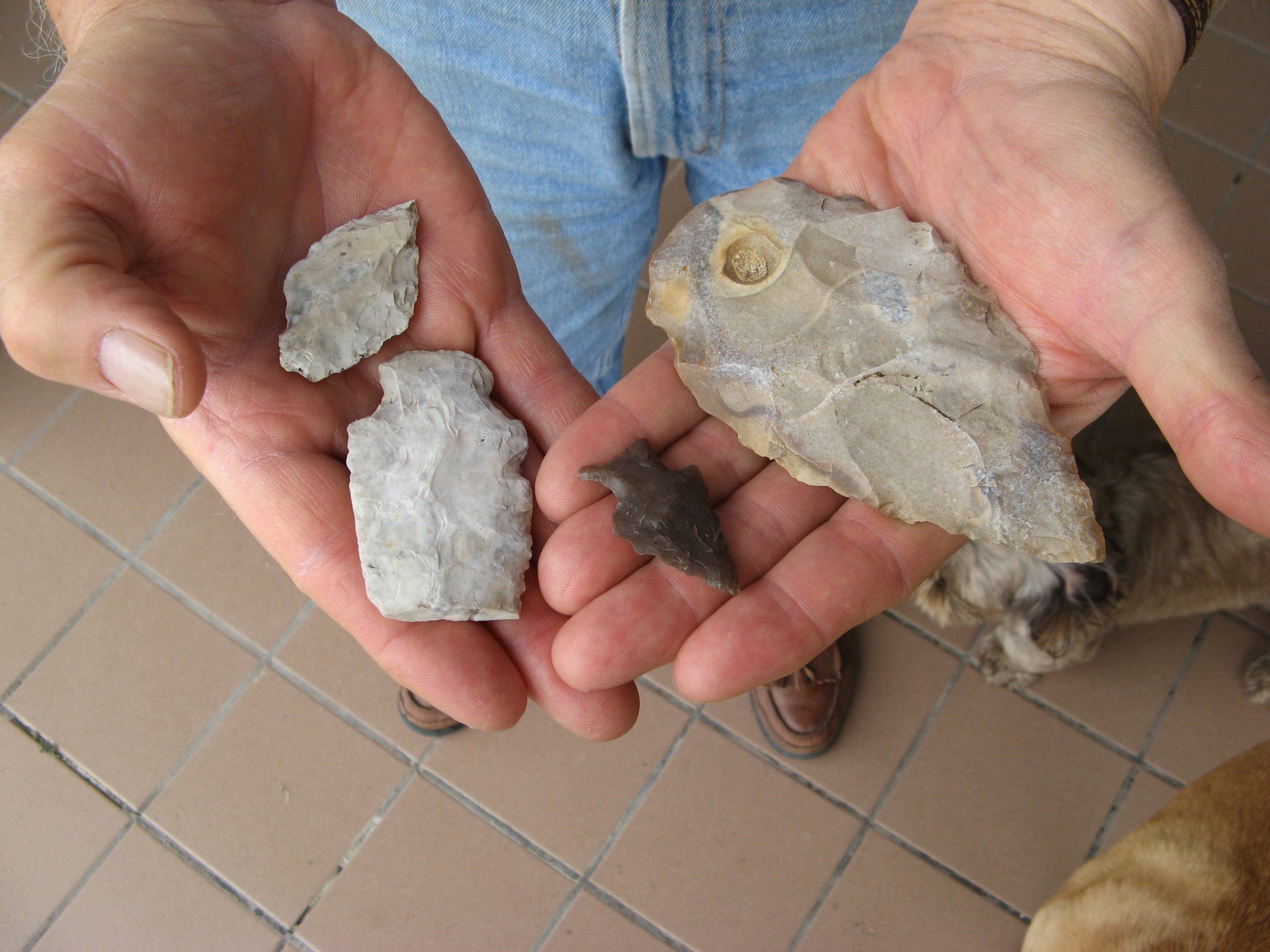
This week has been “ranch camp” for our grandchildren, Ramsey and Graham. They look forward each year to coming to the ranch where they have far fewer restrictions and new outdoor activities. This year they rode and bathed horses, bought and practiced magic tricks, explored the ranches, caught insects, ate around a campfire, and swam. With the clearing of our new second ranch over the last year, interesting items have been revealed. In addition to finding prohibition glass whiskey bottles and a bone yard created by a mountain lion (spotted a couple of times) other interesting objects include arrowheads, spear points, and scrapers.  We  carried out a dig looking for additional artifacts. We were joined by Tom and Linda Norris’ grandchildren from Lubbock and Grand Rapids.

Ramsey and Sydney digging for arrowheads

Ramsey and Sydney digging for arrowheads

The dig lasted about as long as did the attention span of 6 to 13-year old children. We explored what we believe is an Indian mound. Indeed we found a few points and a lot of flint knappings. The area (the location of which shall remain hidden) looks promising for future digs.

As I watched the dig unfold, I was reminded how ancient were the points and spear heads perhaps going back hundreds if not thousands of years. These  artifacts stand in juxtaposition to our young and promising  grandchildren who dug, raked, and strained the dirt. Youth meets remnants of an ancient civilization.

As the old saying goes, God makes up for growing older by giving us grandchildren. What a joy they are to Trudy and me.

Points found at Hidden Falls Ranch

Points found at Hidden Falls Ranch

Does Size Really Make A Difference?

The other evening I viewed a thrilling clip of the beginning of a cattle drive. It was an exciting scene- the beginning of a long drive portending inevitable drama up the trail. The initiation of the drive was full of cowboy yelling, waving of hats, brandishing of ropes, and kicking up of dust as riders on their horses cut back and forth behind a slow to move herd.

Several days later I witnessed an interaction between my cows and horses that gave me a slightly different perspective on this seminal moment in a cattle drive and suggested the true motivation for the cattle to head out. It played out this way:

Because of diminishing pasture this time of year (late February), the cattle and our two horses share a pasture. This is something I try to avoid in deference to the horses,  because the cattle make such a mess.

I scooped horse pellets into the horse trough. Several cows and the bull, sensing an extra feeding opportunity, hurried to the trough and began to chow down. I was singularly unsuccessful in running them off or protecting the horses’ rations. I waved my arms and bellowed threateningly at the cattle but to no avail. They basically ignored me.

Not long thereafter the horses arrived. The horses quickly went to work intimidating the cows and bull and ran them away from the trough. The horses did this by prancing, snorting and throwing their heads. All this acting out seemed to frighten the cattle. Now keep in mind the bull weighs well over 2000 pounds and the horses in the 900-1100 range. Shouldn’t size make a difference here?

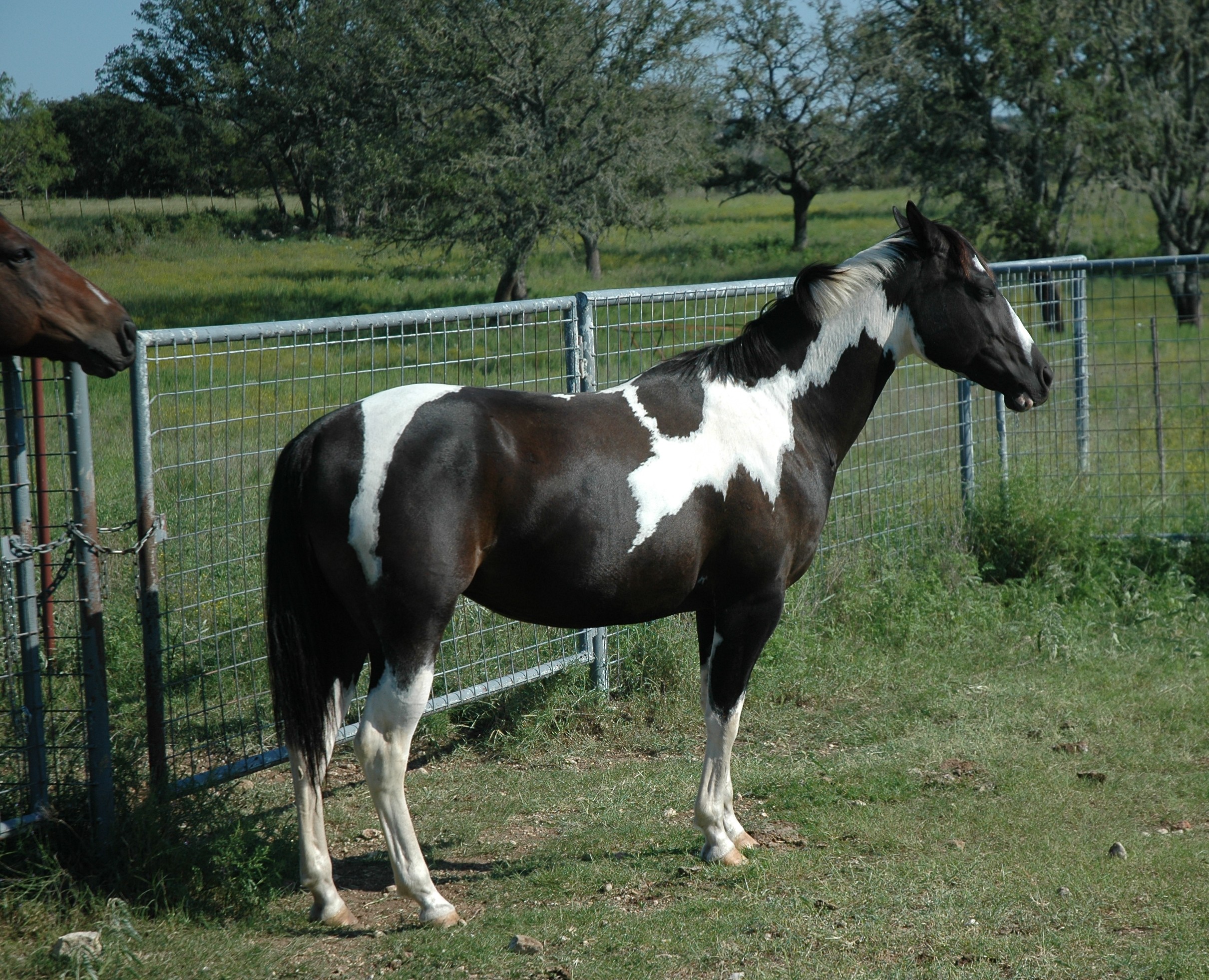
Our paint horse Fancy and Doc's nose

Our paint horse Fancy and Doc’s nose

The takeaway message for me is this; horses for whatever reason dominate cattle. I suppose it is a “pecking order” of long evolutionary standing.

Now I suspect the cowboys’ waving of hats and yelling in the film played a limited role in herding the cattle. The horses underneath the cowboys likely provided the major motivation for the cattle to stop grazing, turn around,

Curly, our Charolais bull

Curly, our Charolais bull

doc

Now does Doc really look that scary?

and begin moving toward the long, dusty cow trail.

Bella’s Big Day

DSC_0892

Bella at six months of age with Little Jack

by Tom Hutton

Bella, our seven month old Border Collie, came to us last August from Kim Hastings, a breeder, near Bridgeport, Texas. She has by now grown to around 35 pounds, shows amazing athleticism, has “the eye”, and is chock full of puppy pranks. She is also as fast as a mongoose.

Two days ago, Bella had a really big day- unplanned, mind you- but it worked out well. Let me set the scene.

I was trying to put out a bale of hay for the cattle. The way this is done is that I spear a roughly thousand pound bale and haul it with the tractor to the metal bale holder. On arriving at the baler, I jump from the tractor and begin to cut off the string that holds the bale together.

This particular day for some reason I had difficulty getting the string cut and off, causing the job to take 10 minutes or so. Buddy, Bella, and Little Jack meanwhile explored the pasture while I worked.

DSC_0888

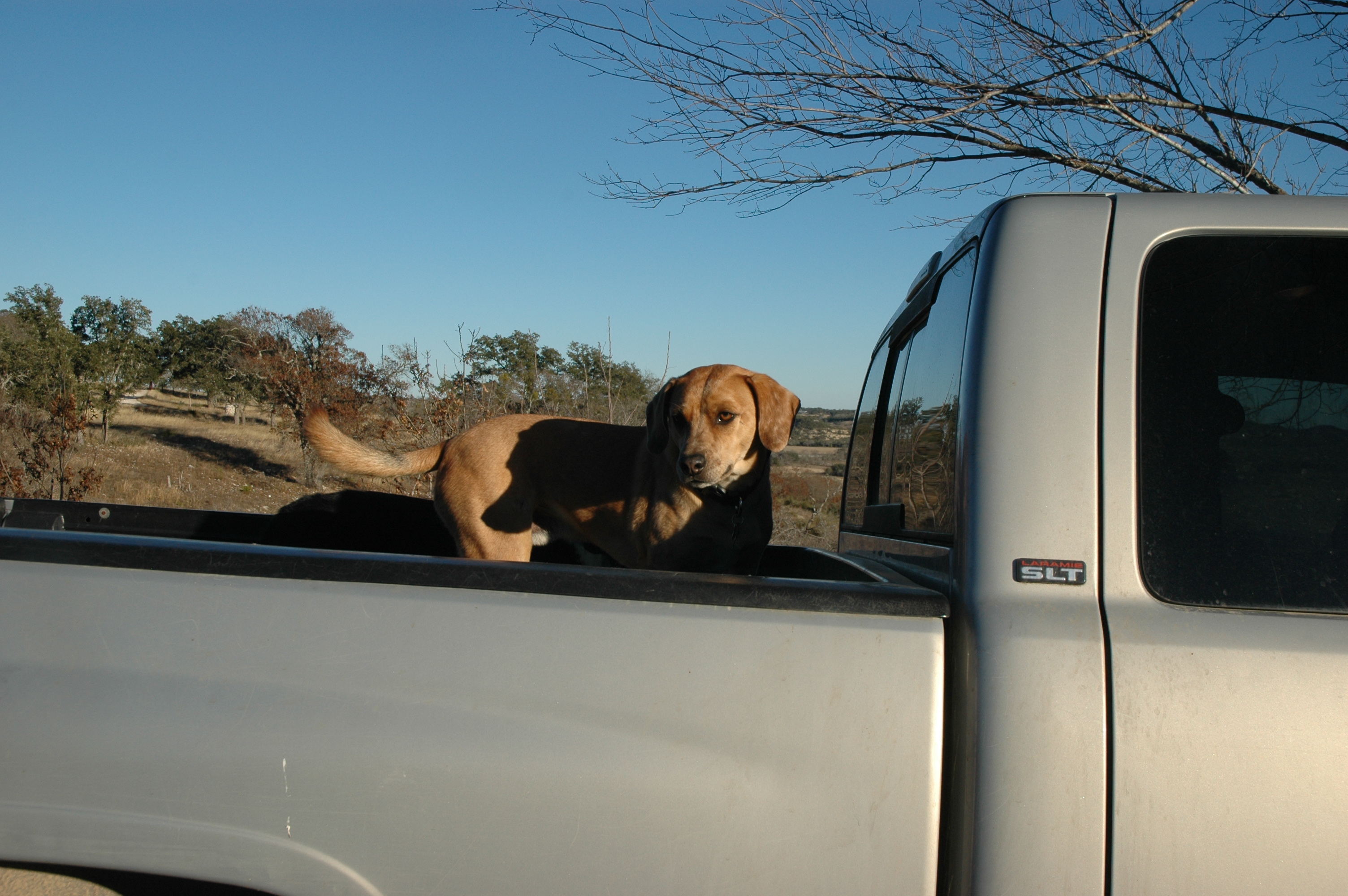
Little Jack- Red Healer, Beagle, Catahoula mix?

The cattle must have heard the tractor, anticipated a meal, and headed in my direction. The herd approached either with amazing stealth or else I was lost in concentration. The first warning that the bell cow, a Longhorn, had bracketed me with her impressive set of horns came from my dogs.  Buddy, Bella, and our little brown dog, Jack, suddenly flew by me in full assault mode. All three charged pall mall into the herd and scattered it. In order to keep the cows at bay, they strafed them, lunging and biting at their noses, all the time barking furiously. The fierceness of their attack succeeded in pushing the herd back and away from me.  The three dogs zigzagged back and forth to keep them from approaching.  I saw Bella and Jack watching our experienced Border, Buddy, and observed them begin to mirror as best they could, his deft movements.

Bella for a pup did an amazing job even if it was premature. I had not planned to introduce her to cows until she was at least a year old because if Border collies are introduced too early, they can be intimidated. This intimidation can affect a dog’s performance for the rest of his or her life. Or so I am told.

Bella showed no fear despite her young age, charging 1400 pound cows and pushing them back. To my amazement, the dogs worked together as if choreographed. Even Little Jack who comes from a questionable lineage worked just like a herding dog and did his job well.

After I had dumped the bale and the dogs returned to the truck, I sensed they were rather proud of themselves. They must have received a big adrenalin boost as it  took some time for their enthusiasm to wear off. Even their usual tussling vanished as they panted, pranced, fidgeted, and enjoyed their “team’ moment.

No doubt the dogs derived benefit by our cattle being “dog broke”. By now the cattle are used to working dogs. One of them had her nose badly gashed years ago by Bandit, our original Border. Be that as it may, I am proud of our herding dogs.

This is far from the first time Border collies have come either my rescue or performed an amazing feat of herding. I trust it promises a successful future on the ranch for our Bella.