Category Archives: Life On The Ranch

Driving In Gillespie Co., Texas and In India

My posting has been nonexistent since our return from a prolonged trip from Singapore to Dubai. Most of our time was spent in India. I was for a time emotionally and intellectually spent. What a wonderful and ancient place India is. I lacked sufficient appreciation before our visit for its complexity and heterogeneity.

I will for now limit my comments about the trip to driving. Imagine driving among 1.3 billion people. Well, that’s India. It is the most chaotic, crazy traffic I have ever witnessed. Rome, Athens, and Beijing do not compare, believe me. The traffic in Gillespie County is mild by any comparison. We complain if we have to sit through one of its few stoplights.

Let me contrast driving in India to Gillespie County. First off folks in our county are rule followers. They do not stray across the center yellow stripe or change lanes without signaling. They are mindful of traffic signs. In India, best I can determine, the yellow lines are something to be ignored. No one pays any attention to them. Even the stop signs are largely ignored.

The traffic in India moves like a school of fish. It is an amazing process to witness. The “school” of cars, buses, pedicabs, and motorbikes move in harmony to the left or right. It allows for maximal passage of traffic and maximal gastric acidity.

In Gillespie County most horns on vehicles have not been used in years. It is  down right rude to honk at another driver even for doing something really stupid. In India by contrast the horn is in constant use. I dare say the horn would take priority over at least one or two of the gears and maybe even a tire. It is illegal there to overtake without giving a toot on the horn. Needless to say, with all that traffic, driving in India is a cacophony of sound.

In one strange way driving is similar in Gillespie County and India. Cattle roam the streets of India and are considered sacred. Cattle in places also roam across the county roads in Gillespie County although not  considered sacred. Gillespie County is considered an “Open Range County” which means that cattle have the right-of-way- you hit one and you pay for it. Cattle on the rural roads are only slightly less dangerous than deer.

I prefer driving in Gillespie County. Among other reasons, I can drive my full-sized pickup that would be an exceptionally large vehicle in India. Another reason is the constant vigilance required with the number of vehicles in India that constantly pass and swerve. The driver of our minivan certainly, in my eyes, earned his fee.

Does Size Really Make A Difference?

The other evening I viewed a thrilling clip of the beginning of a cattle drive. It was an exciting scene- the beginning of a long drive portending inevitable drama up the trail. The initiation of the drive was full of cowboy yelling, waving of hats, brandishing of ropes, and kicking up of dust as riders on their horses cut back and forth behind a slow to move herd.

Several days later I witnessed an interaction between my cows and horses that gave me a slightly different perspective on this seminal moment in a cattle drive and suggested the true motivation for the cattle to head out. It played out this way:

Because of diminishing pasture this time of year (late February), the cattle and our two horses share a pasture. This is something I try to avoid in deference to the horses,  because the cattle make such a mess.

I scooped horse pellets into the horse trough. Several cows and the bull, sensing an extra feeding opportunity, hurried to the trough and began to chow down. I was singularly unsuccessful in running them off or protecting the horses’ rations. I waved my arms and bellowed threateningly at the cattle but to no avail. They basically ignored me.

Not long thereafter the horses arrived. The horses quickly went to work intimidating the cows and bull and ran them away from the trough. The horses did this by prancing, snorting and throwing their heads. All this acting out seemed to frighten the cattle. Now keep in mind the bull weighs well over 2000 pounds and the horses in the 900-1100 range. Shouldn’t size make a difference here?

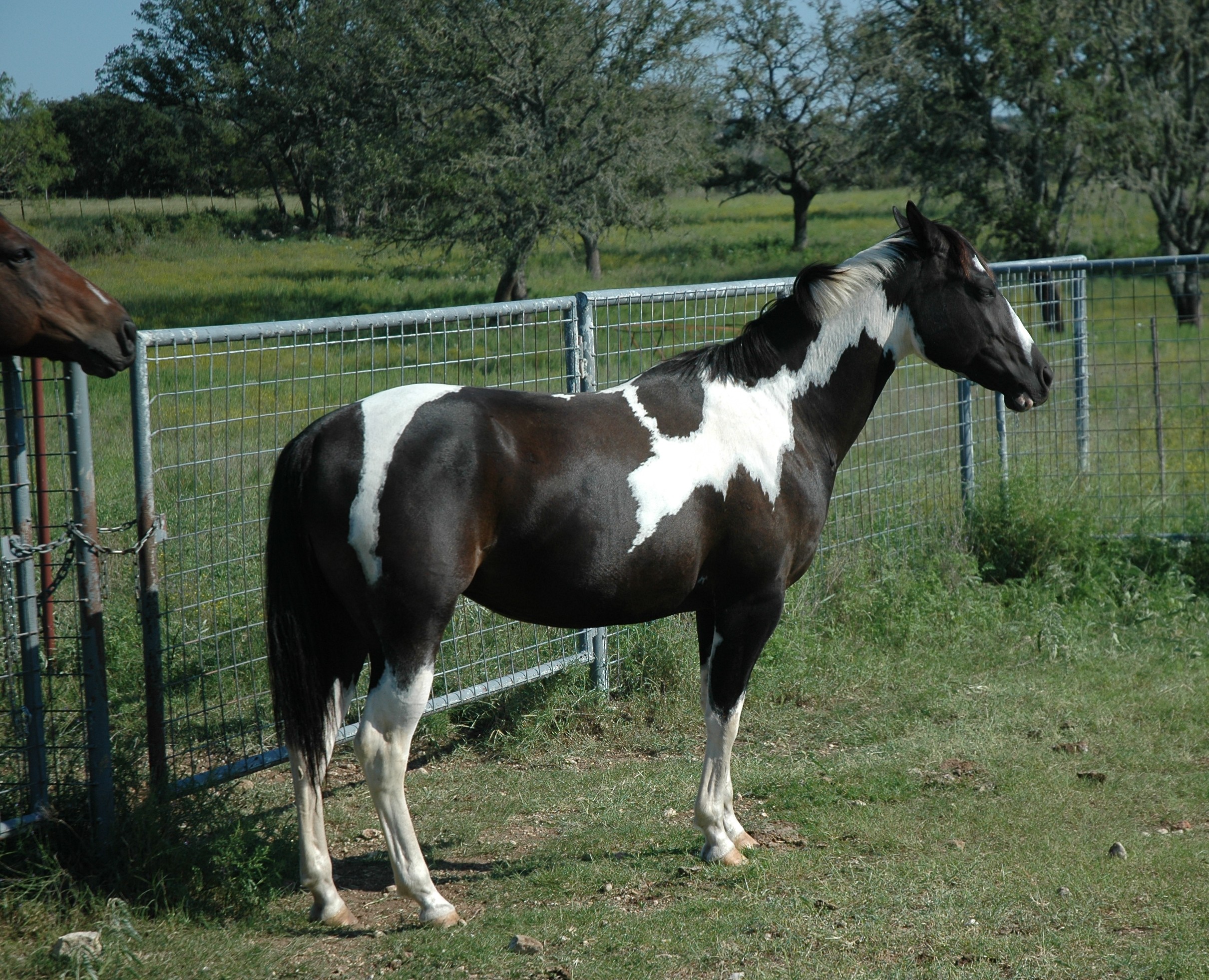
Our paint horse Fancy and Doc's nose

Our paint horse Fancy and Doc’s nose

The takeaway message for me is this; horses for whatever reason dominate cattle. I suppose it is a “pecking order” of long evolutionary standing.

Now I suspect the cowboys’ waving of hats and yelling in the film played a limited role in herding the cattle. The horses underneath the cowboys likely provided the major motivation for the cattle to stop grazing, turn around,

Curly, our Charolais bull

Curly, our Charolais bull

doc

Now does Doc really look that scary?

and begin moving toward the long, dusty cow trail.

Bella’s Big Day

DSC_0892

Bella at six months of age with Little Jack

by Tom Hutton

Bella, our seven month old Border Collie, came to us last August from Kim Hastings, a breeder, near Bridgeport, Texas. She has by now grown to around 35 pounds, shows amazing athleticism, has “the eye”, and is chock full of puppy pranks. She is also as fast as a mongoose.

Two days ago, Bella had a really big day- unplanned, mind you- but it worked out well. Let me set the scene.

I was trying to put out a bale of hay for the cattle. The way this is done is that I spear a roughly thousand pound bale and haul it with the tractor to the metal bale holder. On arriving at the baler, I jump from the tractor and begin to cut off the string that holds the bale together.

This particular day for some reason I had difficulty getting the string cut and off, causing the job to take 10 minutes or so. Buddy, Bella, and Little Jack meanwhile explored the pasture while I worked.

DSC_0888

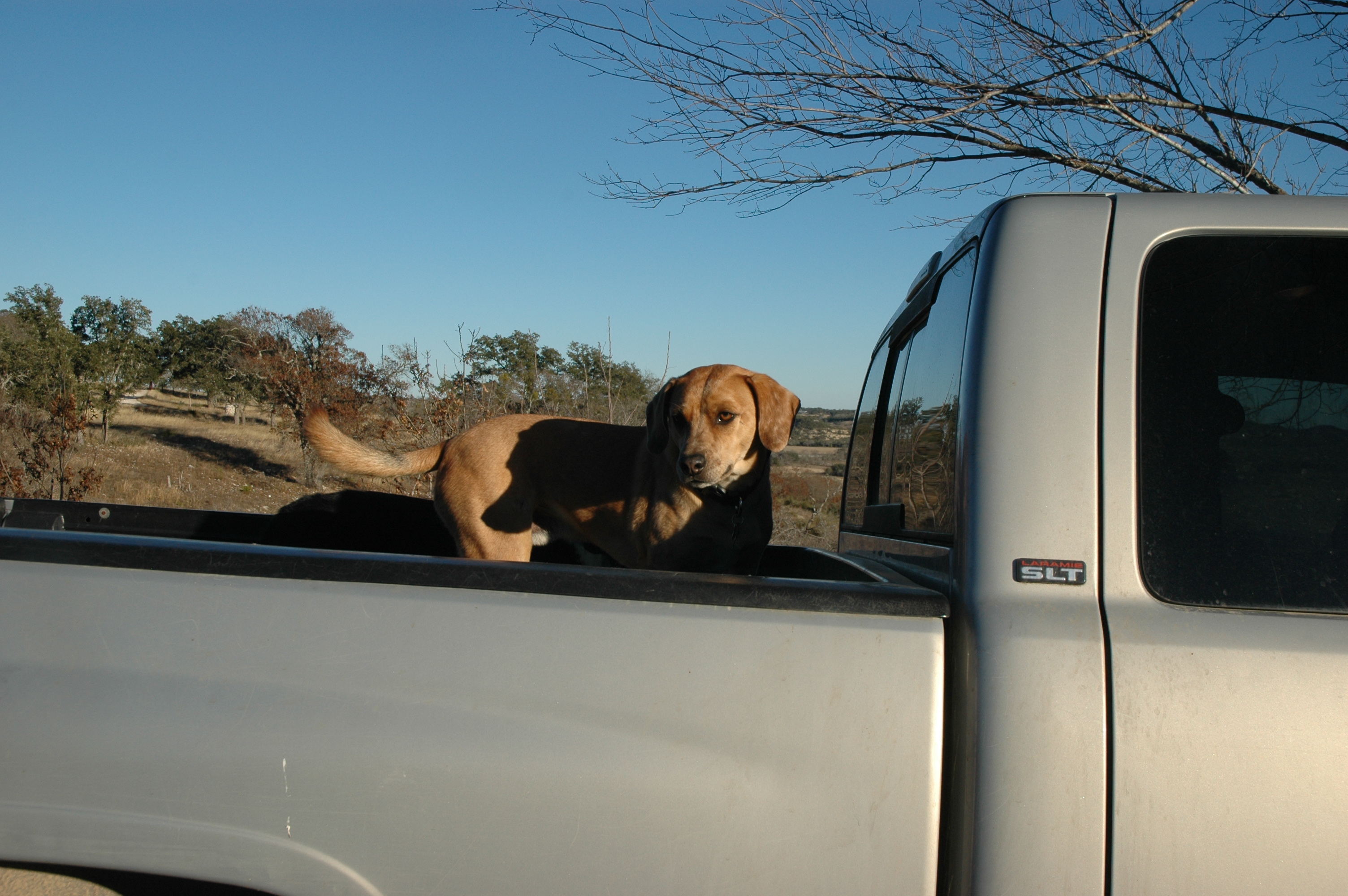
Little Jack- Red Healer, Beagle, Catahoula mix?

The cattle must have heard the tractor, anticipated a meal, and headed in my direction. The herd approached either with amazing stealth or else I was lost in concentration. The first warning that the bell cow, a Longhorn, had bracketed me with her impressive set of horns came from my dogs.  Buddy, Bella, and our little brown dog, Jack, suddenly flew by me in full assault mode. All three charged pall mall into the herd and scattered it. In order to keep the cows at bay, they strafed them, lunging and biting at their noses, all the time barking furiously. The fierceness of their attack succeeded in pushing the herd back and away from me.  The three dogs zigzagged back and forth to keep them from approaching.  I saw Bella and Jack watching our experienced Border, Buddy, and observed them begin to mirror as best they could, his deft movements.

Bella for a pup did an amazing job even if it was premature. I had not planned to introduce her to cows until she was at least a year old because if Border collies are introduced too early, they can be intimidated. This intimidation can affect a dog’s performance for the rest of his or her life. Or so I am told.

Bella showed no fear despite her young age, charging 1400 pound cows and pushing them back. To my amazement, the dogs worked together as if choreographed. Even Little Jack who comes from a questionable lineage worked just like a herding dog and did his job well.

After I had dumped the bale and the dogs returned to the truck, I sensed they were rather proud of themselves. They must have received a big adrenalin boost as it  took some time for their enthusiasm to wear off. Even their usual tussling vanished as they panted, pranced, fidgeted, and enjoyed their “team’ moment.

No doubt the dogs derived benefit by our cattle being “dog broke”. By now the cattle are used to working dogs. One of them had her nose badly gashed years ago by Bandit, our original Border. Be that as it may, I am proud of our herding dogs.

This is far from the first time Border collies have come either my rescue or performed an amazing feat of herding. I trust it promises a successful future on the ranch for our Bella.

Sleepless In Fredericksburg

Recently and on several occasions our dogs uncharacteristically  and noisily have awakened us during the course of a night. When we have one of these disturbed nights, the number of nocturnal awakenings may run to five or six episodes. I might add it is impossible to ignore the high pitched, demanding yelp of a young Border collie. Two dogs then head for the back door and bound out in full attack mode. Only last night did the reason for their strange behavior and our resulting sleeplessness come clear to us.

Trudy and I were awakened last night by our six month-old Border collie, Bella, and our seven year-old Border, Buddy. For some reason Trudy went out into the yard with the dogs and observed them charging the fence, barking furiously.

It was then that Trudy heard what it was that had upset them- the yapping and howling of a band of coyotes. Indoors the coyote sounds are inaudible to humans, but our dogs with their acute sense of hearing must have heard them. Trudy estimated five to six coyotes although making estimates from their howls are often inaccurate.

So it went the remainder of the night with Bella and  Buddy demanding to go outside. Incidentally our third dog, Jack, of indeterminate pedigree (when asked what he is, Trudy responds, “he’s a small brown dog”) never left the comfort of our bed. Jack likes his creature comforts and is loathe to leave the pillow-top mattress short of his bladder nearly bursting. Suspect Jack heard the yapping and howling but determined that he would stay back and act as the rear guard. I imagine the impish canine thinking, well I’ll just wait here snuggled down in the blankets at the foot of the bed in case the coyotes come charging through the back door.

Fortunately coyotes have not been a common occurrence on our ranch. Once though shortly after moving full-time to the ranch, I was awakened in the wee hours by Bandit, our senior Border collie, howling back sounding just like a coyote. He had his head thrown back, his neck arched, and managed a convincing coyote howl and from a distance of not more than a foot from my ear. Needless to say, I awoke with quite a start.

I don’t worry much about our livestock and predators. Mama cows take good care of their calves and can fend off coyotes. Likewise horses protect themselves well and are safe from coyotes. Neighbors who raise sheep and goats have not fared as well. Last year twelve lambs (the entire crop) were taken by predators (most likely coyotes). Since then our neighbor rancher has invested in a Llama and a donkey.

I have another friend whose old Labrador retriever was mauled several years ago by a pack of coyotes. Floppy was torn up pretty good and had to visit the veterinarian. While coyotes usually are only 30 pounds or so, they are wild and fight in packs.

A few years ago we had watched the sunset from the other side of the valley and were sipping a bit of the grape when suddenly out of the darkness came nearby coyote howls. Our three Border collies who had been dozing at our feet immediately charged off into the dusk, giving us a very bad moment. As it turned out the coyotes fled before the three charging,  overly protective Borders; however, the outcome could have been much worse.

So at least we now know what it is that is disturbing the two dogs. Frankly their howls do not even appear to affect Jack’s sleep. Jack is the proverbial lump in the bed. If anyone has an answer other than me sitting in a chair by the fence with a rifle and a spotlight, please let me know. You see, I, like Little Jack, also appreciate my creature comforts.

A Snow and a New Calf

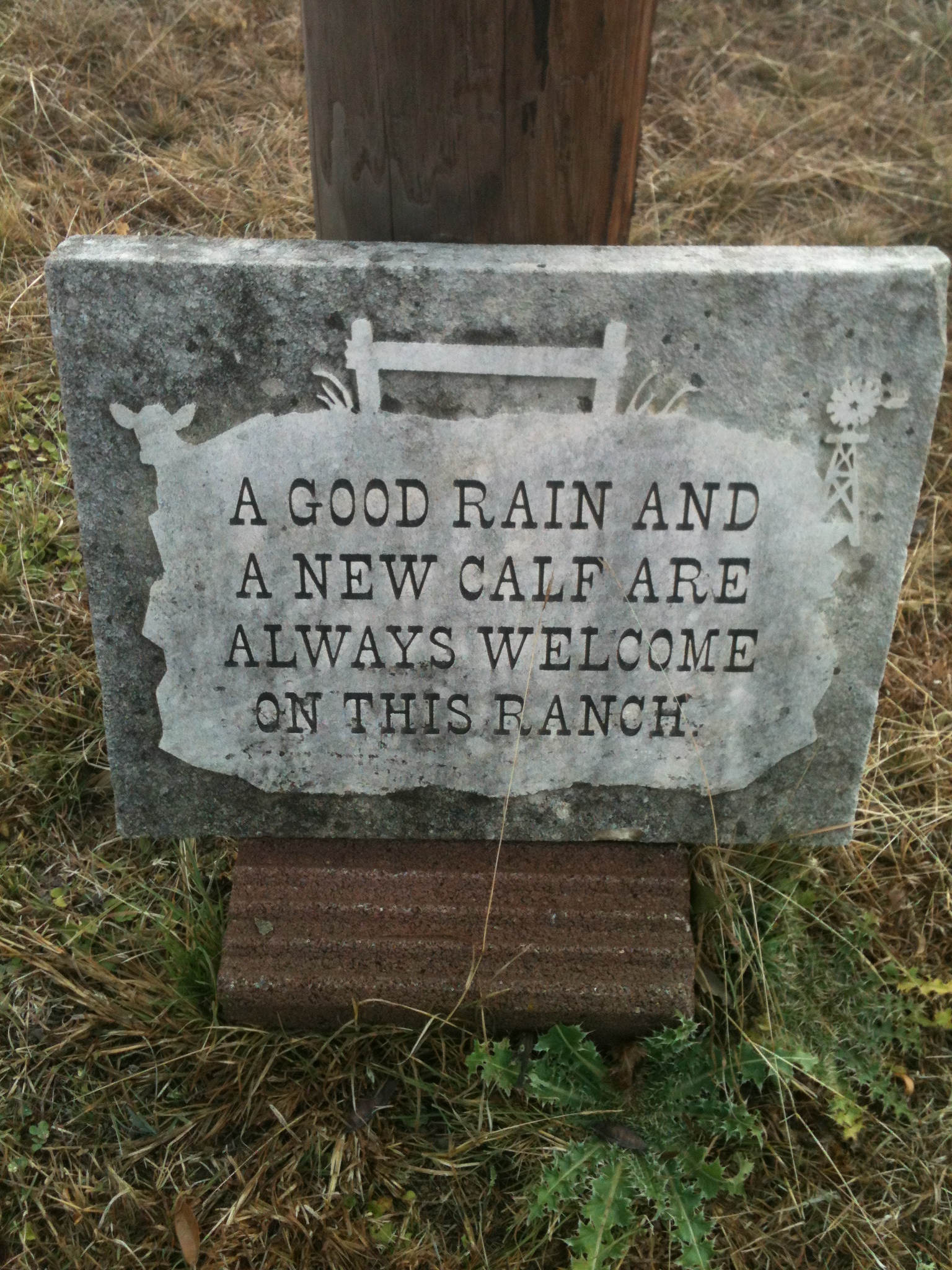
We have a small sign at the entrance to our ranch that says a good rain and a new calf are always welcome. Since calves are the mainstay of cow/calf operations and rain makes the grass grow, the sign makes sense.IMG_0067Well the other night to our amazement we received a couple of inches of snow. This is rare around Fredericksburg. As our cows seem to always wait until the weather is at its absolute worst , the next morning I predictably found one of our mama cows with a brand new bull calf. What a night to deliver a calf. Somehow the little fella came through the cold night just fine. Calves are IMG_0062really hardy.

The calf appropriately is all white- unusual since we cross black baldy mamas with a Charolois bull. The calves usually turn out brown or gray. Nevertheless, this one was white which seemed appropriate enough as he was born during a snowstorm. So now when we refer to this little bull calf , we call him Snowy Calf.

I have a not very good picture of Snowy Calf below. This was taken over a barbed wire fence preventing me from getting very close (probably good as mama cow might not have been in a very good mood. They are notoriously protective of new calves.IMG_0065

Maybe I need to modify the sign to read a good rain or a good snow and a new calf

Curly- Our Ferdinand

Meet Curly

Meet Curly

Curly is a bull. More specifically Curly is our four year old Charolois bull. He has an interesting personality quirk. Ever since we bought him when he was eighteen months of age, Curly has acted differently from our prior Charlois bull or from leased bulls who have visited our ranch. You see, Curly bonds and bonds strongly with the occasional calf.

Initially I assumed the togetherness came from occasional young bull (steer) calves as they followed Curly about the pasture. Curly after all is a big bull weighing about 2000 pounds and clearly has his way in the pasture. Young bull calves might have looked up to the big guy and have wanted to learn from the alpha male.

Curly Is A Large Charolois Bull

Curly Is A Large Charolois Bull

Later when we isolated two steers to feed them out (don’t share this with Alissa, my tender-hearted daughter-in-law, the teacher, whom I told these were special calves rewarded for exemplary behavior with special feed and private pasture). Curly would daily wander away from the herd and head straight for the pasture where the steers were kept. There he would hang around for most of the day at times foregoing the feeding of the herd with range cubes. He would nuzzle the calves and lay contently just outside their pen. He never tried to break down the fence nor did Curly seem upset with me for penning his friends. I have seen Curly’s bonding behavior with both steers and heifers, making the hormonal urges of a bull seemingly irrelevant for explaining this unusual behavior.

I have come to view Curly’s behavior as kin to that of Ferdinand the Bull. You recall the 1938 short animation by Walt Disney of an especially gentle bull who liked to sit under a cork tree and smell the flowers. Well Curly to my knowledge doesn’t smell flowers but he is surprisingly docile like Ferdinand. He approaches me open mouthed when I feed, wanting me to stuff range cubes directly into his cavernous maw. While I have at times given into the temptation, something about such close contact with such a huge and potentially dangerous animal is off putting to say the least.

Open Wide

Open Wide

Now I know I am anthropomorphizing here as did Walt Disney in his short video. Perhaps other explanations exist for Curly’s bonding with calves. Perhaps he wants to round up “the strays” in the pen and herd them into the larger herd. Might this provide an explanation? Nevertheless, this doesn’t wash with me. Why would he lick on the calves, nuzzle them, and hang around when it is clear the fence prevents their following him.

In any event, Curly has proved incredibly gentle. He doesn’t wander off (read ferociously butt his way through fences) like our prior bulls. Instead he will stand at our perimeter fence and meekly gaze at neighbor cows or nuzzle them through the fence. Curly is known to take his turn at babysitting young calves. Typically one mama cow will stay with a group of young calves for protection while the other mothers graze. Never before had I witnessed a bull taking a turn at babysitting, well at least not until I met Curly.

These are the maunderings of a rancher, especially one with a lifetime of interest in exploring behavior. Perhaps I have too much time on my hands. Any other thoughts on Curly’s predilections would be welcomed. Please leave a comment.

Cockleburs and Velcro

by Tom Hutton

My typical morning routine includes feeding and currying the horses. Of late I have had to spend extra time painfully (for me not the horse) removing prickly cockleburs from forelocks, manes, and tails. These tenacious burrs have become so numerous and work their way in to such an extent that at times our horses have the appearance of wearing hair curlers.

This got me to thinking about Velcro. A little googling finds that a Swiss engineer named Georges de Mestral in 1941 invented Velcro. He was inspired after taking a hunting trip to the Alps and having to contend with burrs in his dog’s fur and on his clothing. He placed a burr under a microscope and found  that each spine had a hook, making them stick to virtually anything. This inspired him to fashion Velcro from which I assume he made enough money to fill a Swiss bank vault.

The cocklebur (Xanthium) that I must contend with in Texaas is native to the Americas and eastern Asia. I can only guess that the recent

Just a few of the Cockleburs removed from our horses

Just a few of the Cockleburs removed from our horses

drought in our area somehow relates to the heavy crop of these burrs.

Have You Ever Dedicated An Outhouse? We Did.

Outhouse inaguration-IMG_6271by Tom Hutton

Available time is one of the great joys of retirement. Earlier in my life as a physician, this commodity was always in such short supply . To fill our hours now, we look for fun activities. We even stoop to such lowbrow activities as dedicating new enterprises on our adjacent ranches with our wine drinking and good friends, Tom and Linda Norris. Recently we finished construction of an “outhouse” located behind our hay barn that actually houses a composting toilet (privies are illegal in Gillespie County).

To fully dedicate our new facility, I read “Ode To The Outhouse” as printed below. We also needed one brave, unabashed being to inaugurate it. Young Graham, our almost six year old, stepped up, and sat down, and with an audience gave his all.

An Ode To “The Outhouse”– Author Unknown

The service station trade was slow

The owner sat and rocked around,

With sharpened knife and cedar stick

Piled shavings on the ground.

No modern facilities had they,

Just a log across the rill,

It led to a shack, marked His and Hers

That sat against the hill.

“Where is the ladies restroom, sir?”

The owner leading back, Said not a word but whittled on,

And nodded toward the shack.

With quickened step she entered there

But only stayed a minute,

Until she screamed, just like a snake

Or spider might be in it.

With a started look and beet-red face

She bounded through the door,

And headed quickly for the car

Just like three gals before.

She skipped the log, and jumped the stream.

The owner continued to rock about,

As her stockings, down at her knees,

Caught on a sassafras sprout.

She tripped and got up, and then

In obvious disgust,

Ran to the car, stepped on the gas,

And faded in the dust.

Of course we all wanted to know

What made the gals all do

The things they did, and then we found

That the whittling owner knew.

A speaking system he’d devised,

To make the thing complete,

He tied a speaker on the wall

Behind the toilet seat.

He’d wait until the gals got set,

And then the devilish tyke

Would stop his whittling long enough,

To speak into the mike.

And as she sat, a voice below

Struck terror, fright and fear.

“Please use the other hole,

We’re painting under here!”

On Food Fights and Other Family (Herd) Rivalries

by Tom Hutton

At our place sibling and other family rivalries inevitably arise during family holidays . During our recent Thanksgiving break, son Andy and daughter-in-law Alissa lamented the rivalry between their children; Ramsey, age 9 and Graham, almost 6. What their rivalry means and how pervasive it is are two questions that have of late entered my thoughts.

Conveniently a recent article from the NY times OP-Ed column by George Howe Colt provided insight into the prevalence of sibling rivalry along with such florid examples that it made me feel better about my own family. I have copied Colt’s piece below. Incidentally my experience with sibling rivalry suggests it is not limited to just children, having witnessed it in Trudy’s mother’s four siblings when they were all in their 60’s and 70’s. Their family squabble lasted over a decade and originated from a silly, disputed ownership of a single French tablecloth. Food and tablecloths are likely symbolic for underlying, unresolved rivalries. Such is maturity. Go figure.

Opinion

Sibling Rivalry: One Long Food Fight

By GEORGE HOWE COLT

Published: November 24, 2012

AS one of four brothers, I grew up in a veritable petri dish for sibling rivalry. Harry, Ned, Mark and I rarely fought physically, but there was little we didn’t contest: baseball, checkers and Candy Land, definitely, but more sophisticated sports as well — the battle over the Sunday funnies, the race to take the first bath, the jousting for position on the sofa as our mother read to us before bed.

Our rivalry played out most nakedly at the dinner table. Who got the largest hamburger? Who finished eating fast enough to get seconds before the food ran out? Who got the biggest slice of pie? Attempting to forestall quarrels, our mother cut portions so nearly identical it would have taken a micrometer to tell them apart. But in vain. Whether lunging for the last hot dog, filching an extra piece of crispy skin from the roast chicken or merely noting who had gotten the most cherries in his fruit cocktail, each of us struggled, constantly, to get our fair share — or, preferably, a lot more.

Our fraternal feeding frenzy wasn’t unusual, as I learned while writing a book about brothers. On one “pancake night” in the down-at-heels Joyce household, all four brothers simultaneously dove for the last pancake on the platter. The future author of “Ulysses” got there first. “James made off with the prize and ran up and down stairs, protesting to his pursuers that he had already eaten it,” wrote the biographer Richard Ellmann. “At last they were convinced, and he then imperturbably removed the pancake from the pocket where it lay hidden, and ate it up with the air of little Jack Horner.”

Growing up in a crowded apartment on East 93rd Street, Chico, Harpo, Groucho and Gummo Marx shared a bed relatively peaceably, but not a meal. “There was generally some kind of a brawl at the dinner table over who would get what,” said Groucho, who recalled reaching for the last roll on the plate only to see a cleaver, wielded by the normally equable Harpo, slam down within an inch of his hand.

Of the countless fistfights between Joe Kennedy Jr. and his younger brother Jack, one of the most memorable was triggered when Jack snatched Joe’s slice of chocolate pie — his brother’s favorite dessert — from under Joe’s nose at the dinner table. Gobbling it up, Jack ran outside and down the beach, his apoplectic brother giving chase. Cornered on the jetty, Jack leapt into the bay. Joe stood above him, watching him tread water, until Jack was forced to emerge, cold and dripping. The two Kennedys then duked it out on shore.

That sibling rivalry frequently plays out over dinner — or breakfast or lunch — shouldn’t be surprising. Although sometimes a chicken breast really is just a chicken breast, it doesn’t take Freud to see that food is a relatively literal stand-in for parental nourishment. (When I was a child, of course, if someone had suggested to me that wrestling my brothers for the marshmallows in a box of Lucky Charms might have been a way of vying for the attention of our parents, I would have snorted incredulously.) The word “rival” is derived from the Latin “rivalis,” meaning “using the same stream as another.” In pre-Christian times, rivals were people or tribes who fought over water from the same river. “In our terms,” the psychoanalyst Peter Neubauer once observed, “the river is the mother who supplies our basic needs, and the children compete for access to her.”

The term sibling rivalry was coined in 1930 and popularized by the child psychiatrist David Levy, who gave his patients celluloid dolls that represented their parents and younger siblings and asked them what they felt when they saw the baby brother or sister doll nursing at its mother’s breast. There ensued scenes of sibling carnage to rival anything in the Old Testament. Among the responses recorded by Levy: “dropping,” “shooting,” “throwing,” “slapping,” “hitting with stick,” “hammering,” “tearing apart,” “scattering parts,” “biting,” “crushing with fingers,” “crushing with feet,” “crushing with truck” and “piercing (with screw driver).” Levy (who repeated his experiments among the Kekchi Indians of Guatemala with similarly gruesome results) concluded that regardless of age, gender, birth order or cultural background, sibling rivalry is a fact of family life.

FOOD’S central role in that rivalry is, in part, a matter of biology. The pancake night melee at the Joyces was triggered by the same instinct that drives piglets to fight for position nearest the sow’s head, where the nipples deliver the most milk, or that impels Biscuit, my son’s guinea pig, to shoulder aside his brother, Bean, for first crack at the lettuce dish. Feeding time in the Marx kitchen was tame compared with feeding time in any blue-footed booby nest, where the eldest chick often pecks the youngest to death in order to increase its own chances of survival. The booby is one of some two dozen bird species that routinely engage in siblicide. Among mammals, siblicide is less common, but sibling food fights abound. Spotted hyenas, for example, routinely attack their younger sibling within minutes of its birth, sinking their teeth into its shoulder blades and shaking, in order to minimize competition for their mother’s milk. Evolutionary biologists point out that sibling rivalry among Homo sapiens serves a similar function, as an adaptive response to limited resources. (Among boobies and hyenas, competition for food isn’t gender specific. Among humans, it’s more likely to involve brothers; sisters seem to compete less for what’s on the table than for airtime in the conversation that plays above it. While the Joyce brothers scuffled over the last flapjack, their sisters were apparently content to observe, from the sidelines.)

I suspect that geography also plays a part. In many families, mealtimes may be one of the only occasions siblings convene in such proximity, gathering around the table — the way they used to gather around the Monopoly board in the pre-Facebook era — on which a steadily dwindling number of mouthwatering prizes happen to lie within easy reach. (Called to the dinner table as a child, I sometimes felt like a gladiator being summoned to the arena.) In some homes, parents organize the competition; to encourage Darwinian resilience among his elder four sons, Samuel Marx set out three sweet rolls each morning; as soon as a brother had wolfed down his breakfast, he was permitted to grab a roll, leaving the slowest eater empty-handed.

Pressure may also be a factor. Family dinners are idealized by parents and sociologists alike as the Elysium of familial bonding, their infrequency fingered as damning evidence of the decline of the American family. Researchers tell us that children who grow up in families that eat together regularly are more likely to get better grades, less likely to be overweight, less likely to abuse drugs and alcohol, less likely to be depressed. But as Hollywood movies and bitter experience teach us, family dinners are often the site of the greatest family friction, especially on holidays, when even the most grown-up siblings may slip into old roles and reprise ancient conflicts.

In most families, sibling rivalry softens with time. Over the years, Colt brother dinner table gatherings grew increasingly civilized, although vestiges of the mealtime strategies honed in childhood have occasionally led to trouble in the wider world. When my older brother, Harry, traveling in India after college, was stricken with a mysterious gastrointestinal disease and lost 30 pounds, he suspects the culprit was a half-eaten Popsicle he found on the street and instinctively gobbled up before someone else got it. Our younger brothers, Ned and Mark, are convinced that their predilection-bordering-on-addiction for all-you-can-eat Chinese buffets stems from their childhood fears that there would be nothing left on the plate by the time their older brothers got through with it. A few years ago I came within a desperate wheeze of having the Heimlich maneuver performed on me while gorging on fist-size shrimp at a fancy holiday party.

Some believe that siblings who express rivalry during their youth end up more closely bonded in adulthood than siblings who experience no rivalry. (Show me a sibling who experiences no sibling rivalry, and I’ll show you an only child.) If the Colt brothers are any indication, there may be some truth to this. At Colt family dinners these days, we tend toward the kind of family tranquillity Norman Rockwell depicted in his paintings. We still eat as if we were in a race — my wife says she’d never met anyone who ate as fast as I do, until she met my brothers — but there is no surreptitious pilfering of chicken skin (well, maybe a little), no wrestling over the last piece of pumpkin pie. Of course this may be because for some time now, we four brothers are likely to be the ones cooking. Not only do we love working in the kitchen together, but this way we can also make sure there will be more than enough food for us all.

This lovely piece by George Howe Colt has a happy ending and suggests sibling rivalry is a passing   phenomenon limited to youth. I wonder about this and even if it is limited to humans.

This morning while feeding our two horses- Doc and Fancy, I observed what I interpreted as sibling rivalry-like behavior. Every morning I place equal amounts of horse feed at both ends of the horse
Our paint horse Fancy and Doc’s nose

trough. Fancy, the filly, being the friskier horse proceeds Doc, our gelding, to the trough and always goes to the end Doc prefers. There she immediately gloms onto as many mouthfuls of feed as possible before the larger and dominant Doc arrives, snorting and throwing his head, and running her off to her end of the trough. Again the disagreement involves food as with humans. Doc’s aggressive head throwing and snorting remind me a lot of Joe Jr.’s taking out after Jack Kennedy and pummeling him for having pilfered his slice of chocolate pie .

Our horses’ behavior makes me wonder if such rivalries are limited to humans. Maybe it is broader than that and characteristic of herds. Might it be biologic in nature? This got me to wondering if such competitiveness within herds (flocks, gaggles,etc.) exists in other animal species? Is it more among animal families? Other observations on human or non-human sibling-like rivalries are welcomed. Let me know your thoughts.