The Man Who Played Pinochle With Dogs

Many may know of my interest in writing down patients stories that inspire or entertain. This led to my writing a book of stories gleaned from my medical career. All of these impressed on me the strength of the human spirit. I now have an agent at Trident Media Group in New York City who is shopping my book.

A shortened version of one of the chapters, entitled The Man Who Played Pinochle With Dogs, was submitted to an annual contest by the American Academy of Neurology. To my surprise it won the prize, one thousand dollars, and invitation to an awards ceremony October 2012,

I thought some readers might like to read this shortened version. It will provide a taste of what hopefully the published volume will offer. The story follows below:

THE MAN WHO PLAYED PINOCHLE WITH DOGS

I strode toward a full chart rack.  The intake note read:  “75-year-old Muleshoe farmer, eight-year history of PD, med check.”

Wasn’t Muleshoe that cotton town northwest of Lubbock near the infamous Bloated Goat Saloon?  I had heard about this boot-scooting, brawl-provoking West Texas watering hole.

I scanned prior chart notes, planned my examination, and considered treatment options.  Like battle plans in war, my considerations would soon become obsolete.  As I entered, an elderly man sitting on the exam table glared.  He was short and had a face as fissured as a prune.

“What’s keeping you doc, playing golf?”

“Sorry to keep you Mr. Woodley.  I’m Doctor Hutton.  What can I do for you today?”

The man peered at me like a hawk sizing up its prey.  He wore a sweatshirt that screamed, “If things get better with age, then I’m approaching MAGNIFICENCE.”  I sat on the exam stool and acted nonchalant, as if I had ample time to wait out his petulance.

“It’s nice to finally see you,” he intoned, not yet abandoning his piqueWhile his words were barbed, his West Texas drawl and soft Parkinson’s speech reduced their sting.

“Mr. Woodley, I see Doctor Reynolds treated you.”  Doctor Reynolds, the founder of the Parkinson’s Clinic, had since decamped for a position at Johns Hopkins.

The corners of Sam Woodley’s mouth turned up slightly.  He nodded his head

and ran a gnarled hand along the exam table, smoothing the paper.

“Yep, for years Doc Reynolds my doctor.  Without him suspect I’d move slower’n a constipated slug.  Liked that funny talking Yankee.”  I continued my get-acquainted conversation, sensing a thaw in my frigid reception.

“Do you have family?”

“Wife up and died three years ago.  Kid took off for godless California. Not much to do since leasing out the farm.”

After a few sympathetic clucks, I asked, “Live by yourself?”

“Yep, but ya see a young heifer wantin’ to play house with an old fart like me, ya let me know!”  A mischievous grin came over his weather-beaten face.

I began to admire the pluck of this old farmer.  “I’ll keep it in mind, Mr. Woodley. How do you spend your time?”

“Frankly, not much. Just call me Sam.”

”Okay Sam, what do you do with your time?”

”Take care of the homestead.  Played cards with my Gladys, before cancer took her.”  Before he turned his head away, I noticed his eyes begin to glisten.  His defiance by then had dissipated, replaced by vulnerability and loneliness.

I steered the conversation toward his health.  “How’s your Parkinson’s disease been treating you Sam?”

Sam began describing difficulty cutting his food and tying his shoelaces.  His tremor and shuffling feet embarrassed him.  Surprisingly he said he also found it harder to shuffle cards.  Why, I wondered, did he need to shuffle cards?

Sam conceded his memory had slipped.  I listened, nodded, sympathized, and discussed making lists.  I inquired about side effects of his medicine with a series of nonproductive questions.  Then I asked, “Have you seen animals or people that were not really there?”

Sam hesitated.  I noticed his jaw muscles tighten.  His face took on a look of puzzlement that could not have been greater if I had stood on my head and begun to spit marbles.  Sam measured me, his bushy eyebrows knitting up like two angry caterpillars about to do battle.

“Maybe, maybe not.”

“Please tell me more.”

He ran the back of his hand across his square chin.  I observed his lips quiver.  After taking an unusual interest in the ceiling tiles, Sam Woodley finally blurted,  “Well doc, I see dawgs.”

I quickly followed up in my best nonjudgmental tone.  “Dogs, huh, well big or little?

Sam tugged at a dangling ear lobe.  With a weary sigh, his resistance gave way.  He shared his mystery by relating a bizarre story.  Trust must be earned, as it resides at the core of the doctor/patient relationship.  Sam provided his guarded experiences that allowed me to gain insight but also created for me a challenging dilemma.

“Well, ‘bout every afternoon three dawgs drop by.”  He fell silent awaiting my response to this snippet.

“Go on,” I gently urged.

In his monotone he described a large yellow Labrador, a black and white Border Collie, and a smaller white and brown Cocker Spaniel.

“Are they scary?” I asked.

“Nah, gentle as can be. Besides we play together.”

Puzzled where the conversation was leading, I asked if the dogs had names.  He nodded.  “Yellow Dawg the Lab, Skipper the collie, and Coco the spaniel.”

“Well what do they do?”

“Mostly like to play cards.”

I wondered if my ears were tricking me.  “Oh, I see,” I said, trying to sound, as if I was often told about three dogs playing cards. “Well, what card games do y’all play?”

“Usually pinochle, their favorite.”

“So, play pinochle, do they?”

“Oh yeah, especially Skipper and Coco.”

“I see, make noise while they play?”

“Never a sound, but I know what they want.”

“Please tell me how you and the dogs go about playing pinochle.”

Sam described how he would place the card table and arrange the chairs.  He would then invite the dogs onto their chairs and begin the game. “Coco likes to beat the boys. Upsets her if she loses. Been known to leave in a huff.”

He described shuffling and dealing but admitted he had been having difficulty managing the cards.  Sam said his canine friends had even greater difficulty than he did, forcing Sam to deal.

“You see doc, my hands aren’t as good as before this here Mr. Parkinson’s disease.  Be obliged if you’d just, well, give it back to him!”  With his quip, an endearing smile crossed his weathered, old face.

“Well, maybe I can help,” I encouraged.  Intrigued by his narrative, I gestured for him to continue.

“Well Skipper, the Border, wears green eye shades, you know like bookkeeper types and uh, Coco, the Cocker Spaniel sits on a pink handkerchief, thinks it makes her lucky.  Oh, and Coco sits with the floorboards, not across them- feels strong bout this, just like my Gladys.  Suspect Yellow Dawg comes for the sandwiches.  He’s not good at pinochle.

My mind was reeling, visualizing this elaborate scene.  I concentrated, trying not to project incredulity.  Sam was relating an unreal event with the nonchalance of describing weather changes or the cotton crop.  Was his elaborate hallucination prompted by Cassius Marcellus Coolidge’s series of pictures, Dogs Playing Poker?  My knowledge of pinochle was not extensive, but I knew it was a game for two to four people, not a pastime for dogs.

Mentally I had already determined that Sam required a medicine change to get rid of his hallucinations.

With twinkling brown eyes, Sam warmed to his narrative.  I observed his hand tremor increase, as he affectionately described his daily visitation.

“I make sandwiches before they come.  Yellow Dawg likes ham and cheese and lots of ‘em..  The spaniel and collie prefer turkey.”

He told of putting out dog biscuits.  “They prefer beef flavored ones.”  I sensed Sam’s pride as host.  “Put down a bowl of water in case they’re thirsty.”

“Mr. Woodley, can you touch the dogs?”

“Nah, if I try, hand passes right through ‘em.  Makes ‘em disappear.  Learned not to.”

“What about smelling the dogs?”

“Hadn’t thought ‘bout it, but can’t smell ‘em, feel ‘em, or hear ‘em neither.”  I considered for a few moments what I had heard.  Sam’s hallucinations fit with medication related side effects of Parkinson’s disease but they sounded more complex than I had previously encountered.

“When we finish the game, dawgs head for the door.  Disappear without me even opening it.”

“Do you and the dogs play anything besides cards?”  I wished to learn the extent of his interaction with the dogs and whether an emotional dependence on them existed.

Sam thought and then replied, “Watch the Cowboys on TV.  Don’t know about being America’s team, but sure as hell the dawgs’ favorite.”  Sam laughed heartily.  His hand tremor again increased, acting like his emotional barometer.

“How do you know that?”

“Well, Cowboys make ‘em a touchdown, Skipper jumps off the couch and tears around the room, jumping over furniture—his own little end zone celebration.  If the other team scores, dawgs lay their chins on their paws and look real sad.  Easy to read my dawgs.”

I was by then more certain his hallucinations needed squelching.

“Mr. Woodley, a healthy person’s ability to move about is like a wagon pulled by a team of eight horses.  With Parkinson’s only two healthy horses remain to haul the wagon. To keep it moving, we drive these two harder with medicines- like swinging a whip over the horses’ heads.

Sam sat quietly, listening to my analogy, one to which I hoped he could relate.

“Unfortunately urging them too hard can cause horses to get balky, like side effects, such as seeing things not really there.”  Sam listened without comment.  I explained how Parkinson’s had diminished his store of dopamine and that levodopa/carbidopa supplemented his brain’s inadequate supply.

“You see Mr. Woodley, too much treatment causes hallucinations.  We must reduce your medicine.”

Sam sat motionless.  Then his mouth began chewing movements, as if chewing his thoughts into declarative sentences. He then crossed his arms across his chest.  I quickly assured him that we could banish his hallucinatory hounds.

He at last replied, “Don’t know ‘bout that doc.”

I was taken aback. “Well, you agree we need to get rid of your hallucinations?”

“Dawgs ain’t bothering me none.”

I considered what further arguments to make.  “Are you worried about your movements slowing?”

“Nah, I got plenty of time to do my work.” Sam chewed more before asking.  “But how would I spend my afternoons, if I didn’t play pinochle with my friends?”

I searched for a rejoinder, but before finding one, Sam Woodley added, “Besides whatever would I do with all the extra sandwiches?”

Such rarified moments provide insight.  I gained a better understanding of the unmet emotional needs of Sam Woodley.  The experience also reminded me to view the situation through the other person’s eyes, a valuable lesson in medicine and in life.

My earlier training had taught me that hallucinations required adjustment of medicine.  I knew hallucinations could be well tolerated, and rarely welcomed.  But I also understood hallucinations could increase and become frightening.

Sam showed no signs of hostility or incipient paranoia and claimed reduced boredom.  But still these hallucinations were florid.  And what would my new colleagues think if they learned that I had failed to address them?

Hours later after completing my charting and shrinking a stack of paperwork, I directed fatigued footsteps toward the doctors’ parking lot.

My thoughts returned to Sam Woodley.  I hoped he had arrived home safely.  Remembering, his pugnacious approach to life made me smile.

Had his truculence arisen from a lifetime of farming cotton in borderline soil, violent weather, and semiarid conditions?  Sam’s sad lack of human connectedness struck me as bleak as the flat, treeless Llano Estacado; his loneliness, disease, and his medicine, having given rise to his illusory dogs.  Multiple factors contributed to his elaborate phantasm. One thing seemed certain; his dogs had provided unusual companionship.  I felt satisfaction, knowing I had gained sufficient trust for him to share his dogs with me.  Thirty years later, I appreciate his trust no less.

I visualized Sam arriving at his remote farmhouse.  I imagined him placing the table parallel to the floorboards and moving the dogs’ favorite chairs.  Perhaps he fixed enough ham and turkey sandwiches to satisfy the hungry Labrador.  I felt a smile cross my face.  I felt confident about my decision, considering this individualistic man and his lifestyle.

For now Sam Woodley would continue to enjoy his extraordinary pinochle parties with his dawgs.

Bella’s Big Day

DSC_0892

Bella at six months of age with Little Jack

by Tom Hutton

Bella, our seven month old Border Collie, came to us last August from Kim Hastings, a breeder, near Bridgeport, Texas. She has by now grown to around 35 pounds, shows amazing athleticism, has “the eye”, and is chock full of puppy pranks. She is also as fast as a mongoose.

Two days ago, Bella had a really big day- unplanned, mind you- but it worked out well. Let me set the scene.

I was trying to put out a bale of hay for the cattle. The way this is done is that I spear a roughly thousand pound bale and haul it with the tractor to the metal bale holder. On arriving at the baler, I jump from the tractor and begin to cut off the string that holds the bale together.

This particular day for some reason I had difficulty getting the string cut and off, causing the job to take 10 minutes or so. Buddy, Bella, and Little Jack meanwhile explored the pasture while I worked.

DSC_0888

Little Jack- Red Healer, Beagle, Catahoula mix?

The cattle must have heard the tractor, anticipated a meal, and headed in my direction. The herd approached either with amazing stealth or else I was lost in concentration. The first warning that the bell cow, a Longhorn, had bracketed me with her impressive set of horns came from my dogs.  Buddy, Bella, and our little brown dog, Jack, suddenly flew by me in full assault mode. All three charged pall mall into the herd and scattered it. In order to keep the cows at bay, they strafed them, lunging and biting at their noses, all the time barking furiously. The fierceness of their attack succeeded in pushing the herd back and away from me.  The three dogs zigzagged back and forth to keep them from approaching.  I saw Bella and Jack watching our experienced Border, Buddy, and observed them begin to mirror as best they could, his deft movements.

Bella for a pup did an amazing job even if it was premature. I had not planned to introduce her to cows until she was at least a year old because if Border collies are introduced too early, they can be intimidated. This intimidation can affect a dog’s performance for the rest of his or her life. Or so I am told.

Bella showed no fear despite her young age, charging 1400 pound cows and pushing them back. To my amazement, the dogs worked together as if choreographed. Even Little Jack who comes from a questionable lineage worked just like a herding dog and did his job well.

After I had dumped the bale and the dogs returned to the truck, I sensed they were rather proud of themselves. They must have received a big adrenalin boost as it  took some time for their enthusiasm to wear off. Even their usual tussling vanished as they panted, pranced, fidgeted, and enjoyed their “team’ moment.

No doubt the dogs derived benefit by our cattle being “dog broke”. By now the cattle are used to working dogs. One of them had her nose badly gashed years ago by Bandit, our original Border. Be that as it may, I am proud of our herding dogs.

This is far from the first time Border collies have come either my rescue or performed an amazing feat of herding. I trust it promises a successful future on the ranch for our Bella.

Sleepless In Fredericksburg

Recently and on several occasions our dogs uncharacteristically  and noisily have awakened us during the course of a night. When we have one of these disturbed nights, the number of nocturnal awakenings may run to five or six episodes. I might add it is impossible to ignore the high pitched, demanding yelp of a young Border collie. Two dogs then head for the back door and bound out in full attack mode. Only last night did the reason for their strange behavior and our resulting sleeplessness come clear to us.

Trudy and I were awakened last night by our six month-old Border collie, Bella, and our seven year-old Border, Buddy. For some reason Trudy went out into the yard with the dogs and observed them charging the fence, barking furiously.

It was then that Trudy heard what it was that had upset them- the yapping and howling of a band of coyotes. Indoors the coyote sounds are inaudible to humans, but our dogs with their acute sense of hearing must have heard them. Trudy estimated five to six coyotes although making estimates from their howls are often inaccurate.

So it went the remainder of the night with Bella and  Buddy demanding to go outside. Incidentally our third dog, Jack, of indeterminate pedigree (when asked what he is, Trudy responds, “he’s a small brown dog”) never left the comfort of our bed. Jack likes his creature comforts and is loathe to leave the pillow-top mattress short of his bladder nearly bursting. Suspect Jack heard the yapping and howling but determined that he would stay back and act as the rear guard. I imagine the impish canine thinking, well I’ll just wait here snuggled down in the blankets at the foot of the bed in case the coyotes come charging through the back door.

Fortunately coyotes have not been a common occurrence on our ranch. Once though shortly after moving full-time to the ranch, I was awakened in the wee hours by Bandit, our senior Border collie, howling back sounding just like a coyote. He had his head thrown back, his neck arched, and managed a convincing coyote howl and from a distance of not more than a foot from my ear. Needless to say, I awoke with quite a start.

I don’t worry much about our livestock and predators. Mama cows take good care of their calves and can fend off coyotes. Likewise horses protect themselves well and are safe from coyotes. Neighbors who raise sheep and goats have not fared as well. Last year twelve lambs (the entire crop) were taken by predators (most likely coyotes). Since then our neighbor rancher has invested in a Llama and a donkey.

I have another friend whose old Labrador retriever was mauled several years ago by a pack of coyotes. Floppy was torn up pretty good and had to visit the veterinarian. While coyotes usually are only 30 pounds or so, they are wild and fight in packs.

A few years ago we had watched the sunset from the other side of the valley and were sipping a bit of the grape when suddenly out of the darkness came nearby coyote howls. Our three Border collies who had been dozing at our feet immediately charged off into the dusk, giving us a very bad moment. As it turned out the coyotes fled before the three charging,  overly protective Borders; however, the outcome could have been much worse.

So at least we now know what it is that is disturbing the two dogs. Frankly their howls do not even appear to affect Jack’s sleep. Jack is the proverbial lump in the bed. If anyone has an answer other than me sitting in a chair by the fence with a rifle and a spotlight, please let me know. You see, I, like Little Jack, also appreciate my creature comforts.

Thoughts on Les Miserables

I have for days been under the spell of the screen adaptation of Victor Hugo’s Les Miserables. Trudy and I had previously enjoyed this on stage and were anxious to see the screen version. We packed up and headed off for Kerrville since our local cinema has closed (seems the owner took off with the gal behind the snack bar).

The movie has so many moving themes: selfless love, idealism, struggle against tyranny, and redemption. The production is set prior to the French Revolution amidst the squalor of the poor people of France. Amazing how the makeup artist  made the usually dazzling Anne Hathaway appear pedestrian if not downright off putting. The strongest aspect of the production is in my opinion the music. It is uplifting, stirring, and haunting.

Not to say the movie was perfect. The makers of the film went for star appeal with Hugh Jackman, Russell Crowe, and Ann Hathaway as opposed to great singing talents. The exception is the lady who played Eponine who was incredible. Early in the movie, I was a little disappointed, especially by Jackman’s and Crowe’s singing abilities (accept  this criticism from one who can’t carry a tune in a water trough). Nevertheless, Ann Hathaway’s final song will absolutely touch your soul. She is angelic. There was not a dry eye in the house. Take a handkerchief.

Many years ago after my family watched a stage production, I asked  each of them to whom they related. Trudy said she related to Fontine- the selfless mother, Andy’s related most to the gallant young Marius (CORRECTION- Andy says it was one or two other characters not Marius to whom he identified, still different from the other family members), and Katie identified more with Cosette, the beloved child of Fontine and love interest of Marius. I naturally related to the father figure, Jean Valjean who maintained his promise to the dying Fontine to love and watch over the beloved Cosette.

Maybe this is why Les Miserables had been so incredibly successful. It offers so many appealing characters to whom the audience can relate. Les Miserables remains my all time favorite musical.

I strongly recommend this film. Do yourself a favor and see it- but don’t forget the handkerchief.

–Tom Hutton

A Snow and a New Calf

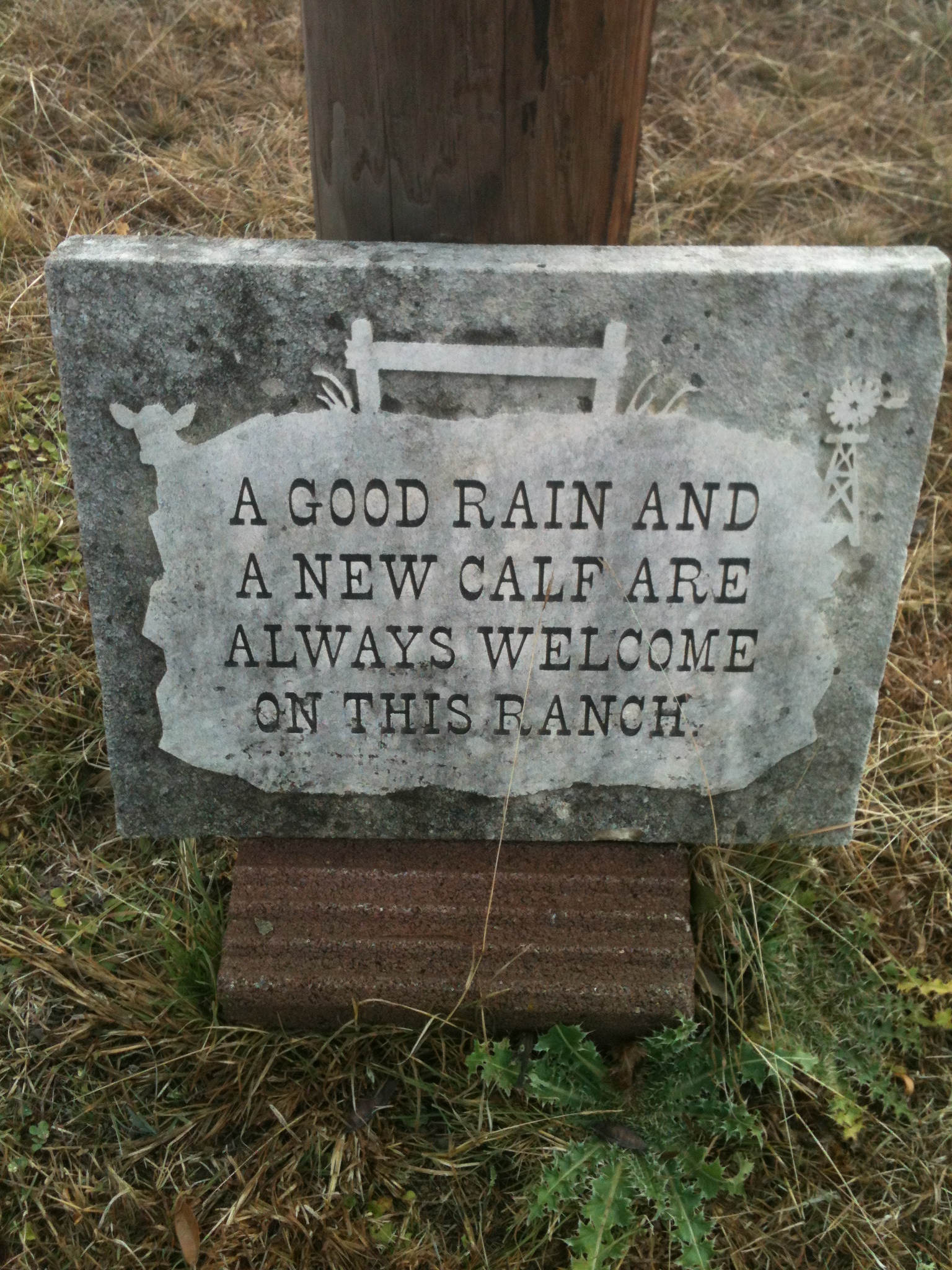
We have a small sign at the entrance to our ranch that says a good rain and a new calf are always welcome. Since calves are the mainstay of cow/calf operations and rain makes the grass grow, the sign makes sense.IMG_0067Well the other night to our amazement we received a couple of inches of snow. This is rare around Fredericksburg. As our cows seem to always wait until the weather is at its absolute worst , the next morning I predictably found one of our mama cows with a brand new bull calf. What a night to deliver a calf. Somehow the little fella came through the cold night just fine. Calves are IMG_0062really hardy.

The calf appropriately is all white- unusual since we cross black baldy mamas with a Charolois bull. The calves usually turn out brown or gray. Nevertheless, this one was white which seemed appropriate enough as he was born during a snowstorm. So now when we refer to this little bull calf , we call him Snowy Calf.

I have a not very good picture of Snowy Calf below. This was taken over a barbed wire fence preventing me from getting very close (probably good as mama cow might not have been in a very good mood. They are notoriously protective of new calves.IMG_0065

Maybe I need to modify the sign to read a good rain or a good snow and a new calf

The Challenges of Teen Pregnancy

Volunteering goes with retirement like jelly with toast. This is especially true for the City of Fredericksburg that relies heavily on volunteers. One of my most enjoyable volunteer jobs has been to serve on the City’s and County’s Health Board.

One of the more difficult areas we have dealt with is a rise in teen pregnancies in our county. While the rate nationally and statewide has dropped in recent years, the rates in our county have continued to rise. (some wags would say we are a bit behind the times here in Gillespie County)

The rate of teen pregnancy in the U.S.A. despite the drop, remains the highest of any of the developed country. To those who complain our country is losing its competitive edge, sadly we have remained all too competitive in numbers of births to teen moms.

A local Teen Pregnancy Prevention Task Force has been established and will be making recommendations to our community leaders. Beginning mid-January a series of Guest Editorials will run in the Fredericksburg Standard-Radio Post, addressing various aspects of this challenge.  This editorials will focus the community’s attention on the problem while the Task Force continues to research and develop practical ways to address Teen Pregnancy. Below is my Guest Editorial as it appeared in the January 2 2013 issue of the Fredericksburg Standard Radio-Post.

Gillespie’s ‘teen baby bump’ alarms

            Mary Nelson (not her real name) once held high hopes for a college degree, a professional career, international travel, and a happy marriage. Her fondest teenage dreams faded when, in a moment of uncontrolled passion, she became pregnant. Mary’s future trajectory suddenly changed from a pursuit of lofty goals to dropping out of school, settling for a minimum wage job, and becoming a welfare recipient.

Five years ago the Gillespie County Health Board repeatedly heard these types of stories. These narratives combined with alarming reports from local doctors and nurses alerted your Health Board to an alarming increase in teen pregnancies in Gillespie County. The Health Board held a series of hearings to gain a better understanding of this problem.

In 2008 the U.T School of Public Health reported the results of a study of Teen Pregnancy in Gillespie County. The full report can be found on the City’s website (under Government, Boards and Committees, Health Board Information). Over a four-year period, births at Hill Country Memorial to Gillespie County teen residents more than doubled (12 in 2004 to 25 in 2008). We learned few births to our teen mothers occurred at hospitals other than Hill Country Memorial. Since HCM numbers are more current than are state or national figures, this allowed the Health Board to rely on their teen birth statistics to determine evolving local trends.

We also learned the State of Texas repeatedly ranks among the top four states in the country in the rate of teen pregnancies. The cost of teen pregnancy with its attendant health, societal, economic, and educational impacts prove staggering for all levels of government and society. We will discuss these individual and public health problems in subsequent Guest Editorials.

A year ago the Gillespie County Health Board found that births to teen mothers continued to be high. In addition we learned of instances of births to early teens attending the Middle School. We held a year of hearings on this topic and heard excellent testimony from professionals on the front lines. Despite a 37% drop in teen births statewide (2009 data), we learned that Gillespie County rates remained high and for the first time exceeded those of our contiguous counties. Why these troubling rates exist for Gillespie County remains unclear and will be explored further.

Along with the Gillespie Translational Advisory Board, the Gillespie County Health Board formed a task force of community leaders to investigate our teen pregnancy challenge and to make recommendations to address it. This broad based community group offers a great opportunity to understand these issues and to recommend approaches to lower our teen birth rates based on local information and local values.

The Fredericksburg Standard-Radio Post will run additional guest editorials describing various aspects of teen pregnancy and its impact on both our teens and our entire community. These additional guest editorials will be written by Dr. Leonard Bentch, chair of our local Translational Advisory Board, and by the co-chairs of the local Teen Pregnancy Prevention Task Force, Dr. Ann Hoch, Pastor of Memorial Presbyterian Church, and John Willome, Executive Director of the Good Samaritan Center.

The goals of the Task Force On Teen Pregnancy Prevention are to increase public awareness of teen pregnancy and to encourage broad based support for efforts to reduce it. In no way will the Task Force stop all teen pregnancies, but it is a promising beginning.

With the advent of a new year, it is time for a fresh start- a community wide approach for addressing the vexing problem of teen pregnancy in Gillespie County. It is a subject that warrants serious consideration by our citizens. The residents of Gillespie County have dealt successfully with difficult issues before. I have no doubt we will do so again.


Tom Hutton MD PhD

Chair, Gillespie County Health Board


Curly- Our Ferdinand

Meet Curly

Meet Curly

Curly is a bull. More specifically Curly is our four year old Charolois bull. He has an interesting personality quirk. Ever since we bought him when he was eighteen months of age, Curly has acted differently from our prior Charlois bull or from leased bulls who have visited our ranch. You see, Curly bonds and bonds strongly with the occasional calf.

Initially I assumed the togetherness came from occasional young bull (steer) calves as they followed Curly about the pasture. Curly after all is a big bull weighing about 2000 pounds and clearly has his way in the pasture. Young bull calves might have looked up to the big guy and have wanted to learn from the alpha male.

Curly Is A Large Charolois Bull

Curly Is A Large Charolois Bull

Later when we isolated two steers to feed them out (don’t share this with Alissa, my tender-hearted daughter-in-law, the teacher, whom I told these were special calves rewarded for exemplary behavior with special feed and private pasture). Curly would daily wander away from the herd and head straight for the pasture where the steers were kept. There he would hang around for most of the day at times foregoing the feeding of the herd with range cubes. He would nuzzle the calves and lay contently just outside their pen. He never tried to break down the fence nor did Curly seem upset with me for penning his friends. I have seen Curly’s bonding behavior with both steers and heifers, making the hormonal urges of a bull seemingly irrelevant for explaining this unusual behavior.

I have come to view Curly’s behavior as kin to that of Ferdinand the Bull. You recall the 1938 short animation by Walt Disney of an especially gentle bull who liked to sit under a cork tree and smell the flowers. Well Curly to my knowledge doesn’t smell flowers but he is surprisingly docile like Ferdinand. He approaches me open mouthed when I feed, wanting me to stuff range cubes directly into his cavernous maw. While I have at times given into the temptation, something about such close contact with such a huge and potentially dangerous animal is off putting to say the least.

Open Wide

Open Wide

Now I know I am anthropomorphizing here as did Walt Disney in his short video. Perhaps other explanations exist for Curly’s bonding with calves. Perhaps he wants to round up “the strays” in the pen and herd them into the larger herd. Might this provide an explanation? Nevertheless, this doesn’t wash with me. Why would he lick on the calves, nuzzle them, and hang around when it is clear the fence prevents their following him.

In any event, Curly has proved incredibly gentle. He doesn’t wander off (read ferociously butt his way through fences) like our prior bulls. Instead he will stand at our perimeter fence and meekly gaze at neighbor cows or nuzzle them through the fence. Curly is known to take his turn at babysitting young calves. Typically one mama cow will stay with a group of young calves for protection while the other mothers graze. Never before had I witnessed a bull taking a turn at babysitting, well at least not until I met Curly.

These are the maunderings of a rancher, especially one with a lifetime of interest in exploring behavior. Perhaps I have too much time on my hands. Any other thoughts on Curly’s predilections would be welcomed. Please leave a comment.

San Saba Apache Mission and Presidio

I recently became aware of some eighteenth century Spanish ruins near Menard, Texas. After an initial visit and several phone calls, I had the good fortune to spend a day with Carleton Kothmann, a spry eighty-something year old historian and supporter of the San Saba Presidio and Mission. We toured the partially restored Presideo, visited the site of the recently re-discovered Apache Mission, and saw several other points of local historical interest. I am indebted to Carleton for his time and expertise.

IMG_0657

State of Texas Historical Site Marker for the Presidio

Below you will find what I gleaned from my visits and research. I have no doubt that one day the San Saba Presidio and Mission will attract legions of avid visitors. Here is a first peak at this partially restored and largely unknown historical site.

Dual purposes drove Spanish exploration of Texas in the eighteenth century: a search for riches such as Cortez in Mexico stole from the Aztecs and the saving of pagan souls. In 1757 Franciscan monks set out from Mexico City for Texas along with soldiers, prospectors, wives, children, and several Indian families. They embarked on the difficult trek to the San Saba River near present day Menard, Texas. The Franciscans accepted with pious enthusiasm their hardscrabble existence on the frontier in order to be the first to plant a Christian cross among the Lipan Apache.

The Spaniards began construction of their fort (the Presidio) and ill-fated Mission immediately on arrival in 1757. After the San Antonio mission complex, it would become the largest fortified Spanish mission in Texas but also would prove to be Spain’s last. When they built their timber and mud outposts on the winding, spring fed San Saba, their east Texas missions had already been active for over 50 years.

Drawing of Later Stone Presidio

Drawing of Later Stone Presidio

The east Texas Spanish fortifications had limited the growth of French settlements outward from Louisiana. It was hoped that the San Saba Presidio and Mission would similarly secure Spain’s valuable trade route from San Antonio to El Paso and prevent raids from the Native American Nations of the north (called the Norteños). Chief among these tribes were the fearsome Comanche, the finest light cavalry in the New World. The Comanche along with other Norteño tribes were the declared enemies of the Lipan Apache. The Spaniards by befriending the Lipan Apache then also became the avowed enemies of the Norteños.

Prospectors boasted of finding rich veins of silver along the nearby Llano River. Sightings of Lipan Apache wearing silver ornamentation fueled the prospectors’ already heady greed. An uncommon duality developed, consisting of idealistic padres zealous to transform Apache ways and avaricious exploiters, equally determined to steal their wealth.

Image

Spanish Conquistador as he would have dressed at the time

Visualize the scene in 1757 when a long train of pack animals, horses, three to four hundred people and thousands of head of livestock noisily departed Mexico City for San Antonio. The procession then trundled cross-country to the upper reaches of the San Saba River. The priests no doubt exuded hope over their lofty prospects of converting the Lipan Apache to Christianity. Miners tramped or rode; dreaming of soon-to-be realized fortunes. Ultimately both groups with their markedly divergent goals would fail in their efforts. Some would pay the ultimate price for their audacity and hubris.

Depiction of Padres Meeting Apache Chiefs and Mission Construction

Depiction of Padres Meeting Apache Chiefs and Mission Construction

Colonel Diego Ortiz Parrilla, commander of the military contingent, was less sanguine than the padres and prospectors. He knew full well the risks that lay ahead from hostile tribes. He suspected the Lipan Apache had embraced the idea of a Spanish Presidio and Mission as a defensive ploy against their Norteño enemies, rather than truly embracing an agrarian lifestyle and Christianity. Parrilla’s reservations would prove correct.

Immediately on reaching the San Saba River, an argument developed between Parrilla and the Franciscan priests. Parrilla urged constructing the Mission near the Presidio for easier defense. The monks countered that a fort close to the mission would intimidate the Lipan Apache and prevent them from entering.

Based on earlier experiences with unruly soldier behavior at the east Texas missions, the priests also worried that the soldiers would molest the Apache women. This grievous sin, they feared, would lead to irreconcilable animosity among the Lipan Apache and preclude Christianizing them.

Despite his profound reservations, Parrilla had little choice but accept the unbending convictions of the priests. The priests chose a building area on the southern bank of the San Saba River four miles downstream from the Presidio. This separation with its intervening expanse of open ground between the mission and the fort ultimately allowed for the sacking of the mission.

Shortly after their arrival, efforts began to build temporary structures to house the Presidio and Mission.  Stockades were thrown up. Huts were constructed. All were hurriedly erected by setting poles upright in a trench and chinking in sticks, mud, and stones to fill the cracks between the timbers. This building technique in Spanish is known as jacales and in English wattle-and-daub. The expectation of the builders was later to build more secure stone fortifications to replace the wooden enclosures.

Ten months later soldiers, civilians, and a few Lipan Apache huddled and fought from within the same wooden structure.  On the morning of March 16, 1858 some 2000 Norteño braves surrounded and attacked the San Saba Mission. A pitched battle ensued. The tribes from the north viewed the Spaniards as alien invaders invading their hunting range. Galvanizing the Norteño tribes together was their common hatred for the Lipan Apache and those who supported them.

DSC_0719

Picture of Restored Round Bastion of the Presidio

DSC_0724

Entrance to Stone Presidio

The Mission was burned to the ground. All but a few of those in the Mission were killed. The Presidio was shortly thereafter strengthed with rock walls. Ten years later with no mission to defend, the Presidio was abandoned. This proved to be the last mission to be built in Texas.

Thanks to the tireless efforts of good folks like Carleton Kothmann, Jim Goodall and his wife, the story of the San Saba Mission and Presidio will not be lost to future generations. With additional investment of money and time, this historical site will no doubt be visited by large numbers of persons wanting to better understand the unique history of Texas. Special thanks are also due Dr. Grant Hall, recently retired Chair of the Department of Archeology at Texas Tech University and to his faculty and students. Their archeological efforts have established the underpinnings for future exhibits and a fully restored historical site.

Cockleburs and Velcro

by Tom Hutton

My typical morning routine includes feeding and currying the horses. Of late I have had to spend extra time painfully (for me not the horse) removing prickly cockleburs from forelocks, manes, and tails. These tenacious burrs have become so numerous and work their way in to such an extent that at times our horses have the appearance of wearing hair curlers.

This got me to thinking about Velcro. A little googling finds that a Swiss engineer named Georges de Mestral in 1941 invented Velcro. He was inspired after taking a hunting trip to the Alps and having to contend with burrs in his dog’s fur and on his clothing. He placed a burr under a microscope and found  that each spine had a hook, making them stick to virtually anything. This inspired him to fashion Velcro from which I assume he made enough money to fill a Swiss bank vault.

The cocklebur (Xanthium) that I must contend with in Texaas is native to the Americas and eastern Asia. I can only guess that the recent

Just a few of the Cockleburs removed from our horses

Just a few of the Cockleburs removed from our horses

drought in our area somehow relates to the heavy crop of these burrs.

Have You Ever Dedicated An Outhouse? We Did.

Outhouse inaguration-IMG_6271by Tom Hutton

Available time is one of the great joys of retirement. Earlier in my life as a physician, this commodity was always in such short supply . To fill our hours now, we look for fun activities. We even stoop to such lowbrow activities as dedicating new enterprises on our adjacent ranches with our wine drinking and good friends, Tom and Linda Norris. Recently we finished construction of an “outhouse” located behind our hay barn that actually houses a composting toilet (privies are illegal in Gillespie County).

To fully dedicate our new facility, I read “Ode To The Outhouse” as printed below. We also needed one brave, unabashed being to inaugurate it. Young Graham, our almost six year old, stepped up, and sat down, and with an audience gave his all.

An Ode To “The Outhouse”– Author Unknown

The service station trade was slow

The owner sat and rocked around,

With sharpened knife and cedar stick

Piled shavings on the ground.

No modern facilities had they,

Just a log across the rill,

It led to a shack, marked His and Hers

That sat against the hill.

“Where is the ladies restroom, sir?”

The owner leading back, Said not a word but whittled on,

And nodded toward the shack.

With quickened step she entered there

But only stayed a minute,

Until she screamed, just like a snake

Or spider might be in it.

With a started look and beet-red face

She bounded through the door,

And headed quickly for the car

Just like three gals before.

She skipped the log, and jumped the stream.

The owner continued to rock about,

As her stockings, down at her knees,

Caught on a sassafras sprout.

She tripped and got up, and then

In obvious disgust,

Ran to the car, stepped on the gas,

And faded in the dust.

Of course we all wanted to know

What made the gals all do

The things they did, and then we found

That the whittling owner knew.

A speaking system he’d devised,

To make the thing complete,

He tied a speaker on the wall

Behind the toilet seat.

He’d wait until the gals got set,

And then the devilish tyke

Would stop his whittling long enough,

To speak into the mike.

And as she sat, a voice below

Struck terror, fright and fear.

“Please use the other hole,

We’re painting under here!”