Love of a Different Type

I have a close friend, Air Force Colonel Tom Norris, who was a POW in North Vietnam for over five years. He sent me an article on the type of plane he  flew and was shot down in, the F-105 Thunderchief. This aircraft  did much of the heavy lifting during this ill conceived conflict. This article was well written and describes lovingly the bond between pilot and his airplane. I suppose this is only natural. All of us probably loved our first car, had a favorite pet, and have had various romantic attachments. Extending such emotions to a piece of equipment that kept you alive despite people on the ground trying to shoot you out of the sky, makes sense to me.
Below you will find the article by another “Thud driver.” I hope you enjoy it and its poignancy as much as I did.

I

A Requiem – by Thomas R. Carlson
I was looking through a spreadsheet that summarized the disposition of the Air Force’s F-105 fleet. Little did I know that what I discovered would start me on a journey into the past that I didn’t really want to make. I had been more or less content with leaving the past where it was and had long since come to grips with memories of decisions and deeds, some right and some fearfully wrong. “Don’t look back unless you want to go there” is usually good advice, and still I was drawn into a place where I imagined that I heard the sounds, smelled the smells and felt the old gut feelings from times past. There was a near physical presence of machines, places and people from the now long ago.
When I found the tail number that I sought, the message was terse, unequivocal and final. “1984 June Scrapped.” That meant that my faithful old #246 had been chopped into pieces and melted down to make beer cans! 246 had been the warhorse of my youthful days, my ride, my big afterburning, supersonic heavy metal. The aircraft had been a proud old war veteran that had once carried the name “Thor’s Hammer” and had met its end at the hands of scrappers, rather than a foreign enemy. A line from Oliver Wendell Holmes’ epic poem about the ship “Old Ironsides” came to mind. “The harpies of the shore shall pluck the eagle of the sea.” Enemies had tried to bring about its demise, and it wasn’t for their lack of trying that it survived the Vietnam War only to meet its end at the hands of scavengers. The war in Southeast Asia had raged for years and Republic F-105D Thunderchief, tail number 62-4246 had been there from the beginning of the air war until the end and had survived against incalculable odds.
246 belonged to the American taxpayers and was posted to the outer frontier of the country’s sphere of influence. In keeping with tradition, pilots were allowed to have their names painted on the canopy rail and, with that done, it was “their” airplane. With my name on the left side of the canopy and Staff Sergeant Myers, the crew chief’s name on the right, 246 was properly adopted. Other names would occupy those same rails over the years as pilots, crew chiefs and airplanes rotated from unit to unit or pilots were lost to accidents or combat. My good fortune was to be first. Fresh from the Republic factory on Long Island it still had the distinctive new car smell and the crisp, clean look of a new machine. In Cold War livery, it was painted silver and had a dark blue stripe around the nose, just aft of the radar dome. The new fighter was ferried from Republic Field to Mobile Alabama to Okinawa with the ultimate destinations of the forward bases of Korat and Tahkli Thailand.
By comparison with other fighters of the day, the Thunderchief was a giant of an airplane and incredibly more complex. My contemporaries and I had originally viewed it with suspicion and admittedly some trepidation. For such a machine to be powered by a single engine and operated by a single pilot seemed optimistic at best. Twenty- five tons of machine when fully loaded gave some credibility to term “Fighter, Heavy.” This was almost comically noted in the designation FH that preceded the buzz numbers on the side of the sixty-four foot fuselage. The Thunderchief name would give way to the universally adopted term “Thud”. What was originally meant to be a put-down would eventually become an accepted and revered name. The term “Thud Driver” would be a badge of honor and respect that would be worn with pride.
246 was assigned to the 44th Tactical Fighter Squadron on Okinawa. The 44th was a unit with a proud tradition dating to the attack on Pearl Harbor where it’s pilots in P-40s rose to meet the Japanese attackers. During the course of World War II, the Vampires, as they were known, earned many battle honors, including the Distinguished Unit Citation. Then equipped with the F-100 Super Sabre and a legacy of excellence, the 44th would be among the units in the Pacific Air Forces to be the recipient of the F-105 aircraft in 1963. This would be a proper home for 246. It would be more than a year before the war in Southeast Asia became heated up to the point that the authorities committed the unit to action and posted the 44th to Korat Thailand on temporary duty. This time interval had been an opportunity for pilots and ground crews to become familiar with the new machine. Maintenance and operations schedules didn’t always match, but when they did, it was squadron policy that pilots flew their own aircraft.
Far from being my personal chariot, 246 was a warplane. The existence of the machine and its presence in that part of the world was for a grim purpose. The Cold War mission was well defined and far too terrible for most to even contemplate. Much of the time, aircraft and pilots were on alert and loaded with the deadliest weapons ever devised. Republic had built the craft to carry and deliver those weapons and the pilots had been trained to carry out the nuclear mission. The alert duty was never taken lightly and yet, I doubt that most pilots, myself included, thought that such madness as a wholesale exchange of such weapons would ever happen. Carried to a logical conclusion, there was no logic to it.
The warplane role of the Thud would play out in quite a different direction. The twenty millimeter Gatling gun in the nose of the craft fired projectiles at a hundred per second. The destruction wrought by such a stream of exploding shells was a new dimension in firepower. A one second burst, fired into a truck, a structure or an aircraft would tear the target to shreds. Hard points on the belly and wings carried the bomb load of a B-17 bomber from another era. Missiles of several            types were carried, intended for airborne and ground targets alike. All the conventional weaponry available was to be employed by the Thud drivers in the years to come.
Modifications were made to the aircraft over time. Hydraulic lines were re-routed and other changes made to enhance survivability. Introduction of the two-seater models to combat expanded the role of the aircraft even more. Wild Weasel, a concept started using the F-100, was soon transferred to the F-105 F, later designated the G model. The Weasels tormented the enemy missile sites and destroyed them when their radar came up on the air sometimes even after the missiles had been launched. The Soviets reportedly believed the Weasel crews were on marijuana or other stronger drugs. The more traditional Thud drivers simply thought that the definition of an optimist was a Weasel crew that quit smoking. The Weasel pilots and their “Bears” (Electronic Warfare Officers) earned a revered and special status in the hearts of all who knew that they had performed the most dangerous task in an environment where all faced grave danger. No tale of the Thud could be told without acknowledging the role of the Weasels.
The spectrum of pilots sent to Asia to fly the Thud would be broad. Initially, the Wing and Squadron Commanders, Ops Officers and some Flight Commanders would be the veteran warriors from the skies of Europe and the Pacific in World War II and From Mig Alley in the Korean War. The younger pilots would be the Cold War era trainees from the fighter pipeline. The Thud drivers would be West Point, Air Force Academy and Annapolis graduates, from The Citadel and VMI as well as those from the ROTC programs and Aviation Cadets. Most would give a good accounting of their time in the airplane.
There would be Medal of Honor recipients, Mig killers, 200 mission survivors, former astronauts and future General Officers. As the war dragged on, and fighter pilot ranks thinned, there would be transport and other multi-engine pilots as well as some staff officers who were hurriedly trained to fly the Thud. While many of them distinguished themselves in their new role, they were, after all, in a new and far different element for which their previous training and experience had            done little to prepare them. In training and in combat, they would die in numbers disproportionate to the long-time fighter pilots but nobody would ever question the courage of those who flew. Thor’s Hammer would respond to the hands of pilots from all these backgrounds.
246 was transferred to Takhli Thailand after my return to the States. It was a successor of mine, Capt. Nels Running, a future Thunderbird Pilot and future Major General, who named it. The legend of the Norse God who brought down thunder from the skies as he wielded his mythical hammer, was a well-chosen and appropriate nom de guerre. Memphis            Belle, Old Ironsides, Glamorous Glennis, Enola Gay, Protestor’s Protector and Thor’s Hammer. Some of these names would be remembered in aviation and naval history and some forgotten. The little-known names of ships and aircraft would be remembered only by the generation that flew or manned them. The Thud would be legendary among aviators, aviation enthusiasts and historians as the workhorse of the Vietnam War. Museums, memorials and pedestals would be home for many of the retired fleet. Memories of Thor’s Hammer and those who flew it would grow dim and eventually disappear as the passage of time relegated them to history’s margins.
Unlike most other fighters, in addition to a conventional pneumatic engine starting system, the Thud had one that utilized an explosive canister much like an oversized, slow-burning shotgun shell. Pilots and ground crews became accustomed to the acrid smell of burning cordite as the coffee can sized powder cartridge spun the big turbine engine to life. Since Chinese alchemists invented gunpowder in the ninth century, that smell had been the essence of war. To the doughboy in the trenches of World War I it was his constant companion, bearing witness to the incessant artillery fire that took friend and foe alike by the hundreds of thousands. To the sailor on a battleship, it signaled the firing of the big guns, sending huge projectiles toward the enemy. To the Thud driver and his crew chief it usually meant a successful engine start. In many ways, it was a hint of things to come.
With the tachometer indicating idle speed, there was a high-pitched whine as the small air turbine motor was brought on line to power the hydraulic and some electrical systems. An almost imperceptible movement of the machine could be felt as compressors and turbines came up to speed, pumps and generators came on line and the start sequence was completed. The smells of hydraulic fluid and burned jet fuel mixing with the dissipating gunpowder aroma completed the sensory inputs and told the pilot that the machine had come to it’s form of life.
Whether in combat or on a routine training mission, flying the Thud was always an adventure. It wasn’t trepidation as much as anticipation of the adrenalin rush which was sure to come. The culmination of boyhood dreams and fantasies of one day being a fighter pilot had been fulfilled. There was the thrill of advancing the throttle to full power for take-off. The landing gear struts which stretched nearly eight feet from their mounting point in the wing to the surface, bent slightly aft as the power was advanced and sprung forward as the brakes were released. Feeling the gear “walk” was a uniquely Thud experience. The throttle was moved outboard to the afterburner detent and, when needed, water injection was selected by a toggle switch forward of the throttle. With that done, 26,500 pounds of thrust accelerated the Thud along the runway and into the air. The painful decibel level reached by the shrieking afterburner and the continuous thunderclap of the engine exhaust were not heard by the pilot. The tight canopy and special fluid-filled, snug fitting headphones in the helmet left the painful noise to torment those on the ground.
In a combat environment, details such as aircraft numbers appeared on scheduling boards and mission cards but were not recorded in the pilot’s log. I don’t know how many times I flew 246 in that role. What were called “good” missions during that early phase of the war were hard to come by and eagerly sought after by most pilots. Nobody much cared about the aircraft number. Escorting unarmed RF-101s on their low-level photo missions, interdiction sorties to Laos, armed reconnaissance along the Ho Chi Minh trail and the real plums, the initial “Rolling Thunder” strikes north of the DMZ, were considered good. There was a “Bitch Board” in squadron operations where missions were tallied in grease pencil to insure that no pilot got more “good ones” than someone else. It wasn’t as though they relished war and the possibility of dying. They were Fighter Pilots who lived on the edge even in peacetime. Going in harm’s way is what they had been trained for, what was expected of them. It was who they were and what they were there to do. No more scrimmage. It was time to get in the deadly contest. This time frame in the war is reminiscent of Rudyard Kipling who made an observation that the “Old Sarge” was usually a bit more circumspect about going into battle than the young recruit.
Each pilot has his own indelible list of remembered places, previously known only to cartographers and locals. The Plain of Jars, Vinh, Than Hoa, Sam Neua, Mu Gia Pass, Dong Hoi and Route 1 were the locations of early targets and were on my list. Those pilots who were there as the war intensified would be exposed to a far more dangerous and foreboding environment of air defenses and a new set of names. Thud Ridge, Downtown, Hai Phong, the Paul Doumer Bridge, Kep, Phuc Yen, the Red River, most of these in what was known as Route Pack Six, would be imprinted in their memories. A hundred times they were required to go where missions were no longer “good.” Surviving one hundred missions to those places, however unlikely that was, would earn those pilots a special status in the aviator’s pecking order. While they might have reveled that their skill and a measure of luck carried them through the ordeal, like soldiers throughout history, they would grieve for their comrades whose fortune was not as good as theirs.
Every combat mission was permeated with risk and, a predictable adrenalin overdose. Even though one was in the company of other flight members and usually part of a larger effort, there was a feeling of aloneness. One engine, one seat, one pilot, one set of thoughts. Dryness in the mouth and the hint of the taste of bile were the signs of trepidation, however slight or well concealed from the others. The mission would be flown and even the slightest thought to the contrary immediately put aside. If a pilot didn’t fly his assigned mission, someone else would have to go in his place.
Surviving one phase of flight was only a set-up for the next phase. There was always the heavyweight take-off where every available foot of runway was needed. The bomb laden Thud gained speed slowly at first. It seemed to have feet of clay as the afterburner and water injection were selected. Further along the take-off roll, the pilot became committed to flight, since there was no stopping once refusal speed and distance had been reached. Clearing the arresting barrier at the far end often seemed in question. Having survived that, the struggling Thud felt as if it remained airborne only by virtue of the downward thrust vector of the blazing afterburner and the extra boost of water injection. As speed was gained and the water injection depleted, the flaps were retracted to the subsonic flight position. The pilots breathing rate returned to somewhere near normal as the speed increased to a comfortable 400knots or so. A join-up with other flight members into normal four-ship formation preceded the tanker rendezvous. Fuel loads were usually topped-off prior to entering the target area.
The refueling was generally a routine matter, but there were notable exceptions. One pilot, Gary Barnhill, suffered an internal aircraft fuel system failure. His Thud exploded in a giant fireball as he backed off the tanker’s boom. At the urging of John Betz his wingman, who observed a massive fuel leak, he ejected a split second before the fireball would have engulfed him. Miraculously, he survived. The bombs on Ned Miller’s aircraft were thought to have detonated because faulty proximity fuses sensed the density of the tanker. Ned perished in the blinding flash that left only bits and pieces of his Thud fluttering and tumbling earthward. George Sasser, flying Ned’s wing, saw the Gatling gun propelled forward out of the fireball as if it had been fired out by a larger cannon. He saw Ned’s limp form descending toward the undercast in his parachute.
The tanker guys always seemed to be where they were supposed to be. They hung around to refuel any post strike fighters that may be low on fuel. This was done at great peril to themselves and with the everlasting gratitude of the fighter pilots, especially the ones they saved.
The heavy weight of the Thuds soon after takeoff made refueling more difficult than usual. There were times when the bomb load and considerable weight of fuel already on board taxed the ability of the engine output, making it difficult to hook-up. Being late on the tanker or not getting a prompt hook-up was undesirable since that may require following the tanker around a racetrack circuit and arriving late on the target. It was better to get there first. Flying Col. Bill Craig’s wing one day, we arrived late on target because of a circuit with the tanker. Predictably, the flight scheduled to follow us was already there. A B-57 pulling off the target went between the leader and me going straight up. He didn’t miss either of us by more than what seemed like inches. I know that he didn’t see us and there wasn’t even time to tense. The episode was over in a fraction of a second but the image remains.
With the refueling done, the target area was next. Time seemed to switch to fast-forward between tanker and target. Lurking somewhere in the recesses of the mind was the knowledge that one could instantly be propelled from the comfort and familiar sounds of the cockpit into the unknown. From the tip of a high-tech spear, into the silent void of nothingness would only take a fraction of a second. Transition to a grim and uncertain future in a primitive cage, far from home and far removed from the thin veneer of civilization, would take a bit longer.
On a dive bomb run at some long forgotten place, I marveled at the countless projectiles heading my way. There were bright colored tracers and those that were less visible shades of gray. The anti-aircraft guns usually focused on the plane presenting the most immediate threat and all of them seemed to be firing directly at me. It looked as if each round was destined to come through the center of the windshield. That none of them had hit me yet seemed impossible. At a speed close to 600 knots, I glanced out the side of the cockpit and it seemed as though tracers were actually arcing up and over my right wing, following the airflow around it. I dismissed this as an optical illusion and concentrated on the delivery of the bomb load. The ripple of the six thousand pounds leaving the aircraft meant that it was time for afterburner and lots of back stick. Vision grew narrow then dim as the G load increased, in spite of the functioning of the G suit and the tightening of body muscles. Acceleration to maximum speed and heading for relative safety away from the target followed. This same drama was to be repeated thousands of times by hundreds of pilots over the next seven years.
Surface to air missiles (SAMs), MIG fighters, 37,57, 85 and 105 millimeter anti-aircraft shells and small arms fire filled the airspace where the Thud lived. According to the data contained in the article where I learned of the fate of my airplane, by rough count, some 423 Thuds were lost to combat or related accidents. Too many pilots and crews died in their prime and too many of them suffered and languished in the fetid torture camps of another culture. One could debate the Vietnam War to infinity. Good war, bad war or no war at all. Wars throughout history represented the failure of diplomacy and were waged as instruments of national policy. Some wars were fought with final victory as the goal, and some weren’t. In my experience, they were neither initiated nor relished by the soldier since it was always the soldier who bore the heaviest burden. Those pilot soldiers who were ordered into battle and flew 246, always made it safely back to their base. On other days and in other aircraft, many of them were not so fortunate.
The heavy losses of aircraft and people were less due to any deficiency attributable to the Thud than because of the incredibly hostile environment where these aircraft and pilots were sent, day after day for some seven years. Against almost incalculable odds, Thor’s Hammer was a survivor, as were those pilots who flew it on each individual mission. Perhaps a thousand times it went to war and a thousand times returned safely. It would be impossible to estimate the number of SAMs and the countless rounds of artillery and small arms that had been fired at this aircraft and failed to bring it down.
246 spent semi-retirement with a reserve unit at Oklahoma City where systems were upgraded, war scars and blemishes repaired and where it continued to serve in the nation’s arsenal. The reservists would have known the airplane’s history since some of them had probably flown it in combat. The old fire horse had found a new, quieter fire station and waited for the bell. The bell, when finally heard by the keepers, would have been a death knell from a distant five-sided steeple. It would have appeared on the daily scheduling board in the squadron simply as “246, ferry, DMA (Davis-Monthan Air Force Base, Tucson).
I would have wanted to be there to fly Thor’s Hammer on that last ferry flight to Tucson when it was time to go, much as a saddened owner would take a beloved dog on that dreaded last trip to the vet. It might be logical for Gen. Running to make the flight, but I’ll have him occupied elsewhere (after all, it’s a fantasy). Besides, Generals didn’t usually engage in anything so mundane.
With a knowing wink and nod, a Master Sergeant assisting in the pre-flight inspection would remove the cover plates on the outboard wing pylon stations, leaving a pair of round voids that worked much the same as blowing across a bottle. They would be off for the traffic pattern at destination so the familiar shriek would be heard as the Thud approached. As a young airman he would have done this in the past. He would have remembered the days of sweating-out the mission on a distant flight line, counting the Thuds as they returned. His contribution would be noted and appreciated.
I would have been aware that many better men than me had challenged fate and survived, strapped in the seat of 246. It would be for them that I would advance the throttle, release the brakes and feel the gear walk for the last time. The afterburner would bark a final defiant insult to the earth-bound’s ears as we lifted off and headed west. In aviator’s jargon, “Gone West” means that one has flown the last sortie to that final and uncertain destination. The irony of geography dictating the direction of flight would not be lost. This would be Thor’s Hammer’s judgment day but there was no uncertainty.
It would have been tempting and so easy to let the speed build and slip through the Mach to supersonic flight. The strike of Thor’s hammer would have brought down thunder from the heavens once more, just as in the Norse legend. Windows would have shattered and dishes rattled along the route of flight. Officialdom would not have allowed such a transgression. I would have to have been content with the memories of other days when supersonic flight had been effortlessly attained in the same cockpit, hand on the same throttle, looking through the same windscreen. Pushing eight hundred knots on the airspeed tape wouldn’t be necessary on this day. After all, we wouldn’t be headed out of the chaos and carnage of battle, or outrunning a pursuing MIG, but bound for a vast graveyard for old, un-needed war machines. Guns that had once fired at the stiletto shape were far away and long silent. The scrappers patiently waited, assured of success where the enemy’s guns had failed. No need to hurry.
A New Mexico rancher astride his horse, who except for his clothing, might have looked like a knight or a cavalryman from another time, would have looked up briefly at the long thin contrail in the stratosphere and the barely perceptible dot pulling it along. He and his mount would return to their earthbound chores without knowing the meaning of the melancholy wisp.
The Captain of an eastbound 767 would have nudged his co-pilot and pointed upward as his airliner passed underneath the old fighter. With his face pressed to the glass, he would have recalled to his captive audience other days and times when he too had been strapped in the cockpit of the magnificent Thud. It wouldn’t have had much of an impact on his younger colleague who was most likely a new-age child of the magenta line. To him, old fighters would probably have been a historical footnote, of some significance to the old guys who lived in the past. The unmistakable silhouette of the needle nose and the forward sweeping intakes would quickly pass from view but not from The Captain’s memory, which would have been instantly at flood tide. He would watch until the contrail left by the Thud dissipated then vanished. He would turn again to the relatively mundane yet important matters at hand. After all, he would have thought, that was then and this is now.
Of course, a good solid 4 G pitch-out to downwind from a 500 knot initial approach would be in order for the last overhead traffic pattern. To hell with it, make it 650! In for a penny, in for a pound! Stay just under the mach so I wouldn’t end up in jail for destroying the place with a sonic boom. . “Black Matt” Matthews, a legendary Thud driver, former Thunderbird pilot and genuine good guy had already paid a price for slipping through the mach during a flyover at the Air Force Academy. Much of the glass construction was reduced to rubble. Matt’s good name was cleared of any blame but still, no need to repeat that. Unlike Matt, I wouldn’t have been blameless.
The massive speed brakes, idle power and 6Gs would combine to slow to the 275 knot gear down speed. The voids in the outer wing panels where the cover plates had been removed would shriek their high-pitched wail. Dogs for miles around would howl and the ground-bound folk would look up and take notice. Some of them would have known immediately without even seeing it. that this wasn’t just another aircraft in the pattern, this was a Thud!
Approach control would already be on the phone to the Airdrome Officer, making note of the speed violation to be filed. Screw ‘em. The plastic colonels who would revel in violating this rogue pilot’s transgression didn’t matter. Neither would a violation matter. Thor’s Hammer’s last traffic pattern would not be one of the post-modern era but from another day, now far in the past when airplane and pilot were at the top of their game. Anything less could not be done nor would it be            acceptable. To wimp out at this point would result in a well-deserved chorus of “You don’t have a hair on your ass!” rising in crescendo from legions of Thud drivers living and dead. Beyond that, the old war horse deserved no less than a full gallop to the ignominious end of a metaphorical glue factory.
Gear down, flaps down then the 200 knot final approach to a touchdown on the numbers. A few knots on the fast side perhaps, but a good comfortable speed and there would be plenty of runway. The abrupt deceleration of the drag chute would hasten the slowing process for the turn off the runway. The canopy that had completed the cocoon of the familiar cockpit would open slowly, once clear of the runway. Even the sudden blast of hot Arizona desert air would feel good against the accumulated sweat and the deep imprint on the face that had been tightly covered by the now dangling oxygen mask. Time to jettison the drag chute and follow the yellow pickup with the “follow me” sign on a serpentine route to the storage facility and journey’s end.
The brakes would be set at the ground handlers stop signal and wheel chocks inserted. As a final, defiant and time-honored obscene gesture in the Thud driver’s repertoire, the refueling probe would be extended then retracted. The device, located in the nose of the aircraft forward of the cockpit, was not visible in the stowed position. When extended, it had the look of a large finger. The absolute last mechanical movement called for from within the guts and soul of the still viable machine would be a gesture to the unseen jury that had imposed the death sentence and those who would carry it out. The meaning of this would probably be lost on the intended audience, the toothless scrappers with their cutting torches at the ready.
The well- worn throttle, made shiny by the thousands of leather- gloved hands that had caressed it for two decades, would be slowly and reluctantly moved to the cutoff position. The clatter of compressor blades, as the engine wound down would be the death rattle of a warrior who had fought well but lost the last battle. An official notation, entered in the logbook, “Flight # 1 OK” would be recorded. Between the lines allotted for commentary would be added: “So long, old timer, well done.” A few minutes would be devoted to checklist items then, a couple of more minutes seated there with arms resting on the canopy rails.
The new car smell would be only a memory from the distant past. The sweat of a thousand pilots, the decades of cordite, hydraulic fluid and jet fuel would have permeated the molecules of the metal, paint and fabric of the cockpit. The smells would hang heavy in all the recesses and voids. The familiar odor of hot titanium and stainless steel would combine with the others and enter the nostrils and consciousness.
The silence would be broken only by the “tink tink tink” sound of cooling metal.__._,_.___

So You Want To Publish: The Urge To Write

I plan to write a series on the writing process.  By necessity this will be personal, detailing my own circuitous pathway leading away from scientific writing to a more popular style. I hope these posts will prove helpful for others who find in themselves a need (a compulsion?) for putting ideas down on paper. “Ink Slingers” arise!
The genesis for my wanting to write lies deeply buried in the past. I doubt that it comes as a Eureka moment for others; it certainly did not for me. I recall always enjoying writing themes in school, and I soon came to appreciate a few of my efforts and those of my classmates were better written and more interesting than others. This development of a critical attitude seems to be a necessity for writing.
I owe much to my H. S. English teacher who encouraged me to write. I also owe much to my mother who would have been an excellent writer had she not been such a dedicated wife and mother of four active children. These two women gave me permission (in the psychological sense) to take a few risks in my writing and try different approaches and styles.
At my undergraduate school, Texas Tech University, I enjoyed honors English. The advantages were smaller class size and excellent professors. Even though I was a science major (Zoology) and science minor (Chemistry). I loved my humanities courses, especially literature. Had it not been for my all consuming desire to become a physician, I likely would have majored in one of the humanities.
The posts to follow will describe the corruption of popular writing wreaked by scientific writing and furthermore how bloomin’ difficult it is to break these ingrained habits (passive voice, overly exacting verbiage, humorless and tortured phraseology, scientific jargon, and brevity to the extreme).

I will also share thoughts on the advantages and challenges of workshops, seminars, writing courses, and critique groups. Each had their impact on my writing, and as one of my former partners used to say, were all “good butt flattening exercises.”

Needless to say, once a book is conceptualized or even written, the real challenge comes in getting it published. My own experience in this journey through this forest of despair will be described- landmines, craters, heartbreak and all. And then the soaring elation of acceptance. I suppose if writing and publishing were easy, everyone would be doing it. Self-publishing nowadays does provide an  outlet for everyone to publish but is this the best pathway?

I hope my own effort to learn popular writing (metaphors, similes, and alliteration really are acceptable in the English language) might prove helpful. Persistence can pay off or as the mock Latin phrase says, illegitimi non carborundum (translated: don’t let the bastards grind you down).

So “Ink Slingers” arise! Pick up those pens as they are said to be mightier than the sword.

Stump Spirit of Blue Jay Way

On moonless nights from the shadows they creep, carrying sundry items within black bags necessary for their nefarious task. Okay, okay maybe dressing up the stump is not quite that secretive or clandestine, but almost. It really is carried out in secret. Thought you mind be interested in the legend of the “Stump Spirit” of Blue Jay Way.

The origins for decorating the stump on Blue Jay Way, a private road serving five ranch families, began benignly enough. A neighbor boy one day left, perhaps by accident, a metal snake on the stump on the Norris property next to Blue Jay Way. Soon thereafter the snake disappeared and a pottery red bird appeared in its place no doubgt to signify the beginning of Spring. Before we knew it, prior to every holiday or season, the stump changed its appearance and the themes grew progressively more elaborate.

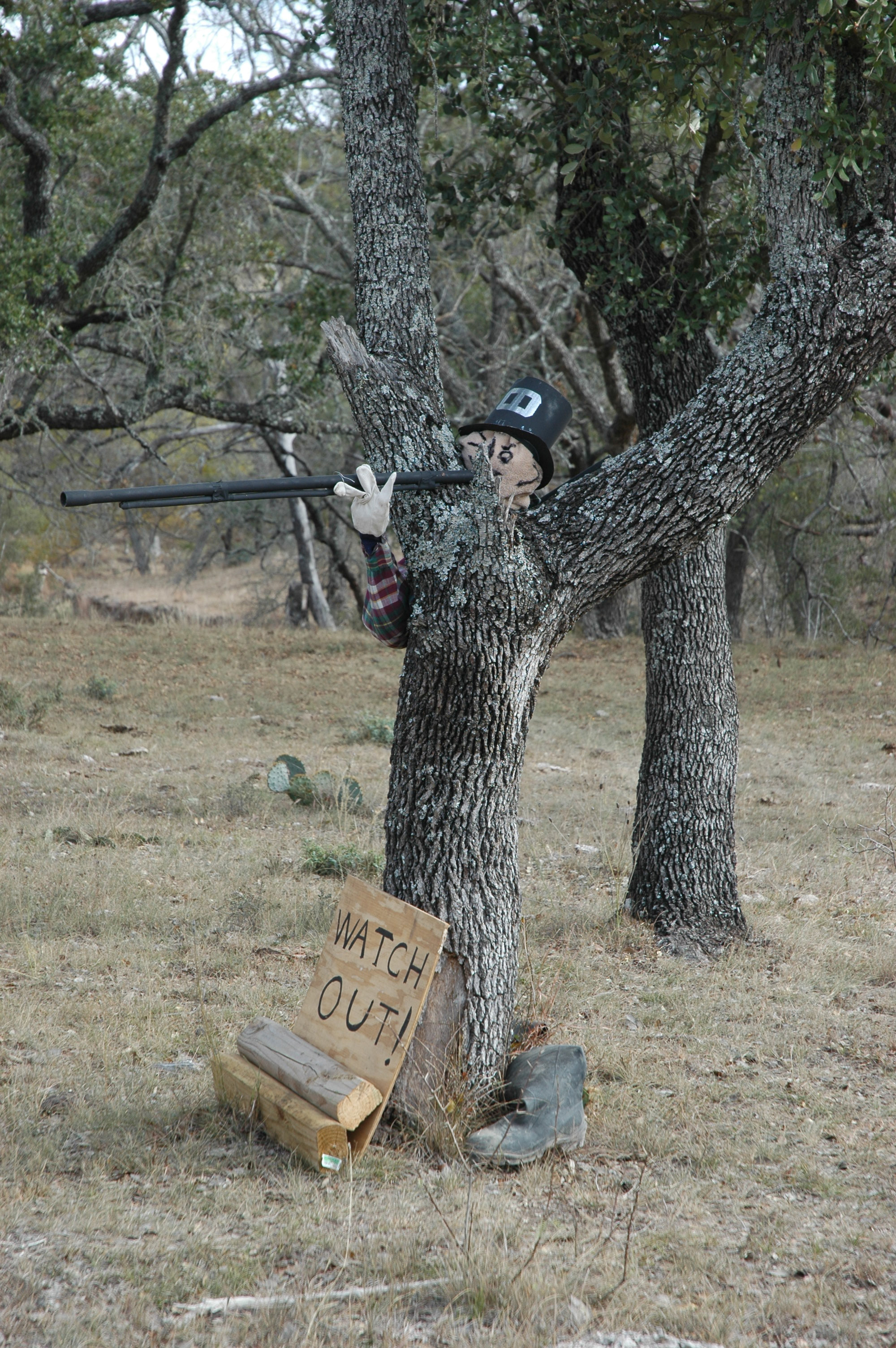
No one really knows who provides the decorating (well not unless you catch the sheepish perpetrator in the act–the neighbor in the headlights look). Nevertheless,  six or so times a year, our previous lowly nondescript oak stump becomes bedecked in new finaries, befitting the season or occasion. Below are a few examples:

Dog days stump spirit 08_0089

The one on the left celebrates the laid back “dog days” of summer with a cold drink and a hound dog with a baseball cap under an umbrella. The one on the right with pumpkins and a scarecrow appeared prior to Halloween.

Turkey ScarecrowDSC_0096Tksgvg hunter

Thanksgiving gives rise to a turkey, a pilgrim, and, a hunter. Christmas is the most elaborate usually and on rare occasions, the stump has even been lit up with twinkling Christmas decorations.

Now the real question to ask is why do the denizens of Blue jay Way do this? I really don’t know. Speculations run from the eccentric activities of the bored retired set, or you have to do something with all the stuff you find during Spring housecleaning, to perhaps a little bit too much of the grape! In any event, the decorating of the stump provides a collective activity for our small ranch neighborhood that brings us closer together.

It has even led to a semi-annual “Stumpfest” where we gather together for bonding, food, beverage, and music. What a way to get to know your neighbors. I have even suggested we don bedsheets and show up like druids on the summer and winter solstices. Needless to say, my wife, the eminent duck wrangler, shot this one down in a hurry. Oh well, not all my ideas are keepers.

So there it is, the Stump Spirit of Blue Jay Way. It is kind of fun and gets you out of the house on those moonless nights.

Postal Goat- Part 2

IMG_0229I’m sure your growing suspense over the origins of the extremely friendly, partly grown Boer goat must have been building to an incredible degree (tongue in cheek). But first before I provide the denouement for this little tale, I wanted to share some theories from those of us living on Blue Jay Way.

Many thought the goat had lost his mother and for reasons, not at all clear, had imprinted on humans.

Many of us also thought the goat had previously experienced close contact with humans and was trying to reestablish just such a bond.

Among the more fanciful ruminations was the goat was waiting for a mail order bride from the postman. It did seem an amorous little fellow. This sounded about right to me, as the goat had entered his adolescence and no doubt had goatly hormonal surges. Alternatively we thought he was waiting for a ride in order to head off for a great goat get-along. Oh well.

The goat’s desire to climb the fence became abundantly clear when he repeatedly managed to get out of the pasture. We would chase him down, grab the goat, lift him over the fence, and deposit him back into the neighbor’s pasture. This was getting old for all of us, especially for the ranch owner.

Suddenly one day the goat was gone. No more was I met at the mailbox by the floppy eared, friendly one. I must admit to feeling a sense of loss. This led me to inquire of our neighbor, the ranch owner, about the goat’s absence.

Unfortunately Marion Baethge, who owned the pasture next to the mailboxes, had tired of retrieving the goat from the county road. We learned the goat actually belonged to his son who lived elsewhere. Indeed the goat had been a bottle baby and had been raised in their house. As he grew, he did what goats do, namely learn how to butt. Apparently no one was safe, especially if they tried to bend over. This had gotten old pretty quickly, as I suspect the inhabitants must have become as jukey as road lizards, never knowing when the goat was heading full stream at them.

Marion’s son had left the goat at Marion’s ranch which was not nearly as nice as the house from which he came. The goat it seems  began auditioning for a new home and new people/targets to butt.

Marion finally became so flummoxed from having to retrieve the goat from the county road that he called his son and asked he immediately take him back.

So there it is. The mystery of the postal goat at last has been revealed. Nevertheless, checking the mail these days just isn’t as pleasing as it once was.

The Postal Goat

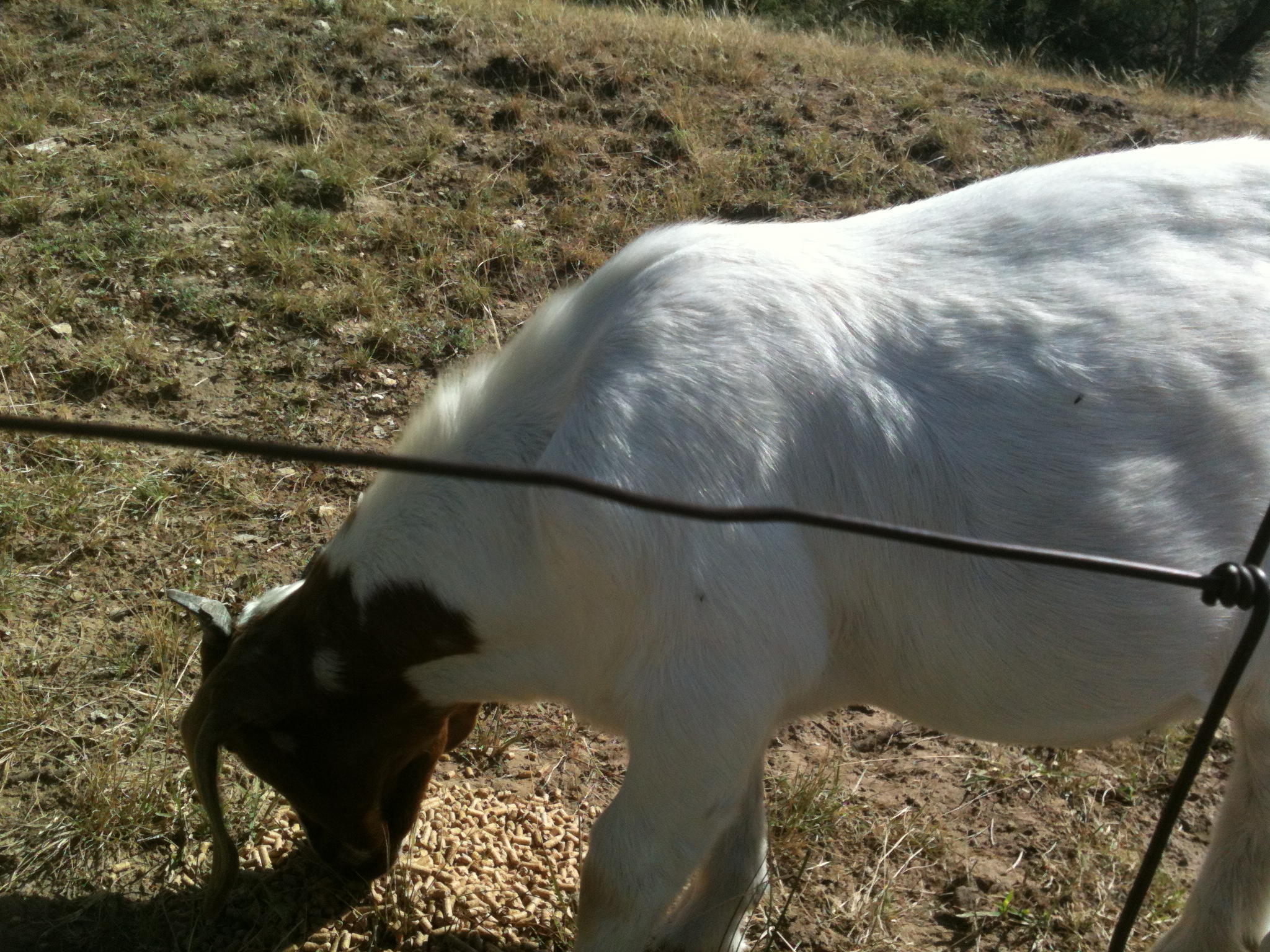
IMG_0231When stopping at our mail box on Loudon Road not long ago, I was surprised to find  a young goat standing a few feet away just on the other side of the fence. He frantically tried to get to me. I sensed a friendly attitude.

This behavior, for those of you with limited goat experience, is highly unusual. Normally goats run when they see a stranger, especially one not bearing food. This little fellow, on the other hand did everything he could to gain attention including standing up with front hooves resting on the fence, protruding his head through the wire, and wanting his ears scratched.

What was going on here! I saw no other goats in the pasture. I looked particularly for a nanny goat but saw none. This lone goat proved an enigma to me. The plot thickened each time I picked up our mail. Every time i stopped, there was the lone, not fully grown goat. I wondered if he might just be an orphan.

For over a month the scuttlebutt among the denizens of Blue Jay Way largely consisted of theories dealing with the origin and behavior of the little Boer goat. In response to his entreaties, we began to feed the demanding goat. Whereas I routinely carry a sack of horse feed in the back of my pickup truck, I removed some and offer the feed. As if famished, the goat ate hungrily from my hands or feed scoop. He much preferred eating from my hands or from the scoop rather than eating it off the ground. This struck me as strange goat behavior indeed. What gives?

The four families who have their mailboxes clustered together at the end of Blue Jay Way began to speculate about why the goat acted as he did. Before revealing what the outcome, take a moment to speculate by completing the poll below. We’ll see if this works.


2014 in review

Was pleased to see the roughly 1100 hits the blog received this last year.

I resolve to post more regularly in 2015. My book, Carrying the Black Bag, will be in press, allowing me additional writing time. My mother who has been with us for the majority of the last two years  looks to require more care than we are able to provide going forward. This will require an alternative living situation. Bummer. Should however provide more time to write, ranch, and travel.

Hope everyone has a wonderful 2015. Thanks for visiting my blog site, Views From Medicine Spirit Ranch.

The WordPress.com stats helper monkeys prepared a 2014 annual report for this blog.

Here’s an excerpt:

A San Francisco cable car holds 60 people. This blog was viewed about 1,100 times in 2014. If it were a cable car, it would take about 18 trips to carry that many people.

Click here to see the complete report.

My Book Will Be Published

Good News: I’ve had a book accepted! The title likely will be Carrying the Black Bag: A Doctor’s Story. My editor currently has me rewriting four of the eighteen parts of the book, a task that has lately consumed much time. Nevertheless, my editor was spot on and the book will be better for the effort.

My book will come out next fall. It will tell of my life as a doctor and of especially memorable patients who demonstrated unusual courage, humor, and bravery in the face of sometimes life threatening illnesses. The stories are inspirational and useful for anyone who knows someone with a serious illness or who will someday develop a serious illness. Well, that is just about everyone, I suppose. I also hope it will speak to health care professionals about our very special roles in caring for others.

The patient stories I tell were so important to me that I spent years writing, rewriting, editing, and reediting them. In most instances I am the last person standing who can relate these often poignant stories about special people who trusted me not only with their medical care, but also with their private thoughts.

In all likelihood I will divide this blog into two parts: book related and ranch (retirement) related. I am thinking about adding a second category of Views From the Black Bag to parallel Views From Medicine Spirit Ranch. What do you think? Please let me know.

I plan to share in upcoming posts my long process of unlearning scientific writing skills and learning popular writing skills. This has been tougher to do than I ever imagined. It’s as tough as trying to get rid of belly fat. And it’s not just all about losing the jargon either.

I will keep you posted as to the process and progress of this exciting writing venture.

A Backward Glance–Part 2 by Paul Hayes, Guest Blogger

This is Part 2 of the piece written by Paul Hayes. Paul, like me, always had a hankering to be a cowboy but first had to have a paying job to afford to do so. For Paul it was a successful career as a land man for Marathon Oil and for me, a career in Neurology. It was worth waiting for!– Tom Hutton

Two Longhorn cows and calf

Two Longhorn cows and calf

Paul Hayes wrote the following:

COWS

While we didn’t have any horses or cows ourselves, we lived on a dirt road at the edge of a very small town. So farm animals were all around me. In fact, the family of one of my best buddies, Bobby White (I think he was named after a quail), had a farm just down the road, and they had lots of animals. One day, while playin’ at Bobby’s place, he came up with an idea for the ages. He thought it would be a really great idea if we went and roped a cow. “heck, yes” I exclaimed with enthusiasm. Did I mention that I was the brainy one in my group of friends?

We dashed out to their barn. Remember, if it weren’t worth runnin’ to, then it weren’t worth doin’. Bobby climbed up on a horse stall and pulled a rather stiff rope down from a rusty ol’ nail on the barn wall. He jumped down into a cloud of dust and we proceeded to the pasture.

Now, bein’ the smart boys that we were, we picked a young cow are our first target. Bobby had growed up on the family farm and actually knew how to rope. Not livin’ on a farm myself, the only rope that I had knowed was fer jumpin’. We walked as close as we could get to our victim, and Bobby took his stance. He swung that rope around a few times and throwed it in the direction of that cow. Much to my amazement, and Bobby’s too I suspect, the lasso went over that cows head. As the cow jumped, the rope tightened. Bobby screamed for me to help and I grabbed aholt of that rope. We dug our heels in as far as we could and pulled with all the might that two boys of six years of age could muster. After a few harrowin’ seconds, the cow calmed herself and all seemed quiet.

But, the really fun part started with my next question. “Well, that was excitin’. Now what do we do?” After a few brief seconds of thought, which, as luck would have it, was not sufficient time to come up with a reasonable plan, Bobby said that, while one of us holds the rope, the other will crawl under the cow. Yep, you heard me right. Again, what six-year-old boy wouldn’t want to have that on his resume. Since there were only two of us, and since Bobby was already holdin’ on to the rope, he said I could go first. With not nearly the hesitancy of my first horse ride, I willfully got down on the ground next to the small cow. As I approached, I saw the rope tighten and I saw Bobby dig in for whatever might come. Wantin’ a good view of the excitement, I got on my back and began scootin’ along the ground under the cow. I am directly under the cow when I discovered that a six-year-old boy does not possess the strength to hold even a small cow in place. The cow jumped, kicked like a mule and then ran out into the pasture – rope draggin’ behind. I, on the other hand, laid breathless on the ground with hoof prints on the portion of my white Sears tee shirt that covered the center of my chest.

I had followed up my horse lesson with an equally successful lesson about cows. I am not certain, but I may have been rethinkin’ this cowboy thang at this juncture.

GUNS

Paul Dennis Harris was a boy who lived across the pasture from my house. He was a year older’n me so I, quite naturally, believed that everythang he said was as gospel as Sunday preachin’. I would come to learn that there are two voices that we hear in our lives, one is the voice of God, the other is the voice of Paul Dennis Harris. On this particular day, as I peered out the kitchen winder, I could see Paul Dennis over in the pasture playin’ with somethin’. I just couldn’t see what it was. That situation required a prompt investigation. As I approached, Paul Dennis displayed a pistol that he told me his grandpa said he could play with. I later doubted that the ol’ man, not havin’ been afflicted with brain damage to the best of my knowledge, knew anythang about the pistol caper. At six years of age, I knew nuthin’ ‘bout guns, includin’ the fact that they could lift a boy’s skull from his head if pointed in the wrong direction.

I have no idea what the caliber of the gun was. But it was heavy, and it was real. Paul Dennis suggested that we shoot a target, so he proceeded to set a coke bottle on top of a fence post. While I knew that that coke bottle was worth three cents down at the local grocery store, I was willin’ to forego that income for a new experience. Bein’ the nice guy that he was, he even said that I could shoot first.

Are you hearin’ a repeatin’ theme in these stories?

Well, by this time, bravery was my middle name, and I happily accepted the offer. He loaded the revolver with six bullets – five more, as it would turn out, than I would need to complete the experience. He then handed me the gun, stood back and covered his ears.

I’m six years old. I have no idea how to use a gun. Ne’ertheless, I took the pistol in my hand and held it up to my cheek just below my right eye. Takin’ good aim at that bottle, I slowly pulled the trigger. I am not certain what hurt worse, the powder burn on my cheek, the damage to my eardrums or the butt beatin’ I got from my dad when he found out. I immediately dropped the gun to the ground and ran home cryin’ like a cat in a rockin’ chair factory.

I learnt a hard lesson that day from the likes of Paul Dennis Harris. Age, as it turns out, does not necessarily equate to wisdom.

COWBOY?

Though I survived the age of six, my parents decided to move to Dallas before I could learn any more lessons about life in a small country town. I became a city boy whose only exposure to cowboys from that point on were the ones who played football on Sundays. Now, at the age of 56, I find myself living back in the country. However, it is safe to say that I will live my life as a cowboy vicariously through you.

Thanks for your contribution to my longevity.

Paul

A Backward Glance–Guest Blog by Paul Hayes

What a pleasure it is to receive a response to an item I posted on my blog. Paul Hayes recently sent a lengthy and thoughtful piece. A second part of his piece will follow. The satisfaction of impacting others is the most fulfilling aspect of having a blog. I hope reading my posts will prompt others to glance backward at their lives and recall similar fun episodes. If so, let me know. Thank you Paul for sending this piece.

Paul Hayes wrote the following:

Tom,

It is always a joy to read about life at Medicine Spirit Ranch. Undoubtedly, during all those years working in the medical community, you secretly harbored the desire to be a real-life cowboy. Now, after retirement from the city life, you get your chance to experience the cowboy life first hand.

Like you, I knew early on that I, too, wanted to be a cowboy someday. After all, what’s to know about horses, cows and guns? What follows are true accounts from my youth about my training to be a cowboy.

HORSES

Take my first experience ridin’ a horse. When I was near about six years old, my friends and I gathered at Ricky Robinson’s house for an afternoon of whatever we could find to do on a Summer’s day in our tiny little town. Randy Brewer, who lived a rock’s throw down the ol’ dirt road from Ricky, was the imaginative one in our gang. When he would enlighten us with one of his stories of famous relatives and such, we would tell him that he was just imaginin’ thangs.   However, on this occasion, he was the one who imagined that we ought to go saddle up their old mare and go horseback ridin’ around their backyard – much of which also served as Mrs. Brewer’s veg’table garden. Now tell me, what group of young boys wouldn’t take advantage of an opportunity like that. Each of us, decked out in out white Sears tee shirts and blue jeans, high tailed it over to Randy’s house to begin our cowboy experience.

Anytime we went from one place to another, it was always a race. We never walked a single place. If it weren’t worth runnin’ to, then it weren’t worth doin’.

The Brewer’s mare was quite old and very docile around us kids (we can thank the Lord for that little favor). Randy, we would come to learn, knew as much about horses as I knew about girls of the opposite sex at the age of six. Ne’ertheless, he managed to get one of those metal chompin’ thingies into the horse’s mouth so that we would have something to hang on to once we got on top. That, my friend, would prove to be the easiest part of this adventure into the world of cowboys.

Next came the saddle. I distinctly remember askin’ if we REALLY needed a saddle at all. “After all, I’ve seen injuns ride bareback on all the TV westerns”, I would proclaim. Wantin’ the real cowboy experience, by buddies quashed that idea quicker’n Paladin drawin’ his six shooter on a stage coach bandit. Ok, so herein lies the problem. We have five boys, each of which measures about 4 foot nuthin’, and a full grown horse whose back, though swayed, is taller’n all of us. But don’t you think for a New York second that such a small challenge would deter this group of would-be rustlers. No siree, Bob. With Randy holdin’ that leather strap thang and the other four of us standin’ on a rickety ol’ table that we found in the garage, we hoisted that saddle up onto that ol’ horses back – on about the fourth attempt, that is. We actually achieved the feat on the third attempt, only to discover that the saddle was on back’ards.

Now, not havin’ lots of deposits in my vast horse-knowledge bank, my misguided mind thought we was through. Some brilliant mind came up with the sayin’ “hold your horses” just for occasions like this one here. “Oh, no”, explained Randy. At this point, we were all willin’ to learn a thang or two from our friend, Randy. He instructed Tommy Wilson to grab aholt of the rope that was attached to the saddle and walk under the horse to the other side. Without hesitation, Tommy grasped that rope in his hand, ducked his head only slightly (he was shorter‘n the rest of us) and proceeded to traverse that horse’s belly. Well, as dumb luck would have it, just at that time, that ol’ horse decided to buck an’ come down on Tommy’s head like a big ol’ hay bale. We rushed to see the damage, but it was nuthin’ more than a couple of tears. Although Tommy recovered quickly and wiped the tears as if they weren’t never there, I feel certain that he had screws in his neck by the age of 30. He jumped up, grabbed the rope and handed it to Randy. Randy, again bein’ the horseman of our gang, ran the rope through a silver ring and pulled it about as tight as a six-year-old could pull. It was only a few minutes later that we would come to realize that the strength of a six-year-old may not have been sufficient for the job.

Well, the only thang left to decide was who would be the first of us to ride that day.   Country boys are just born with the innate wisdom of the democratic process, and we understood that the only fair way to decide that question was to draw straws. Randy grabbed his maw’s broom that was leanin’ ag’inst the garage door and he picked off five straws. He then pulled a pocket knife from his pocket (where else would one keep a pocket knife?) and he commenced to cuttin’ those straws so that one would be shorter than the others.

Now, we hadn’t yet got to the point in our cowboy development where bravery was fully developed. While nobody dared say, none of us was hopin’ to draw the short straw that day. As I recollect, Joey Andrews was the first to draw. His was a long one. Next was Tommy, and he too smiled as he slide a long straw from Randy’s now sweaty hand. As if written for a big screen suspense thriller, Rickey likewise tugged on a straw, revealin’ a third long one. Only Randy and I remained. As I reached for the straw on the left, Randy jerked his hand as if to say “not that one”. But, bein’ the brainy one in this group, I now knew exactly what I had to do. I reached for the straw on the right and tugged quickly. Randy laughed with delight as he exposed the remainin’ long straw, still in his hand.

Right at that moment, to my mind came another sayin’ that someone had made up just for such an occasion – “Never let ‘em see you sweat”. So as to demonstrate my bravery, the development of which took a small leap forward that day, I jumped up on that table and grabbed aholt of that saddle. “Now what”, I asked Randy. “Th’ow your leg up over the saddle and slide on top” he explained. Sizin’ up the feat, I explained in a semi-calm voice that “I need a boost”. Ricky joined me on that table and, cuppin’ his hands together, I placed my foot, and my life it seemed, in his hands. I then pushed my way up and onto the saddle. That ol’ horse, she barely moved at all. With a whole new level of accomplishment and confidence, I smiled and declared “I’m ready”.

As Ricky and Joey moved the table aside, Randy handed me that leather strap that, as I recalled from watchin’ westerns on TV, worked like a steerin’ wheel for a horse. Problem was, at six years of age, I had no idea how a steerin’ wheel worked. But, that didn’t matter, not one bit. This gentle ol’ mare took one step forward and the saddle and I began what seemed like a slow motion slide. With my eyes closed tighter’n a skeeter’s ass, I held on for dear life. When the motion had stopped, I was still holdin’ on to that handle-like knob on the front of the saddle, my feet now draggin’ the ground. The ol’ horse didn’t take nary another step, which was amazin’ considerin’ the roar of the laughter that had erupted from my gang of buddies.

It was, indeed, an inauspicious beginnin’, but I vowed to remain fearless in my quest for cowboydom.

Update to “Generosity Begins At Home”

Some time ago I wrote about a mama cow adopting a calf despite having her own hungry offspring. I had never before seen this occur and have learned it is very unusual behavior. Thought an update to this curiosity was needed.

The mama cow, bless her generous heart and sizable milk bag, continued to nurse both calves until they were yearlings. The calves grew into big, strong steers. I was proud when time came last week to take them to the auction barn. (Yes, I know what you may be thinking. Taking the grown calves to the auction barn is only a preliminary for 3-6 months at a feedlot and then a slaughterhouse. This is true enough. Yet, we need to remember how most of us enjoy a well marbled steak or a juicy burger. The animals are raised just for this reason not being, in any way, an endangered species.)

In any event I admired the two good looking steers when I dropped them off at the auction house. I also said a silent thank you that day to the giving mama cow. The result of this transaction; however, turned out to be surprising.

The first pleasant surprise was that I obtained the best price ever for the two steers. Several days later a second surprise occurred. A package arrived in the mail. In it was a a really fancy knife sharpener with a small plaque on it, notifying me that I had won the “top steers award.”

Imagine that: a calf that would have ended up a runt after losing his mama had instead been adopted by a generous mama cow. The two steers became the top steers at an auction last week of somewhere around 1000 head of beef. So as Paul Harvey used to say, “Now you know the rest of the story.”