A Backward Glance–Part 2 by Paul Hayes, Guest Blogger

This is Part 2 of the piece written by Paul Hayes. Paul, like me, always had a hankering to be a cowboy but first had to have a paying job to afford to do so. For Paul it was a successful career as a land man for Marathon Oil and for me, a career in Neurology. It was worth waiting for!– Tom Hutton

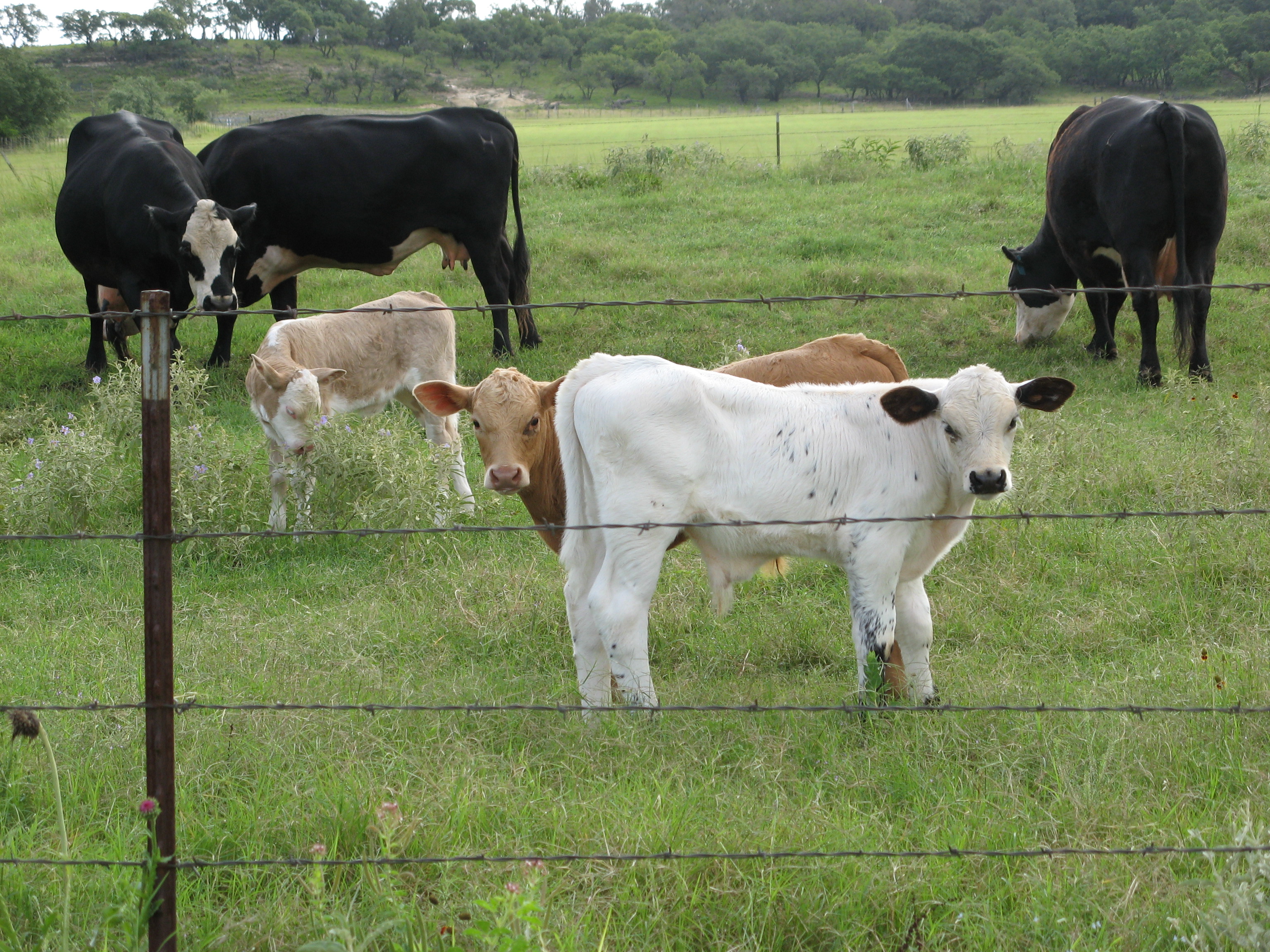
Two Longhorn cows and calf

Two Longhorn cows and calf

Paul Hayes wrote the following:

COWS

While we didn’t have any horses or cows ourselves, we lived on a dirt road at the edge of a very small town. So farm animals were all around me. In fact, the family of one of my best buddies, Bobby White (I think he was named after a quail), had a farm just down the road, and they had lots of animals. One day, while playin’ at Bobby’s place, he came up with an idea for the ages. He thought it would be a really great idea if we went and roped a cow. “heck, yes” I exclaimed with enthusiasm. Did I mention that I was the brainy one in my group of friends?

We dashed out to their barn. Remember, if it weren’t worth runnin’ to, then it weren’t worth doin’. Bobby climbed up on a horse stall and pulled a rather stiff rope down from a rusty ol’ nail on the barn wall. He jumped down into a cloud of dust and we proceeded to the pasture.

Now, bein’ the smart boys that we were, we picked a young cow are our first target. Bobby had growed up on the family farm and actually knew how to rope. Not livin’ on a farm myself, the only rope that I had knowed was fer jumpin’. We walked as close as we could get to our victim, and Bobby took his stance. He swung that rope around a few times and throwed it in the direction of that cow. Much to my amazement, and Bobby’s too I suspect, the lasso went over that cows head. As the cow jumped, the rope tightened. Bobby screamed for me to help and I grabbed aholt of that rope. We dug our heels in as far as we could and pulled with all the might that two boys of six years of age could muster. After a few harrowin’ seconds, the cow calmed herself and all seemed quiet.

But, the really fun part started with my next question. “Well, that was excitin’. Now what do we do?” After a few brief seconds of thought, which, as luck would have it, was not sufficient time to come up with a reasonable plan, Bobby said that, while one of us holds the rope, the other will crawl under the cow. Yep, you heard me right. Again, what six-year-old boy wouldn’t want to have that on his resume. Since there were only two of us, and since Bobby was already holdin’ on to the rope, he said I could go first. With not nearly the hesitancy of my first horse ride, I willfully got down on the ground next to the small cow. As I approached, I saw the rope tighten and I saw Bobby dig in for whatever might come. Wantin’ a good view of the excitement, I got on my back and began scootin’ along the ground under the cow. I am directly under the cow when I discovered that a six-year-old boy does not possess the strength to hold even a small cow in place. The cow jumped, kicked like a mule and then ran out into the pasture – rope draggin’ behind. I, on the other hand, laid breathless on the ground with hoof prints on the portion of my white Sears tee shirt that covered the center of my chest.

I had followed up my horse lesson with an equally successful lesson about cows. I am not certain, but I may have been rethinkin’ this cowboy thang at this juncture.

GUNS

Paul Dennis Harris was a boy who lived across the pasture from my house. He was a year older’n me so I, quite naturally, believed that everythang he said was as gospel as Sunday preachin’. I would come to learn that there are two voices that we hear in our lives, one is the voice of God, the other is the voice of Paul Dennis Harris. On this particular day, as I peered out the kitchen winder, I could see Paul Dennis over in the pasture playin’ with somethin’. I just couldn’t see what it was. That situation required a prompt investigation. As I approached, Paul Dennis displayed a pistol that he told me his grandpa said he could play with. I later doubted that the ol’ man, not havin’ been afflicted with brain damage to the best of my knowledge, knew anythang about the pistol caper. At six years of age, I knew nuthin’ ‘bout guns, includin’ the fact that they could lift a boy’s skull from his head if pointed in the wrong direction.

I have no idea what the caliber of the gun was. But it was heavy, and it was real. Paul Dennis suggested that we shoot a target, so he proceeded to set a coke bottle on top of a fence post. While I knew that that coke bottle was worth three cents down at the local grocery store, I was willin’ to forego that income for a new experience. Bein’ the nice guy that he was, he even said that I could shoot first.

Are you hearin’ a repeatin’ theme in these stories?

Well, by this time, bravery was my middle name, and I happily accepted the offer. He loaded the revolver with six bullets – five more, as it would turn out, than I would need to complete the experience. He then handed me the gun, stood back and covered his ears.

I’m six years old. I have no idea how to use a gun. Ne’ertheless, I took the pistol in my hand and held it up to my cheek just below my right eye. Takin’ good aim at that bottle, I slowly pulled the trigger. I am not certain what hurt worse, the powder burn on my cheek, the damage to my eardrums or the butt beatin’ I got from my dad when he found out. I immediately dropped the gun to the ground and ran home cryin’ like a cat in a rockin’ chair factory.

I learnt a hard lesson that day from the likes of Paul Dennis Harris. Age, as it turns out, does not necessarily equate to wisdom.

COWBOY?

Though I survived the age of six, my parents decided to move to Dallas before I could learn any more lessons about life in a small country town. I became a city boy whose only exposure to cowboys from that point on were the ones who played football on Sundays. Now, at the age of 56, I find myself living back in the country. However, it is safe to say that I will live my life as a cowboy vicariously through you.

Thanks for your contribution to my longevity.

Paul

A Backward Glance–Guest Blog by Paul Hayes

What a pleasure it is to receive a response to an item I posted on my blog. Paul Hayes recently sent a lengthy and thoughtful piece. A second part of his piece will follow. The satisfaction of impacting others is the most fulfilling aspect of having a blog. I hope reading my posts will prompt others to glance backward at their lives and recall similar fun episodes. If so, let me know. Thank you Paul for sending this piece.

Paul Hayes wrote the following:

Tom,

It is always a joy to read about life at Medicine Spirit Ranch. Undoubtedly, during all those years working in the medical community, you secretly harbored the desire to be a real-life cowboy. Now, after retirement from the city life, you get your chance to experience the cowboy life first hand.

Like you, I knew early on that I, too, wanted to be a cowboy someday. After all, what’s to know about horses, cows and guns? What follows are true accounts from my youth about my training to be a cowboy.

HORSES

Take my first experience ridin’ a horse. When I was near about six years old, my friends and I gathered at Ricky Robinson’s house for an afternoon of whatever we could find to do on a Summer’s day in our tiny little town. Randy Brewer, who lived a rock’s throw down the ol’ dirt road from Ricky, was the imaginative one in our gang. When he would enlighten us with one of his stories of famous relatives and such, we would tell him that he was just imaginin’ thangs.   However, on this occasion, he was the one who imagined that we ought to go saddle up their old mare and go horseback ridin’ around their backyard – much of which also served as Mrs. Brewer’s veg’table garden. Now tell me, what group of young boys wouldn’t take advantage of an opportunity like that. Each of us, decked out in out white Sears tee shirts and blue jeans, high tailed it over to Randy’s house to begin our cowboy experience.

Anytime we went from one place to another, it was always a race. We never walked a single place. If it weren’t worth runnin’ to, then it weren’t worth doin’.

The Brewer’s mare was quite old and very docile around us kids (we can thank the Lord for that little favor). Randy, we would come to learn, knew as much about horses as I knew about girls of the opposite sex at the age of six. Ne’ertheless, he managed to get one of those metal chompin’ thingies into the horse’s mouth so that we would have something to hang on to once we got on top. That, my friend, would prove to be the easiest part of this adventure into the world of cowboys.

Next came the saddle. I distinctly remember askin’ if we REALLY needed a saddle at all. “After all, I’ve seen injuns ride bareback on all the TV westerns”, I would proclaim. Wantin’ the real cowboy experience, by buddies quashed that idea quicker’n Paladin drawin’ his six shooter on a stage coach bandit. Ok, so herein lies the problem. We have five boys, each of which measures about 4 foot nuthin’, and a full grown horse whose back, though swayed, is taller’n all of us. But don’t you think for a New York second that such a small challenge would deter this group of would-be rustlers. No siree, Bob. With Randy holdin’ that leather strap thang and the other four of us standin’ on a rickety ol’ table that we found in the garage, we hoisted that saddle up onto that ol’ horses back – on about the fourth attempt, that is. We actually achieved the feat on the third attempt, only to discover that the saddle was on back’ards.

Now, not havin’ lots of deposits in my vast horse-knowledge bank, my misguided mind thought we was through. Some brilliant mind came up with the sayin’ “hold your horses” just for occasions like this one here. “Oh, no”, explained Randy. At this point, we were all willin’ to learn a thang or two from our friend, Randy. He instructed Tommy Wilson to grab aholt of the rope that was attached to the saddle and walk under the horse to the other side. Without hesitation, Tommy grasped that rope in his hand, ducked his head only slightly (he was shorter‘n the rest of us) and proceeded to traverse that horse’s belly. Well, as dumb luck would have it, just at that time, that ol’ horse decided to buck an’ come down on Tommy’s head like a big ol’ hay bale. We rushed to see the damage, but it was nuthin’ more than a couple of tears. Although Tommy recovered quickly and wiped the tears as if they weren’t never there, I feel certain that he had screws in his neck by the age of 30. He jumped up, grabbed the rope and handed it to Randy. Randy, again bein’ the horseman of our gang, ran the rope through a silver ring and pulled it about as tight as a six-year-old could pull. It was only a few minutes later that we would come to realize that the strength of a six-year-old may not have been sufficient for the job.

Well, the only thang left to decide was who would be the first of us to ride that day.   Country boys are just born with the innate wisdom of the democratic process, and we understood that the only fair way to decide that question was to draw straws. Randy grabbed his maw’s broom that was leanin’ ag’inst the garage door and he picked off five straws. He then pulled a pocket knife from his pocket (where else would one keep a pocket knife?) and he commenced to cuttin’ those straws so that one would be shorter than the others.

Now, we hadn’t yet got to the point in our cowboy development where bravery was fully developed. While nobody dared say, none of us was hopin’ to draw the short straw that day. As I recollect, Joey Andrews was the first to draw. His was a long one. Next was Tommy, and he too smiled as he slide a long straw from Randy’s now sweaty hand. As if written for a big screen suspense thriller, Rickey likewise tugged on a straw, revealin’ a third long one. Only Randy and I remained. As I reached for the straw on the left, Randy jerked his hand as if to say “not that one”. But, bein’ the brainy one in this group, I now knew exactly what I had to do. I reached for the straw on the right and tugged quickly. Randy laughed with delight as he exposed the remainin’ long straw, still in his hand.

Right at that moment, to my mind came another sayin’ that someone had made up just for such an occasion – “Never let ‘em see you sweat”. So as to demonstrate my bravery, the development of which took a small leap forward that day, I jumped up on that table and grabbed aholt of that saddle. “Now what”, I asked Randy. “Th’ow your leg up over the saddle and slide on top” he explained. Sizin’ up the feat, I explained in a semi-calm voice that “I need a boost”. Ricky joined me on that table and, cuppin’ his hands together, I placed my foot, and my life it seemed, in his hands. I then pushed my way up and onto the saddle. That ol’ horse, she barely moved at all. With a whole new level of accomplishment and confidence, I smiled and declared “I’m ready”.

As Ricky and Joey moved the table aside, Randy handed me that leather strap that, as I recalled from watchin’ westerns on TV, worked like a steerin’ wheel for a horse. Problem was, at six years of age, I had no idea how a steerin’ wheel worked. But, that didn’t matter, not one bit. This gentle ol’ mare took one step forward and the saddle and I began what seemed like a slow motion slide. With my eyes closed tighter’n a skeeter’s ass, I held on for dear life. When the motion had stopped, I was still holdin’ on to that handle-like knob on the front of the saddle, my feet now draggin’ the ground. The ol’ horse didn’t take nary another step, which was amazin’ considerin’ the roar of the laughter that had erupted from my gang of buddies.

It was, indeed, an inauspicious beginnin’, but I vowed to remain fearless in my quest for cowboydom.

Update to “Generosity Begins At Home”

Some time ago I wrote about a mama cow adopting a calf despite having her own hungry offspring. I had never before seen this occur and have learned it is very unusual behavior. Thought an update to this curiosity was needed.

The mama cow, bless her generous heart and sizable milk bag, continued to nurse both calves until they were yearlings. The calves grew into big, strong steers. I was proud when time came last week to take them to the auction barn. (Yes, I know what you may be thinking. Taking the grown calves to the auction barn is only a preliminary for 3-6 months at a feedlot and then a slaughterhouse. This is true enough. Yet, we need to remember how most of us enjoy a well marbled steak or a juicy burger. The animals are raised just for this reason not being, in any way, an endangered species.)

In any event I admired the two good looking steers when I dropped them off at the auction house. I also said a silent thank you that day to the giving mama cow. The result of this transaction; however, turned out to be surprising.

The first pleasant surprise was that I obtained the best price ever for the two steers. Several days later a second surprise occurred. A package arrived in the mail. In it was a a really fancy knife sharpener with a small plaque on it, notifying me that I had won the “top steers award.”

Imagine that: a calf that would have ended up a runt after losing his mama had instead been adopted by a generous mama cow. The two steers became the top steers at an auction last week of somewhere around 1000 head of beef. So as Paul Harvey used to say, “Now you know the rest of the story.”

Generosity Begins At Home

Two calves and one mama. She accepted an orphaned calf

Two calves and one mama. She accepted an orphaned calf

A few weeks back we unfortunately lost a mother cow. The calf was old enough, barely, to be weaned. Nevertheless, the calf turned out to have different ideas. Something remarkable happened.

Typically mama cows push, none too gently, interloping calves away from the milk bar. To our great surprise, we found both the cow’s own calf and the orphaned calf suckling the generous mama cow.

I have never seen this before, nor have I read about it. The general rule is that a mama cow identifies only with her own calf, something to do with smell. I suppose every rule has an exception and this one made me feel really and pleased for the orphan. Thought you might like to see this.

Life is good on the ranch.

“Mama Duck-Me” Guest Blog by Trudy Hutton

How did I become Mama Duck? Earlier this summer we and our neighbors decided to raise some Rouen ducks for our pond (known in Texas as a “stock tank” or just “tank”.) We have raised ducks before—five or six years ago– but they have all disappeared through old age or predators and we decided we would enjoy them again.

The ducks are ordered from a breeder and come via mail at one day old. The post office calls first thing in the morning…and I mean first thing, usually about 6:00 a.m….that there is a cheeping box of birds to be picked up AS SOON AS POSSIBLE.

113-1388_IMG

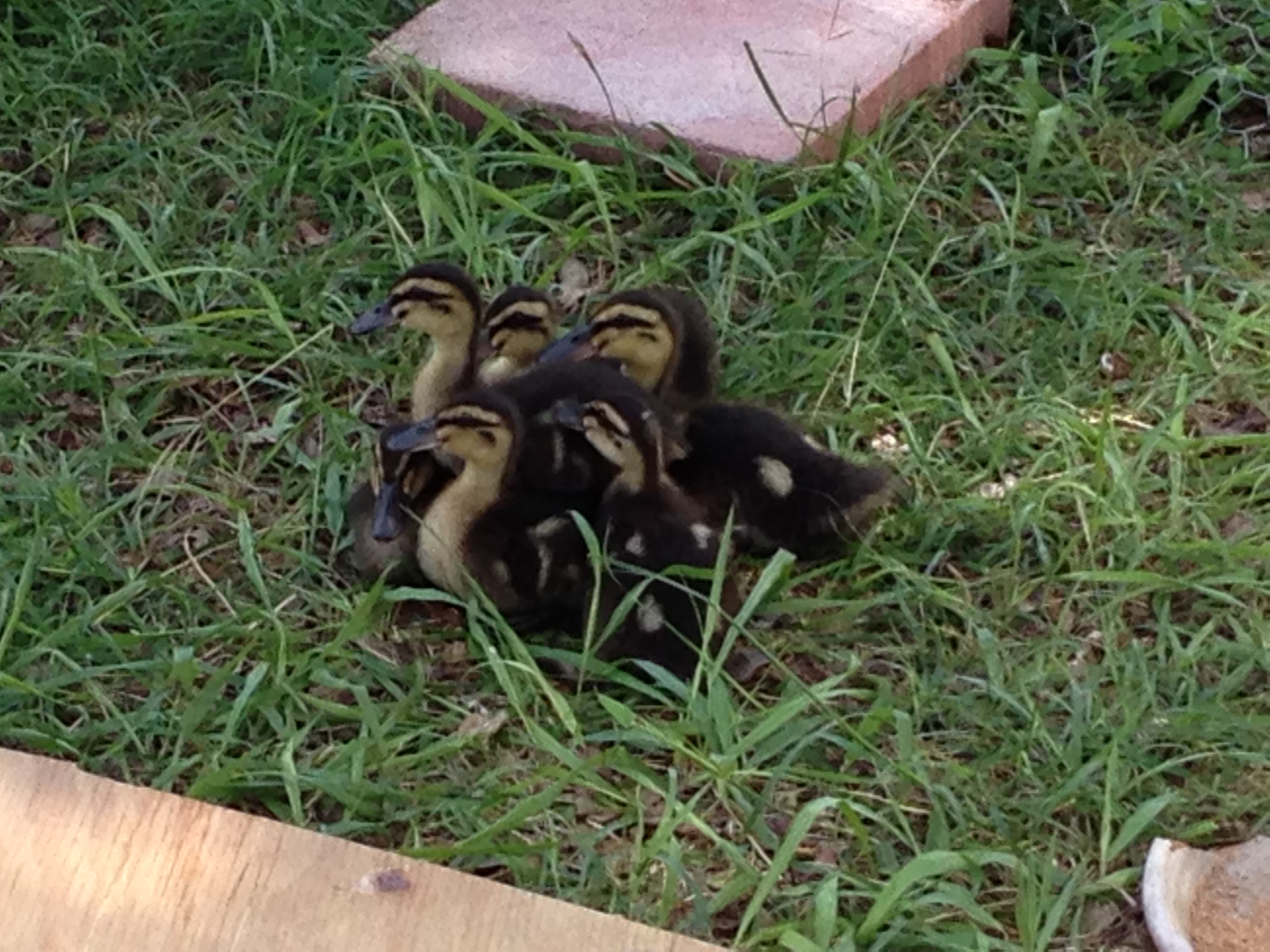
Our ducks, six cheeping handsful of down, lived for the first week in the laundry room in a large cardboard box. They had a heat lamp to keep them warm and we lined the box with newspaper to keep them semi-clean They are messy, smelly little things; the box needed to be cleaned daily, lined with fresh newspaper and food and water dishes refilled. Ducks like water. They really saw their water dish as a small swimming pool. Every morning about 4:30 they would begin cheeping for fresh water and food. Tom was the one who heard these early morning protestations and got up to fulfill their requests. Enough of that. The second week we moved them out to the shop and into an old poultry cage we had before used for our birds. Out of earshot and smell range (not to mention they were quickly outgrowing the box) we slept a little better.

We built a nice round chicken wire pen inside the fenced garden and filled a small wading pool for their swimming enjoyment.

IMG_1305

DSC_0167Although they were growing fast, we had to build “duck ramps” for them to be able to get into the water and we placed a rock “island” in the middle of the pool for them to rest on.

Every morning we gathered the ducks into a cardboard box and transported them to the outdoor pen. In the evening we rounded up the ducklings, after chasing them around the outdoor pen and putting them in the box to transport back to the poultry cage. (Making the outdoor pen round was not a good idea – no corners to catch them in.) They are very fast little devils! I would “quack, quack” to reassure them that it was Mama Duck, and hopefully convince them to follow me.

After the second week the ducks had outgrown the small wading pool, so we added a larger one and took down the chicken wire pen. They now have full roaming rights to the entire garden area.

IMG_1312

By the end of that week, they had the morning and evening routine down. We no longer have to transport them in a box between the garden and their night-time pen. Open the door to the shop and the cage door in the morning and I could lead the ducks out to the garden, quacking as we went. Tom says I flapped my wings, too, but I deny it.


After a few days I didn’t even have to do much as far as leading or herding. Now when we open the door to the poultry pen, out they march, in a close group, on their own.

About sundown we reverse the routine, usually following behind the ducks, as they seem to know it’s time for bed. They head straight into the shop and the evening safety of the poultry pen. A few nights ago, I was a bit late going out to bed them down and found they had already taken themselves inside for the night!

IMG_1314

As the ducks grow we may have to find a bigger swimming pool. But before too much longer they will be big enough to move down to the tank and be on their own. Rouen ducks are identical in coloring to Mallards, but unlike Mallards they cannot fly more than 20 or 30 yards. By the time they grow enough to move to the tank, they will be able to swim into the middle of the water for safety from predators.

I still “quack, quack” when I feed them daily in hopes that when they do make the move to the tank, it will only take a few “quacks” to call them up to feed. We’ll see how the transition to the tank goes. The last time we had ducks ready to move to the tank, I walked down to the tank, quacking as I went, with 6 mostly grown ducks behind me. However, I barely got back to the house when we heard them quacking at the back gate. They had not only followed me down to the tank, but evidentially thought Mama Duck wanted them to follow her home. Time will tell about these little quackers..

Hay’s In The Barn

How affirming those words, “hay is in the barn”.  Have you ever wondered how hay is cut and baled? We cut our hay fields this week and baled both round and square bales. Below I share the process of carrying out this important ranch activity.

Two months ago our fields were brown and dusty. After our lengthy drought the fact that we obtained a cutting at all is fortunate. The process began two months ago.The rains this year came at the right time, namely just after we had fertilized the fields and then subsequent rain was well spaced till harvesting.

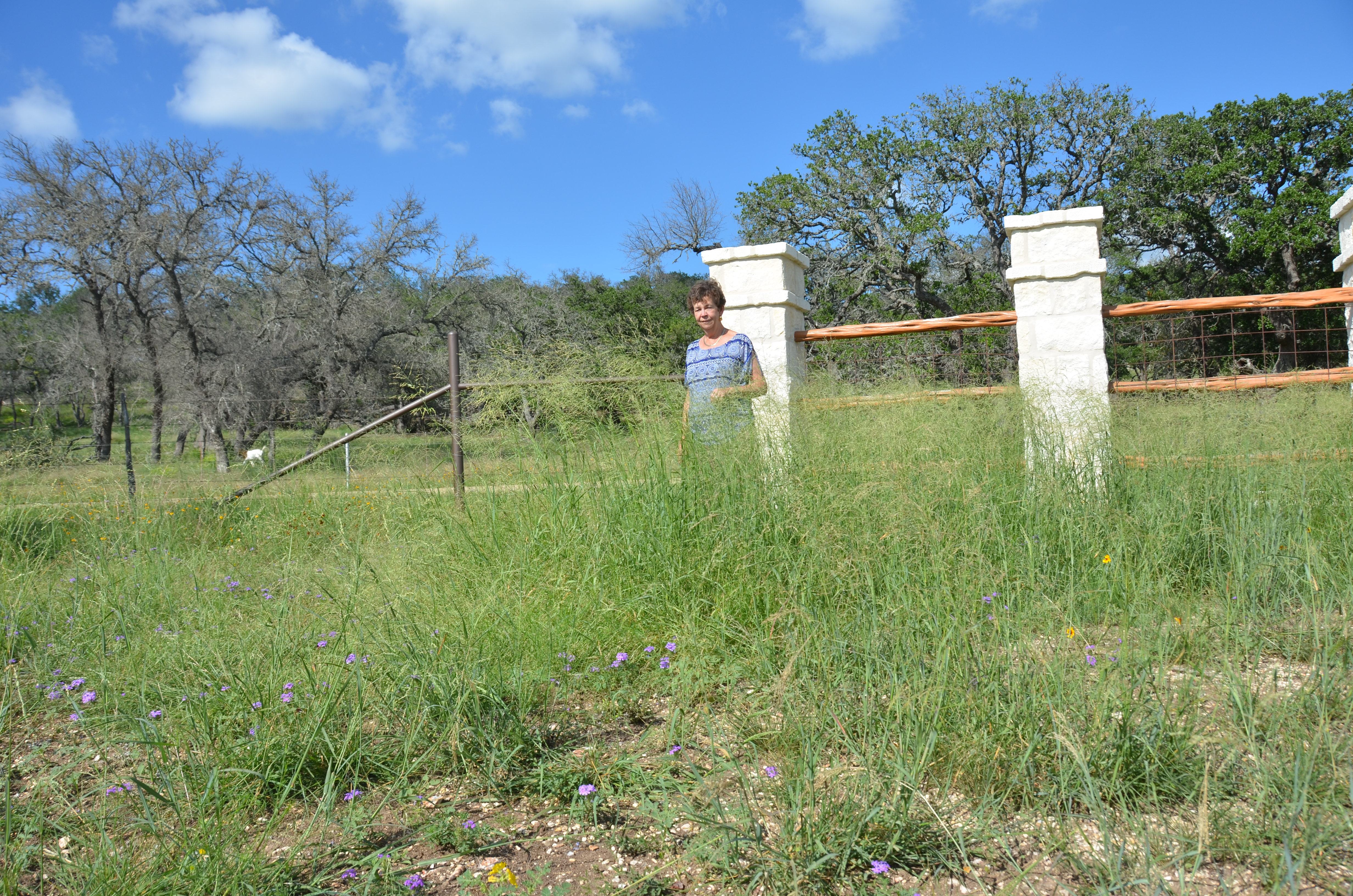
Trudy in Klein grass field

Trudy in waist high Klein grass field

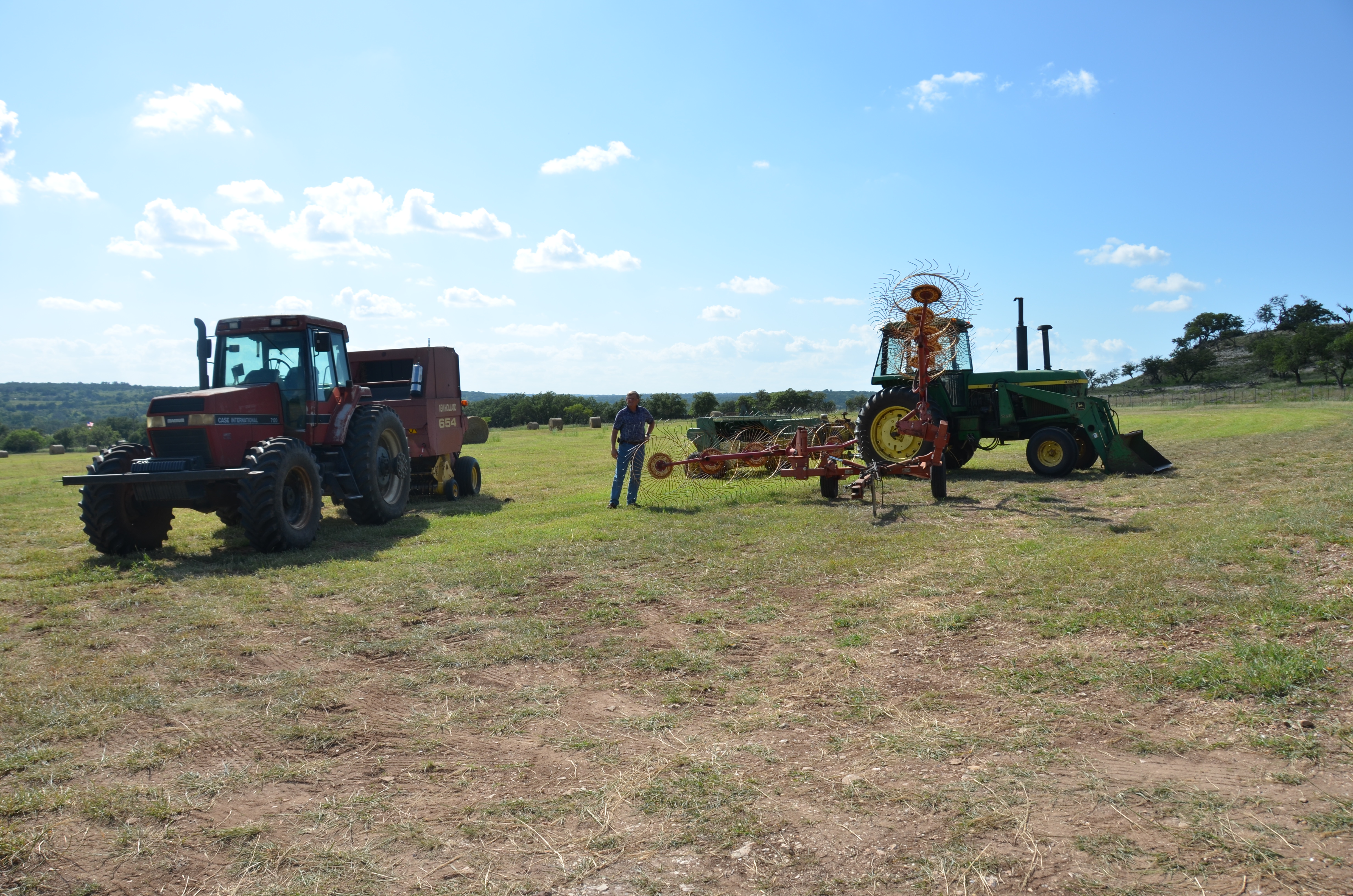
Being a small operator, we don’t own the cutting, raking, and baling equipment. Instead I hire someone with equipment and pay a per bale charge. The charge for cutting and baling our hay is substantially less than buying it, especially so during our recent drought years.

Yours truly with baling equipment

Yours truly with baling equipment

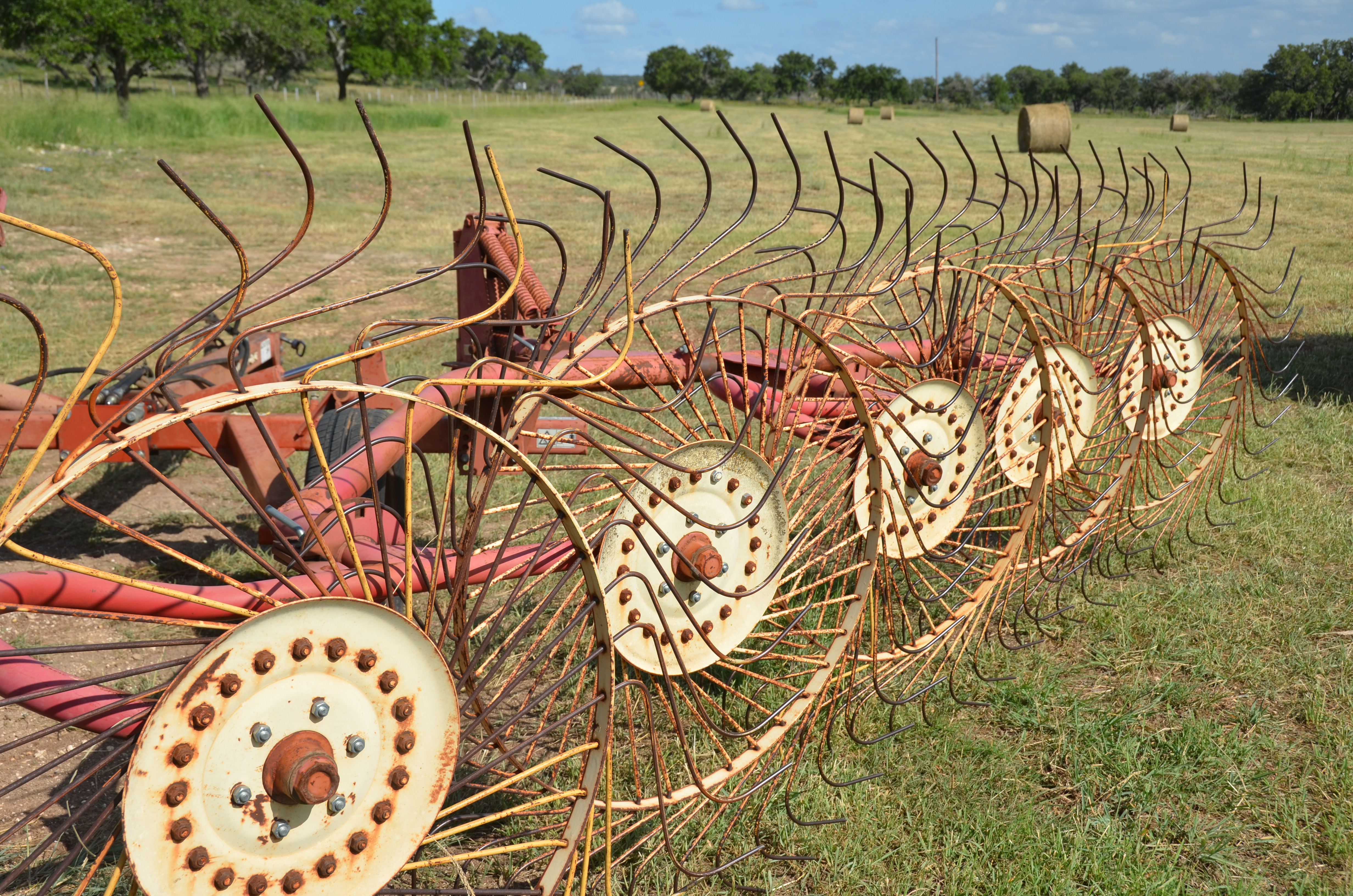
When the hay has grown and begun to head out, the tractor pulls the cutter through the fields and lays it down, much like a giant scythe. The hay then needs to dry for several days. Because of the threat of rain this year, we baled the Klein grass into bales before it had completely dried. Once the hay was cut and dried, the tractor pulled a giant rake through the fields, creating a large snake-like furrow of hay. Next the tractor pulled the baling machine through the field and picked up the rows of grass,  turning it into thousand pound round bales or sixty pound square bales. The machine amazingly ties the bale tightly with twine or wire to hold it in place.

Hay rake

Hay rake

Trudy with Hay bale

Trudy with Hay bale

Given the higher than normal moisture content of the grass this year, we will leave the bales in the field for a week or so to dry before moving them to the hay barn. This interval diminishes the chance for spontaneous combustion. Yes, instances have occurred where barns have burned down due to prematurely enclosed hay bales.

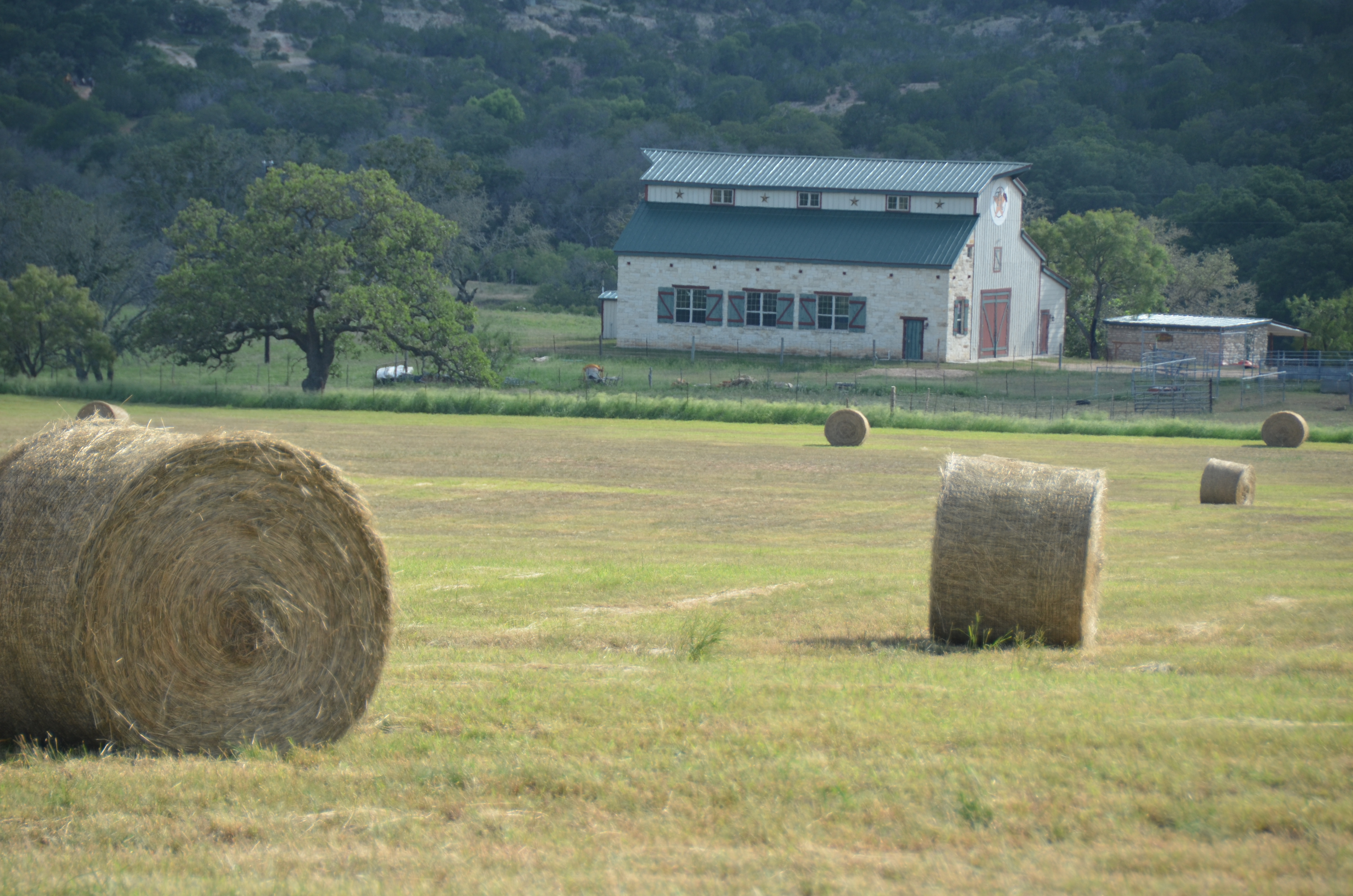
Hay bales and Hay Barn

Hay bales and Hay Barn in distance

Next week we will move the bales (both the large round ones for cattle and the smaller coastal square bales for horses) to the barn to store for the winter. Placing  the hay in the barn is a particularly satisfying time, knowing the animals will have ample hay during the non-growing season.

Prospective consumers of hay

Prospective consumers of our hay

Cattle Auctions

The date we sell our calves at auction is the best day of the ranch year–it is also the worst. How can this be?

As anyone knows who has been to the grocery store lately, beef prices are high. This reflects in the prices ranchers receive at the sale barn. Last week’s prices for a load of six calves were our personal best. We received about twice the usual price (this is a good thing as cattle ranching for a long time has not been profitable). The sale is the payoff for a year of raising the cattle, vaccinating them, castrating the bull calves, being a careful steward of the herd, putting out hay during the winter, carefully managing the pastures, and dealing with any veterinary problems that come up. The rancher obtains a bonus for quality as well as existing market conditions. We feel this year like we hit the jackpot!

Young Calves

Young Calves

CALVES IMG_0191 New calves

I enjoy hooking up the cattle trailer, loading the calves, donning my Stetson and proudly driving to the sale barn. This provides a fitting finale to the year’s hard work.

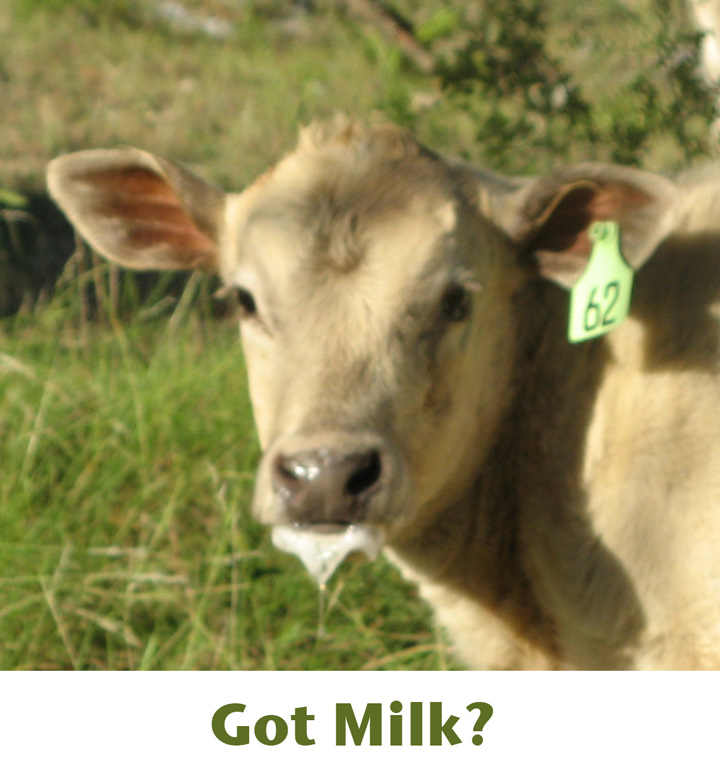
While sale day makes for the best day of the ranch year, parting with our calves is bittersweet. Frankly it hurts to send our critters away. After all, these are the baby calves that were once so cute, and we watched gain for the first time their wobbly feet. They entertained us with their joyful scampering, insatiable curiosity, and calf games. A few calves we have had to bottle feed when their mamas were unable or unwilling to act as the milk bar. Anyone who doesn’t bond with these hungry little fellas with their big brown eyes and who suck so vigorously at the bottle must, in my opinion, must have thwarted emotional development. There is something about their appreciative stares as they drain the giant milk bottles.GOT MILK 1

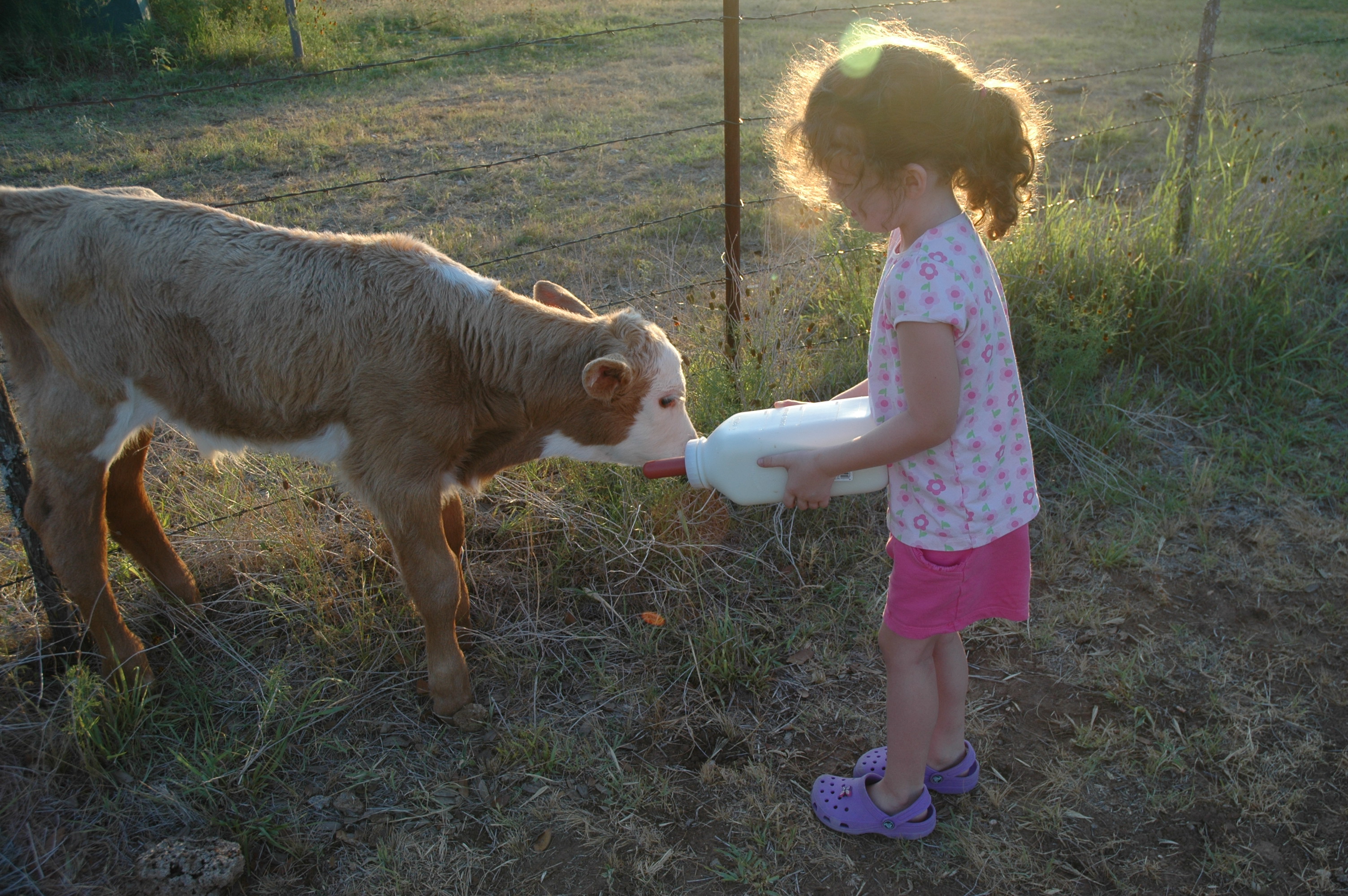
Granddaughter Ramsey bottle feeding a calf

Granddaughter Ramsey bottle feeding a calf

We remind ourselves at sale time what calves are raised for. They are not endangered species and are raised to feed people. As a ruminant, they have the amazing ability to convert grass into a nutritious meal. By the time we sell them, they have grown to 500-600 pounds and aren’t nearly as cuddly as they once were. This helps. Also assisting the separation is knowing they will go on to feedlots for another three to six months and eat all they want and fatten up before rendering up their steaks, hamburger, and fajita meat. Knowing others will benefit from the nutrition they provide and enjoy a tasty meal helps as well.

So sale day brings about mixed emotions for us. We appreciate the payday but suffer a tinge of sadness sending off our calves. We hope one day you will enjoy some exceptional beef from Medicine Spirit Ranch.


Guest Blog by Paul Hayes

Tom,


This morning, I read some of your entries on Views from Medicine Spirit Ranch. I was intrigued and entertained by the few writings that I read, choosing to preserve some of the others for my reading pleasure at a later date. However, there was one entry that, for me, really struck a chord, stirring feelings and memories from days long since passed. The entry was “Reflections on Greenville, Texas: The Blackest Land And The Whitest People”.


You see, in the early 60s, my family and I were living in the very small town of Emory, Texas, located just about 30 miles southeast of Greenville. Population: just over 500. Though very young at the time, I have vague recollections of that slogan. These memories probably come from an occasional trip to eat barbeque at the joint in Greenville that had sawdust on the floor. Being that I was but a youngster, I recall more about the characteristics of certain places than the actual names. Nevertheless, that memory was there, and it was brought fully to my consciousness by your story.


There are two memories that really flowed to the forefront as I sat thinking of those days in that small town in northeast Texas.


Racism in the South


I grew up in the south, as did my parents. I have never considered my parents, nor my grandparents, to be racist in any way. However, I do recall the use of the “n-word” during my upbringing. Even to this day, I will, on occasion, hear my dad or my in-laws use the word. Growing up in the south during the 1920s and 30s, being different than black kids, even being BETTER than black kids, was simply an accepted norm. Right or wrong, it was a sign of the times in America. It was an aspect of life that, though dark, was years away from any realization of meaningful change.


During my youth, my parents and grandparents would use the term much as they would use any other identifying noun. It seemed, during those days of my youth in the early 60s, to be no different than referring to a man as a “plumber” or a “Baptist”. It simply identified the person with some aspect that may or may not have been immediately apparent.


As I said, I do not consider my family elders to have been racists. Case in point: Well before my birth, my grandfather, who was an auto mechanic, was working diligently in his shop one day. Into the shop entered a young, black boy appearing to be in his mid-teens. The young man approached my grandfather and indicated that he was a very poor boy and needed a job to help his family. It took but only a minute for my grandfather to understand that this young, black man was mentally handicapped. On that day, J, C, Harris would become an employee in my grandfather’s repair shop. He would quickly learn the name of every tool; he would clean them after use and place them back in their proper location after use.


We never knew exactly how old J. C. was. But, my dad was a young teenager when J. C. first came around, and they could tell that he was just a couple of years older than my dad. J. C. would become, and remain, not just an employee, but a part of the Hayes family until his death when he was somewhere in his 60s. I remember going to his funeral. I recall feeling just how sad it was that there were only a couple of members of his own family, the Harris family, in attendance. But I was proud of the fact that my family was there to give J. C. a proper send-off. My dad and his sisters, even my grandmother, who had always had a love-hate relationship with J. C., cried like babies for the loss of their “brother” and “son”. My grandfather, who had also grown to love J. C., had died a few years earlier.


So, I have learned to forgive my folks, and even others of their generation, for their verbal indiscretions. I know in my heart that they are capable of loving their fellow man, regardless of the color of his skin.


They grew up in a different environment than I did, and I, in turn, grew up in a different environment than my own children. On rare occasion, I will still hear my dad use the “n-word” in front of one of my daughters, and they are quick to chastise him for what they deem to be his insensitivities. It makes me proud to know that they will stand up and correct someone for whom they have such love, admiration and respect.


Times have, indeed, changed. We have been witness to that. And, like the sign that once hung on Main Street in Greenville, some things need to go into the shop for repairs, never to be seen again.


More Lessons from a Southern Upbringing


Please allow me to refer you to a very specific date: November 22, 1963. It is a date that you, no doubt, recall. I was but 5 years old, but it was a date that, for all Americans of the time, will reside in our memory banks as the day our country went through a dramatic change. My dad, who was the county agent for the U. S. Department of Agriculture in Rains County, had come home for lunch as was his usual routine. Following lunch, he and I took our usual position lying on the couch in the living room. For the next five minutes, I would scratch my dad’s back. I would keep my eye on the second hand of his watch to ensure that he got only the allotted amount of time. At the end of the five minutes, he would reach into his pocket, pull out a nickel and give it to me. For the life of me, I have no idea what I did with those nickels. I do not recall having any reason to spend any money at that time of my life. Entertainment for my brother and me was usually comprised of gathering with friends and strolling through the old cemetery, or going hiking in the nearby woods, all of which cost exactly nothing.


But this day would be different. Following our daily business transaction, my dad returned to work. The black and white TV in its large wooden box was still on. Suddenly, a man whom I had seen many times before, came on the TV. I would later recall that his name was Walter Chronkite. He made some sort of announcement. Though I heard his words, I did not really understand the meaning. But then I looked at my mom, standing there in front of the TV, and she began to cry. Though I did not understand what was happening, my mom had suddenly become very sad. For that reason alone, tears began to well up in my eyes. She immediately got on the phone to my dad and told him that some man had died. Within minutes (Emory was a very small town, so everything was within minutes), my dad was back home and consoling my distraught mother.


Again, at five years of age, I did not understand what had happened, but I filed that memory away and, a number of years later, I would come to appreciate the significance of the events of that day. I grew to understand that, not only had my mother cried that afternoon, but my whole country had mourned; and they would continue to mourn for years to come.


One of the things that I learned that day, even as a young boy, is to file away the memories of events that seem significant, even if you do not understand exactly why. Experience, I would come to realize, is the great teacher, and lessons are not always immediate. Sometimes it takes time and reflection to learn life’s lessons.


It would be another 38 years before I would witness something on TV that would so materially impact my life and the lives of those around me. September 11, 2001 would become, for my children, that moment in time, that memory, which would change the way they view life. My children were a bit older at the time, and the impact was more immediate. But that day would become their November 22.


I firmly believe that we are all products of our experiences. While some events will resonate with great sadness, they are, nonetheless, key moments that shape who we are as individuals; possibly more so than all of our other experiences. These are the moments that define who we are and what we will become.


In November of 1965, Dallas would become my home and would remain so for the next 15 years. To this day, I take pride in knowing what happened there and how I was able to take something positive from such an overwhelmingly unfortunate experience.


Thank you, Tom, for sharing your thoughts and stirring old memories of my own.


Paul

King Edward Vlll and Wallis Simpson: An Historical Snippet

Most are familiar with the story of King Edward Vlll abdicating the British throne to “marry the woman I love”. Wallis Simpson was an American socialite with two living prior husbands who became the mistress of Edward, the then Duke of Windsor. When he became king, she wished to divorce her husband, marry Edward, and become Queen of England. Naturally this shuffling of bedrooms created quite a stir in the UK and its Dominions.

OSTENSIBLY to avoid a constitutional crisis, the king abdicated to marry Mrs. Simpson, as the British press was fond of calling her. In August of 1939, Edward and Wallis, Duke and Duchess of Windsor, boarded a commercial liner going from Lisbon to the Bahamas. There they would sit out the war, carrying out mostly ceremonial functions in the British territory.

According to a now deceased close family friend who worked for the U.S. State Department , another reason existed for their virtual exile that Wallis tartly characterized as her own “Saint Helena” in reference to Napoleon’s six year exile by the British. This family friend, Fletcher Warren, shared this story with me one evening years after his retirement from the State Department. I never forgot his shared insights or his gentle nature.

Fletcher Warren who went on to a distinguished career as U.S. ambassador to several major countries described certain curious facts about the Duke and Wallis Simpson while in the Bahamas. He had been asked to monitor Edward and Wallis during their stay there. While acting as a liaison with the U.S. Department of State, he also was tasked with watching their activities and those with whom they fraternized.

While both Edward and Wallis had been suspected Nazi sympathizers and had ongoing relationships with Nazi officlals, to my knowledge no documented conspiracy with the enemy has been previously shown.

Mr. Warren described to me finding cryptic messages intended for Nazi spies sewn into Edward’s and Wallis’ clothing that was going out for cleaning. Their ruse to provide sensitive information to the enemy was discovered by Mr. Warren and the messages read. These actions were directly against the interests of the UK and would have represented treason. But what does a government and its allies do with an ex-king and his wife, a Duchess, who are so involved?

One thing would be to maintain a cover story related to the Duchess being unacceptable because of a lesser offense, say being a three time divorcee, and then encouraging the King to abdicate. Such a story of marital infidelities appealed to prurient interest but left the royal family unscathed from charges of treason. Such a charge conceivably might have brought down the British monarchy.

Based on Mr. Warren’s information, I strongly suspect  suspicions of Nazi leanings by Edward and Wallis were precisely on target. Their friendly dealings with Nazis and their statements of support for Nazi Germany after the outbreak of WW11 speak to this end. It is clear that the British government did not trust Wallis Simpson. The snippet of information shared herein suggests they also did not trust their own, recently abdicating king.

Makes for an interesting snippet don’t you think?

Reflections on Greenville, Texas: “The Blackest Land And The Whitest People”

GreenvilleSign-1

One benefit of a few gray hairs is having had the time to see how beliefs change over time. Recent discussions with my brother-in-law, Paul Plunket, prompted my interest in Greenville, Texas’ infamous slogan–The Blackest Land And The Whitest People.

In 1957 or 1958 I first learned of this sign, crossing as it did a major street in downtown Greenville. My family had relocated to Richardson, Texas from the Kansas City area and would twice a year load up the 1950 blue Buick with its Dynaflow transmission and travel to Kansas City for the Christmas holidays and summer vacations. Greenville lies about sixty miles to the northeast of Richardson and is the county seat of Hunt County.

It was during one of these periodic family migrations that I first saw the sign and quizzed my parents about its curious message. Was it not flatly out racist? This sign bothered me then as it does now. The history of the sign proves interesting but the intent of the locals may have been different from what I originally assumed.

Will N. Harrison, the so-called “Land Man” of Greenville, created the slogan. Harrison’s business card that bore the slogan caught the eye of President-elect Woodrow Wilson. Harrison and his two sons who were leaders n the Greenville Booster Club and who spent substantial time in Washington, D.C. pushing policies and programs benefiting the hometown community. The whole time Will N. Harrison was passing out his cards with the unique slogan-one that surely grates on current sensibilities and haunts Greenville to the present day.

To honor Will N. Harrison, the city put up the famous banner in Greenville in about 1913 and had the slogan painted on its water tower. All of this rapidly spread around the country and the world.

Years later when I was courting my bride-to-be, Sarah Gertrude Plunket from Greenville, I delicately brought up the subject with her family. I learned Greenville sits astride a broad belt of rich black land  favorable for growing cotton. The early Greenville economy had been based on cotton, both its production and shipping. This part, namely The Blackest Soil, made sense.

The second part of the slogan, “The Whitest People” proved harder to swallow. To the locals “white” inferred good or pure, not racism per se. My brother-in-law, Paul Plunket, claims to having used the local interpretation of white when discussing the sign for almost 50 years and has yet to have anybody outside Greenville, buy it. Nevertheless, to family members in Greenville, this interpretation seemed  to make sense or at least less threatening to the reputation of their beloved hometown.

I rush to the defense of my family by marriage. After all in the early part of the 20th century, Trudy’s grandfather, Paul Plunket Sr. hid the local Catholic Priest at his lake house from the Ku Klux Klan. This defiance of the Klan risked recriminations had the good padre been discovered camping in the Plunket’s attic. While products of their age, Trudy’s family in general had more progressive views on race and religion than many other Greenville-ites. Regrettably use of the n-word in the community remained prevalent in the 1960s.

The infamous sign was removed int he 1960s following the request by then Texas Governor John Connally. Trudy maintains the local story in Greenville was the sign was taken down for repair and, amazingly, never reappeared. Was this the politically palatable way to remove a sign under attack by “Yankees” and out-of-towners?  The sign by then in the racially charged atmosphere of the 1960s had attracted great and unwanted national attention.

Maybe “white” had the connotation of pure and good in the early part of the 20th century. Likely little appreciation existed that its antonym, “black” must mean its opposite. Racism was institutionalized at the time and racial sensitivities were not developed to where they are these days. In any event sensitivity toward the feelings of others and fostering tolerance for the differing views and trying not to offend may be the takeaway message. I would welcome your thoughts.