My Writing Process

One frequently asked question readers have asked since publishing Carrying The Black Bag is about my writing process and any efforts utilized to foster creativity. I’ve decided to add some thoughts here on my blog to answer my readers more fully:

Yes, some authors do goofy things to stimulate their creativity. i’ve known some and read about others. The superstitious may choose to sit only in a specific chair or drink only one brand of tea. Others play up-tempo music or stirring classical works. Admittedly, I’ve been known to don a cap (my Greek fisherman’s cap’s my favorite) to prime the creative juices. But the goal for each author, no matter what the idiosyncrasy, is to achieve a creative fervor whereby the characters take command of the story and  fingers simply race to keep pace with surging thoughts.

For me I appreciate sitting before my word processor with a clear mind, a comfortable chair, and an exciting idea. I usually outline the story before beginning it. This isn’t an absolute but generally I find outlining helpful. I try and determine what the chapter requires for plot or subplot and then with trepidation shove off into the unknown.

Nothing inspires fear more in writers than a blank page or screen. Once immersed in the story, my pace inevitably picks up. Usually after the first draft I simply hate it. I often think what I have written is not fit for bathroom walls. It is not until  many more drafts later that I begin to like it even a little bit.  I 22109118then put it “in the can” for awhile. Usually after a week or so, I am able to spot additional flaws and weaknesses. I then adjust the story, much like adjusting a recipe to taste, substituting stronger verbs, adding apt similes/metaphors, and creating further descriptions.

The next stop for me on this literary journey is my writing group. Our group of five writers has met for many years and by now has developed a sense of trust. While we possess vastly different styles and genres, the feedback never fails to benefit my story. Soon thereafter I make the additional changes. After a final read through with minor edits I may write THE END. If the writing project is particularly important I may ask a beta reader for his/her thoughts. These are extremely valuable folks who must like your writing and be anxious to share their precious skills.

The question among writers that repeatedly comes up is whether the spouse should act as an informal editor or serve as an alpha reader. The usual response and one to which I hardily agree is NO, absolutely NOT! Having said that, almost every author I know or have read about uses (abuses) their spouse in this way, so long as he/she is halfway literate. I fully recognize this marital extortion is totally unfair to my spouse. In general the writer’s wife or husband feels torn between being supportive and being honest. To this I say, “tough.” No one ever said marriage would be easy!

So yes, Trudy regularly reads my stories. I ask her to do this when I am simply written out or else in need of a fresh eye. She also is good at word choice and grammar. Sorry Trudy. Such editorial services I’m sure must have been hidden in the fine print of the marriage contract.

My inspiration often springs from my surroundings and experiences. I love to tell stories. I love to watch people and animals and try to figure out what makes them do what they do. I love seeing people in extraordinary circumstances do extraordinary acts (this is the watermark underneath my patient stories  in Carrying The Black Bag). These stories show real people demonstrating courage and perseverance that, in some instances, they never knew they possessed. They tell us something good about the nature of our humanity.

Animal behavior also strikes me as overlooked for the substantial insights it provides for human behavior. I love animals. Maybe that is why in college I majored in Zoology. It wasn’t simply because it was a good Pre-Med major, and Chemistry, the other option, held for me no allure.

Much has been written on the creative process. I’m convinced creativity steals into the picture and cannot be forced. When it hits me, it does so unexpectedly much like a pigeon dropping. A rested mind, a beautiful scene, and a tickling of intellectual stimulation all enhance my potential for creativity.

Since the writing process per se is language-based, it is is strongly left brain. However, sudden insights like solving a problem or flashes of intuition come from the right brain. This  ability to perceive a solution requiring synthesis is right hemispheric and cannot be arrived at verbally. To write well, both sides of the brain need to work together. To paraphrase and alter the old Greek saying, we need a strong left hemisphere and a strong right hemisphere. That is, the brain must process verbal material, but also be able to discern some broader interpretation in order to tell a good story.

I believe this to be true, and try to put this into practice. And now so much for superstition or goofy acts. Now where was it I laid my Greek fisherman’s hat.


More Early Praise for Carrying The Black Bag

My book, Carrying The Black Bag: A Neurologist’s Bedside Tales, recently appeared in bookstores. This is particularly gratifying as there had been several unavoidable delays due to exceptional circumstances at the publisher. My book is the culmination of years of hard work. I am most gratified by how it’s been received by both individual readers and reviewers.Carrying the Black Bag book

Glen Dromgoole recently contacted me and asked if I would lead off the Texas Author’s Series March 7 in Abilene. I am excited to be a part of this effort featuring five authors over a period of months. It will be held at the Abilene library.

Glen Dromgoole who writes a column for multiple newspapers in Texas on literary matters recently  reviewed my book. I have attached the link below and love his review. If you are in the area, hope you will join us for the event. It should be a lot of fun. Below is the link to Dromgoole’s review.

http://lubbockonline.com/books/2015-12-27/dromgoole-huttons-stories-show-compassion-insight-humor#.VomiNvEsYZ0

2015 in review

The WordPress.com stats helper monkeys prepared a 2015 annual report for this blog.

Here’s an excerpt:

A San Francisco cable car holds 60 people. This blog was viewed about 3,000 times in 2015. If it were a cable car, it would take about 50 trips to carry that many people.

Click here to see the complete report.

Ranch Mistakes Are Not Unusual, Just More Painful

Perhaps it’s the time of year or my advancing age, but I find myself lately reminiscing more. As they say, “Some of the best memories were not always the best experiences.” Such was my first major injury on Medicine Spirit Ranch.

It went something like this. The day was warm and welcoming. Trudy and daughter Katie were enjoying the lovely weather but chose to do so sitting.  I, anxious to practice horseback riding, saddled Doc, our gelding, andwished to enjoy the beauty of the day from his broad, well muscled back.

I rode Doc in a  pasture nearby the barn, enjoying the day and the ride, while Trudy and Katie sat chatting amiably on a nearby hill. Feeling I could manage a bit more adventure, I urged the horse into a trot and then on into a gallop and began to race across the pasture.

What I had not planned for was that Doc took issue with me bouncing up and down on his back. Mid-stride and without warning he bucked me out of the saddle and over the saddle-horn.  To my considerable surprise, I found myself riding along with my arms frantically searching  his head and neck for something to hold onto.

Realizing I would not long remain balanced in this precarious position and with Doc still loping through the pasture, I struggled to inch my backside down his neck and back over the saddle-horn. Trying to clear the saddle-horn felt akin to backing myself over the Himalayas. It just wasn’t going to happen. I don’t know how jockeys maintain their racing, butt-up, position but at least they have stirrups, something I  was sorely lacking at this point.

I recall slowly slipping sideways from his neck and having a flickering thought to look for a soft spot on the ground. After that I have no further recall.

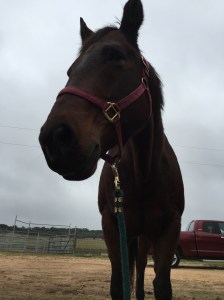
I regained consciousness on the ground experiencing terrific pain in my neck, head, and right arm. My view from the ground was something like the picture below with me looking up into the flaring nostrils of my horse.

"I told you my back hurt."

“I told you my back hurt.”

It was only later when the vet found the calcium stones in Doc’s urethra which he referred to as beans that I understood the role his painful kidneys had played in my unplanned departure from his back. The pressure on his kidneys from back pressure must have hurt him and my bouncing up and down on his back had increased his discomfort still more. Doc had, under the circumstances, chosen to remove the source of his increased pain (me) although by doing so directly adding to my own.

I imagine Doc looking down at me on the ground thinking something like, “So didn’t I tell you my back was hurting when you foolishly decided to saddle me?”

As for me, my broken arm was later set, placed in a cast, and it ultimately healed. My jammed neck recovered as well. As for Doc following this event, he received twice yearly bean removals from his urethral sheath and urethra. Since that time he’s never bucked again, making both him and me happier.

In addition to the broken arm and jammed neck, I’ve encountered while working on the ranch a ruptured disc in my low back. This resulted from trying to man-haul trees from the creek (not my finest day or decision). This landed me in bed for six weeks. I’ve also been run over and rolled by an irate mama cow. Oh yes, and there was also the time a cow tossed me out of the cow pen. For comparison sake, I never in my long neurological career received a single injury while swinging my reflex hammer!

As mentioned earlier, this is now a great memory but was a bad experience!

Guest Worker Program at the Ranch

IMG_0421

A new face temporarily resides at Medicine Spirit Ranch. No, Curly, our white Charolais bull didn’t get a black dye job nor did he lose 800 pounds. The Black Angus bull in the picture belongs to our good neighbors, Steve and Carla Allen and goes by the politically questionable name of “Sambo.”

The bull is staying for three months to breed with my heifers. Since they are first time heifers, we needed a small bull. Hope to sell the bred heifers for a good price in the spring.

The vernacular calls Sambo a “working” bull. Now guys, how much work can it really be? He has five heifers to breed and plenty of time in which to do it. No pressure here!

Lets see- he has plenty of grass or hay, range cubes, clean water, and five heifers. Does this really sound like work to you? And we refer to it as the “Life of Riley” but in reality it’s the “Life of Sambo.” He seems happy in his work.

We’il see how this breeding experiment works out next spring when the heifers are pregnancy checked. Meanwhile they will frolic in the most gorgeous weather we have seen in awhile.

I did a little research on Black Angus. They originally came from the shires of Aberdeen and Angus in northern Scotland. The cattle from Aberdeen were affectionately referred to as “hummlies” and those from Angus were called “Doddies.”

The transfer of Angus to the States began in 1873 when four Angus bulls were imported to Kansas. Over the next 12 years some 1,200 Angus beef cattle were imported and they have become one of the most popular breeds of cattle in the USA. They are especially prized in Japan.

They are naturally polled (meaning they have no horns) which for anyone like me who’s been bonked by a Longhorn’s horn sounds like a real plus.

Crashing Into The Digital Age

15998415

Thanks to Trudy’s cousin, Pud Kearns, I now have a website. With the release later this month of my book, Carrying The Black Bag: A Neurologist’s Bedside Tales, it was important to increase my visibility. So much publicity these days is online whereas before it was done more by book signings and lectures.
To my amazement within the first 24 hours of a new FB page, over 100 likes came in. Wow, that’s an impressive reach- so many people and so quickly.
I look forward to answering questions and interacting with readers. And now I have a convenient and fast way to do it. This digital stuff is pretty impressive. Book out toward the end of the month. Hope to hear from you.

HITLER’S MALADIES AND THEIR IMPACT ON WORLD WAR II

Early Praise for Carrying The Black Bag: A Neurologist’s Bedside Tales

4335496

Wow, I’m really pleased by this early endorsement of my book due out in November. The following  review recently appeared on Goodreads:

Carrying the Black Bag: A Neurologist’s Bedside Tales by Thomas Hutton, M.D. tells the human side of medicine. Hutton’s warm storytelling will draw you into his book as you learn about what it’s like to become a doctor to practicing medicine. There are some truly heartwarming stories and some truly funny stories too. Last night I read the chapter about Hutton’s Dalmatian, Dice. Dice is not the brightest nor best-behaved dog on the planet, according to the author, as Dice managed to get tossed out of obedience school (a first I think) for his bad behavior. Dice and Dr. Hutton took a road trip, which Hutton carefully documents in his book. The chapter about the road trip is worth reading and will have you laughing. At least I was quietly laughing, as I did not want to wake up my husband who was sleeping next to me. (I love to read books in bed every night before heading off to dreamland.) Dice managed to save the day during their road trip, but you’ll have to read the book to find out how.

Hutton has other delightful tales such as the veteran who had a go-round with arsenic; there’s his tale of a Parkinson patient who played Pinochle every afternoon with his canine buddies (a hallucination probably caused by medication, according to Hutton’s book); or how love is lifelong under the most trying circumstances. You will also read about a mild mannered engineer who turns into a true Mr. Nasty thanks to a medical disorder.

Overall, this is a heartwarming book that illustrates the human side of medicine.

If I could give this book 10+ stars I would.

Highly recommend.

Review written after downloading a galley from Edelweiss.

BlackBagCover

Man and Dog- A Special Relationship

When primitive man walked onto the pages of history, a dog no doubt trotted amiably by his side. And while the strength of this ancient bond has not diminished, the nature of the relationship between man and dog has evolved from those early days.
After wolf/dog allied with man, together they secured meat, provided mutual protection from predators, and shared body warmth during cold Stone Age nights. Man has since voyaged from caves to the moon, but this special bond, like no other between man and animal, remains.
While dogs may still fetch newspapers, retrieve downed birds, and guard against intruders, a visit to a neighborhood park nowadays reveals the main role of dogs is companionship.
Jon Katz in his book, The New Work of Dogs (Random House) depicts dogs as filling expanding roles in peoples’ lives, loves, and families.
Our lives have become increasingly private and relatively more connected digitally than by face-to-face contact. A headphone wearing skateboarder, on-line shopper, or P.D.A punching subway commuter could compete as icons of our modern age.
Diminishing direct contacts have created newer and unexpected roles for pets. Irrepressibly affectionate and endearing, our pooches provide emotional props for our lives. Our pampering, caressing, and crying over departed pets demonstrate our need both to nurture and be nurtured. Our behavior exposes, if we dare to admit it, a reciprocal dependence on our canine companions.
Many of us work from home offices foregoing daily commutes to busy workplaces. We sit at our computers, delivering services (while scratching our Canis familiaris under the desk), rather than heading off to tailor suits or hawk vacuum cleaners.
In recent years, family sizes have shrunk with less opportunity for sibling interaction. Dogs now, more than ever, serve as playmate, best friend, and protector. The Darling family, as depicted in “Peter Pan,” illustrated this point with Nana, their English Sheep dog guarding the children and serving as playmate.
Martha, a friend of mine, tells a childhood memory of having regularly been sent outdoors by her parents to play and undoubtedly to provide a rest for her parents’ ears. Lobo, her German shepherd, was always sent along with Martha who was still a toddler.
Martha and Lobo would chase and play ball in the unfenced yard that lay adjacent to a busy thoroughfare. When Martha would totter close to the street, Lobo would scamper after her, sinking his teeth into her diaper and hauling Martha back to safety into the yard.
Lobo, like the fictional Nana in Peter Pan, served as both playmate and trusted baby sitter.
The nature of friendships in modern society has evolved or devolved depending on your point of view. Some cultures today and many earlier ones held lifelong friendships as nearly sacrosanct. With modern mobility and inevitable relocations, such filial attachments have diminished. Often before indelible bonding can occur, a friend up and moves away. Such abrogation of nascent chum-ships prevents lifelong friendships from years of shared experiences from ever forming. Nevertheless, our societal mobility affects our canines not in the least, as they accompany us willingly, as we move about from place to place.
Changing personal traits may have also diminished the quality of our human contacts. Don Chance, a Louisiana State University finance professor, blames an increasing sense of entitlement among his college students on the late Fred Rogers. In an article written by Jeff Zaslow in the July 5, 2007 issue of the Wall Street Journal, Professor Chance describes what can be called the “Mr. Rogers effect”.
The late Fred Rogers, a Pittsburgh Presbyterian minister, for years hosted a popular children’s TV program-“Mister Roger’s Neighborhood.” He possessed a gentle and affirming nature and aimed to make young viewers comfortable with their circumstances and improve their self-esteem. Toward this end, he affirmed them, by saying that he liked them, just the way they were.
Unfortunately, many parents, teachers, and much of intelligent humanity saw a yawning need for improvement in the decorum of many of these pint-sized reprobates. Along with improved self-image according to Zaslow, Fred Rogers contributed to leading generations of youth toward a finely tuned narcissism.
“If I am just fine the way I am, why should I improve or interact better with others? Why worry about the needs of others, as the kindly Mister Rogers likes me just the way I am?”
Obviously Fred Rogers cannot be solely blamed for excessive doting on our offspring. He undoubtedly meant well, instilling self-confidence in his youthful viewers. However, Mr. Rogers epitomizes a phenomenon among some young adults today of increasingly impolite and solipsistic behavior.
Despite our insular ways and self-centered behavior, many of us remain emotionally starved. Along with our 36-ounce drinks, we seek and need over-sized dollops of affection. If we fail to receive succor from large families or long-term friendships, then we look elsewhere, but where in modern life might we find it?
For the family pet, an opportunity has developed; one for which Fido has proves far more skillful than in retrieving the newspaper. But how can dogs communicate their support?
I know my dogs, Bandit and Mollie, patiently listen to my shtick. They have no difficulty making their wants known. For many lonely people, dogs represent their best, and sadly, only willing listener.
What about you and

Man's Best Friends

Man’s Best Friends

your dog? Let me hear from you.

Do Human Behaviors Mirror Animal Behavior?

Lately I’ve been pondering how animal and human behaviors mirror each another. My curiosity on this was prompted by an amazing experience Trudy and I had while in Kenya.

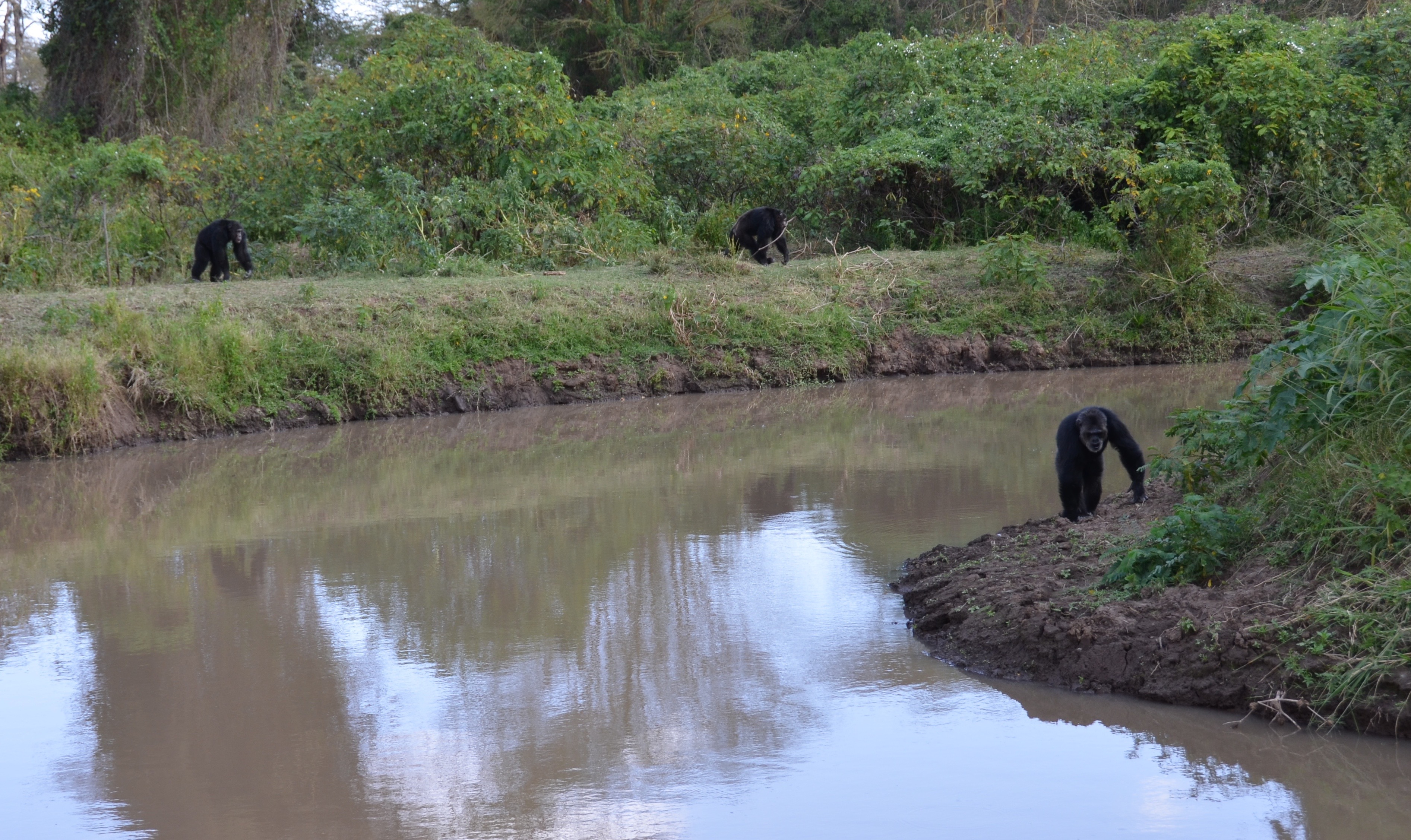
While visiting a chimpanzee conservancy, we viewed two populations of chimps divided by a river. Since chimps don’t swim, the populations remained separated and suspicious of one another.
One group of chimps on the right bank approached the river bank where on the left side another population of  chimps lived. This led to a rapid escalation of tension and an aggressive display. The outburst consisted of one group rallying their fellow chimps and racing full bore through the forest, vocalizing loudly and shaking trees wildly. On reaching the river bank the charging chimps hurled branches far into the river to intimidate the opposing band of chimps on the opposite bank.DSC_3532

DSC_3550This brought to mind the admonition by Colin Powell regarding the lead up to the Iraq war. He maintained that “shock and awe” would play a big part in any subsequent battle and, indeed, it did. The Iraqis quickly abandoned their positions. Aggressive displays in chimps and man?

Lately I’ve taken special notice of my horses’ feeding behavior. Fancy, our mare, always stops at the end of the trough nearest to our slow-footed, approaching gelding, Doc. There she will eat as much as equinely possible in the brief time before Doc arrives and chases her to the other end of the trough.

While Fancy schemes, he still gets his share.

While Fancy schemes, Doc still gets his share.

Fancy uses a strategy to consume as much food as possible given her smaller size but faster pace. This got me to reminiscing about my own upbringing.

I recall growing up and eating (dueling might be more accurate) with my two hungry brothers. We brothers would each mound up our potatoes and vegetables as high as possible, conserving space on the plate before one of our parents served our portions of the tasty entree.  We all took care to leave a large vacant and inviting spot on our plates to suggest the need for a generous serving of meat.

Seems to me something of a commonality exists between horse and human eating behaviors. Both in these instances sought to game the system in order to gain as much food as possible at the expense of either the other horse or a brother.

What do you think? Any instances where you see similar mirrored behavior between humans and animals? Would love to learn your thoughts.

Cover Release


My book, Carrying the Black Bag: A Neurologist’s Bedside Tales, will be released mid-November by Texas Tech University Press. The cover design for the book is above. The design is simple and immediately conjures up a physician with his black medical bag and dangling stethoscope. I believe the cover describes what the book is about, a memoir detailing patient stories that tell of courage, pathos, and humor.

I welcome your thoughts on the book cover. My book is intended for a popular audience. It shares  stories of brave individuals living with and thriving despite their neurological illnesses. All of us at some time will likely face a chronic illness in ourselves or loved ones and this book will assist in preparing for this challenge. It also should benefit health care professionals and serve as a reminder of the wonderful opportunity we have to involve ourselves so intimately in the lives of those for whom we care.

The book is dedicated to those who trusted me enough to share their personal stories of courage, pathos, heroism, and inspiration.