Norman’s Emancipation- So Why Does It Feel Like Rejection?

Of late I’ve written extensively about Norman, our bottle fed calf who was rejected by his biological mother in favor of his heifer, freemartin twin.

Mama Trudy and Norman

Mama Trudy and Norman

I feel my story may have reached its denouement. It’s inevitable, I suppose, but surprising by how soon it happened. After two months of twice daily bottle feedings, to Trudy’s and my surprise, Norman has begun to rebuff our feeding efforts. His action has been not so much stiff-arming us but rather a polite demurral. He still saunters over and allows us to scratch his neck and ears and he continues to gaze at us with his dark eyes with long, curly eyelashes that Madonna would kill for. Nevertheless, he has been refusing to take hold of the nipple despite our best cajoling. This has proved surprising and concerning to us as prior bottle fed calves have continued to take a bottle for many more months.

When the herd realizes we’d not come to offer them range cubes (think cow candy), they soon return to mowing the pasture and graze away. Norman, observing their departure, has been turning away from us, responding to the strong social draw of the herd.

One evening several days after once again being rebuffed by Norman, Trudy and I stood in the pasture holding our still full bottles of milk, feeling full of rejection. We both worried about Norman lacking sufficient nutrition to sustain himself.

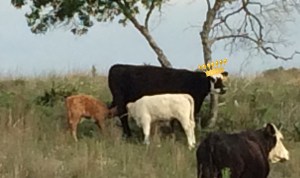
It was then we observed a nearby cow who had been keeping a keen eye on Norman and us. Nearby was her white calf of four or five months of age. We soon saw her calf meander up to her and latch onto a full udder for his evening feeding. Shortly after this occurred came a  more surprising sneak attack occurred from Norman. He approached between mama cow’s hind legs and began to feed earnestly but on a less impressive hind teat.

The reader needs to understand how rare it is for a mama cow to accept a calf for feeding that is not her own. Nevertheless, there it was before our eyes- two calves, one her own and one adopted, suckling away.

Trudy turned to me with an expression one part surprise and one part relief. Our bottle calf was no more. Over the last week we’ve observed Norman feeding from this cow several times. While he only merits “hind tit”, he chooses his lowly feeding station over our carefully mixed and precisely warmed calf formula.

Adoptive mother, her white calf, and Norman sneaking milk. Crown attached courtesy of photoshop

Adoptive mother, her white calf, and Norman sneaking milk. Crown attached courtesy of Trudy and Photoshop

To be sure, Trudy and I welcome the extra hour in the morning and in the evening and not having to prepare the formula, seek out Norman, feed him his gallon of milk, and cleaning the calf bottles. Nevertheless, we are left with an “empty nest” feeling like when our children left home to go off to college. It’s only natural of course that Norman become a full member of the herd and attends fully to his cattle herd and less to his humans. Our heads get it. But our hearts feel pangs of rejection.

Whether or not this is the end of his feedings or he will require only occasional supplementation will be determined. When Norman is bigger, I might just carrying range cubes in my pocket and slip him an occasional treats. He still feels special.


Norman Part III: Our bull calf and his freemartin twin sister

Mama Trudy and Norman

Mama Trudy and baby Norman

Recently I’ve written about a set of twins born at our ranch. The mother cow unfortunately promptly rejected the bull calf in favor of the heifer calf such that Trudy and I soon became surrogate parents to the bull calf. We have been bottle feeding him twice a day. Well at least we don’t have to throw him over our shoulders and burp him!

While cattle twins are rare, We’ve learned the concept of freemartinism in cattle. This occurs when a male calf (Norman in our case) and his female twin are born. The heifer usually has an abnormal reproductive tract. Her abnormality occurs due to the presence of male hormones in the bloodstream in utero that prevents normal development of the ovaries and/or other aspects of her reproductive tract.

The freemartin becomes an infertile cow with masculinized behavior (someone else will have to share exactly what this behavior looks like as I haven’t noticed any unusual spitting or scratching (thank you Ann Richards for the quote). A freemartin occasionally occurs in sheep, goats, and pigs.

The Roman writer Varro described freemartins and referred to them as “taura”. John Hunter, an 18th century physician, determined a freemartin always has a male twin. Talk about creating sibling grudges!

The question arises whether this condition might occur in human twins as this has been claimed in folklore. This belief was perpetuated for generations and was mentioned in the early writings of Bede. No good support exist for freemartins in human twins to the best of my knowledge. If others know differently please share your thoughts and level of support for this.

Norman and a big friend

Norman and a big friend


Am pleased to share with you that Norman is growing and appears healthy. Another mama cow has allowed Norman periodically to nurse. Likewise his sister does well and continues to enjoy the mothering offered her by her biological mother. As for Norman he spends time in the nursery with the other calves during the day, scampers toward Trudy and me when we approach him, and like his ears and neck scratched.

Norman’s twin (the freemartin) is destined to become a beef calf rather than for breeding purposes. If I don’t watch it, Norman may, if Trudy has her way, end up as a big backyard pet.

Reflections On My West Texas Book Tour

IMG_0363I enjoyed a busy week recently in Lubbock speaking on their NPR station at Texas Tech University, at an event at the Texas Tech University Library, to a private book party entitled “A Celebration and a Conversation” kindly hosted by Judy Wilkins and La Nelle Etheridge, and to the Lubbock Roundtable. Wow, each was a lot of fun. The comments on my book, Carrying The Black Bag, proved very positive and I enjoyed the interaction.
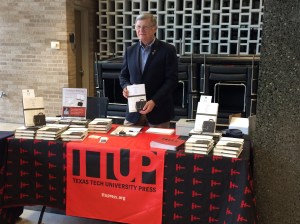
Below I’ve shared a couple of pictures from the library presentation and a very nice video provided by the library. Should you wish a similar talk to your organization, please contact Trudy, my wife, who keeps the schedule (don’t they always). Her email is trudy_hutton@yahoo.com

IMG_0383IMG_0386Here is the link to the presentation at the Texas Tech University Library:

https://youtu.be/yyh241N4zNg

Lubbock Book Tour This Week-Carrying The Black Bag

21122377Looking forward to several book related events this week in Lubbock. Thursday morning I’ll tape a thirty minute program for Dr. Tom McGovern”s radio program that will play on the Texas Tech University NPR station. Dr. McGovern is a fine Ethicist and a wonderful human being whom I always enjoy being around and learn from.

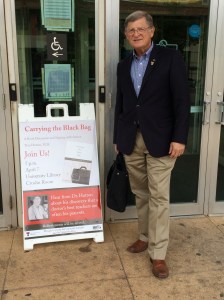
Then on Thursday evening at 7 pm I will be presenting at the Texas Tech University Library on my book, Carrying The Black Bag: A Neurologist’s Bedside Tales. The event is open to the public.

Friday evening my good friends Judy Wilkins and La Nelle Etheridge are having a “Celebration and Conversation” event where I will speak about my book to their invited guests. This is such a generous invitation and one I’m greatly looking forward to.

Then on Saturday morning I will again share stories from my book at the Lubbock Roundtable at 11:00 at the Hillcrest Country Club.

I feel fortunate to have been asked to give numerous book talks since Carrying The Black Bag came out three months ago. These are all fun events. I particularly enjoy gaining feedback from folks whose lives have been impacted meaningfully by my book and from learning their stories. Let me know if you would wish to schedule me for a book talk and Trudy and I will try to make it happen.

If you are in Lubbock this week, hope to see you at the TTU Library Thursday night or as Charles Osgood says, “I’ll see you on the radio.”

Naming Our Bottle Calf Norman

I recently described here my shock at finding a rare set of newborn calf twins and being still more shocked when the mama cow refused to allow the tiny bull calf to nurse. Knowing this was not an unusual circumstance with beef cattle twins and previously having bottle fed calves, Trudy and I swung full force into action with store bought colostrum and powdered cow’s milk.

A nameless baby bull calf and big friend

A nameless baby bull calf and his heifer friend

We determined the calf needed a name, but what should we call it? We typically don’t name those destined for the livestock auction, but in this case a handle shorter than “the bottle fed bull calf” was needed.

Since posting that story I’ve heard from “Rowdy’s Mom” who suggested the name, OLLI. Rowdy’s Mom  until recently was the very capable director of the Osher Lifelong Learning Institute at Texas Tech University, hence the acronym “OLLI” and her understandable affection for the name. As an aside, She also is most responsible for cajoling me two years ago into helping to establish a branch of the OLLI-TTU in the Texas Hill Country. Thanks Emma for all your wonderful help and my arm has almost recovered from your persuasion.

Despite her’s being a very good suggestion, by the time we received it another name was already being  used.

Mama Trudy and Norman

Mama Trudy and Norman

Have you seen the movie, City Slickers? This humorous movie starring Billy Crystal depicts his character and two chums (all New York City slickers) at a dude ranch improbably herding cattle via horseback from New Mexico to Colorado. During the long trail drive, a mama cow gives birth to an adorable calf they call Norman. Billy Crystal’s character is forced to rescue the calf from a surging river, he bonds with it, and quixotically packs him home in a crate to join his family in the city. The calf in the movie looks very much like our bottle fed calf and, you guessed it, we call our calf- Norman.


The feeding of Norman twice a day has become a regular staple of ranch activities. Betty and Cecil Selness, great friends from Minnesota, recently spent time with us and became regulars at Norman’s feedings.

Betty giving Norman his evening bottle while Cecil drinks his own libation

Betty giving Norman his evening bottle while Cecil drinks his own happy hour libation


Grandson Graham spent part of his spring break at the ranch with fishing, horseback riding, gator driving, and hikes on the agenda but his favorite activity above all others was feeding Norman. Graham also learned how hard a baby calf can buck against a bottle when the milk doesn’t come out quickly enough.IMG_0656
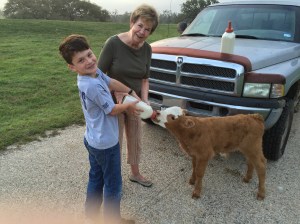
Needless to say, Norman has frolicked and suckled his way into our hearts. It’s hard to spend so much time staring into Norman’s appreciative dark eyes and not develop a bond of affection. In a year when we need load him into the cattle trailer for the one way trip to town,it will be a sad day indeed.

In my next post, I’ll share what I’ve learned about bovine twins of different genders and the concept of freemartins. Please let me know if you’ve had similar experiences and, if so, what you learned, especially about yourselves. For now you can think of Trudy and me as Calf Mama and Calf Papa.

Midwest Book Review of Carrying The Black Bag

15998415

My book, Carrying The Black Bag: A Neurologist’s Bedside Tales recently received this wonderful review in Midwest Book Review. I am gratified to share it with you:

From March 2016 issue of Midwest Book Review…www.midwestbookreview.com

MBR Bookwatch: March 2016
James A. Cox, Editor-in-Chief
Midwest Book Review
278 Orchard Drive, Oregon, WI 53575

Dunford’s Bookshelf

Carrying the Black Bag
Thom Hutton, M.D.
Texas Tech University Press
PO Box 41037, Lubbock, TX 79409-1037
http://www.ttupress.org
9780896729544, $27.95, HC, 240pp, http://www.amazon.com

Synopsis: During his thirty-plus years of practicing in West Texas and Minnesota, physician and neurologist Tom Hutton discovered that a doctor’s best teachers are often his patients. From these (extra)ordinary individuals, he gained a whole-hearted respect for the resourcefulness, courage, and resilience of the human spirit. Part memoir and part homage to those patients who faced major illness with grace, grit, and dignity, “Carrying the Black Bag: A Neurologist’s Bedside Tales” invites readers to experience what it is like to be a doctor’s hands, eyes, and heart. Imagine the joy of witnessing a critically ill five-year-old who, against all odds, claws her way back from a coma and near certain death. Meet a lonely Texas widower with Parkinson’s disease who hosts elaborate pinochle parties for a pack of imaginary canines. Step into the surgical booties of the author when he attempts to deliver his own child amid heart-stopping obstetrical complications. Through real-life patient narratives, Dr. Hutton shines light on ordinary people facing extraordinary challenges. Moreover, this captivating tale captures the drama of medicine, including its mystery, pathos, heroism, sacrifice, and humor. For more than just those working in the healthcare profession, “Carrying the Black Bag” also shares a behind-the-curtain peek at the rapidly changing American health care system.

Critique: Impressive, exceptional, absorbing, informative, thoughtful, and entertaining, “Carrying the Black Bag: A Neurologist’s Bedside Tales” is a compelling and rewarding read from beginning to end. “Carrying the Black Bag” is very highly recommended for both community and academic library collections, as well as to the attention of non-specialist general readers with an interest in the ‘real world’ experiences of a dedicated physician.

Michael Dunford
Reviewer

Seeing Double

Several weeks ago one of our mama cow gave birth to a set of twins. I performed the classic double-take, thinking I must be seeing double. The two newborn calves were distinct from one another with a bull calf having a white face and otherwise light brown color and the other being a gray heifer.

Somewhere I’d read beef cattle reject one twin more often than do milk cows because beef cows produce less milk than do milk cows. In any event, rejection was the case with us. It didn’t take long to determine mama paid little attention to her bull calf and was downright mean to him when he tried to suckle.

On viewing this, I immediately took off to the feed store to purchase colostrom and a large bag of powered cow’s milk. The next challenge was to separate the bull calf from his mother in order to feed him. While the cow in question was not a good mother, she still had protective instincts for her bull calf as well as for her heifer calf. She tried to run me down several times when I approached, brandishing a bottle of milk. Having twice before during an earlier calving having been run down and rolled by this unpleasant mama, I was surely on my guard.

The frequency of twinning in beef cattle is about half a percent, that is one in every 200 births. We have never before encountered this on our ranch. The twin calves are usually smaller than single births and have a higher rate of birthing complications. Just imagine eight legs and two heads trying to exist the uterus. This gives rise to all sorts of possible complications and explains the increased rate of dystocias.

While unfamiliar with twins, Trudy and I have previously had to bottle feed several other calves. This proves time consuming (feeding twice a day) but gratifying. It is fun to see the bottle calf emerge running from the herd in the direction of a bottle toting person.

Follow on articles will touch on the naming of the calf and the phenomenon of freemartinism that frequently occurs with one bull calf and one heifer calf. More to come.

West Texas Book Tour

Trudy and i at book signing following the Lubbock Women's Club presentation

Trudy and i at book signing following the Lubbock Women’s Club presentation

Pleased to say I had three book presentations last week- two in Lubbock (Lubbock Women’s Club and Osher Lifelong Learning Institute at Texas Tech University) and one in Big Spring (Greater Big Spring Rotary Club). Enjoyed seeing the historic Settles Hotel that has been recently refurbished and was at 15 stories for a time the tallest building between Fort Worth and El Paso. Had a great time meeting some wonderful folks and presenting on Carrying The Black Bag.

Special thanks to Judy and Paul Rostad for arranging the Lubbock events and Emily McCann for setting up the Big Spring event. I continue to be gratified by the impact the book has on people, many of whom have a family member with a chronic illness or else care for someone with one.

Paul Rostad who organized my OLLI presentation and an attendee

Paul Rostad who organized my OLLI presentation and an attendee

Blog Tour and Recent Presentations

My wonderful publicist, Maryglenn McCombs, recently arranged a 10-Texas Blog Tour. This has brought about increased information and excitement for my book, Carrying The Black Bag. One blog asked me to answer a series of questions. Since I have found these to be frequently asked questions, I wanted to share this now with my blog readers (see below).

Also have enjoyed recently speaking at the Hondo Rotary Club and the Osher Lifelong Learning Institute in the Texas Hill Country. These were a lot of fun and met many nice folks. i continue to be extremely gratified by the overwhelmingly positive response to my book including reviews by the Manhatten Book Review, The Chicago Sun Times, and the Austin American Statesman among others. I welcome opportunities to share these stories with other organizations. Just let Trudy or me know if you would like for me to speak to your groups and we will see if we can schedule an event.


Blog Tour Questions

  1. What made you want to share your story and write this book?

One reviewer described Carrying The Black Bag as part memoir and part love story between a doctor and his patients. While unusual, this statement is largely true. The wonderful patients described in my book have by now passed on, making me the last person standing who can share their poignant, humorous, and courageous stories.

The sobering impact of life altering illnesses crystalizes what is most important in our lives, deepens commitment to spouses and families, increases reflection on spiritual lives, or even, in rare instances, as described in the book, leads to revealing hallucinations due to loneliness and illness.

Family caregivers are usually irrevocably changed by intense caregiving and might just discover unknown depths of resolve and determination.

Such insights allow intriguing insights into the human condition.


  1. What do you want people to take away from reading this book?

First, I want them to experience a good read. Without reading enjoyment few would continue turning the pages. Secondly, I hope these stories will help others deal with current or future medical problems with greater insight and confidence and be inspired by the patients described.

I also hope readers will develop greater understanding of the importance of good doctor-patient-family communication and how this benefits patient care. The reader should as well enjoy and experience “a behind the curtain peek” at the medical profession.


  1. What is the most important thing you have to do as an author of nonfiction vs. fiction?

Nonfiction must have authenticity as well as be engaging. Whereas fiction can be spun from whole cloth, nonfiction must strive for accuracy, develop context within our life experience, and inform to a much greater extent.


  1. Did you find writing about your life as a physician a difficult or therapeutic process?

Reliving the excitement of a fulfilling medical career was a wonderful experience. Admittedly dredging up the intense challenges, the anxieties of a newly minted physician, and recalling the overwhelming fatigue proved emotionally difficult but overall proved therapeutic and satisfying.


  1. Now that you are retired, what do you say was the most challenging part of your profession?

Doctors along with their families must sacrifice in order for the doctor to be available for patient needs. Illnesses and injuries ignore social calendars. For example, my formally dressed wife on several occasions spent her evenings sitting in a busy emergency room amid feverish people, inebriates, and the injured waiting for her sidetracked husband to finish up. Trudy fortunately was able to accept my demanding schedule. Many doctors were not so fortunate and suffered high divorce rates.

I don’t know if my children realized the effort required to be present for their events, to enjoy a regular family dinner, and make sure family vacations came about. On the other hand, I know I missed events important to them while attending my patients who had first claim on my time. This proved painful for me. Managing these medical versus personal challenges proved the most difficult part of my professional life.


  1. What do you say was the most rewarding part of your profession?

Without a doubt, the most rewarding aspect of my medical career was the unique relationship that develops between a doctor and patient. The doctor/patient relationship is like no other in that trust has to exist. Few other relationships involve this degree of intimacy and sharing of personal information. Open communication also becomes vital in order to provide the best of care. The trust and appreciation shown by my patients proved incredibly rewarding.

Practicing neurology also proved extremely satisfying. Neurological diagnosis requires careful history taking and examination. This teasing out of clues is paramount to making a correct diagnosis. In a way in this day of enhanced medical imaging and laboratory evaluations neurology is an anachronism. Due to the amount of medical instruments required for the examination, its practitioners may appear old fashioned as they still carry black medical bags.


  1. What do you think is the biggest challenge facing medical care now and in the future?

The inherent conflict between the need to combat rapidly escalating medical costs and the ongoing desire of people for individualized medical care presents the greatest challenge to medicine today. Drastic limitations on time spent with each patient driven by third party reimbursements, increased record keeping requirements, and cookbook medicine detract from patient-specific needs.

I hope the art of medicine and careful communication between doctor and patient will not be compromised in a headlong pursuit of cost saving nor will the art of medicine give way entirely to technological advancements such as in imaging and laboratory evaluation.

The sharing of electronic medical records has potential for great benefit. A less attractive aspect is the growing diminished face-to-face communication among members of the medical team. Such institutions as the “midnight meal” for interns and residents may become a thing of the past. Nevertheless newer means of exchanging and gaining further information than from chart reviews and fostering collegiality will be needed.


  1. Any other projects planned for the writing world of Tom Hutton MD?

At least two projects interest me. First I would like to write a sequel to Carrying The Black Bag, perhaps titled Retiring The Black Bag. With the tremendous number of baby boomers retiring each year, a continuation interests me including my own personal challenge taking off the stethoscope and becoming, what my wife refers to as a real person. Further I wish to share the unusual/incredible role an amazing Border collie named Bandit had in effecting this challenging transition. Moreover the colorful people involved in this important phase in my life would provide interesting reading and relatable events. It might prove helpful to others anticipating and hopefully planning for their own retirements.

Secondly, I am interested in writing an expanded version of the account of Adolf Hitler and his medical problems. In addition to his neurological disorder, Hitler had serious heart disease and a litany of other medical complaints and disorders. The horrendous impact that der Führer had on the twentieth century continues to fascinate and too little attention has been paid to the impact his poor health had on his decision-making.


From Manuscript to Book: How It Happens

Linda, what a wonderfully practical exercise for your students. This is good stuff and will benefit them as they move forward. Great stuff.

lindaktaylor's avatarLinda Taylor: Teacher, Editor, Publishing Professional

I’ve been intensely creating syllabi for the last month. Spring semester begins February 1 and I have three classes to prep. (I never appreciated my class syllabi for my classes in college. But now that I’ve had to be creating them, wow. What a lot of work and planning!)

One class I’m particularly excited about is a new one I’m creating called “From Manuscript to Book: How It Happens.” I did a version of it during a May term at Houghton College back in 2009, but I’m refashioning it to fill a full semester. Five local authors have entrusted us with their complete manuscripts (all fiction), and my class will become a publishing company (name to be determined) that will walk these manuscripts through the entire publishing process.

My students will work in groups. Each group will receive a manuscript and they’ll first work as content editors. They’ll keyboardconsider all the things fiction editors have…

View original post 387 more words