Tag Archives: Thaddeus Septimus Hutton

The Legendary Texas Longhorns

Nothing in Texas is more iconic than Longhorn cattle.  The Longhorn even has its own folklore. In Native American cultures the Longhorn represents a symbol of good luck and spiritual guidance. While in Spanish culture, the Longhorn represents power, resilience, and strength. For Texans it is simply the basis upon which the State economy was built post-Civil War and to this day the Longhorn remains a treasured Texas icon.

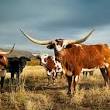
Below is a stock image of Longhorns. Not my picture.
Yet where did the Longhorn come from? With its long horns it looks nothing like the European cattle breeds. And as any Longhorn rancher knows, it acts differently. The Longhorn is smarter, heartier, can better find forage and water, and is more disease resistant than other popular cattle breeds.

Origin and History of the Texas Longhorn

According to Dr. David Hillis, author of Armadillos To Ziziphus and the Director of the Biodiversity Center at the University of Texas at Austin, cattle likely arose from aurochs about 10,000 years ago and in two different parts of Eurasia; one being in the Middle East, and the second in the subcontinent of India. From there domesticated cattle spread to Africa and eventually via the Moorish invasion to Spain.

Christopher Columbus, on his second voyage to the New World in 1793 and intending to establish a colony in Hispaniola, stopped by the Canary Islands where he purchased pregnant heifers. The cattle  thrived in Hispaniola. By the early 1500s the Spanish explorers took descendants from these original cattle to Veracruz on the Gulf Coast. As the Spanish explored Mexico, they took along cattle for food, but many animals escaped or were released into the wild.

The countryside at the time had large and dangerous predators including bears, coyotes, and mountain lions. In an evolutionary act that warms this prior college zoology major’s heart, the strongest feral cattle with the longer horns survived better and bred. Over many generations of survivors and through the process of natural selection, the sturdy, fiercely protective Longhorn that we now recognize came into its own. With its longer horns it was able to defend its calves from predators, fight for dominance in the herd, survive in the wild and even flourish. Eventually vast herds of Longhorn cattle roamed what became in 1836 the the independent country of Texas and later in 1845, the State of Texas. Literally millions of feral Longhorns roamed the broad prairies of the State of Texas.

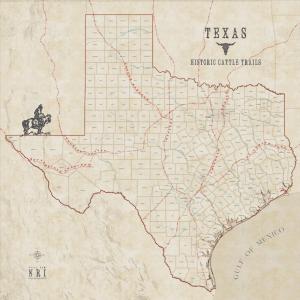
In the 1870s and 1880s vast cattle roundups and cattle drives began in south Texas, passed through the Texas Hill Country said to be the greatest cattle raising area in the world, and on through Texas and Oklahoma to the railroad depots in Kansas. The Great Western Trail saw at least two million Longhorns arriving in Kansas from where they were transported east to feed a hungry nation and to supply tallow for candles, the primary source for light at night.

Along with establishing the economy of an impoverished State, this era introduced Cowboy culture and the era often portrayed by the westerns in cinema. This author’s great grandfather, Thaddeus (Thad) Septimus Hutton worked as a cowboy and lived near Seymour, Texas alongside the Great Western Trail. It is likely that Thad Hutton in addition to working on a ranch, also rode up the trail to Dodge City where he would have interacted with the likes of Wild Bill Hitchcock, Doc Holiday, Wyatt Earp and other notable Dodge City legends.

Below are the Legendary Texas  Cattle Drives
By the 1900s Longhorns were deemed less desirable than the European breeds that yielded more beef per animal. The era of the Longhorn had passed into history and the Longhorn came close to extinction. The western writer, J. Frank Dobie along with the oilman, Sid Richardson and various nostalgic ranchers began to preserve the breed. Charles Schreiner III, a Hill Country rancher, is best known locally for his great efforts in preserving the Longhorn breed. In 1941 a State herd of Longhorns was established and now reside both in various State parks and on private ranches.

It seemed only appropriate that the first cattle we brought to our Medicine Spirit ranch were Longhorns.  The lone survivor now serves principally as pasture art whereas the calves from Black Baldys (a specific mixture of Angus and Hereford) crossed with Charolais are more prized by market forces and are the principal stock on our ranch.

Why We Love Longhorns

Longhorns in addition to their distinctive long horns also are remarkable for their coloration. No other breed has as many different colors as Longhorns including white, brindled blacks and reds, multi-colored roans, yellow linebacks, or everything in between.

J. Frank Dobie wrote in his book, The Longhorns, “Next to the horns…the most striking quality in appearance of the Texas cattle was their coloration. It is incorrect to say that they represented all the colors of the rainbow. Their colors were more varied than those of the rainbow.”

Texas Longhorns look different from other breeds and act differently as well. They possess a sense of pride with their heads held high and the males even demonstrate a swagger. They possess a wiliness not often associated with bovines. The calves are small at birth but grow rapidly. Their muscles strengthen, and they show a sense of of self-confidence not often observed in other breeds. Despite their long horns, the Longhorns are typically gentle. We often hand have fed our Longhorns, something not often possible with many of our Black Baldys.

The Longhorns are easy breeding due to having a larger pelvic outlet than other cattle breeds. Often first time heifers of other breeds are bred with a Longhorn bull because of this easy calving trait received from the Longhorn bull. Longhorns in our experience become the alpha cow in a mixed herd and have a distinct knack for leading the herd to a water source and to the best grazing. In addition to their smarts, the Longhorns are largely disease resistant, saving on vet bills.

In Conclusion

In tribute to this Texas icon, the Longhorn occupies a warm spot in the hearts of Texans. The horns from our first Longhorn now hang proudly in my study where I admire and recall her long life and many feats. Her name was Bell Pepper, and her daughter was named Cinnamon. The thought behind the names was that they “spiced up” our ranch. Indeed they did along with bringing with them a strong sense of proud Texas nostalgia.

Two Black Baldy cows with their calves

Bell on the left and her daughter, Cinnamon along with their human admirers

Family Geneology- Don’t Fail To Ask

Recently I wrote a bio for my paternal grandfather for our family Bible. To enliven the piece, I struggled to remember anecdotes that would illustrate his life. This recall proved challenging, and I wish I had asked a lot more questions about his growing up. My plea to others is don’t forget to ask. You’ll likely be sorry later if you do not.

Below is the brief bio of my grandfather, John Francis Hutton (Frank). Family and those who knew this kind gentleman may find it interesting.

John Francis Hutton
(By John Thomas Hutton, grandson)

John Francis (Frank) Hutton was born in Garden City, Missouri on April 11, 1888 to Thaddeus (Thad) Septimus Hutton and Elizabeth (Betty) Jane Ragan Hutton. Frank was the only child born to Thad and Betty who was not born in Texas. He had three brothers; Thaddeus Leslie, George Earl, and John Francis who died in infancy and two sisters; Emma Jane and Margaret Mary. In October 1904 the family moved to Kansas City, Missouri where Frank attended Central High School, Central Business College, and the American Savings and Loan Institute.
Frank married Kate Frances Lincoln on October 1, 1913. Years later Frank shared a story about his courting of Kate. Frank’s home in Kansas City lay about 20 miles from Kate’s home in Liberty, Missouri. In order to visit her, Frank would borrow the family horse and buckboard and head for the Lincoln’s farm. At the end of the day, Frank would climb back into the buckboard, point his horse in the direction of Kansas City, loosely tie the reins, and then crawl into the back of the buckboard. There to the metronomic clip clop of his horse’s hooves, Frank would fall fast asleep. After all he had to work the following day and needed rest in order to be productive. When the horse would eventually stop, Frank realized that he had arrived home. He would then climb out of the buckboard, unharness the horse, and head off to bed. Frank’s practical approach to his late night transportation needs demonstrated an early example of a driverless vehicle, a smart horse, and a resourceful suitor.
For a time after getting married, Frank worked as an accountant for a salt company in Salina, Kansas. For the last thirty years of his work career, Frank worked at Metropolitan Savings and Loan in Kansas City, Missouri, working his way up the ranks until becoming Vice President.
Frank and Kate had one child, John Howard Hutton, born in Liberty, Missouri April 11, 1921. Frank eventually purchased two acres of land and a red brick two-story home at 909 Vivion Road in Kansas City, Kansas where he and Kate enjoyed a semi-rural lifestyle. For many years the Frank Hutton family planted and tended a large vegetable garden that provided abundant harvests.
The yard on Vivion Road was large and required Frank to own two lawnmowers; one a large machine he called Big John and a smaller one that he named Little Boy. Frank used Big John for the broad swathes and Little Boy for the tighter areas. Frank regularly pruned the shrubbery, fertilized the yard, and mowed at regular intervals. Frank’s yard reflected his own personality with its simplicity, understatement, and tidiness.
One of Frank’s lessons for his grandchildren dealt with neighborliness. He described how one good neighbor would extend his fertilizing for a short distance across his property line and into his neighbor’s yard. Likewise the next-door neighbor would extend his fertilizing efforts across the boundary into the first neighbor’s yard. This extension inevitably led to a deeply green and luxuriant strip of grass midway between the two yards. This practice, Frank suggested, embodied good neighborly relations.
Frank for years enjoyed a regular Saturday golf outing with his friends and continued to play until he was well into his eighties. While a slight man at about five feet six inches and 130-140 pounds, his drives down the fairways were short but remarkably on target. His iron play and putting remained as deadly as ever.
Frank knowing the wonderful life lessons that golf taught wanted to pass the golf legacy to his three grandsons. Despite his patient instruction his attempts were not universally accepted. With the exception of David, none initially took up the game. Frank’s grandsons were larger, stronger, and more physically fit than their slightly built and aging grandfather, yet their grandfather was so far superior to their own unrefined efforts that each grandson questioned whether golf was destined to be his game.
Frank’s Christian faith played a guiding role in his life. For many decades Frank served as a dedicated Sunday school teacher with regular attendance at the Ivanhoe Christian Church in Kansas City, Missouri.
Several of Frank’s personality characteristics spring to mind. He demonstrated great affability. He possessed a kindness and interest in people that served him well throughout his life and gained him many close friends. Frank may have acquired his affability from his father who possessed this attribute as did Frank’s son, Howard. Frank also possessed a wonderful sense of humor and told grand stories. He was soft spoken and mild mannered except when attending the Kansas City Athletics baseball games at Metropolitan Stadium where he rooted loudly for the home team. Frank often took friends and family to sit in the Metropolitan S & L box that was located along the first base line. Frank always treated his family and friends generously with treats and soft drinks.
A second personality characteristic of Frank was his loyalty. He was for decades a devoted employee at Metropolitan Savings and Loan. He showed loyalty to his family as well. When his son, John Howard Hutton, transferred from Kansas City to Dallas to fly for Braniff Airlines, shortly after Frank’s retirement Frank and Kate followed and bought a home only several blocks away from Howard Hutton’s home in Richardson. Frank and Kate said they wished to watch their grandchildren grow up. In Richardson (a northern suburb of Dallas) he attended innumerable youth ball games, church events, school plays, sporting events, graduations, and city happenings. Frank was a doting and loving grandfather. Frank remained loyal to the Christian Church in Richardson where he and Kate regularly attended and where he again taught Sunday school. He also founded a Senior Citizens group that for many years served the community.
A third characteristic of Frank Hutton was his calm demeanor. Undoubtedly, he likely must have displayed excessive emotionality at some point, but this observer never once saw him lose his temper or become upset. He served as an emotional anchor for his family and calmly surfed the upsets of life that would often distress others.
Frank Hutton enjoyed good health until very near the end of his life. He died on September 14, 1975 following a fall on his driveway that gave rise to intracranial bleeding. He was 86 years old. Of Frank Hutton it can be said, he was truly a gentle person who was widely respected and loved by all who knew him.