Tag Archives: Retirement

Bandit Achieves Our Retirement- Part IV

This is the fourth blog piece in a series that features our first Border collie, Bandit, and is taken from an unpublished book titled The Bandit’s Gift. I wrote this manuscript which I suppose could be considered my practice book, shortly after retiring from my Neurology practice in Lubbock and moving to our ranch outside of Fredericksburg, Texas. The title of the book hints at our Bandit dog’s substantial role in bringing about our early retirement. Trudy and I feel indebted to Bandit for his efforts in hastening our move from a frenetic life in the city to the beauty and peacefulness of the Texas Hill Country.

This installment describes our migration from Lubbock to our ranch near Fredericksburg. It also introduces Mollie, a female Border collie, whom we acquired shortly before our move to the ranch. Mollie as a puppy came from a New Mexico ranch whereas Bandit had been raised a city dog in Lubbock.
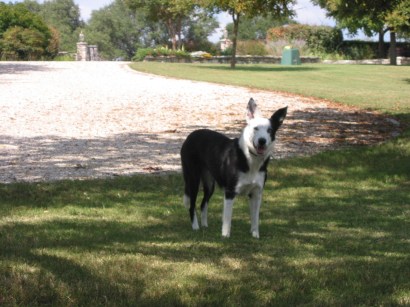
                             Mollie our second Border collie who was from herding stock

In August of 2001, Trudy and I departed Lubbock for permanent retirement at our Fredericksburg ranch. Bandit and Mollie rode in the backseat nestled among hanging clothes and piles of shoes.  Mollie sat on the passenger’s side, Bandit on the driver’s side.  As Lubbock receded into the tabletop-flat landscape, Bandit cast what I considered a satisfied if not smug glance out the window for having brought about this major change in our lives.  I wondered how our canine conniver felt, as he had been a motivating force for my early retirement, mounting a determined campaign having nearly destroyed our home in Lubbock.

“Bandit, say good-bye to Lubbock.”

His long white tipped tail began slapping the back of the seat.

“Thump, thump, thump.”

“Trudy, that dog sounds like he’s beating a drum, am I imagining it or is Bandit celebrating?”

“Thump, thump, thump.”
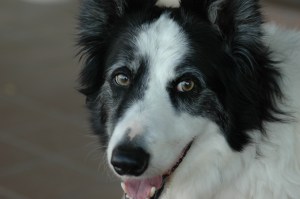
                                                              Bandit looking so innocent

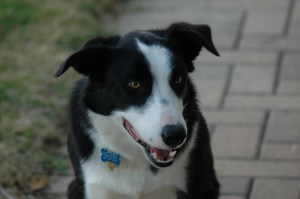
Mollie sat quietly in her corner of the backseat.  When I turned to scratch her chin, I noticed her peculiar smile.  When Mollie smiled, she retracted her lips and exposed her teeth.  Her eyes squinted and her face showed a broad dog smile- a smile sometimes misinterpreted as a snarl. I sensed that Mollie was happy, knowing we were leaving a city and headed permanently for a ranch.

Optimism and a sense of unburdening welled up within me.  My exhausted spirit for years had yearned for a saner, more private existence.  The long work hours, the stress of holding together a clinic and hospital practice, and the daily grind of dealing with desperately ill patients had extracted a physical and emotional toll from me.

While Trudy and I had worked well together, our communication styles differed.  For me, small talk has always proved difficult.  Give me a family with a brain-dead member, or the need to relate a terminal diagnosis, and I am at my rhetorical and sympathetic best.  But when at a social function calling for light banter, I feel like a stammering dolt.  Moreover, I suffer near stupefaction when faced with the usual social banalities.

Trudy on the other hand handles social situations with aplomb.  She can discuss grandchildren, the weather, the latest gossip, or pop-culture with the best of them.  She finds difficulty, though, when talking of emotionally laden topics, especially those affecting her or her family.  It was just such heavy topics that had for years nagged at the corners of my mind.

Trudy’s unhappiness and worry may have prompted verbal zingers aimed at a workaholic, slow to mobilize, and frequently absent husband.

Remember that Surgeon in Medical Records, draped over his pile of charts like a bad suit of clothes, dead as Hamlet’s buddy, Yorik?  You’re not indestructible either Buster. I’m too young and gorgeous to be a widow.  Lots of young bucks have the hots for well off, sexy widows.”

“Yeah, rave on,” I had said, suspecting I had not deflected this conversation for long.

Later as I drove off the cap rock of the Llano Estacado and away from the loneliness of the high plains, I became lost in a tumble of conflicting questions and emotions. Long drives have always put me in pensive moods, providing uninterrupted time for contemplation. Memories began to tug at my sleeve.

Being a physician had been at the core of my identity.  I wondered how life would change without Medicine being my magnetic north.

Why am I ambivalent about leaving? Sure, I’ve loved Medicine- the intimacy that goes with caring for others.  Where’s the satisfaction gone? Had it been the hospital’s economic realities that at times impinged on the quality of clinical care I wished to give? Had this led to incessant medical upheavals?  Why had it been a struggle to maintain a successful group practice, run an efficient medical practice, and carry out good clinical care and research? Had I asked too much of myself as both a private practitioner and an academic?

After an initial scuffle in the backseat when Mollie tried to take Bandit’s usual place, the canines had calmed. Bandit circled and plopped down with an audible exhalation.  Long before we reached the cap rock, Bandit had fallen fast asleep.  Mollie rested her chin at the window and observed passing fence posts, her light blue eyes tracking and flicking from one to the next.
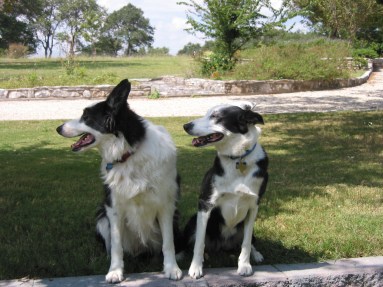
                                           Bandit on the left and Mollie on the right in profile

As the miles sped by, my mind shifted from labors left behind to this land’s history through which we passed which I began to recall. We headed southeast, counter to the migration of earlier settlers, toward what in 1800 had been the northernmost frontier of the Mexican State of Coahuila and Tejas.  Long before becoming a Mexican State, the land had been occupied by Tonkawa Indians who in turn gave way to the more warlike Apache, Kiowa, and Comanche.

Texas won its independence from Mexico in 1836 and became an independent republic.  In 1845 a proud but destitute Texas joined the United States of America as its 28th State.  The following year German immigrants arrived in the Hill Country to partake of free land and increased economic opportunities.

In Germany, the unwitting emigrants had been reassured the new land was peaceful, only on arrival to find themselves in their newly established village, surrounded by hostile Native Americans.  This grievous case of real estate exaggeration ranks just behind Eric the Red who named a frozen expanse of icecap, Greenland.

We traveled through Sweetwater, a small west Texas agricultural town with yet another unpretentious name.  I thought- did no one have imagination when giving names?! 

Bandit briefly awoke when we stopped at a red light in Sweetwater.  I felt his cold nose nudging my shoulder, urging my attention. I reached back and scratched his ears. The white tip of his tail (the so-called Shepherd’s Lantern) striking the back of my seat.

“Thump, thump, thump.”

Mollie glanced at her emotionally needy canine companion but quickly returned to watching the towns stream by.  I wondered if Mollie expected a meandering herd of sheep or scattered herd of cattle to appear in desperate need of a Border collie to organize them.

I thought how different these two dogs were in soliciting affection.  Bandit fawned on people, begging- even demanding attention. Mollie never stooped to such antics, although she appreciated affection when it was offered by a family member.
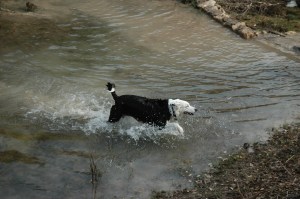
Mollie was a rare Border who loved to swim

After leaving the town behind, I heard Bandit again flop down in the back seat.  My own thoughts returned to the history of central Texas that still lay several hundred miles ahead.

German men from Fredericksburg led by their able leader John Meusebach, in a desperate gambit, ventured out of the relative safety of their new settlement to secure peace with the natives.  They successfully met up and powwowed for several weeks beside the San Saba River. After much talk, countless pipes, and no doubt many earnest, silent German prayers, a peace treaty was established with seven large tribes of natives.

This treaty, remarkably, over the years has remained intact. It is claimed to have been the only treaty in Texas, and possibly the entire United States, with Native Americans to have not been broken.  An annual Powwow of Native Americans and Fredericksburg citizens celebrated the success of the treaty for many years thereafter in Fredericksburg.

While the peace talks had dragged on alongside the San Saba River, other natives surrounded the village of Fredericksburg, awaiting news that would either prompt an attack on or befriend the hapless settlers. Huddled within their makeshift cabins, stoic German settlers tried to carry on their lives without projecting fear to their children.

On Easter eve night, bon fires ominously appeared on the many hills surrounding Fredericksburg. The German settlers worried these fires might signal an impending attack.  In truth the bon fires communicated to the Native Americans high in the hills around Fredericksburg that a peace treaty had been achieved at the Powwow on the San Saba River.

Initially the significance of the bon fires was unknown to the settlers, but the fires on Easter evening prompted one mother, full of bravado, to proclaim to her worried children that the Easter Bunny was building fires to boil their Easter eggs.  The brave spirit manifested by the unknown German mother inspired for many years the yearly Fredericksburg Easter fires tradition where bon fires were built each Easter eve on top of the hills surrounding Fredericksburg.

We motored across the Texas prairie where 150 years earlier the Apache had been driven by the still fiercer Comanche.  I recalled the struggle for control of the green hills and streams of central Texas.  With increasing distance from Lubbock, the table-flat, featureless, and bleak landscape gradually changed into rolling prairie dotted with tall prairie grasses, scraggly mesquite, cottonwood, and Juniper trees.

We traveled through Coleman to Santa Anna (named after a famous Penateka Comanche chief) where we turned south, passing by the ruts of the old Great Western Cattle Trail. A roadside historical sign informed that more cattle had passed up this cattle trail to Kansas than had occurred on any of the other Texas cattle trails.  The Western Cattle Trail ended in the wild western town of Dodge City where lawmen Bat Masterson and Wyatt Earp became famous and where Earp was finally laid to rest.

Some twenty million Longhorns had moved up the cattle trails following the Civil War, establishing a viable economy for a desperately poor Texas. I proudly recalled my great grandfather, Thaddeus Septimus Hutton, having been a Texas cowboy who had likely pushed cattle up this very trail through the Oklahoma territory to the rail head at Dodge City.  I pondered what it must have been like to herd cattle in the 1870s through wild country. Had he even a glimmer of the historic nature of the western life he lived and the fame that would be later accorded the lawmen of Dodge City.  Of one conclusion I felt certain, that more hard work and less adventure had existed on the cattle trail than was depicted later by Hollywood movies.

Several hours further on, the rolling prairie gave way to green hills, clumps of stately live oak trees, and cultivated green pastures.  Artesian spring fed streams and rivers snaked among the hills.  Wild game had been and remains prevalent, and the tall native grasses supported greater numbers of grazing animals than had the near barren Llano Estacado.

Looking at this dramatic transition in the land helped me to understand why the Native Americans believed the Hill Country possessed such “strong medicine.” The Texas Hill Country with its beauty and bounty favorably compares to the western, more arid portion of the State.  I thought no wonder Native Americans had fought so ferociously to maintain control of the Hill Country.

While I mulled these matters, Mollie, with remarkably sustained attention, continued to observe the changing landscape.  Once when passing an eighteen-wheeler, Mollie stood upright, staring at a black, ride along dog that stared back from the truck’s passenger window.  I could see the other dog barking. Mollie calmly observed the dog and gazed at the truck until it was lost to sight.

Bandit didn’t awake again until we arrived in Brady, the geographical center of Texas.  He awoke, stretched, yawned, and appeared to anticipate our arrival at the ranch.  I felt his chin on the back of my seat and sensed his warm, moist breath.  I could see in the rear view mirror that he had perked up his ears and was staring down the highway ahead of us.  When I reached to give Bandit a scratch, I was rewarded with several languid licks to the back of my hand.
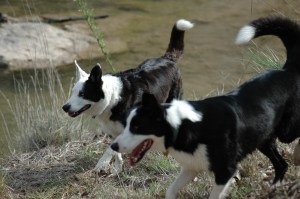
    Mollie and Buddy at the ranch

“Thump, thump, thump.”

An hour and fifteen minutes later, we drove through the front gate of our ranch. I halted the car briefly, so that Trudy and I could exhale years of pent up tension.  Whimpers came from the backseat.  Trudy and I opened the back doors of the car.  Mollie leaped out and sped across the pasture, ears flattened to her head, back arching, and legs striding.  Bandit jumped out and loped behind Mollie, inspecting trees, clumps of grass, and rocks.  Mollie scared up a jackrabbit, and both collies began a deliriously happy, zigzagging pursuit, interrupted only finally by an impassable barbed wire fence.

Trudy and I joined hands and watched in peaceful silence; an interlude as pure as that between young lovers. We had parked on a caliche ranch road near a grove of live oak trees.   We wordlessly observed the rabbit chase and basked in the exuberance of the moment. Bandit and Mollie eventually strutted back to the car; tails held high.  The two dogs sniffed and scuffled and seemed to be thoroughly enjoying themselves.

From over my shoulder, an orange-red sunset beckoned above a white limestone ridge.  We heard the mellifluous sounds of water rushing over stones in a nearby brook.  I experienced a rare moment of awareness and understanding.  What had seemed confused a few hours earlier, in this tranquil setting, now seemed clearer, even achievable. I could feel a smile develop across my face.

“Welcome home Trudy.”

Trudy slowly turned her eyes to meet mine. I saw a loving smile, crinkled nose, and teary eyes.

“Didn’t think I’d get you out of Lubbock alive,” Trudy said with an uncharacteristic tremor in her voice.  Moments later her tendency to chide rallied and she said, “Besides Cowboy, why are you planted here like a stupid yucca, let’s get on with our new lives!”

Just as I leaned across the front seat of the car to kiss Trudy, from the backseat came Bandit’s black and white head. Trudy and I stopped just short of planting bookend kisses on his furry snout.  Trudy and I laughed, and Bandit cocked his head impishly as if understanding the joke.  Trudy and I were now retired, and with Bandit and Mollie, we were four.

to be continued

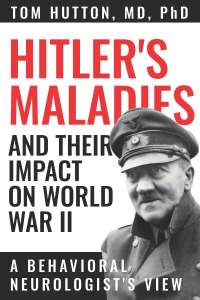
If you have not had the chance to read my latest book, Hitler’s Maladies and Their Impact on World War II: A Behavioral Neurologist’s View (Texas Tech University Press), I invite you to do so. The book explores an important aspect of the Hitler story and World War II that has not been well studied. Many of Hitler’s catastrophic errors including the premature invasion of the Soviet Union in June 1941, the slowness of German forces to counterattack at the Battle of Normandy in 1944, and the highly risky Battle of the Bulge in late 1944 into 1945, can be better understood, knowing the sizeable impact that Hitler’s physical and mental conditions had on these vital battles.

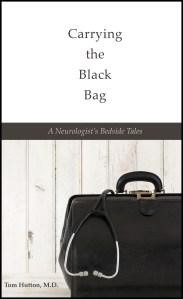
Also, consider picking up a copy of my earlier book, Carrying The Black Bag: A Neurologist’s Bedside Tales (Texas Tech University Press). Please join me on my personal journey as a physician and meet my patients whose reservoirs of courage, perseverance, and struggles to achieve balance for their disrupted lives provide the foundation for this book. But step closely, as often they speak with low and muffled voices, but voices that nonetheless ring loudly with humanity, love, and most of all, courage.
Buddy’s Place In The Sun

Many years ago I read The Good Earth. Pearl Buck wrote this magnificent book in the early 1930s and won a Pulitzer prize in 1932 for it and received a Nobel in 1938. The story covers multiple generations of a Chinese family- a family that had to struggle against all types of external and internal challenges. Particularly vivid in my memory is the book’s ending where the old Chinese grandfather, who having run his race, retires to his comfortable chair, occupying his richly deserved place in the sun. He sits remembering and enjoying a deep sense of satisfaction from his long efforts.

I am reminded of this daily when I observe my thirteen-year-old Border collie, Buddy, and his aging behaviors. Due to infirmity he wisely retired from herding cattle over a year ago. I wrote the story, Buddy- The Slacker early on but did not get around to posting it until March 30 of 2018. In the story Buddy is only a half-grown dog but amazingly manages to break up a ferocious fight between two huge bulls. After so doing, he ran the neighbor’s bull off and then returned our bull unassisted through a forest and around rocks and streams to our ranch. This proved to be the single best herding achievement by a dog that I’ve ever witnessed. After witnessing this event, I no longer referred to the half-grown Border collie as Slacker.

One days several years later I was unaware of a Longhorn cow sneaking up on me while I fiddled with a difficult gate. Buddy saw the approaching cow and easily could have sped off. Instead he stood his ground, short canines against very long, heavy horns. The cow thumped me many times before Buddy helped to drive her back. I can think of no better example of Buddy’s loyalty.

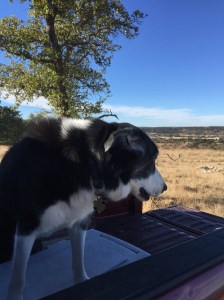
While Buddy no longer herds, he still enjoys riding around the ranch in the back of my pickup. I must lift Buddy up and into the bed of my pickup to gain his rightful place of honor. His old gray snout becomes animated when riding in the back of the pickup and surveying his ranch. His ears perk up, his dull eyes become livelier and dart from object to object, and he stands erect and proud as if for a few moments his joints no longer pain him. He points his nose into the air and listens as intently as his old ears allow.

It’s my ranch and I still look out for it.

Because of his advanced age, Buddy has largely stopped going on walks with Bella, Little Jack, and me. He will usually await our return while waiting patiently beside my pickup that in the driveway. The effort to take a walk on his painful limbs must have simply become too great, I suppose, and he has taken this commonsense approach.

Buddy has multiple beds in the house which is only appropriate because the majority of his day is spent napping. He has a doggie bed in the study where he keeps track of me while I distractedly click away on my computer. Buddy has another bed “in his office” located in a corner behind a screen where he monitors the goings on in the living room. Buddy also has a doggie bed in our bedroom where he catches many a daytime nap.

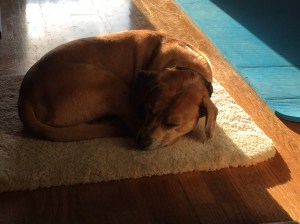
Enjoying the warmth of the sun and a good nap

Buddy frequents all of his sleeping spots at various times during the day. These spots have something in common; each allows him to soak his aging bones in the warm sunlight streaming through nearby windows. Buddy migrates from spot to spot to capture the healing sunlight. I like to think this warmth provides pain free rest periods. These doggie beds, I believe, are Buddy’s places in the sun.

Hey, don’t forget I also like to lay in the sun.

I sometimes observe Buddy dreaming with his legs making running movements. His whiskers shake and shiver. I, of course, have no idea what he dreams about, but I hope Buddy is reliving his best herding memories and summing up his many adventures. I know that at age 13 (or 91 in dog years), Buddy won’t be around much longer. i can hardly bear to think about losing him.

Buddy was born on the ranch (actually in my bedroom closet) and has barely left the outer reaches of the ranch. He models stoicism and provides more unconditional love than we can ever hope to return.His loyalty and desire to protect his people goes beyond question.

During this wonderful holiday season, the thought occurs to me that God’s love for all his creatures is, in small part, represented by our dogs love for their humans. For this let us give thanks and offer in return unconditional love.

Dream on Buddy, my loyal companion. You’ve earned your place in the sun.

Buddy’s Retirement- April 20, 2018

Buddy as a younger dog

It was inevitable, I suppose. Retirement is part of life isn’t it, that is if we live long enough. Buddy about whom you’ve heard much lately (Buddy- The Slacker) retired from his life’s work today. His retirement from herding came suddenly or at least it surprised me.

On request Buddy declined to jump out of the bed of the pickup to help herd the mama cow about which I recently wrote (A Sad Day On The Ranch). This job in the past would have been an easy one for Buddy, merely moving one cow through a couple of gates and into an adjoining pasture where the remainder of the herd grazed.

When I called to Buddy, he merely stared back at me. Has he suddenly gone deaf? What’s wrong with that dog!

After a few moments of reflection on the statue-like, immobile Buddy, I thought perhaps his bad back might be hurting him or else he had judged after twelve and a half years he’d accomplished his limit of herding cattle. Nevertheless, pushing one cow through a couple of gates and into another pasture has previously hardly been work for our Buddy who has lived to herd. But I know twelve and a half years makes for an old dog, especially for a Border collie.

He’s been the best herder I’ve ever had on the ranch. His exploits are legion, as I tried to indicate in the Slacker piece, his first herding experience. Nevertheless, lately he has been less invested and less enthusiastic about this effort. I maintain that in his place today he urged the younger Bella to help me. Surprisingly Bella did a fairly good job but not up to the standards set earlier by Buddy.

Buddy on left and Bella on right. Photo by Ramsey

Buddy has lately spent more time napping on one of his four beds (yes, can you believe it- four beds) that are scattered strategically around our house. He never has to take more than a few steps to find a doggie bed. If a bed is not immediately available, a low chair will do just fine.

While he still enjoys riding around in the pickup, he now seems anxious to return to the house and resume his doggie slumbers.

Perhaps his life’s arc from superb and indefatigable herding dog to his current “just don’t bother me” attitude is an expected part of normal aging thatis sure to affect us all. I’ll admit since retiring, I enjoy naps more.

Years ago when I asked my grandmother Hutton when she was quite elderly what it was like to get old, she replied, “Tom, you just slow up.” This observation must be as true for Border collies as it is for humans.

I hope Buddy reneges on his retirement for at least a brief period of time. What gives me hope is that Francisco, our ranch hand of seventy-five years old has retired at least five times. Each time after his announced retirement he came back to the ranch after having become thoroughly bored with watching TV and missing “his” ranch.

The animals, the beauty of nature, and the opportunity to make the ranch better proves for Francisco an incredibly strong draw. Might Buddy one day feel a spurt of new resolve along with a strong desire to herd- just one more cow? Time will tell.

By the way, what does one give a Border collie as a retirement gift? He has no use for a watch. Your thoughts?

Buddy, the retiree, taking one of his frequent naps

Best New Debut Author for 2017

Recently received the very good news that my book, Carrying The Black Bag: A Neurologist’s Bedside Tales, won a national book award for 2017 from The Feathered Quill. This is a really big deal!

Will you please share this good news? The marketing/publicity from a regional publisher is limited and your help in networking my book would be much appreciated. Below is the news release for this award.


FOR IMMEDIATE RELEASE

Contact:                Maryglenn McCombs (615) 297-9875 maryglenn@maryglenn.com


TEXAS DOCTOR WINS NATIONAL AWARD FOR MEMOIR:

Carrying the Black Bag by Tom Hutton, M.D. among honorees in literary awards competition


LUBBOCK, Texas – Texas doctor Tom Hutton, M.D.’s memoir, Carrying the Black Bag: A Neurologist’s Bedside Tales has been named among the winners in the Feathered Quill Literary Awards.


Sponsored by Feathered Quill, a leading web-based book review, the Feathered Quill Literary Awards is a national awards program that celebrates excellence in publishing. Recognizing books from both large and independent presses, the Feathered Quill Literary Awards honors the best books in numerous categories.


Carrying the Black Bag: A Neurologist’s Bedside Tales, a memoir of Hutton’s career in medicine, was awarded the Bronze medal in the “Best Debut Author” category. Published by Texas Tech University Press, Carrying the Black Bag is available in hardcover edition (6 x 9, 257 pages; photographs; ISBN: 978-0-89672-954-4)


According to Ellen Feld, Editor at Feathered Quill “We were overwhelmed by both the number and extraordinary quality of entries for this year’s awards program. In particular, The Best Debut Author category was filled with worthy entries: consequently, it was difficult for our judges to pick among the many excellent contenders. Tom Hutton, M.D.’s memoir, Carrying the Black Bag was a real standout: compelling, well-written, and an incredibly beautiful and hopeful testament to the human spirit. It is our great honor to recognize Dr. Hutton among this year’s Best Debut Authors. We can only hope he has more books in the works.”


During his thirty-plus years of practicing in West Texas and Minnesota, physician and neurologist Tom Hutton discovered that a doctor’s best teachers are often his patients. From these (extra)ordinary individuals, Hutton gained a whole-hearted respect for the resourcefulness, courage, and resilience of the human spirit. Hutton’s patients—and the valuable lessons they taught—served as the inspiration for Carrying the Black Bag. Part memoir and part tribute to the patients who faced major illness with grace, grit, and dignity, Carrying the Black Bag invites readers to experience what it is like to be a doctor’s hands, eyes, and heart. Imagine the joy of witnessing a critically ill five-year-old who, against all odds, claws her way back from a coma and near certain death. Meet a lonely Texas widower with Parkinson’s disease who hosts elaborate pinochle parties for a pack of imaginary canines. Step into the surgical booties of the author when he attempts to deliver his own child amid heart-stopping obstetrical complications—during a paralyzing Minnesota blizzard. Through real-life patient narratives, Hutton shines light on ordinary people facing extraordinary challenges. Moreover, this captivating tale captures the drama of medicine—its mystery, pathos, heroism, sacrifice, and humor.


Tom Hutton, M. D., is an internationally-recognized clinical and research neurologist and educator. The past president of the Texas Neurological Society, Dr. Hutton served as professor and vice chairman of the Department of Medical and Surgical Neurology at the Texas Tech School of Medicine. He now lives on his cattle ranch near Fredericksburg, Texas. Visit Tom Hutton online at: https://jthomashutton.wordpress.com/


Members of the news media wishing to request additional information about Tom Hutton, M.D. or Carrying the Black Bag are kindly asked to contact Maryglenn McCombs by phone: (615) 297-9875 or email: maryglenn@maryglenn.com

###


Reflections on Getting Older- Part II

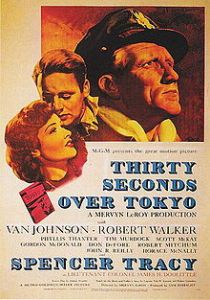
Not long ago I had the pleasure of hearing Col. R.E. Cole recount his experiences as Jimmy Doolittle’s copilot as depicted in the book and movie, Thirty Seconds Over Tokyo. This was my favorite early war film. I like many others of my generation grew up steeped in heroic films about World War II. The movie starred Van Johnson as Captain Ted W. Lawson, Phyllis Thaxter as his wife Ellen, Robert Walker as corporal David Thatcher, Robert Mitchum as Colonel Bob Gray, and the inimitable Spencer Tracy as Lt. Colonel Jimmy Doolittle. Heroism was on full display and made you proud to be an American.

220px-thirtysecondsovertokyo-1

Colonel Cole is now 101-years of age and, while frail, is still sharp. I must assume the events depicted in the movie and book proved to be the signal event of his life.

A recent article, My Flight With a Doolittle Raider, was published in Texas Coop Power. In it the author, Matt Jolley, describes a day in 2010 when he and Colonel R. E. Cole strapped themselves into a World War II-era B-25 bomber and roared off the runway for a spin. Once in the air the owner of the plane  turned the controls over to Colonel Cole.

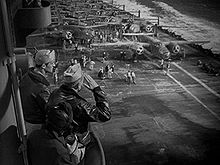
I believe Cole’s thoughts may have gone back to April 1942 when he and 79 other volunteers, only four months following Pearl Harbor, managed to take off from the swaying deck of the U.S.S. Hornet. They flew at the absolute outer fuel limits of their planes to drop a limited bomb load on Tokyo. While the physical damage was limited, the attack by Doolittle’s Raiders tremendously elevated American morale and diminished that of its enemy.

B-25 bombers awaiting takeoff from the deck of the Hornet

B-25 bombers awaiting takeoff from the deck of the Hornet

Imagine the satisfaction Colonel Cole must have experienced when he relived this event a few years ago. The author of the piece saw no boyish transformation in Cole, nor did he see a giant grin. What he witnessed was the quiet confidence of a man in full control of his airplane. I believe Cole must have felt a surge of satisfaction, reliving those seminal moments that has given his life such special meaning.

Colonel Cole is the last living Doolittle Raider. At his public speaking appearances, he is now attended closely by his daughter. He still loves to share his stories with others. With Veteran’s Day two days ago, it’s only fitting to remember and honor Colonel Cole and the other gallant men for their service and sacrifice to our nation.

But in another sense, what do events such as this one mean to the individual who experienced them. Wouldn’t it be marvelous if everyone who reaches old age could have the opportunity to re-experience their own signal  life’s event.  While this may not be possible, it suggests another option.

Why not allow an older person to reflect (tell their story). Our lives as story have such great importance for our own understanding. I only wish I had listened more closely to my grandparents’ stories. This inter-generational transfer of knowledge is good for both the listener and the speaker.

With the upcoming holidays, the opportunity exists to deepen understanding of the narrative of the older members of your family. I hope all will take advantage of this, not only to learn the stories, but to assist in the meaningful development of the aging process for your loved ones by allowing them to reflect deeply on what was important for their lives.

I would love to hear how this works for you.

To Be Continued


Reflections on Getting Older

You are likely familiar with the verse written by Robert Browning:

Grow old along with me! The best is yet to be, the last of life, for which the first was made.

When I first heard this verse, albeit at a much younger age, my thoughts were something like, “bunk, hogwash, senseless prattle, horse feathers!!!!”

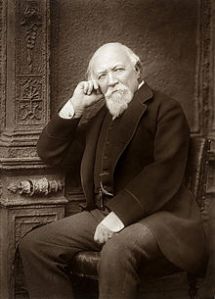
Robert Browning 1888

Robert Browning 1888

Over the years though I’ve gained greater appreciation for what Robert Browning was getting at.  In part, admittedly, this was due to my professional interests in Gerontology and Geriatrics. But this was largely book learning and short on personal experiences. Now that I’m living the aging process, I can better understand both the challenges and gifts that accompany it.

I hope in a series of blog posts to explore this topic further and relate the accepted features of aging and also the personal anecdotes. As always, I look forward to reader’s comments.

I suppose what made me think about this topic was an eightieth birthday party I attended several weeks ago. My son’s father-in-law was turning eighty. Alissa, his daughter threw him a no-presents birthday party, and instead requested everyone submit a letter describing what her Dad had meant to their lives. An astounding 88 letters arrived! These were carefully cataloged by Alissa and presented to her Dad.

Now the really good part: Roger on seeing all this and better understanding the impact his life had on others- teared up and became quite emotional (well for a Norwegian anyway). Now this is a stoic man who was a very successful businessman, a real numbers cruncher type who had played athletics at a very high level. He is a stoic Scandinavian-American not prone to public displays of emotion. But a public display of emotion he showed. Why was that?

I began thinking about this and melding my inner thoughts with what I knew about developmental psychology. While I have taught a college course on this topic, I’m really not an expert, but I wish to share my musings.

On entering “the third act” of our lives, most folks begin summing up of their accomplishments and  coming to grips with areas in which they were less successful. This phase of life often includes the deepening of relationships, dousing the inner fires, reducing the drive for accomplishments, and the sharing wisdom with others. This is a phase when mentoring of younger people often takes place along with the passing on of meaningful experiences to others .

The testimonials offered about Roger impacted his personal developmental journey, as it did mine. The birthday party affirmed his life’s worth and informed him of long forgotten kindnesses and other positive impacts on others. This timely theme for the party blended perfectly with the very developmental process he was undergoing. What a stroke of genius by Alissa for organizing the event in this way.

If we are fortunate, we all will age to a ripe and healthy old age.

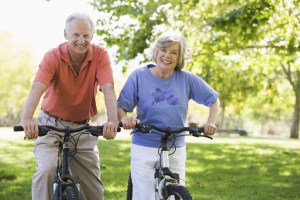
Health and vibrant aging can be such a gift

Health and vibrant aging can be such a gift

The more of life I experience, the greater I recognize that Robert Browning’s wisdom, “the best is yet to be.” Let’s hope so.


To Be Continued

Like Walking On Toast

A saying exists among Texas Hill Country ranchers that we live in a permanent drought only interrupted by periodic flash floods. Well if so, then bring on the flash floods! To no surprise for those in the region, we are suffering one of the worst droughts of all time. The 2011 drought that actually began during the last quarter of 2010 remains severe and shows no sign of abating. Many ranchers by now have sold off their herds.  In will take a couple of growing seasons for the grass to reestablish enough to support grazing. Others have maintained their cattle and hold onto them with the tenacity of a koala to a Eucalyptus tree.

Recently I heard an experienced rancher describe what it’s like when he walks across his parched pasture as, “like walking on toast.” As bad as this is, it’s even worse when walking silently over only dessicated dirt.

I made the decision two years ago to thin my cattle herd but to keep most. I had a herd of really good, young heifers and like a crazed gambler in Las Vegas, I felt my luck was sure to change any day. Two years later, I fear my doubling down was a sucker’s bet. The drought requires feeding hay–hay hard to impossible to grow and expensive to buy. The choice becomes really how one loses money; sell your herd and buy it back high, or keep your herd and buy costly hay. It’s a Hobsen’s choice to be sure.

Needless to say, I obsessively fret over my not very enticing options. I pride myself on being a good steward of the land, but when push comes to shove, I will look after my livestock first. My real choice at this point is whether to sell off the herd and wait for the land to recover, or fight on with the grass I have bought and stored in the barn.

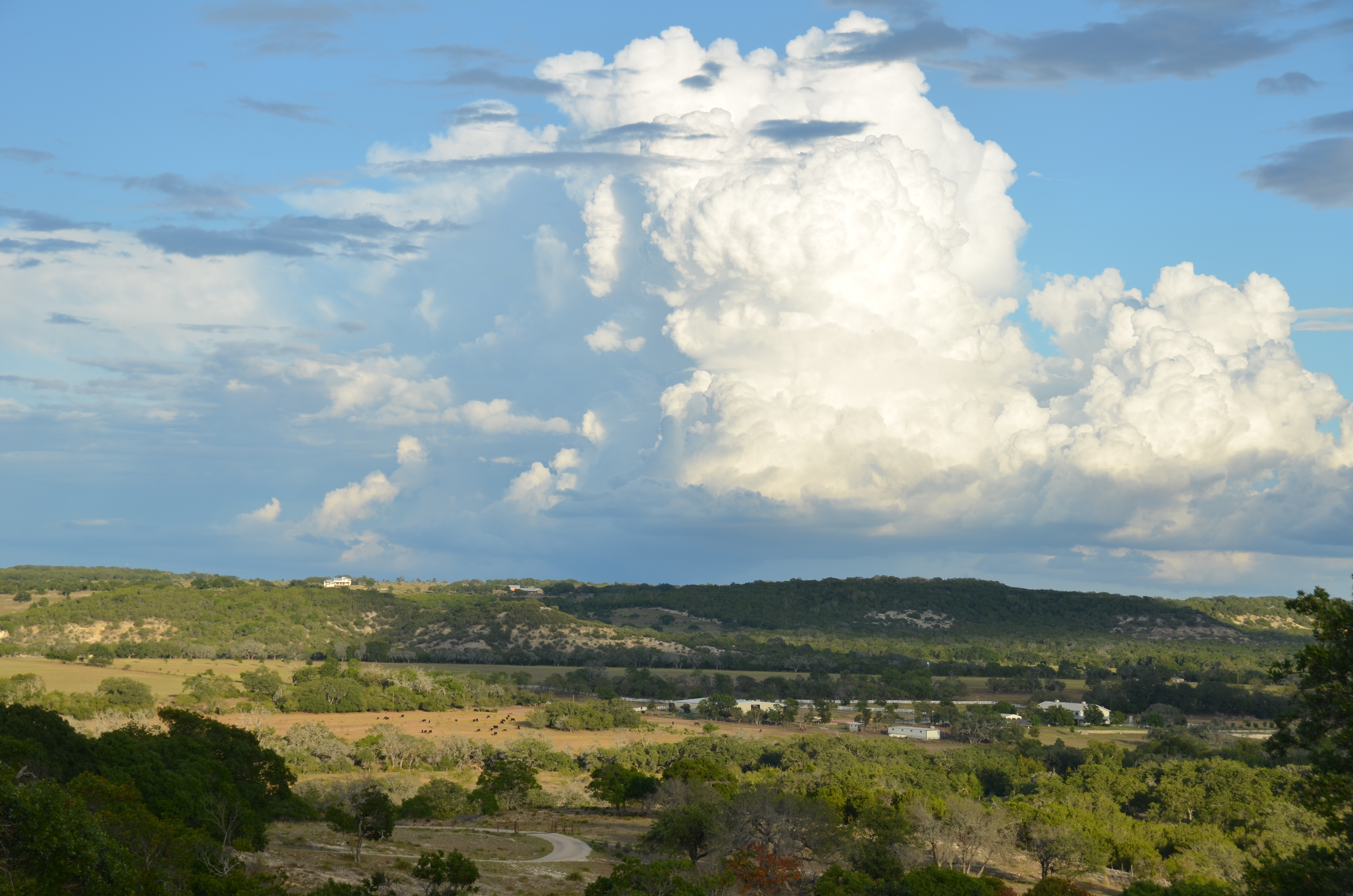
We are now into September, around these parts the second heaviest rain month of the year. Nevertheless, the average September rainfall is a bit below 2.5 inches, hardly enough to impact this fierce drought. With wanting eyes, we ranchers look to the Gulf for a tropical storm to head our direction and rain heavily down upon us. The earlier predicted robust hurricane season has already flopped. Now our chances for a tropical storm diminish by the day like a chocolate cake at a convention of sumo wrestlers. But Hill Country denizens remain steadfastly hopeful, perhaps how the Comanche desperately hoped for a miracle to turn back the relentless western expansion of the white man.DSC_1196

Periodic thunderstorms head our way. To date they are like a stripteaser and only tempt us. Mostly the rains that come are limited and not the long, drenching rains that are much needed to replenish our tanks, streams, and  wells.

As I longingly search the sky, I despair not knowing what to do with my herd. I only know that I need to make a decision in the near future. Will my attachment for the herd prevail, or will my desire for good stewardship for the land win out- I know not. I am sad and conflicted. Tune in…

Hutton’s Calves Take A Trip To Town–And Then Back Again

This morning with the help of my ranch hand, Francisco, and my long suffering wife, Trudy,  I loaded seven calves into the cattle trailer. They were big enough and ready to head off. I might have known something was awry, when the loading turned out to be easy, really too easy. It went without a single  calf bolting or hitch in the procedure of any kind. It was almost as if the calves hurried into the trailer in order to take their morning ride.

On arriving at the auction barn in Fredericksburg, I immediately became suspicious when no line of trucks with trailers existed waiting to unload their stock. It was then that I spotted a small but all too informative sign posted in the window of the auction house- “No sales on July 2 or 3”.

Silly me, I had failed to remember the auction barn closes on holidays such as Thanksgiving, Christmas, and New Years. It had never occurred to me that it would close for sales during the week of the 4th of July. Isn’t anyone going to eat steaks, hamburgers, or beef ribs, I fumed. Regrettably I was forced to point the nose of “the Old Goat”, my gas guzzling V-10 1999 Dodge pickup, homeward for the return trip.

I don’t think “cow” very well, but I would like to believe the calves enjoyed their outing. I know the ride along dogs enjoyed it, as Bella and Jack gave me numerous wet and raspy licks both on the way into town and on the way back to the ranch. With my face thoroughly washed and abraded, I unloaded the calves into the front pasture. They trundled out, looked blankly around, then kicked up their heels, and ran straight  in the direction of the herd. They appeared no worse for wear and had experienced a remarkably cool ride into town for a July morning in Texas.

My error today was certainly not my most painful as a rancher. For instance it does not compare to when I was pitched from a horse and broke my arm and jammed my neck, or in a second instance when i blew out a disc in my back trying to man-haul a stump out of the creek bed after a flood (in my defense, my tractor was broken and what else could I do?).

Now those two mistakes hurt! Mind you, I never in 30 years got injured swinging a reflex hammer at someone’s knee as a neurologist. Since retiring and becoming a rancher I have broken two bones, torn ligaments, blown out my back, and worst of all suffered numerous instances of major loss of face.

It’s also not the most foolish ranching mistake I have committed. Several candidates for this dishonor readily come to mind. Expanding my herd prior to the onset of a major drought might come in at most expensive. I never would have guessed that hay could get that expensive. Personally, I rather like the time when I determined to paint one of my pipe cattle guards red and black in honor of my undergraduate Alma Mater, Texas Tech University. I thought it would look nice and thought just maybe the cows would enjoy it too.

Trudy, despite otherwise having good sense and having utterly failed to talk me out of this folly, got down on her hands and knees and helped me complete the goofy project. I do recall her muttering under her breath most of the time it took to complete. Trudy, I think this would fall under the clause in the marriage contract, “For Better Or Worse”. You’ve got to admit, our marriage hasn’t been dull!

Looking back on it, I’ve made plenty of ranching mistakes. Perhaps it’s inevitable having been a “city boy” most of my life and having lived rural ranch life only for the last 12 years. But that’s the fun of it. I have learned more from my all too frequent mistakes than from the ranch books I have read or the Ranch Day Programs I have attended. It has been fun. Besides as Trudy and I say to one another if taking life too seriously, “No one is going to die from this.” In my previous life, I certainly could never say that.