Tag Archives: Ranching

Guess What We Found On Leaving Our Ranch Recently?

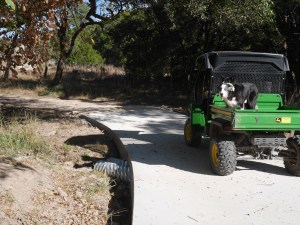
The other morning Trudy and I spotted something unrecognizable on the cattle guard at the edge of our ranch. Approaching closer I could tell it was a newborn calf, actually a Longhorn/Charolais cross. The poor little heifer had all four legs stuck between the pipes of the cattle guard and was totally helpless as she lay across the pipes.

The calf a week later doing well in the pasture

One surprising thing about a Longhorn calf is how quickly they stand up as opposed to other types of calves. This little heifer apparently stood up while its mother was down pasture grazing, wandered to a nearby cattle guard, and slipped and had ts legs plunge through it.

Trudy and I jumped out of the car and working together pulled the calf’s legs out from between the bars and carried it to the nearby grass. There we stood it up and encouraged it to move down the pasture to where its mother grazed. She saw us coming and raced to her calf. When last we saw the calf, it was chowing down at the milk bar.

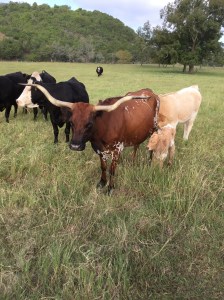
The proud mother with calf by her side

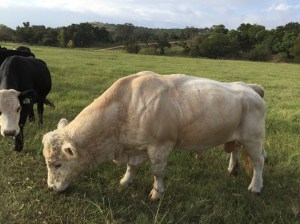
The proud daddy, a Charolais bull

The calf has done well ever since. Let’s just hope it has good one trial learning when it comes to why cattle guards  are there in the first place. I did notice a few days later when we vaccinated her for blackleg that she didn’t seem at all afraid of me. Might she have been appreciative or at least remember me? I’ll never know. Turned out to be a pretty good excuse, though, as to why we were running late for Sunday School.

The Birds, The Birds… They’re Back

I recently viewed a dozen or so cattle egrets within and perched upon our cow herd. These white, long necked, and long legged birds have been absent from our ranch for about a year. Our cattle tolerate them well. I couldn’t get close enough to take a picture of them but have some images taken from the internet.

The relationship between the egrets and cattle is a symbiotic one, as the egrets eat flies and ticks off the cattle. Both egret and cow have mutual benefit from their relationship.

What I discovered yesterday was that the egrets also provide entertainment for our friskier Spring calves. The calves playfully run at them, scattering the birds for a short fly around. The egrets soon after land in the herd and the chase is on again. The calves appeared to be enjoying themselves, but I can’t speak for the egrets.

Several times recently I’ve spotted a Great Blue Heron hanging out in the pool below the waterfall at Hidden Falls Ranch (our ranch across the county road). I can’t say for sure that it’s the same one about which I wrote the blog series last winter, but it looks the same. It’s dramatic to view it taking off from the pool, gaining altitude, and flying by me at eye level and not more than 20 feet away. According to Native American legend Great Blue Herons bring good luck. Bring it on!

Bulletin: Just viewed a Great Blue Heron in our stock tank below the house. It’s back! What wonderful news. Life is good in the Texas Hill Country.

I’m back

Bonus Calves

Woo hoo!!! Three bonus calves were born this week. That is, mama cows purchased in September with calves already by their side, and now have given birth to yet another unanticipated calf. The average price for the pair, now the trio, just went down. What a bargain!

Surprise, bet you weren’t expecting me!

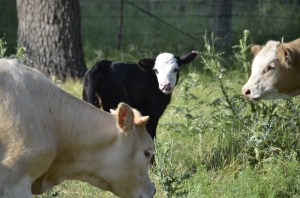
The bonus calves have white faces with the remainder black or brown. Our Charolais bull does not throw this color calf with our Black Baldies, but instead throws smoky colored calves, light brown or gray. Also the cow gestation period of nine and a half months just doesn’t work for our Charolais bull. Sorry Curly you can’t claim parentage!

Curly, the bonus calves stepdaddy

These are small calves compared to our usual smoky calves. With an Angus daddy, the calves start  smaller than with a Charolais daddy.  All three of the bonus calves are heifers. Perhaps I will let them grow and given their different genetics, make them into new producers for the ranch. Now that is an additional bonus.

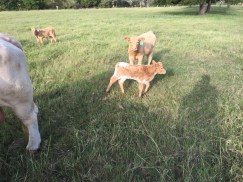
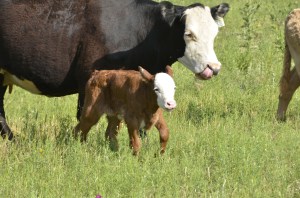
The first bonus heifer at one week of age. Note smoky calf on right and a longhorn/charlolais cross in foreground

Baby calves are so cute no matter their lineage. Must admit though when I saw the first I took a double take. You can imagine my surprise after the third. Life is sweet. Spring calves are one of the highlights of springtime on our cattle ranch. Hoping you too find bonuses in your lives during this lovely season.

Loose Livestock

The questionable county road sign on our ranch

The questionable county road sign on our ranch

The road sign above stands on the corner of our ranch. When first she spotted it, Trudy, my wife, became bothered, maintaining the county was demeaning the morals of our cattle. Now grant you, our bull is hardly monogamous nor will our cows necessarily shun the attention of an interloping bull, but Trudy claimed  no reason existed to impugn the morals of the Hutton’s cattle. Whether or not this was tongue-in-cheek or not, I’m not completely certain. She’s like that sometimes.

Quite possibly the sign referred to the unfenced ranch on the other side of the gate where, at times, drivers encounter livestock standing in the middle of the road. Just sayin’ this is a possibility, dear wife. The county commissioners might not be demeaning the morals of our herd at all.

What do you think?

“Mama Duck-Me” Guest Blog by Trudy Hutton

How did I become Mama Duck? Earlier this summer we and our neighbors decided to raise some Rouen ducks for our pond (known in Texas as a “stock tank” or just “tank”.) We have raised ducks before—five or six years ago– but they have all disappeared through old age or predators and we decided we would enjoy them again.

The ducks are ordered from a breeder and come via mail at one day old. The post office calls first thing in the morning…and I mean first thing, usually about 6:00 a.m….that there is a cheeping box of birds to be picked up AS SOON AS POSSIBLE.
113-1388_IMG

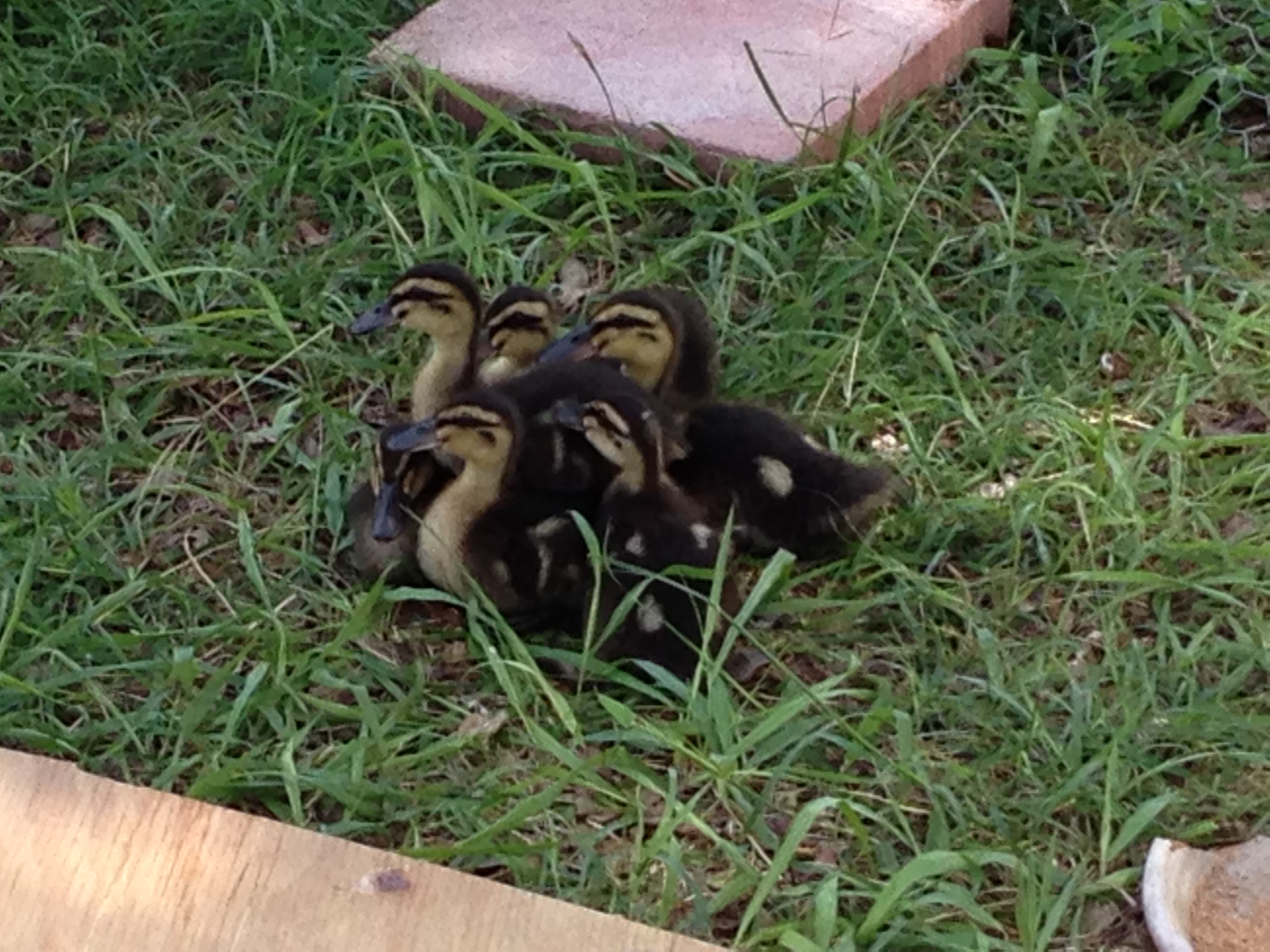
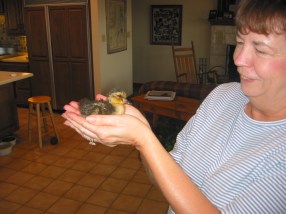
Our ducks, six cheeping handsful of down, lived for the first week in the laundry room in a large cardboard box. They had a heat lamp to keep them warm and we lined the box with newspaper to keep them semi-clean They are messy, smelly little things; the box needed to be cleaned daily, lined with fresh newspaper and food and water dishes refilled. Ducks like water. They really saw their water dish as a small swimming pool. Every morning about 4:30 they would begin cheeping for fresh water and food. Tom was the one who heard these early morning protestations and got up to fulfill their requests. Enough of that. The second week we moved them out to the shop and into an old poultry cage we had before used for our birds. Out of earshot and smell range (not to mention they were quickly outgrowing the box) we slept a little better.

We built a nice round chicken wire pen inside the fenced garden and filled a small wading pool for their swimming enjoyment.

IMG_1305

DSC_0167Although they were growing fast, we had to build “duck ramps” for them to be able to get into the water and we placed a rock “island” in the middle of the pool for them to rest on.

Every morning we gathered the ducks into a cardboard box and transported them to the outdoor pen. In the evening we rounded up the ducklings, after chasing them around the outdoor pen and putting them in the box to transport back to the poultry cage. (Making the outdoor pen round was not a good idea – no corners to catch them in.) They are very fast little devils! I would “quack, quack” to reassure them that it was Mama Duck, and hopefully convince them to follow me.

After the second week the ducks had outgrown the small wading pool, so we added a larger one and took down the chicken wire pen. They now have full roaming rights to the entire garden area.

IMG_1312

By the end of that week, they had the morning and evening routine down. We no longer have to transport them in a box between the garden and their night-time pen. Open the door to the shop and the cage door in the morning and I could lead the ducks out to the garden, quacking as we went. Tom says I flapped my wings, too, but I deny it.


After a few days I didn’t even have to do much as far as leading or herding. Now when we open the door to the poultry pen, out they march, in a close group, on their own.

About sundown we reverse the routine, usually following behind the ducks, as they seem to know it’s time for bed. They head straight into the shop and the evening safety of the poultry pen. A few nights ago, I was a bit late going out to bed them down and found they had already taken themselves inside for the night!

IMG_1314

As the ducks grow we may have to find a bigger swimming pool. But before too much longer they will be big enough to move down to the tank and be on their own. Rouen ducks are identical in coloring to Mallards, but unlike Mallards they cannot fly more than 20 or 30 yards. By the time they grow enough to move to the tank, they will be able to swim into the middle of the water for safety from predators.

I still “quack, quack” when I feed them daily in hopes that when they do make the move to the tank, it will only take a few “quacks” to call them up to feed. We’ll see how the transition to the tank goes. The last time we had ducks ready to move to the tank, I walked down to the tank, quacking as I went, with 6 mostly grown ducks behind me. However, I barely got back to the house when we heard them quacking at the back gate. They had not only followed me down to the tank, but evidentially thought Mama Duck wanted them to follow her home. Time will tell about these little quackers..

Like Walking On Toast

A saying exists among Texas Hill Country ranchers that we live in a permanent drought only interrupted by periodic flash floods. Well if so, then bring on the flash floods! To no surprise for those in the region, we are suffering one of the worst droughts of all time. The 2011 drought that actually began during the last quarter of 2010 remains severe and shows no sign of abating. Many ranchers by now have sold off their herds.  In will take a couple of growing seasons for the grass to reestablish enough to support grazing. Others have maintained their cattle and hold onto them with the tenacity of a koala to a Eucalyptus tree.

Recently I heard an experienced rancher describe what it’s like when he walks across his parched pasture as, “like walking on toast.” As bad as this is, it’s even worse when walking silently over only dessicated dirt.

I made the decision two years ago to thin my cattle herd but to keep most. I had a herd of really good, young heifers and like a crazed gambler in Las Vegas, I felt my luck was sure to change any day. Two years later, I fear my doubling down was a sucker’s bet. The drought requires feeding hay–hay hard to impossible to grow and expensive to buy. The choice becomes really how one loses money; sell your herd and buy it back high, or keep your herd and buy costly hay. It’s a Hobsen’s choice to be sure.

Needless to say, I obsessively fret over my not very enticing options. I pride myself on being a good steward of the land, but when push comes to shove, I will look after my livestock first. My real choice at this point is whether to sell off the herd and wait for the land to recover, or fight on with the grass I have bought and stored in the barn.

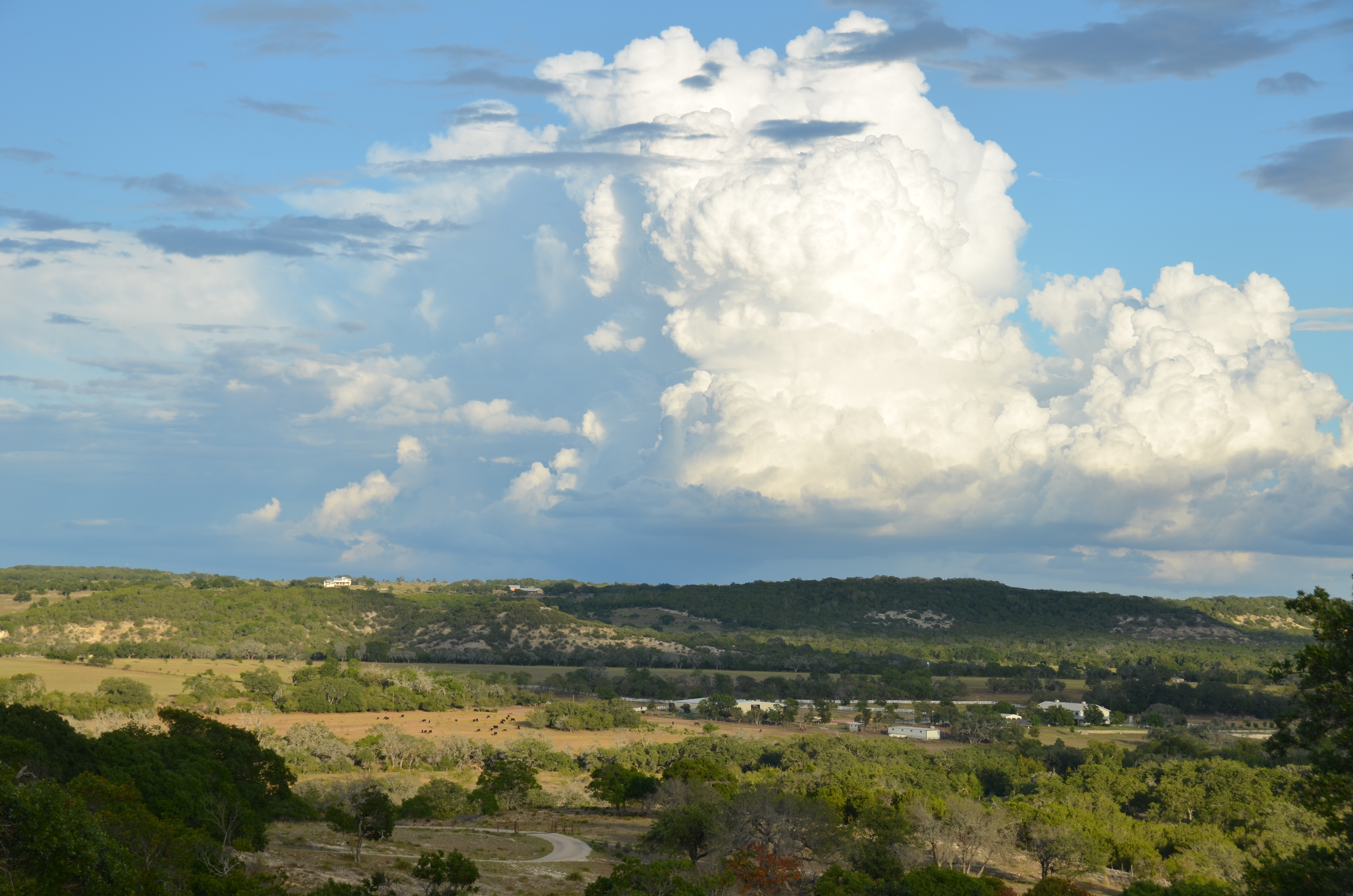
We are now into September, around these parts the second heaviest rain month of the year. Nevertheless, the average September rainfall is a bit below 2.5 inches, hardly enough to impact this fierce drought. With wanting eyes, we ranchers look to the Gulf for a tropical storm to head our direction and rain heavily down upon us. The earlier predicted robust hurricane season has already flopped. Now our chances for a tropical storm diminish by the day like a chocolate cake at a convention of sumo wrestlers. But Hill Country denizens remain steadfastly hopeful, perhaps how the Comanche desperately hoped for a miracle to turn back the relentless western expansion of the white man.DSC_1196

Periodic thunderstorms head our way. To date they are like a stripteaser and only tempt us. Mostly the rains that come are limited and not the long, drenching rains that are much needed to replenish our tanks, streams, and  wells.

As I longingly search the sky, I despair not knowing what to do with my herd. I only know that I need to make a decision in the near future. Will my attachment for the herd prevail, or will my desire for good stewardship for the land win out- I know not. I am sad and conflicted. Tune in…

Hutton’s Calves Take A Trip To Town–And Then Back Again

This morning with the help of my ranch hand, Francisco, and my long suffering wife, Trudy,  I loaded seven calves into the cattle trailer. They were big enough and ready to head off. I might have known something was awry, when the loading turned out to be easy, really too easy. It went without a single  calf bolting or hitch in the procedure of any kind. It was almost as if the calves hurried into the trailer in order to take their morning ride.

On arriving at the auction barn in Fredericksburg, I immediately became suspicious when no line of trucks with trailers existed waiting to unload their stock. It was then that I spotted a small but all too informative sign posted in the window of the auction house- “No sales on July 2 or 3”.

Silly me, I had failed to remember the auction barn closes on holidays such as Thanksgiving, Christmas, and New Years. It had never occurred to me that it would close for sales during the week of the 4th of July. Isn’t anyone going to eat steaks, hamburgers, or beef ribs, I fumed. Regrettably I was forced to point the nose of “the Old Goat”, my gas guzzling V-10 1999 Dodge pickup, homeward for the return trip.

I don’t think “cow” very well, but I would like to believe the calves enjoyed their outing. I know the ride along dogs enjoyed it, as Bella and Jack gave me numerous wet and raspy licks both on the way into town and on the way back to the ranch. With my face thoroughly washed and abraded, I unloaded the calves into the front pasture. They trundled out, looked blankly around, then kicked up their heels, and ran straight  in the direction of the herd. They appeared no worse for wear and had experienced a remarkably cool ride into town for a July morning in Texas.

My error today was certainly not my most painful as a rancher. For instance it does not compare to when I was pitched from a horse and broke my arm and jammed my neck, or in a second instance when i blew out a disc in my back trying to man-haul a stump out of the creek bed after a flood (in my defense, my tractor was broken and what else could I do?).

Now those two mistakes hurt! Mind you, I never in 30 years got injured swinging a reflex hammer at someone’s knee as a neurologist. Since retiring and becoming a rancher I have broken two bones, torn ligaments, blown out my back, and worst of all suffered numerous instances of major loss of face.

It’s also not the most foolish ranching mistake I have committed. Several candidates for this dishonor readily come to mind. Expanding my herd prior to the onset of a major drought might come in at most expensive. I never would have guessed that hay could get that expensive. Personally, I rather like the time when I determined to paint one of my pipe cattle guards red and black in honor of my undergraduate Alma Mater, Texas Tech University. I thought it would look nice and thought just maybe the cows would enjoy it too.

Trudy, despite otherwise having good sense and having utterly failed to talk me out of this folly, got down on her hands and knees and helped me complete the goofy project. I do recall her muttering under her breath most of the time it took to complete. Trudy, I think this would fall under the clause in the marriage contract, “For Better Or Worse”. You’ve got to admit, our marriage hasn’t been dull!

Looking back on it, I’ve made plenty of ranching mistakes. Perhaps it’s inevitable having been a “city boy” most of my life and having lived rural ranch life only for the last 12 years. But that’s the fun of it. I have learned more from my all too frequent mistakes than from the ranch books I have read or the Ranch Day Programs I have attended. It has been fun. Besides as Trudy and I say to one another if taking life too seriously, “No one is going to die from this.” In my previous life, I certainly could never say that.