Tag Archives: Dog Training

Why Dogs Sniff Crotches and How to Discourage It

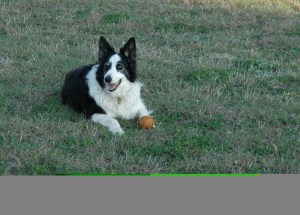
We have a new dog at Medicine Spirit Ranch about whom a future post will be written. Duke our new Border Collie/Australian Shepherd mix who despite many good qualities turns out to be an inveterate crotch sniffer. His nosy behavior (pun intended) is awkward when friends drop by for a visit, as clearly Duke doesn’t respect human boundaries. His nose to the groin behavior prompted me to review why dogs sniff crotches and what can be done about this embarrassing doggie trait. Perhaps you have had a similar experience and wondered as well?

Duke our new Border/Aussie  mix

It is common knowledge that all dogs have a keen sense of smell, but did you know that a dog’s sense of smell is 10,000 times as sensitive as humans? It is this keen sense of smell that makes it possible for them to sniff out drugs, bombs, cancer, bed bugs, insulin levels and even Covid-19 infections. That’s quite a good sniffer!

Mary Beth McAndrews writing for the American Kennel Club also describes how dogs have a special olfactory organ termed a Jacobsen’s organ or vomeronasal organ that is located in the roof of the mouth. It plays a vital role in the dog’s superior sense of smell. The scent-dedicated part of the brain in dogs is forty times as large as in humans. But what is it that dogs are sniffing for?

Dogs sniff for the scent put out by sweat glands also termed apocrine glands, as they release pheromones that convey tremendous amounts of information for canines. The highest concentration of apocrine glands in dogs is found in the genitals and anus, explaining why dogs sniff other dogs’ butts. Apocrine glands in humans are especially prominent in armpits and crotches. Whereas most dogs are too short to sniff human armpits, most focus their keen olfactory attention on crotches for gaining information.

These pheromones inform them for example whether a person has recently had sex, given birth, or if menstruating. In each instance a sniff reveals a higher level of pheromones. These higher levels of pheromones also explains why many dogs tend to steal underwear since these undergarments carry the owner’s scent. Talk about awkward when your pooch parades through a social gathering at your home with your underwear clenched in his teeth!

While dogs love to introduce themselves to other dogs by sniffing the other’s rear end, something gets lost in doggie decorum when they do it to people. To better understand why dogs sniff crotches, it is helpful to understand why they are doing it in the first place. When meeting humans, we can ask relevant questions, but of course dogs can’t speak and must rely on their superior sense of smell. They instead will rush in to do a nose scan of the private areas, leaving behind their wet nose spot on your nicely laundered garment.

According to Rover.com and Dr. Sperry, it is improper to discipline your dog when they get nosy with a guest. The dogs won’t understand your concern, understand what they did wrong, or comprehend what you would wish for them to do differently. Dr. Sperry instead advises a more polite outlet by redirecting their sniffing behavior.

One example of redirecting is to teach your dog to sit when guests enter the house. By doing so your guest will have time to extend a hand for sniffing (plenty of apocrine glands in the palms of hands exist) rather than providing an unguarded opening for a crotch sniff. Another more guest friendly approach is to teach your dog to a High-Five. This is a particularly cute trick that will undoubtedly invite praise from your guests.

To train a dog to give a High-Five, place a dog treat in your fist and hold it out head high to your dog. Eventually your dog will paw your hand and allow you to reward him/her with the treat hidden within your fist. By rewarding your dog with praise, a treat, and a verbal “High-Five”, the trick can be learned. Our new dog Duke, learned the trick in only three repetitions (a little bragging here). A verbal cue can usually be learned quickly, making the trick both diverting and praiseworthy.

Of course taking your dog on a long walk with ample time for nose work may also prove helpful. Gaining opportunity to sniff will reduce the need for crotch sniffing. Myriad objects in the outdoors will tantalize your dog’s Jacobsen’s organ and allow for more socially acceptable nosework.

And please keep in mind that when your dog sniffs a crotch, it is not trying to be rude. Instead it is only trying to learn more about the person. Crotch sniffing is in the doggie world is more like a handshake or introductory human banter. Let’s be gentle with our pouches and redirect crotch sniffing in a more socially acceptable way.
A Sad Day at the Ranch

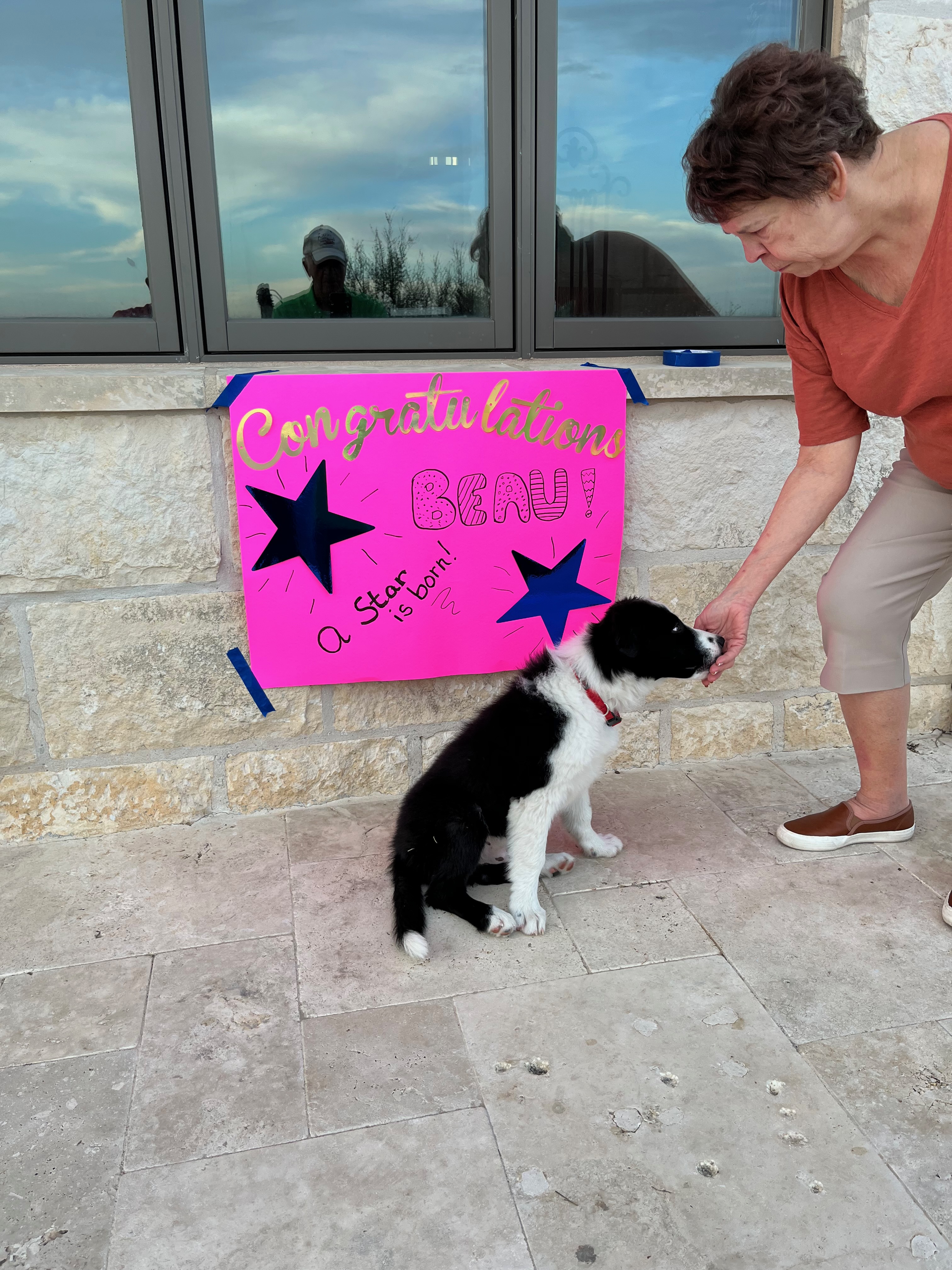
Over the years I have expressed moments of great joy at Medicine Spirit Ranch and a few instances of deep sadness. Today, I express the latter. Beau our young Border collie who had such great promise as a herder and with whom we fell in love over his antics, is leaving us.

Beau showing off his star form after making a Purina One Commercial

You see, Beau began to pick up the bad habit of biting not only our old and virtually blind Bella, but also Trudy and me. Trudy sustained a wound to her hand that required five stitches while I have received too many bites to count. Yesterday he sank his teeth deeply into the fleshy part of my right hand. I bled extensively and it was quite painful. His biting is getting worse and increasing in frequency.

Why Beau enters into a blind rage that leads to his biting, is difficult to say. In part he will growl to protect his food, his toys, and even his people. Resource protection is not all that unusual. But at other times he curls his lip, growls, and attacks ferociously because he is willful to keep his position in the truck or because he demands to chase cows or horses or for other reasons known only to him. His enthusiasm is welcomed, but his rage and serious biting are intolerable. It is as if he has a screw loose.

Beau has been through obedience school. Other than a single instance in which he growled at another dog, Beau proved the star of his class. No great surprise as Border collies usually are the stars in obedience class. We also have been working with a wonderful dog trainer. For the longest time, Beau hid his aggressive tendencies from her but last week his rage showed forth in front of the dog trainer. Yvonne, the dog trainer, was taken aback. She now says that she fears Beau and tells us his behavior will likely only worsen. She advised we contact Beau’s breeder and ask if similar examples exist in their other dogs and whether she would take him back.

The breeder shared that no other examples of such aggressive behavior have occurred among her dogs. The breeder agreed to take Beau back. The alternative for us was to put Beau down, a move that I cannot yet carry out. We know the breeder likely will see similar bad behavior and that Beau has only a small chance of living much longer. We are heartbroken.

I don’t recall any of our Border collies having as much instinct for herding as Beau. Likewise, I’ve never seen any of our prior four Border collies become aggressive or bite.

Trudy and I feel like dog rearing failures. We’ve done everything our veterinarian and dog trainer have advised. Beau was neutered without any appreciable change in his behavior. Doggie downers have been ruled out by our vet. We have worked extensively with him on his decorum and on various types of training. He is well cared for and never abused. He is deeply loved. So why the rare but very real aggression?

I would not be able to live with myself if Beau were to bite a child or another person. I feel we have no good options left.

The breeder has a number of Border collies and a large working cattle ranch. Perhaps, just perhaps a change of environment will bring about a favorable change in Beau’s behavior. He will become an outside dog living much of his time in a dog run. Will this extend his life? Well, I can hope…

This evening we make the transfer. My nearly constant ranch companion for the last year will leave us and take with him a little of my heart.

Bandit-Our First Border Collie-Part 3

Thank you for continuing to follow the Bandit story. He proved to be my dog of a lifetime and as subsequent stories will show- changed our lives in meaningful ways.

Evening Trips to the Park

Neighborhood children frequently shadowed us during our trips to the local park. Neighbors often appeared at windows, observing Bandit’s effortless saunter along the sidewalk, pursued by his increasingly haggard looking owner.  Several, gave sympathetic words of encouragement to me as  might have  been offered to the final straggling runners in the Boston marathon.

Ignoring the local leash ordinance, assuming no doubt incorrectly, that voice control would suffice, we allowed Bandit to stride ahead, carrying a ball or Frisbee in his mouth.  He truly was under control, knowing to sit and wait at each corner, and never crossing a street without permission.  Nevertheless, I always felt relieved when I returned from the park without a citation from Lubbock Animal Control.

Once at the park with its smells of newly mowed grass and yellow glare of the lights, Bandit would become thoroughly engaged with our games. He would ignore the thwacking sounds of competing nearby tennis matches, giggling children on swing sets, and even other curious dogs that came around him.  The focused intensity of a Border collie is truly splendid to behold.  Bandit would take his crouch and stare at me, waiting for me to sling the ball.

With visions of Sandy Koufax or Mickey Mantle running through my head, I would rear back and throw tennis balls as far as possible.  I remember thinking a bit smugly that during high school I had possessed a good throwing arm.

Bandit would tear out after the ball, scoop it up while still rolling, and rapidly return it to me. Bandit seemed untiring. His alert, dark eyes would glisten, and he panted with excitement. After several weeks of pitching tennis balls, I was no longer feeling quite so smug about my ability to throw the ball, as I developed a painful arm strain.

Over several more days my arm worsened. It became so painful that I found it difficult to elevate it above my head.  After still more park excursions, it got to the point that I could not easily dress myself.  On more than one occasion, I had to ask Trudy to hold my shirt, so that I could slip my tender right arm into the sleeve.

She then suggested in her inimitable way, “Why not give up the Nolen Ryan bit and try tennis?”

Tennis Anyone

 Following Trudy’s practical suggestion, I began hitting balls with a tennis racket and soon marveled at the added distance this provided.  Hitting the tennis ball with a racket also drew upon a different set of muscles than throwing, so that I could swing the racket almost without pain. Bandit appeared not to care how I launched the ball, as he continued to pursue it with equal enthusiasm.

I enjoyed watching the yellow tennis ball explode off the racket and arc far across the park.  I marveled at the grace and speed of Bandit’s longer out runs. I also observed how Bandit then would drop the ball about three quarters of the way back to me and retreat some distance. The time it took for me to trot out and collect the ball provided Bandit time to prepare and adopt his vigilant stance. By this process, Bandit also imposed my own exercise routine.

Chasing the tennis ball caused Bandit to expend additional energy, leading me foolishly to believe we were at last making progress. But after weeks of hitting the ball, rather than Bandit showing any signs of exhaustion, I instead developed tennis elbow, no less painful than my previous shoulder strain. In short order, I was forced to retire from both doggie baseball and doggie tennis. Heck, I still have doggie kickball and doggie golf.

Unexpected Results

“Hey big guy, you’re not the jock I married thirty-five years ago,” Trudy teased. I responded without comment but likely with a pained smile.  Indeed, this collie had taken a heavy toll on my middle-aged, soft-bellied self and had allowed an opening for Trudy to proceed with friendly ribbing.

Despite the physical toll on me, the new regime of activities and exercise brought about improvement in Bandit’s behavior. Trudy and I, to our surprise, also noticed our own bodily changes.

“Hey Trudy, is the scale broken?” I asked one morning after a month or two of the exercise programs.

“Don’t think so, but I was surprised too when I weighed.”

Not only had we lost weight, but we were feeling more fit.  I found the morning jaunts to the park to be less exhausting than earlier and at times found myself even jogging alongside Bandit to and from the park.

Even more astonishing, our spirits had elevated. We began to laugh more. Life became more interesting. Trudy and I began to plan a date night weekly, something we had not enjoyed for many years. In short, we found ourselves with increased energy– energy that allowed us to better address sources of diminishing satisfaction within our lives.

Frisbee

Bandit and I began to spend more time together as well. It was during this period that I introduced Bandit to Frisbee. He absolutely loved it. Bandit took to Frisbee like a pregnant woman to cheesecake.  Soon he was snatching Frisbees out of mid-air like a lizard catching flies. He learned to make over-the-shoulder acrobatic catches amid his dramatic leaps. His performances began to pay dividends and in highly unexpected ways.

After several weeks, Bandit’s fame at retrieving Frisbees had spread throughout the neighborhood. Adults as well as children now began leaving their homes to walk with us to the park.  Cars would often slow down when passing the park, even parking at the curb to watch our graceful, athletic black and white dog snatch Frisbees out of the air.

One spring day I heard a shout from the street and looked up from our game of Frisbee. To my shock, I spotted half a dozen cars parked at the curb with still more pedestrians watching us. Many were total strangers, intently observing Bandit and acknowledging his athletic ability.

I would rear back and whip the Frisbee in a high gliding arc.  Bandit would sprint away toward the arcing Frisbee, leaping high into the air like a ballerina to snag the disc. Shouts would erupt from the throng following particularly agile catches.

“Hooray, just look at that dog.”

“Never seen anything like it.”

“What a dog!”

Friendly waves and smiles came from the spectators. I sensed these strangers, beaming and whooping support for our black and white ham, somehow benefited from the experience. Bandit put on amazing performances of running and jumping, and making acrobatic catches, but I questioned why his Frisbee catching attracted so much attention.

Occasionally people wandered onto the grassy field to inspect Bandit more closely.  When this happened, Bandit would break off his crouch and would wiggle up to them, swishing his tail in a wide and friendly arc. The momentum of his tail wags was such that they wagged his whole rear end.  He would lick any extended hand.

After more evening Frisbee sessions, I began to seriously ponder the reasons for Bandit’s enlarging audiences. It seemed to me that Bandit provided these city-churned commuters brief moments of joy between hectic work schedules and responsibilities awaiting them at home.  During these brief intervals his fans vicariously enjoyed Bandit’s unmitigated joy.

To Be Continued

If you have not had the chance to read my latest book, Hitler’s Maladies and Their Impact on World War II: A Behavioral Neurologist’s View (Texas Tech University Press), I invite you to do so. The book explores an important aspect of the Hitler story and World War II that has not been well studied. Many of Hitler’s catastrophic errors including the premature invasion of the Soviet Union in June 1941, the slowness of German forces to counterattack at the Battle of Normandy in 1944, and the highly risky Battle of the Bulge in late 1944 into 1945, can be better understood, knowing the sizeable impact that Hitler’s physical and mental conditions had on these vital battles.

Also, consider picking up a copy of my earlier book, Carrying The Black Bag: A Neurologist’s Bedside Tales (Texas Tech University Press). Please join me on my personal journey as a physician and meet my patients whose reservoirs of courage, perseverance, and struggles to achieve balance for their disrupted lives provide the foundation for this book. But step closely, as often they speak with low and muffled voices, but voices that nonetheless ring loudly with humanity, love, and most of all, courage.