Tag Archives: Creative Nonfiction

Bandit Our First Border Collie- Part 5: Intruder

While driving across my ranch one early morning several months following retirement, I discovered my neighbor’s exceptionally large White Park bull standing amidst my small, young heifers. This jarring discovery became my first true ranch emergency and called for greater skill than than this neophyte rancher possessed at the time.

My inexperienced Border collies, Bandit and Mollie, surprisingly resolved this frightening situation for me, and by so doing revealed previously well hidden talents. The incident also provided me with a greater understanding of Bandit’s destructive and irritating behavior while feeling restricted in a city.

Bandit represents what can happen to anyone who is poorly suited for a particular place and then becomes transformed when moved to a more conducive environment.

This is a fitting final story about Bandit for this blog series, as he affected our lives so greatly. His story may inspire humans other than ourselves to seek changes in their lives and environments in which they have failed to bloom.


Towering above my black cows stood a giant, ghostly white bull. Its massive white head was accented by black ears, nose, and black-rimmed eyes. The bull was thick, muscular and three times the size of my young, first time heifers.

“Oh damn,” I murmured. “Now what?”

I  glanced around for my black Angus bull that I had recently leased to breed my first time heifers, but found it nowhere in sight. I realized that if this white behemoth were to breed my heifers the offspring would be much too large to deliver, putting the lives of my young heifers at risk. I felt a state of near panic rising up within me. The welfare of my young cows depended on me- the clueless city guy who was brand new to cattle ranching.

 After shoving two intensely interested Border collies deep within the truck, I opened the door and bailed out of my pickup. If freed I feared my two rookie collies might cause a stampede, leaving either the dogs or the cattle as casualties. I soon spotted a mangled section of fence not far from our old and falling down pole barn. Barbed wire dangled uselessly from broken cedar posts that lay scattered on the ground. The gouged and scraped dirt beneath the broken fence identified where the intruding bull had entered my ranch.

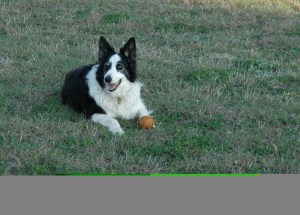
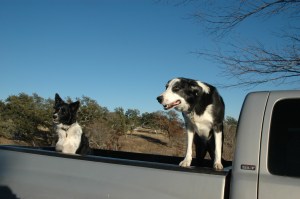
Mollie and Buddy want to help

Bulls are territorial animals. My herd bull would have confronted the the intruding bull at the perimeter fence and would have violently defended his domain. I instinctively knew that my small, leased Angus bull  would have had no more chance to repel the larger white bull, than would a destroyer pitted against a battleship.

I picked up a small limb from the ground and scuttled in the direction of the herd as fast as poorly conditioned legs would allow. My hand repeatedly gripped the rough bark of the stick, milking the stick for a plan to expel the intruding bull.

With my attention fixed on the bull, I failed to notice an exposed Live Oak root. I caught my foot on it, lost my balance, lurched forward, and struck the ground hard. My right hip absorbed the initial blow, causing a searing pain to explode down my leg and into my low back. My head next hit, smacking into a cow patty. As I pushed myself up from the ground, the pungent smell of cow dung filled my nostrils. Rage welled up within me. I scraped dung from cheek and glasses, regained my balance, and limped onward; anger supreme over pain. By then I had lost all semblance of common sense.

I shrieked, “I’m getting you, you trespasser! Can’t sneak onto my ranch!”

What I expected to accomplish with my limp along, futile advance was unclear, but lacking a plan to remove the bull, bravado was all I could muster. The bull threatened my small kingdom and challenged my role as protector of these young cows. To be sure, bulls were not the only territorial animals on the Hutton ranch that day.

My herd complete with the offending bull grazed in a pasture nearby the cattle pens. The herd stood a hundred yards removed from my now abandoned pickup, providing a degree of separation from my dogs, but I could still hear their barking coming from within the truck .

When I drew within twenty yards of the bull, the great white bull raised its massive head and slowly turned toward me. Its baleful, unblinking eyes fixed on me; a stare so powerful and so frightening that it stopped my movement. The bull’s coal black eyes seemed to project malevolence. I observed the immense thickness of his neck, thicker than a man’s chest. After taking a deep breath and steeling my resolve, I crabbed forward, all the time visually measuring the distance to the relative safety of the cattle pens in the event that the bull were to charge.

The bull lowered its massive head and slowly scraped his enormous hoof along the ground, throwing dirt up under its massive belly. This aggressive display again momentarily halted my forward progress. I observed how the bull’s dirt-caked nose dripped and how drool streamed from his maw. I could hear the bull’s low-pitched sounds, as if coming from a bass speaker, but so deep it was hard to imagine the sounds emanating from an animal rather than some mythological beast in a subterranean cavern. Evolution designed this warning to frighten away other bulls, predators, and foolish, neophyte ranchers like me.

Mercifully, the bull did not charge, leaving me to share my story. Perhaps surprised at seeing a yelling, flailing, limp along man, carrying but a small stick, he chose instead to fall back. The bull likely did not have fear me as much as viewing me as an inconvenience, like a pestering swarm of  flies.

Over the next twenty minutes, I attempted without success to separate the intruding bull from my herd. Despite repeated efforts, the bull stubbornly remained among my heifers. Despite the coolness of the morning, I soon found myself sweating and felt my shirt sticking to my back. My lungs began to burn, and more than once I was forced to bend over with hands on knees to recover from my efforts. My limited physical activity of a physician had certainly not prepared me for such physical exertion.

Once, I briefly separated the bull from the heifers, only to have him circle around me and quickly rejoin the cows. I felt irritated and and even a little embarrassed by my failure. Bulls, I learned, moved surprisingly fast to be such large animals.

Defeated, exhausted, and still smarting from my fall, I limped back toward my pickup. By then the earlier rosy glow above the eastern hills had developed into a breaking dawn. But the additional light provided me no further illumination as to how to rid the bull from the ranch. I turned toward the bull in a parting gesture- in case any neighbors across the fence happened to be watching- and yelled, “Just you wait, you’ll make the biggest meatloaf in history, make the Guinness Book of Records!”

Despite my bluster, I felt diminished and outsmarted by this roving ruminant. My boots scraped along the ground. I felt embarrassed- with my many years of education, outwitted and outrun by a dumb bovine.

While approaching the pickup, I heard howling from within it. When I raised my eyes, I saw my pickup visibly rocking. Bandit and Mollie’s wailing seemed to demand their release. Mollie had by then jumped over the seat and careened from side to side, banging forcibly into the car doors. She used her body like a small battering ram in her attempt to free herself.
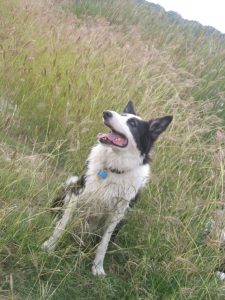
Did someone say cows?

Bandit with his well practiced destructive ways had meanwhile shredded the back seat. Stuffing from the macerated seat had spread throughout the cab and the white seat stuffing made the interior resemble a snowstorm. A tuft of stuffing even crowned Bandit’s head like snow atop a mountain peak. Momentarily I stood dumbfounded, looking at the swaying truck and the dog-inspired mayhem within. I learned yet another painful ranch lesson- never leave the Borders in the pickup with nearby cows.

It became ever so clear the dogs demanded their opportunity at moving the bull. But realistically how could small, inexperienced dogs help against this giant marauder? I thought Bandit and Mollie could be hurt or even killed. The risk was too great to consider. I felt anguish, torn by fear for my dogs yet tormented by my responsibility for the young heifers and lack of a viable plan to evict the bull. Good reasons existed for not releasing the dogs, as they could be kicked, stomped, or butted by the giant bull. Their frenzied desire to participate in their Border collie birthright, however,  struck me as oddly compelling, and I had no better option.

I grasped the door handle but stood frozen by indecision. The dogs could do no worse than my sloppy misadventure, having driven the intruder still farther from the broken fence line.

Peering through the window of the pickup, I asked, “You want to help?”

In response deeply emotive howls erupted from within. Their tails beat a staccato against the seats, their eyes burned with an intensity not previously seen. Their bodies quivered. I pushed the button on the door handle, cracked the truck door ever so slightly, only to have it blown open, as two yelping Border collies erupted from the pickup like two demons escaping Hades.

“Go get the bull! Get him!” I yelled after them, my voice larded with desperation.

The dogs, like low flying cruise missiles, sped off in the direction of the intruding bull.
They raced across the pasture. Mollie, the younger and faster of the two, reached the bull first. As she neared Mollie cut her stride, dropped her head, eyed the bull, and began slowly to circle him. When an opening arose, Mollie darted between the bull and the cows. She crouched down, awaiting Bandit’s arrival. The bull lowered its head and watched Mollie intently.

Bandit’s appearance was not long in coming and consisted of a headlong, yapping, suicidal charge straight at the bull. His kamikaze-like onslaught caused the giant bovine to spin around to face his new attacker. In the last instant, Bandit veered off, barely escaping the bull’s head butt. This diversion of the bull’s attention provided Mollie the opportunity to surge forth and bite at the bull’s hind legs.

The bull appeared surprised and then perturbed by the double onslaught. He twisted his massive body around to determine the source of the bite and momentarily focused his malice on Mollie. He clattered a huge, hoof over the rocky soil. He bellowed a deeply pitched warning. The bull then retaliated with several ferocious kicks that narrowly missed my circling dogs. My spirits sank. Had I been foolish to release my dogs? A dog’s skull would be crushed by landing a single kick from this massive bovine.

To my surprise, my usually docile pets had transformed into snarling, vicious animals. They fixed wolf-like stares on the bull. They snarled, revealing gleaming white canines. My fear for my dogs’ safety became mixed with incredulity at their agility and bravery. Mollie and Bandit repeatedly darted at the bull, dodging his flying hooves. The efforts of the giant bull kicked up a dust cloud that at times obscured my view of the dogs. I felt loathing for this bull. He threatened the well-being of my heifers but now sought to kill my rookie herders. My heart pounded in my chest.

The bull shifted his glare between Bandit and Mollie, his eyes never leaving my determined dogs. Then the bull lifted his head and, surprisingly, took a tentative step backward. The dogs, sensing his hesitancy, stepped up their attacks as if choreographed, demonstrating a fury that left the bull appearing bewildered. While the dogs appeared to be dodging and diving haphazardly, it became apparent their efforts were forcing the bull to retreat.

By then I had arrived close enough to the mêlée to smell the musky aroma of the bull. I stationed myself on the opposite side of the bull from the downed fence. I brandished my stick- a stick that in the presence of the dogs drew increased respect. Together the dogs and I edged the bull slowly across the pasture toward the distant breech.

After several more minutes, we managed to move the bull about a hundred yards away from the herd. It was when circling from opposite directions that the unexpected happened. The dogs with eyes fixed on the bull collided full force after running into each other. This sent both dogs sprawling in the dirt. For an instant, both Borders lay almost motionless on the ground, legs splayed awkwardly.

On seeing this unexpected opportunity, the bull whirled around and reversed his course and headed back toward the heifers. He swept by me, ignoring my windmilling arms, leaving me standing helpless in his lumbering wake. He had thundered by me so close that I smelled his rank odor and could have reached out and touched his broad back. The dogs quickly reacted, regaining their feet. Bandit stretched a painful limb, as if testing it. Soon both dogs were again afoot and raced back into the fight.

Mollie closed to a spot directly behind the bull where she bit and grasped his tail. In the next instant, I saw Mollie, attached Bulldog-style, rocketing behind the galloping bull looking like a miniature black and white caboose attached to a runaway locomotive. When the bull slowed, Bandit charged and sensing an opportunity, bit down on his broad nose, leaving behind a bloody gash. Bandit’s attack temporarily distracted the bull from the tenacious tail-grasping Mollie.

The bull, now bleeding from his nose, appeared flummoxed. He stepped away from Bandit and then proceeded to buck like a rodeo bull. By so doing the bull’s tail whip-like flung Mollie high into the air. She fell to the ground some twenty feet away, her back awkwardly pressed against a water trough.

My heart sank. Was she hurt? Would she be all right?

As if to answer, Mollie sprang up, shook herself, and raced back across the dusty paddock toward the bull. The collies outran the bull and placed themselves between the bull and herd. At the dogs’ urging the bull again turned back and with collies in close pursuit moved toward the broken fence. He eventually began to run directly for the broken fence line. The dogs, arcing from side to side trailed the trundling, ghost-like bull, herding him always onward.
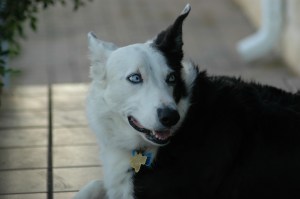
Where did the bull go?

The bull thundered by the pickup, circled around the corrugated aluminum barn, and crossed the caliche ranch road with his giant hooves causing crunching sounds. The bull then in full gallop with an occasional desultory kick at the pursuing dogs headed for the broken fence and to safety from the pursuing dogs. Despite my best efforts, I fell behind the faster moving bull and dogs. But I was able to view the bull as he jumped through the yawning breach and into the pasture of the neighboring ranch.

I arrived at the breach in the fence where I found Bandit and Mollie pacing like two guard sentries. Both gazed in the direction of the disappearing marauder. I collapsed to my knees, sucking in huge quantities of air. I threw my arms around their furry necks, hugged them fiercely, and buried my face in their pungent, silky coats. Bandit and Mollie had accomplished what only minutes before had seemed utterly impossible.

Bandit, happy at last at the ranch where he never again chewed up furniture

From deep within these collies had come an instinct to separate the foreign bull from the herd and to drive him to the broken fence line. Moments before the dogs had acted ferociously, but they had transformed again into my pets. Their eyes still shone and tongues dangled haphazardly. Bandit and Mollie seemed to comprehend the magnitude of their accomplishment and appeared alive in a way I had never before witnessed.

Still too winded to speak, I embraced my incredible dogs. I scratched their ears. I hugged their necks I feet the softness of their fur against my cheeks. Raspy tongues licked my face and ears. Pride swelled within me. I felt exultant, as my burden had suddenly and miraculously been lifted. Bandit and Mollie, my two courageous Border collies, had provided a present, as dear in their giving as in my receiving.

Eventually my breathing became more normal and I was able to speak. I cupped their warm, damp muzzles in my hands. The dogs stared back at me, their eyes gleaming. They appeared expectant. With my first words, I uttered the time honored, but ever so parsimonious Border collie congratulation.

”That’ll do Bandit.”
“That’ll do Mollie.”

If you have not had the chance to read my latest book, Hitler’s Maladies and Their Impact on World War II: A Behavioral Neurologist’s View (Texas Tech University Press), I invite you to do so. The book explores an important aspect of the Hitler story and World War II that has not been well studied. Many of Hitler’s catastrophic errors including the premature invasion of the Soviet Union in June 1941, the slowness of German forces to counterattack at the Battle of Normandy in 1944, and the highly risky Battle of the Bulge in late 1944 into 1945, can be better understood, knowing the sizeable impact that Hitler’s physical and mental conditions had on these vital battles.

Also, consider picking up a copy of my earlier book, Carrying The Black Bag: A Neurologist’s Bedside Tales (Texas Tech University Press). Please join me on my personal journey as a physician and meet my patients whose reservoirs of courage, perseverance, and struggles to achieve balance for their disrupted lives provide the foundation for this book. But step closely, as often they speak with low and muffled voices, but voices that nonetheless ring loudly with humanity, love, and most of all, courage.

Bandit Achieves Our Retirement- Part IV

This is the fourth blog piece in a series that features our first Border collie, Bandit, and is taken from an unpublished book titled The Bandit’s Gift. I wrote this manuscript which I suppose could be considered my practice book, shortly after retiring from my Neurology practice in Lubbock and moving to our ranch outside of Fredericksburg, Texas. The title of the book hints at our Bandit dog’s substantial role in bringing about our early retirement. Trudy and I feel indebted to Bandit for his efforts in hastening our move from a frenetic life in the city to the beauty and peacefulness of the Texas Hill Country.

This installment describes our migration from Lubbock to our ranch near Fredericksburg. It also introduces Mollie, a female Border collie, whom we acquired shortly before our move to the ranch. Mollie as a puppy came from a New Mexico ranch whereas Bandit had been raised a city dog in Lubbock.

                             Mollie our second Border collie who was from herding stock

In August of 2001, Trudy and I departed Lubbock for permanent retirement at our Fredericksburg ranch. Bandit and Mollie rode in the backseat nestled among hanging clothes and piles of shoes.  Mollie sat on the passenger’s side, Bandit on the driver’s side.  As Lubbock receded into the tabletop-flat landscape, Bandit cast what I considered a satisfied if not smug glance out the window for having brought about this major change in our lives.  I wondered how our canine conniver felt, as he had been a motivating force for my early retirement, mounting a determined campaign having nearly destroyed our home in Lubbock.

“Bandit, say good-bye to Lubbock.”

His long white tipped tail began slapping the back of the seat.

“Thump, thump, thump.”

“Trudy, that dog sounds like he’s beating a drum, am I imagining it or is Bandit celebrating?”

“Thump, thump, thump.”

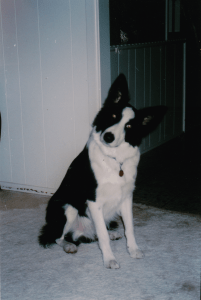
                                                              Bandit looking so innocent

Mollie sat quietly in her corner of the backseat.  When I turned to scratch her chin, I noticed her peculiar smile.  When Mollie smiled, she retracted her lips and exposed her teeth.  Her eyes squinted and her face showed a broad dog smile- a smile sometimes misinterpreted as a snarl. I sensed that Mollie was happy, knowing we were leaving a city and headed permanently for a ranch.

Optimism and a sense of unburdening welled up within me.  My exhausted spirit for years had yearned for a saner, more private existence.  The long work hours, the stress of holding together a clinic and hospital practice, and the daily grind of dealing with desperately ill patients had extracted a physical and emotional toll from me.

While Trudy and I had worked well together, our communication styles differed.  For me, small talk has always proved difficult.  Give me a family with a brain-dead member, or the need to relate a terminal diagnosis, and I am at my rhetorical and sympathetic best.  But when at a social function calling for light banter, I feel like a stammering dolt.  Moreover, I suffer near stupefaction when faced with the usual social banalities.

Trudy on the other hand handles social situations with aplomb.  She can discuss grandchildren, the weather, the latest gossip, or pop-culture with the best of them.  She finds difficulty, though, when talking of emotionally laden topics, especially those affecting her or her family.  It was just such heavy topics that had for years nagged at the corners of my mind.

Trudy’s unhappiness and worry may have prompted verbal zingers aimed at a workaholic, slow to mobilize, and frequently absent husband.

Remember that Surgeon in Medical Records, draped over his pile of charts like a bad suit of clothes, dead as Hamlet’s buddy, Yorik?  You’re not indestructible either Buster. I’m too young and gorgeous to be a widow.  Lots of young bucks have the hots for well off, sexy widows.”

“Yeah, rave on,” I had said, suspecting I had not deflected this conversation for long.

Later as I drove off the cap rock of the Llano Estacado and away from the loneliness of the high plains, I became lost in a tumble of conflicting questions and emotions. Long drives have always put me in pensive moods, providing uninterrupted time for contemplation. Memories began to tug at my sleeve.

Being a physician had been at the core of my identity.  I wondered how life would change without Medicine being my magnetic north.

Why am I ambivalent about leaving? Sure, I’ve loved Medicine- the intimacy that goes with caring for others.  Where’s the satisfaction gone? Had it been the hospital’s economic realities that at times impinged on the quality of clinical care I wished to give? Had this led to incessant medical upheavals?  Why had it been a struggle to maintain a successful group practice, run an efficient medical practice, and carry out good clinical care and research? Had I asked too much of myself as both a private practitioner and an academic?

After an initial scuffle in the backseat when Mollie tried to take Bandit’s usual place, the canines had calmed. Bandit circled and plopped down with an audible exhalation.  Long before we reached the cap rock, Bandit had fallen fast asleep.  Mollie rested her chin at the window and observed passing fence posts, her light blue eyes tracking and flicking from one to the next.

                                           Bandit on the left and Mollie on the right in profile

As the miles sped by, my mind shifted from labors left behind to this land’s history through which we passed which I began to recall. We headed southeast, counter to the migration of earlier settlers, toward what in 1800 had been the northernmost frontier of the Mexican State of Coahuila and Tejas.  Long before becoming a Mexican State, the land had been occupied by Tonkawa Indians who in turn gave way to the more warlike Apache, Kiowa, and Comanche.

Texas won its independence from Mexico in 1836 and became an independent republic.  In 1845 a proud but destitute Texas joined the United States of America as its 28th State.  The following year German immigrants arrived in the Hill Country to partake of free land and increased economic opportunities.

In Germany, the unwitting emigrants had been reassured the new land was peaceful, only on arrival to find themselves in their newly established village, surrounded by hostile Native Americans.  This grievous case of real estate exaggeration ranks just behind Eric the Red who named a frozen expanse of icecap, Greenland.

We traveled through Sweetwater, a small west Texas agricultural town with yet another unpretentious name.  I thought- did no one have imagination when giving names?! 

Bandit briefly awoke when we stopped at a red light in Sweetwater.  I felt his cold nose nudging my shoulder, urging my attention. I reached back and scratched his ears. The white tip of his tail (the so-called Shepherd’s Lantern) striking the back of my seat.

“Thump, thump, thump.”

Mollie glanced at her emotionally needy canine companion but quickly returned to watching the towns stream by.  I wondered if Mollie expected a meandering herd of sheep or scattered herd of cattle to appear in desperate need of a Border collie to organize them.

I thought how different these two dogs were in soliciting affection.  Bandit fawned on people, begging- even demanding attention. Mollie never stooped to such antics, although she appreciated affection when it was offered by a family member.

Mollie was a rare Border who loved to swim

After leaving the town behind, I heard Bandit again flop down in the back seat.  My own thoughts returned to the history of central Texas that still lay several hundred miles ahead.

German men from Fredericksburg led by their able leader John Meusebach, in a desperate gambit, ventured out of the relative safety of their new settlement to secure peace with the natives.  They successfully met up and powwowed for several weeks beside the San Saba River. After much talk, countless pipes, and no doubt many earnest, silent German prayers, a peace treaty was established with seven large tribes of natives.

This treaty, remarkably, over the years has remained intact. It is claimed to have been the only treaty in Texas, and possibly the entire United States, with Native Americans to have not been broken.  An annual Powwow of Native Americans and Fredericksburg citizens celebrated the success of the treaty for many years thereafter in Fredericksburg.

While the peace talks had dragged on alongside the San Saba River, other natives surrounded the village of Fredericksburg, awaiting news that would either prompt an attack on or befriend the hapless settlers. Huddled within their makeshift cabins, stoic German settlers tried to carry on their lives without projecting fear to their children.

On Easter eve night, bon fires ominously appeared on the many hills surrounding Fredericksburg. The German settlers worried these fires might signal an impending attack.  In truth the bon fires communicated to the Native Americans high in the hills around Fredericksburg that a peace treaty had been achieved at the Powwow on the San Saba River.

Initially the significance of the bon fires was unknown to the settlers, but the fires on Easter evening prompted one mother, full of bravado, to proclaim to her worried children that the Easter Bunny was building fires to boil their Easter eggs.  The brave spirit manifested by the unknown German mother inspired for many years the yearly Fredericksburg Easter fires tradition where bon fires were built each Easter eve on top of the hills surrounding Fredericksburg.

We motored across the Texas prairie where 150 years earlier the Apache had been driven by the still fiercer Comanche.  I recalled the struggle for control of the green hills and streams of central Texas.  With increasing distance from Lubbock, the table-flat, featureless, and bleak landscape gradually changed into rolling prairie dotted with tall prairie grasses, scraggly mesquite, cottonwood, and Juniper trees.

We traveled through Coleman to Santa Anna (named after a famous Penateka Comanche chief) where we turned south, passing by the ruts of the old Great Western Cattle Trail. A roadside historical sign informed that more cattle had passed up this cattle trail to Kansas than had occurred on any of the other Texas cattle trails.  The Western Cattle Trail ended in the wild western town of Dodge City where lawmen Bat Masterson and Wyatt Earp became famous and where Earp was finally laid to rest.

Some twenty million Longhorns had moved up the cattle trails following the Civil War, establishing a viable economy for a desperately poor Texas. I proudly recalled my great grandfather, Thaddeus Septimus Hutton, having been a Texas cowboy who had likely pushed cattle up this very trail through the Oklahoma territory to the rail head at Dodge City.  I pondered what it must have been like to herd cattle in the 1870s through wild country. Had he even a glimmer of the historic nature of the western life he lived and the fame that would be later accorded the lawmen of Dodge City.  Of one conclusion I felt certain, that more hard work and less adventure had existed on the cattle trail than was depicted later by Hollywood movies.

Several hours further on, the rolling prairie gave way to green hills, clumps of stately live oak trees, and cultivated green pastures.  Artesian spring fed streams and rivers snaked among the hills.  Wild game had been and remains prevalent, and the tall native grasses supported greater numbers of grazing animals than had the near barren Llano Estacado.

Looking at this dramatic transition in the land helped me to understand why the Native Americans believed the Hill Country possessed such “strong medicine.” The Texas Hill Country with its beauty and bounty favorably compares to the western, more arid portion of the State.  I thought no wonder Native Americans had fought so ferociously to maintain control of the Hill Country.

While I mulled these matters, Mollie, with remarkably sustained attention, continued to observe the changing landscape.  Once when passing an eighteen-wheeler, Mollie stood upright, staring at a black, ride along dog that stared back from the truck’s passenger window.  I could see the other dog barking. Mollie calmly observed the dog and gazed at the truck until it was lost to sight.

Bandit didn’t awake again until we arrived in Brady, the geographical center of Texas.  He awoke, stretched, yawned, and appeared to anticipate our arrival at the ranch.  I felt his chin on the back of my seat and sensed his warm, moist breath.  I could see in the rear view mirror that he had perked up his ears and was staring down the highway ahead of us.  When I reached to give Bandit a scratch, I was rewarded with several languid licks to the back of my hand.

    Mollie and Buddy at the ranch

“Thump, thump, thump.”

An hour and fifteen minutes later, we drove through the front gate of our ranch. I halted the car briefly, so that Trudy and I could exhale years of pent up tension.  Whimpers came from the backseat.  Trudy and I opened the back doors of the car.  Mollie leaped out and sped across the pasture, ears flattened to her head, back arching, and legs striding.  Bandit jumped out and loped behind Mollie, inspecting trees, clumps of grass, and rocks.  Mollie scared up a jackrabbit, and both collies began a deliriously happy, zigzagging pursuit, interrupted only finally by an impassable barbed wire fence.

Trudy and I joined hands and watched in peaceful silence; an interlude as pure as that between young lovers. We had parked on a caliche ranch road near a grove of live oak trees.   We wordlessly observed the rabbit chase and basked in the exuberance of the moment. Bandit and Mollie eventually strutted back to the car; tails held high.  The two dogs sniffed and scuffled and seemed to be thoroughly enjoying themselves.

From over my shoulder, an orange-red sunset beckoned above a white limestone ridge.  We heard the mellifluous sounds of water rushing over stones in a nearby brook.  I experienced a rare moment of awareness and understanding.  What had seemed confused a few hours earlier, in this tranquil setting, now seemed clearer, even achievable. I could feel a smile develop across my face.

“Welcome home Trudy.”

Trudy slowly turned her eyes to meet mine. I saw a loving smile, crinkled nose, and teary eyes.

“Didn’t think I’d get you out of Lubbock alive,” Trudy said with an uncharacteristic tremor in her voice.  Moments later her tendency to chide rallied and she said, “Besides Cowboy, why are you planted here like a stupid yucca, let’s get on with our new lives!”

Just as I leaned across the front seat of the car to kiss Trudy, from the backseat came Bandit’s black and white head. Trudy and I stopped just short of planting bookend kisses on his furry snout.  Trudy and I laughed, and Bandit cocked his head impishly as if understanding the joke.  Trudy and I were now retired, and with Bandit and Mollie, we were four.

to be continued

If you have not had the chance to read my latest book, Hitler’s Maladies and Their Impact on World War II: A Behavioral Neurologist’s View (Texas Tech University Press), I invite you to do so. The book explores an important aspect of the Hitler story and World War II that has not been well studied. Many of Hitler’s catastrophic errors including the premature invasion of the Soviet Union in June 1941, the slowness of German forces to counterattack at the Battle of Normandy in 1944, and the highly risky Battle of the Bulge in late 1944 into 1945, can be better understood, knowing the sizeable impact that Hitler’s physical and mental conditions had on these vital battles.

Also, consider picking up a copy of my earlier book, Carrying The Black Bag: A Neurologist’s Bedside Tales (Texas Tech University Press). Please join me on my personal journey as a physician and meet my patients whose reservoirs of courage, perseverance, and struggles to achieve balance for their disrupted lives provide the foundation for this book. But step closely, as often they speak with low and muffled voices, but voices that nonetheless ring loudly with humanity, love, and most of all, courage.

Bandit-Our First Border Collie-Part 3

Thank you for continuing to follow the Bandit story. He proved to be my dog of a lifetime and as subsequent stories will show- changed our lives in meaningful ways.

Evening Trips to the Park

Neighborhood children frequently shadowed us during our trips to the local park. Neighbors often appeared at windows, observing Bandit’s effortless saunter along the sidewalk, pursued by his increasingly haggard looking owner.  Several, gave sympathetic words of encouragement to me as  might have  been offered to the final straggling runners in the Boston marathon.

Ignoring the local leash ordinance, assuming no doubt incorrectly, that voice control would suffice, we allowed Bandit to stride ahead, carrying a ball or Frisbee in his mouth.  He truly was under control, knowing to sit and wait at each corner, and never crossing a street without permission.  Nevertheless, I always felt relieved when I returned from the park without a citation from Lubbock Animal Control.

Once at the park with its smells of newly mowed grass and yellow glare of the lights, Bandit would become thoroughly engaged with our games. He would ignore the thwacking sounds of competing nearby tennis matches, giggling children on swing sets, and even other curious dogs that came around him.  The focused intensity of a Border collie is truly splendid to behold.  Bandit would take his crouch and stare at me, waiting for me to sling the ball.

With visions of Sandy Koufax or Mickey Mantle running through my head, I would rear back and throw tennis balls as far as possible.  I remember thinking a bit smugly that during high school I had possessed a good throwing arm.

Bandit would tear out after the ball, scoop it up while still rolling, and rapidly return it to me. Bandit seemed untiring. His alert, dark eyes would glisten, and he panted with excitement. After several weeks of pitching tennis balls, I was no longer feeling quite so smug about my ability to throw the ball, as I developed a painful arm strain.

Over several more days my arm worsened. It became so painful that I found it difficult to elevate it above my head.  After still more park excursions, it got to the point that I could not easily dress myself.  On more than one occasion, I had to ask Trudy to hold my shirt, so that I could slip my tender right arm into the sleeve.

She then suggested in her inimitable way, “Why not give up the Nolen Ryan bit and try tennis?”

Tennis Anyone

 Following Trudy’s practical suggestion, I began hitting balls with a tennis racket and soon marveled at the added distance this provided.  Hitting the tennis ball with a racket also drew upon a different set of muscles than throwing, so that I could swing the racket almost without pain. Bandit appeared not to care how I launched the ball, as he continued to pursue it with equal enthusiasm.

I enjoyed watching the yellow tennis ball explode off the racket and arc far across the park.  I marveled at the grace and speed of Bandit’s longer out runs. I also observed how Bandit then would drop the ball about three quarters of the way back to me and retreat some distance. The time it took for me to trot out and collect the ball provided Bandit time to prepare and adopt his vigilant stance. By this process, Bandit also imposed my own exercise routine.

Chasing the tennis ball caused Bandit to expend additional energy, leading me foolishly to believe we were at last making progress. But after weeks of hitting the ball, rather than Bandit showing any signs of exhaustion, I instead developed tennis elbow, no less painful than my previous shoulder strain. In short order, I was forced to retire from both doggie baseball and doggie tennis. Heck, I still have doggie kickball and doggie golf.

Unexpected Results

“Hey big guy, you’re not the jock I married thirty-five years ago,” Trudy teased. I responded without comment but likely with a pained smile.  Indeed, this collie had taken a heavy toll on my middle-aged, soft-bellied self and had allowed an opening for Trudy to proceed with friendly ribbing.

Despite the physical toll on me, the new regime of activities and exercise brought about improvement in Bandit’s behavior. Trudy and I, to our surprise, also noticed our own bodily changes.

“Hey Trudy, is the scale broken?” I asked one morning after a month or two of the exercise programs.

“Don’t think so, but I was surprised too when I weighed.”

Not only had we lost weight, but we were feeling more fit.  I found the morning jaunts to the park to be less exhausting than earlier and at times found myself even jogging alongside Bandit to and from the park.

Even more astonishing, our spirits had elevated. We began to laugh more. Life became more interesting. Trudy and I began to plan a date night weekly, something we had not enjoyed for many years. In short, we found ourselves with increased energy– energy that allowed us to better address sources of diminishing satisfaction within our lives.

Frisbee

Bandit and I began to spend more time together as well. It was during this period that I introduced Bandit to Frisbee. He absolutely loved it. Bandit took to Frisbee like a pregnant woman to cheesecake.  Soon he was snatching Frisbees out of mid-air like a lizard catching flies. He learned to make over-the-shoulder acrobatic catches amid his dramatic leaps. His performances began to pay dividends and in highly unexpected ways.

After several weeks, Bandit’s fame at retrieving Frisbees had spread throughout the neighborhood. Adults as well as children now began leaving their homes to walk with us to the park.  Cars would often slow down when passing the park, even parking at the curb to watch our graceful, athletic black and white dog snatch Frisbees out of the air.

One spring day I heard a shout from the street and looked up from our game of Frisbee. To my shock, I spotted half a dozen cars parked at the curb with still more pedestrians watching us. Many were total strangers, intently observing Bandit and acknowledging his athletic ability.

I would rear back and whip the Frisbee in a high gliding arc.  Bandit would sprint away toward the arcing Frisbee, leaping high into the air like a ballerina to snag the disc. Shouts would erupt from the throng following particularly agile catches.

“Hooray, just look at that dog.”

“Never seen anything like it.”

“What a dog!”

Friendly waves and smiles came from the spectators. I sensed these strangers, beaming and whooping support for our black and white ham, somehow benefited from the experience. Bandit put on amazing performances of running and jumping, and making acrobatic catches, but I questioned why his Frisbee catching attracted so much attention.

Occasionally people wandered onto the grassy field to inspect Bandit more closely.  When this happened, Bandit would break off his crouch and would wiggle up to them, swishing his tail in a wide and friendly arc. The momentum of his tail wags was such that they wagged his whole rear end.  He would lick any extended hand.

After more evening Frisbee sessions, I began to seriously ponder the reasons for Bandit’s enlarging audiences. It seemed to me that Bandit provided these city-churned commuters brief moments of joy between hectic work schedules and responsibilities awaiting them at home.  During these brief intervals his fans vicariously enjoyed Bandit’s unmitigated joy.

To Be Continued

If you have not had the chance to read my latest book, Hitler’s Maladies and Their Impact on World War II: A Behavioral Neurologist’s View (Texas Tech University Press), I invite you to do so. The book explores an important aspect of the Hitler story and World War II that has not been well studied. Many of Hitler’s catastrophic errors including the premature invasion of the Soviet Union in June 1941, the slowness of German forces to counterattack at the Battle of Normandy in 1944, and the highly risky Battle of the Bulge in late 1944 into 1945, can be better understood, knowing the sizeable impact that Hitler’s physical and mental conditions had on these vital battles.

Also, consider picking up a copy of my earlier book, Carrying The Black Bag: A Neurologist’s Bedside Tales (Texas Tech University Press). Please join me on my personal journey as a physician and meet my patients whose reservoirs of courage, perseverance, and struggles to achieve balance for their disrupted lives provide the foundation for this book. But step closely, as often they speak with low and muffled voices, but voices that nonetheless ring loudly with humanity, love, and most of all, courage.
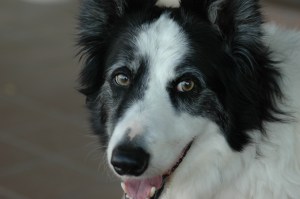
Bandit-Our First Border Collie-Continued-Part 2

With Andy and Katie’s departures for college, it dawned on Trudy and me that we were in deep trouble. We immediately missed our college age children who had spent time walking the dog, taking Bandit on car rides, and teaching him tricks.

After the kids’ departures, changes in our busy schedules became necessary. Weather permitting on work days Trudy and I would leave Bandit in the fenced backyard. Evidence suggested that Bandit would scamper among the bushes leaving behind broken branches, chase about the patio knocking over furniture, swim in the fountain, topple the water plants, and amuse himself by digging impressive craters in the vegetable garden. The garden excavations  grew  deep enough for me to fantasize about Bandit striking oil and making us rich.

Our outdoor strategy, imperfect though it was, maintained the house in good shape, so long as we gave up any hope of flowers in the garden, vegetables in the garden plot, or legs on the patio furniture.

When autumn colors faded into the sparkle and ice of winter, compassion compelled us to move Bandit indoors to avoid the Texas Panhandle’s “Blue Northers”. This shift in tactic not only provided warmth for Bandit, but also offered him novel opportunities to explore. And “explore” he did.

A few chewed magazines and curtain tassels did not panic us– not two professionals who had successfully mastered screaming divorcees in the courtroom and grand mal seizures in the waiting room.

“Oh, just puppy behavior,” Trudy had said unconvincingly, as if whistling her way to a root canal.

“Of course,” I had opined,  “All dogs chew. Probably good for his baby teeth.”

The indoor move required that we travel home during the day to let him outside to pee. It also allowed a brief respite for playing with the dog. This interlude required Trudy or me to break away from the office, an office often bordering on chaos, replete with hormonal nurses, disgruntled patients, and self-important doctors.

The trips home provided a break for which Trudy and I soon competed. When possible, both of us would head home for lunch and Bandit play. This mid-day interlude, away from the escalating emotions in the office, allowed us most welcome quiet time for conversation and gave us an opportunity to amuse ourselves for a few minutes playing with an appreciative Bandit dog.

Worse Still

Despite our considerable efforts, Bandit escalated his destructive antics- big time.  If we thought we had seen a damaging dog before, we had been fooled, having witnessed merely the preliminary warm-up for a doggie demolition derby. Before we knew it, Bandit had started a whole new gig– home annihilation.

In short order the remainder of our chair legs developed signs of piranha-like gnawing. We found the cording that had mysteriously been separated from the furniture. To this day, I don’t have the foggiest notion  what happened to some of it. We found several electrical cords chewed, rugs macerated, and household objects broken, covered up, or rearranged.

“Bandit, you do this?” I asked, while pointing to a chair leg that looked, as if set upon by crazed beavers. I feared the chair would give away if someone were to sit on it.

Bandit cocked his head innocently to the left and flashed an endearing look, a look of such sincerity that I began to question my suspicions. One day on arriving home through the back door, I spotted Bandit in the den. Rather than his usual hell-bent-for leather charge toward me, he slunk away into our daughter Katie’s bedroom and hid under her bed.  As I entered the den, the reason became all too apparent.

Before me lay a blizzard of pillow stuffing. It covered the floor, hung from the lamps, and decorated the hearth.  The remainder of the pillowcase lay on the floor as flat as a flounder.  When I tracked down the canine conniver, I noticed a piece of stuffing still hanging from his impish mouth.

A few days later our anxieties zoomed into the stratosphere when we discovered Bandit had stripped off the wall covering in the day room and had managed to chew on several door jams and doors.

To understand the pain associated with Bandit’s latest act, its important to understand the significance that the wall covering held for Trudy and me.  To diminish the poor acoustics in the day room, we had applied fabric to the walls over a thick cotton batting.  The upholstered walls had been expensive to construct but a welcome redo to our family room that had echoed like the depths of Carlsbad Caverns.  Now before us our acoustical dampening  lay in tatters.  Our home sweet home had begun to look as if under attack by an army of demented squirrels, voracious termites, and a truculent rhinoceros or two.

“And he looks like such an angelic animal,” Trudy said dejectedly.

“Don’t let his elfin looks fool you.  This dog won’t be happy till we’re living in a heap of sawdust!”

We Fight Back

One effort we employed to occupy Bandit consisted of stuffing cheese or dog biscuits into toys that Trudy found at a local discount store. These clever playthings, no doubt invented by a similarly desperate fellow dog owner, had been advertised as requiring lengthy and determined manipulation before discharging their treats.

Trudy and I would spend thirty minutes each morning stuffing pieces of cheese or dog biscuits into these over hyped furniture and house savers.  Trudy and I bubbled with newfound confidence, assuming we had at last found a  method for diverting our one dog wrecking crew.

Unfortunately, our optimism faded quickly. The toys occupied our strong-minded dog for a fraction of the time advertised before discharging their delicacies.  Bandit was left with far too much unoccupied time with which to work. While this toy proved useful, it was not what we desperately needed.

Trudy and I would arise early and hide scores of these treat-baited toys throughout our house. After our departure for work evidence suggested that Bandit would scour the house for the toys, apparently play with them, and consume the treats.  I have always suspected that Bandit found, obtained, and ate the treats in less time than it took for us to load and hide them. While this tactic met with only limited success, it had the benefit of distracting Trudy and me in the mornings from instead pondering insolvable work concerns.

Increased Exercise

We then determined to increase Bandit’s exercise by walking him to an old buffalo wallow about a mile away that had been converted into a lighted City Park.  I can only imagine what early rising neighbors thought when catching a glimpse of two bedraggled people slow-trailing an energetic dog down the darkened and leafy streets of Lubbock.

Once within the shadowy park, I would throw progressively slobbery tennis balls for Bandit. Trudy and I would then dodge about into hiding places, trying to avoid running into trees and light posts, encouraging Bandit to find us before racing back to hide yet again.  We hoped to wear out what seemed to be an indefatigable canine. This tag-team process may have been successful in depleting Bandit’s energy level slightly, but it proved substantially more exhausting for Trudy and me.

In the evening, rain or shine, and after a busy day of rounds and consults, I would stumble-march Bandit to our local neighborhood Kastman park where I would again throw tennis balls until my arm gave out. This became a routine that Bandit would not allow me to forget. While I would have gladly given half my medical practice at times to remain in my comfortable recliner, Bandit’s whimpering and nudging could simply not be ignored.

When Bandit heard the rumbling of the garage door opening at the end of the day, he always began racing around the house in search of a ball. Upon my entering the house, he would run to me and crouch with a tennis ball in his mouth.  He would rest on his forelegs with rump raised, his eyes staring at me as if to say, “I’ve been waiting for you all day and finally it’s time.”

Having experienced Bandit’s piercing gaze on many occasions, I understand why sheep find the stare of a Border collie so motivating. I can with little effort summon very real sympathy for sheep.

Bandit Makes Friends

Bandit’s park evening outings became something of a neighborhood happening.  People in their yards would turn to watch man and dog head off for their daily excursion.  Once on a hot summer evening bedecked by a gorgeous orange and red sunset, I recall seeing a red-faced Mr. Jones, the undisputed neighborhood grump, descending his stepladder. He turned to face us, as we walked on the sidewalk by his yard.  Fearing the worst, I kept my head down.  Bandit, on the other hand, loped over wagging his tail and proceeded to apply an unhurried lick to the old grump’s hand.

Rather than a torrent of verbal abuse as was expected, Mr. Jones instead gestured in a friendly manner at me, as if he was beckoning to an old friend. He then astonished me even more by asking multiple questions about Bandit. I shared information about his breed, what he ate, and why we visited the park so regularly. Who would have guessed Mr. Jones would prove to be a dog lover.

After extracting Bandit from this unexpected but welcomed encounter, man and dog headed down the block toward the park.  When well out of earshot, I exclaimed to Bandit, “Well how’d you manage that?”   He strutted ahead, ears perked up and wagging his tail broadly, cocking his head around to give what seemed to me to be an enigmatic look.

To Be Continued

If you have not had the chance to read my latest book, Hitler’s Maladies and Their Impact on World War II: A Behavioral Neurologist’s View (Texas Tech University Press), I invite you to do so. The book explores an important aspect of the Hitler story and World War II that has not been well studied. Many of Hitler’s catastrophic errors including the premature invasion of the Soviet Union in June 1941, the slowness of German forces to counterattack at the Battle of Normandy in 1944, and the highly risky Battle of the Bulge in late 1944 into 1945, can be better understood, knowing the sizeable impact that Hitler’s physical and mental conditions had on these vital battles.

Also, consider picking up a copy of my earlier book, Carrying The Black Bag: A Neurologist’s Bedside Tales (Texas Tech University Press). Please join me on my personal journey as a physician and meet my patients whose reservoirs of courage, perseverance, and struggles to achieve balance for their disrupted lives provide the foundation for this book. But step closely, as often they speak with low and muffled voices, but voices that nonetheless ring loudly with humanity, love, and most of all, courage.
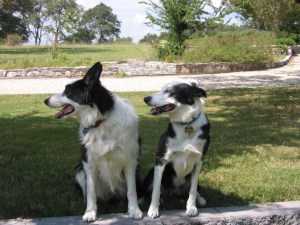
Our First Border Collie

I have written several blog pieces lately about our new puppy, Beau. Writing about Beau and his antics reminds me of our experiences with our first  Border collie, Bandit. Bandit played such a meaningful role in our lives and had much to do with relocating Trudy and me from a frantic urban existence to the peacefulness and solitude of Medicine Spirit Ranch.

If lucky, once in a lifetime your perfect dog comes along. Bandit was that dog for me. Bandit below as a puppy.

Beau reminds me of Bandit in so many ways including his looks, enthusiasm, and intelligence. Our initial unexpected encounter with Bandit came about via Trudy. The story goes something like this.

In The Beginning

While shopping at the Lubbock South Plains Mall In 1997, my wife Trudy unwittingly sewed the seeds of my early retirement.  For one whose life had been meticulously planned and extensively fretted over, this single instance of pure happenstance played a huge role in my future.

“Ooohh, look at that darling puppy!”

So began Bandit’s story with us in mid-April, 1997 when Trudy lovingly uttered these simple, affectionate words,  having locked gazes with a floppy eared, seven-week old black and white puppy. It had cocked his head quizzically and viewed Trudy through the front window of the pet store. With its white tipped tail and white paws, the pup unabashedly stared at her, seemingly beseeching her to take him home. I visualize Trudy standing outside the Lubbock Pet Store window, hands resolutely on hips, head cocked to one side to mirror the puppy’s head cocking and with her usual steely resolve melting faster than an ice cream cone in July.

Andy, our eldest child, had expressed a heartfelt wish for doggie companionship to divert him from his life of torts and criminal proceedings. Andy lived by himself in an apartment in Raleigh, North Carolina and was lonely — an emotion he felt that the right dog would promptly alleviate.

“So why a Border collie?” I had asked.

He responded by saying, “I like smart schools and smart people and want my dog to be smart.” Blissfully ignorant of Border collie ways, other than their reputation for being the most intelligent breed of dogs, Andy determined that a Border collie puppy would make the perfect pet.

Trudy and I proved equally ignorant of Border collie ways. However, we were supremely proud of our son, our Duke Law School student- a boast we trumpeted far and wide. Admittedly, we proved once again to be indulgent parents.

After watching the endearing puppy with the warm, golden-brown eyes ever so cleverly displayed by the owner of the pet store in the front window, Trudy as if pulled by a tractor beam was drawn into the shop. Among the fluttering of parakeet wings, the musky smells of the animals, and amid the mews and barks, she requested to personally inspect the puppy in the front window. A young blonde haired clerk fetched the puppy and placed him in Trudy’s arms. There the conniving rascal had immediately snuggled into the crook of her elbow.  Trudy said she sniffed that unmistakable  new puppy scent and immediately fell in love with the puppy. He solidified his future with us by soulfully licking her arm and playfully chewing on the cuff of her blouse. In retrospect this mere nibble had significance far beyond Trudy’s understanding at the time.

With her usual practicality by then in headlong retreat, Trudy with puppy pressed to her chest had headed further into the pet store where she proceeded to fill a basket with what she described were “a few” puppy-related items.

Trudy’s “few” items later became apparent to me when unpacking her Datsun SUV and finding a dog bed, collar, kennel, six month supply of dog food, chew toys, balls, pull toys, leashes, dog raising instructional books, assorted dog magazines, and various toys- all of which when compressed emitted irritating squeaking noises.

“You think we’ve enough supplies?” I asked in mock irritation.

She replied, “Well, if we’re going to have a dog, we need to be prepared.” I nodded dumbly. Had we only known then how truly UNPREPARED we were.

We assumed the puppy and Andy would stay the summer before returning to North Carolina for the Fall term. Within a few days the dog’s paraphernalia lay scattered about the house like landmines, but what the heck, we thought, such disorder wouldn’t exist for long.

Several weeks later, Andy arrived home, having completed his first year of Law School. He proved eager to hold his new puppy that he previously had seen only in pictures. Andy shared with us that knowing he had a puppy waiting for him had powered him through the slog of final exams.  His mother and I beamed proudly, having done our best to stoke his enthusiasm by phoning him cute puppy stories and mailing him photos of the adorable pint-sized pup.  His excitement reinforced our thoroughly rationalized– if unenlightened– decision to buy the dog.

We had sent Andy one picture showing the fluffy imp staring adoringly into the camera.  Beside his kennel we had placed a sign that read “Andy, Hurry Home Soon.”

“Your Mom and I have been calling him MacDuff. Since the Border collie breed originally hails from the border of Scotland and England, the geography fits.”

Andy glanced away and studied the tiny animal that lay before him. I sensed Andy didn’t care for our suggested name but was careful not to offend his doting parents. After all, we were paying for his incredibly expensive higher education, an expense near equal the economy of a small third world country.  Andy squinted his eyes and looked out the window before tactfully torpedoing our name for the puppy.

Andy sat cross-legged on the carpeted floor while inspecting his pup.  He rolled the puppy onto his back, studied each white tipped foot, tweaked his tiny black nose, and scratched his rounded and protruding belly.  He stared thoughtfully for a few moments into the puppy’s sensitive, dark eyes.

Andy lifted the puppy to his neck, sniffed its uniquely appealing scent and snuggled it. He lowered the puppy while pointing and said, “Look at these black patches around his eyes, looks like a Bandit’s mask… I think I’ll call him Bandit!” Below when Bandit was older with his distinctive black eye patches.

So Bandit the puppy became.  And while it wasn’t the name we had in mind, its appropriateness over the next several months became especially evident.

The Adventure Begins

“Trudy, have you seen that pair of socks I laid out?”

“Have you looked on your feet?”

Not only socks but shoes, books, belts, and small throw rugs disappeared, only to reappear in unusual places, and sometimes having acquired gnaw marks. Items were regularly recovered from under beds, in the tiny spaces behind the sofa, and anywhere humans could not easily access.

One morning just before heading for the hospital and while in a rush frenzy, I could not locate my black medical bag. The allure that my leather bag might hold for a puppy with a leather fetish suddenly struck home.  I became increasingly concerned, bordering on frank panic. Trudy and I launched a search in the usual doggie hiding places. Eventually to my embarrassment, I discovered that sleepy me had failed the night before to remove the black bag from my car.

“My mistake Bandit, but don’t you ever even think about taking this bag,” I said, as I held out my medical black bag for his inspection. Bandit cocked his head to the left and gave me a look that I interpreted as, “Who, me?”

“If Border collies are so smart, maybe you can train him to search for your black bag, because I’m sure not going to, Sherlock,” Trudy harrumphed. I blew her a kiss and backed sheepishly out the hall door into the garage.

A Glimmer of Understanding

The white-coated heavy set vet assistant with heavy footsteps ushered us along an narrow hallway barely large enough for her to pass and into a room at the far end. The room smelled faintly of antiseptic and was furnished with a stainless-steel examination table, sink, and three chairs.

Before the vet arrived, I passed Bandit to Trudy and tried to wash the yellow stain from my sleeve.  I scrubbed with paper towels and hand soap drawn from the dispenser, accomplishing little except spreading the stain.  I had just finished with my unsatisfactory effort when Dr. Brown with white coattail flapping blew into the room. He was a man of average size with an open face, curly salt and pepper hair, exuberant eyebrows, and better tanned than any hard working, small animal veterinarian should be.

Dr. Brown soon turned his full attention to our young dog. Our puppy tried with licks, moans, and waggles to endear himself to this new potential playmate.

“So you decided on a Border collie, did you?” Doctor Brown said while lifting our dog up and onto the polished metal examination table. The puppy fidgeted about while trying to gain traction on the slippery metal exam table.

There was something unsettling in the vet’s tone of voice.  Was he being haughty?  I ignored it, assuming due to my fatigue I was imagining an affront. “Yes, we knew Borders to be such intelligent animals,” I responded.

“Oh, he’s not ours, he’s our son’s to take back to school,” Trudy chimed in, sounding, I thought, a little defensive.  But my wife had reinforced my suspicion that she too had detected something left unsaid by the vet.

Dr. Brown raised his thick bushy eyebrows to a remarkable peak, shooting us a brief look of strained disbelief, if not outright incredulity. He then turned his attention fully to examining our pup.  He began to gently probe the dog’s protuberant belly. Our dog returned his interest by applying a slow lick along the veterinarian’s chin, ending just short of his well tanned left ear lobe. 

Doctor Brown ignored the affection and continued his exam by checking the puppy’s teeth, listened to his lungs, auscultated his heart, and finally administered various vaccinations.  He then surprised me by asking if I would restrain little Bandit while he performed a rectal swab.

Soon the veterinarian completed his taking of a stool sample. I lifted the puppy from the table, again sensing his softness, and cradled the puppy in my arms. Before leaving the room, Dr. Brown looked earnestly at Trudy and me and said, “Border collies can be pretty busy, you know. There’s an old adage, ‘You have to give a Border collie a job, or else he will become self-employed… and never productively.’” Again, as if to emphasize his point, he arched his impressive eyebrows in his quite remarkable way.  He then turned quickly and exited the room, carrying his sample with him in a small piece of white gauze.

“Well, what do you make of that?” I asked when the door had closed behind Dr. Brown.  “I thought his eyebrows were going to kiss his hairline!”

“What did he mean with that job bit?  Audacity, if you ask me.  Maybe not a Border collie lover.  Looks more like the Schnauzer type.”

“Besides,” I said, “You’ve emptied the pet store of supplies and toys, and I’ll take the dog to the park every few days.”

“He just doesn’t know how capable we really are!  Look how successful we’ve been raising our two children.  How much trouble does he think one little bitty dog can be? Besides, we successfully raised a not too bright Dalmatian and two Shetland Sheep dogs. One tiny dog, Piece of cake!”

We murmured all this while keeping our voices low, as Dr. Brown banged about next door within his laboratory.  After about fifteen minutes, the door to the examination room burst open, and the veterinarian like a sudden summer storm swept back into the exam room, his broad face bearing an unmistakable look of satisfaction.

Dr. Brown confirmed to us what he had apparently suspected. The rounded belly (that very one that Trudy and I had found so adorable) resulted from distension caused by parasites.  PARASITES! He explained our dog was small, because he was competing, and none too successfully mind you, for nourishment with his belly worms.

“With a round of antibiotics, we’ll put those parasites on the run and get this dog growing again,” Dr. Brown clucked.

“Great, we sure hope so,” I recall saying, an aspiration I would later seriously regret.

Trudy later reminded me of the old adage that says- be careful of what you ask for.  Little did we know? It was months later before Trudy and I appreciated the full significance of the veterinarian’s not so subtle warnings.

           A Growth Spurt

As predicted by Dr. Brown, those magic little pills shrank the dog’s belly but also had a similar effect on my wallet. The pup over the next several weeks, lacking his parasitic competition, began to grow like the time-lapsed pictures from the TV dog food commercial.

The dog ate prodigiously. He ate vast amounts of puppy chow, canned dog food, leftovers from the table, morsels stolen from trashcans, my comfortable old leather loafers, and a few tasty treats from the refrigerator that admittedly I snitched for the puppy. Yes, I aided and abetted the seemingly starved puppy.

Following several futile refrigerator searches, a miffed Trudy reported she had harbored other plans for the missing leftovers. Our poor parasitic wracked dog deserved a few extravagances or so I thought.

Although he began small, our dog soon surpassed the average fifteen to forty pounds for the breed.  Even more impressive than his weight that had zoomed past 60-pounds was his meteoric increase in height. Despite his classic Border collie markings, people often inquired if he carried any non-Border collie blood.

Soon after beginning the antibiotics, a geyser of energy developed in Bandit.  While he had been active before, Bandit then became super-charged. Admiring his spike in liveliness one afternoon caused me to daydream of performing a medical study to distill the remarkable goodness of his overachieving mitochondria into pill form and cash out by advertising on late night cable TV.  When I shared this daydream with its potential for Midas-like riches with my wife, I once again was treated to her “dumb look” and her lack of a verbal response.

A month after our visit to the vet and after entering from the garage one night, I greeted Trudy and  sheepishly inquired how Bandit had done that day.  Almost on cue, I heard a faint scampering of small paws from the den, followed by a series of noises, suggesting minor collisions in the vicinity of the dining room, followed a few moments later by Bandit in full stride charging through the kitchen door. With an ecstatic face between two floppy black ears, he rocketed off the carpeted dining room, churning like a dynamo on a path straight for me.  Several feet away from me, he hit the brakes, thrusting his paws out in front of him.  The pup sensed that he had lost all traction on the linoleum and immediately entered an uncontrollable slide.

Bandit developed a quizzical look on his face, casting uncertain eyes upward to me in what I thought was an apologetic way.  He vigorously began to backpedal before ending up in a furry heap atop my shoes. From there he looked up at me with a look of adoring and abject joy.

I lifted the squirming puppy to my cheek where he began licking furiously.  Such ungoverned displays of joy are not unusual with Bandit. They have occurred following my being out of town several days, or having just returned from the corner mini-mart.  The dog just doesn’t take long to miss his people.

“Honey, maybe we could get him a job as a greeter at Walmart?” I offered lamely.

To this Trudy responded with a weak smile and a “Huh”.

Trudy and I failed to match Bandit’s surge in energy. His need to stay busy while typical for Borders is not for middle-aged, pudgy, and chronically fatigued humans. Our plans for more frequent doggy exercise hadn’t meshed well with our exhausted physical states.

“Honey, do you feel a slight vibration?” I asked one night while I dozed in my favorite chair in the den.

“Nope, but I thought I heard grinding.”

“There it is again, I know I feel a slight vibration in this chair,” I said.

Fearing what I might discover, I slowly leaned over the side of my chair and looked beneath it. I spotted an open mouthed snout bearing tiny razor sharp teeth with a death grip on the chair leg.  “Say Honey, this chair you like so well?  I think it’s become an alteration project for the Bandit dog!”

Bandit’s piranha-like teeth unfortunately were not limited to teething on chair legs but extended to sampling cushions, carpets, table legs, and even plastic patio furniture.  The dog seemed to have become a pint-sized canine version of a wood chipper. This called for action.

We Fight Back

In a desperate attempt to limit further damage to the house and furniture, we tried distraction. Bandit became the designated companion for any family member leaving our home on an errand.  He became the ever present, excited, ear-flapping, ride along dog, drooling out the window of a Hutton car.

I had never seen him happier than when riding shotgun for the family. Perhaps he saw his rides as a job. I imagined that he felt like the guy on the stagecoach carrying the gun, protecting the driver from desperadoes or Indians on the warpath.  Clearly Bandit’s new position was not the job for which a Border collie had been bred, but it was, nevertheless, a job.

“Say, Shotgun, want to ride to the emergency room with me?”  Bandit wagged his tail vigorously.  “Well load ‘em up Shotgun and mind the strong box.  We’ve got some rough country to travel!”

Andy and Katie, our high school aged daughter, recounted that Bandit visited local fast food establishments and cruised the broad boulevards of Lubbock, often until deep into the star studded west Texas night. Bandit would ride along, head extended from the window, as they drove past the statue of Will Rogers astride his horse, Soapsuds, located on the Texas Tech University campus or circled through downtown Lubbock, passing by the oversized statue of a guitar toting,  thick rimmed and bespectacled Buddy Holly.  Bandit happily accompanied anyone with errands to run or packages to mail.

Bandit occasionally even went on dates with Andy. Trudy and I chuckled at what Andy’s girlfriend must have thought, sharing her date with an enthusiastic puppy.  We imagined Bandit at a drive-in movie snuggled between them, curled up around a box of popcorn, enjoying his people. To my surprise, once prior to a date night, I found Trudy down on the floor next to a curled up Bandit, instructing him on his responsibilities as a chaperone.

“You don’t think this is really going to do any good, do you?”

“Hey Buster, these dogs are really smart, and besides, I don’t trust that bleached blonde bubble-headed temptress,” Trudy said, twisting around to look at me.

“Do you think at the end of the evening both Andy and Bandit will give her a goodnight smooch?  Suspect Bandit could really tickle her tonsils!”

Ride-along car trips were not our only gambit for distracting our young dog.  Desperation, after all, breeds creativity.  At our urging Andy and Katie spent hours playing with Bandit, teaching him to sit and shake, walking him up and down the block, and showing him off to their friends. Bandit proved a quick study at learning tricks and entertaining friends, and particularly enjoyed chasing sticks thrown by Andy, Katie, and their friends.

To our relief, the time Bandit spent playing fetch was time not spent digging gorges in our backyard or shortening our furniture. Trudy and I suffered from sapped energy, stemming from our busy, stressful lives at the clinic and from attempting to keep up with the energetic dog.

To her credit Trudy signed the dog up for two series of obedience classes. After a long day at the office, she sacrificed many evenings, trying to improve our doggie’s decorum. To Bandit’s credit, he became the star pupil in his obedience class.

Trudy took pride in relating his ability to learn quickly. Trudy returned from class more than once disdainful at the slowness of other dogs to learn even basic commands.

“You should have seen Sal, a really stupid and clingy Cocker Spaniel.  The instructor worked for 15 minutes just getting the lop-eared hound to follow her.  All he wanted to do was stay with his master or else sniff other dogs’ butts.  I wasted my time just standing there at the end of Bandit’s leash and watching that dim-wit.”

“Now dear, not all dogs are as smart as Border collies,” sounding I feared a bit too patronizing.

Toward late summer, unexpected complications arose with Andy’s Fall housing arrangements. While reviewing his apartment lease from North Carolina, Andy had discovered a previously overlooked clause that pointedly excluded dogs weighing over 30-pounds.  By then Bandit had eaten his way through the canine middleweight division and was on his way to heavyweight status and was still growing like Jack’s, well fertilized, beanstalk.

The Ask

While Andy toyed with fudging this not so tiny detail in the contract, at about the same time another complication arose in taking Bandit with him back to North Carolina.  Andy learned his scheduled clerkship in criminal law would require longer absences from his apartment than he previously thought.  Lacking a fenced yard, Bandit would have to remain inside the apartment for lengths of time beyond the bladder endurance of a young dog.

“Dad, Mom could I speak with you for a few minutes?”

Something in Andy’s voice should have tipped us off that sweltering August evening, and we should have run the other way. How we missed this opportunity to avoid THE TALK, I will never know. Had I been wise, I would have grabbed my pager and my black bag and trumpeted how pressing matters awaited me at the hospital.

With the gravitas befitting an eighteenth century French diplomat, Andy politely requested we join him at the kitchen table. Outside I heard crickets chirping what must have been a warning.

Once Andy had us gathered at the wooden pedestal kitchen table and had confirmed that we were comfortable and not lacking for refreshment, he bit by bit came around to his point. After more thoughtful moments, as if choosing his words for a final summation before the U.S. Supreme Court and after reiterating his unexpected housing and scheduling difficulties for the third time, Andy came to his question.  I saw him swallow hard and with a look of earnestness on his handsome young face blurt out the reason for our meeting.

“Mom, Dad do you think you might keep Bandit, just till after Christmas?” He quickly added, “I’ll take him back in January, soon as I complete my criminal law clerkship.”  His plight and sincerity proved strangely moving. 

Silly us, I should have known it was a well-rehearsed ploy, a mere affectation learned by all fledgling law students.   Trudy and I should have considered letting our eldest child endure the consequences of his poor planning, although, admittedly, we too were complicit.  It could have been character building for the son– right?

Fortunately, unanticipated consequences of faulty judgments do not always become immediately clear, especially when parents’ well-loved children are the committers. It may even be better for parental self-esteem that we don’t perceive our foolhardiness right away.

At the time I was struggling to manage a busy private practice, direct a neurological research center, and maintain stability in a fractious physician group. These were a lot of plates to keep spinning at the same time.

Trudy had left the practice of law as Director of Lubbock Legal Aid to manage the Neurology Research and Education Center that I had established.  I had simultaneously created the Center along with the private practice but was finding too few hours to do justice to both. Actually she, a Family Law attorney, had tired of divorcing people who inevitably were contentious and angry. I rationalized that she longed for a fresh career outside of Law; however, this doctor/husband has enjoyed claiming (even perhaps boasting at times) to have reduced the legal workforce in Lubbock by one.

In Trudy I had complete trust to coordinate the Neurology Research and Education Center. As a wife, she knew the emotional importance to me of maintaining research and educational interests despite my having left the rarefied air of academia.  Her selfless sacrifice for my career was vintage Trudy.  Whenever my professional advancement had required a change of location, Trudy had agreed to support the change, even when it conflicted with her own career- no blatant feminism in Trudy.  I knew my blessings.

Both Trudy and I had stayed overly busy with our jobs, rarely seeing each other during the workday, despite working mere steps away.  Trudy’s day at the Neurology Research and Education Center would end around 5:00 P.M., and she would depart for home to prepare dinner, clean the house, pick up dog toys, and attend to  family chores left undone from her largely absent husband.

Many days I would work 16 hours or more in the hospital and clinic only to come home with a big stack of electroencephalograms to interpret and to be on call for the emergency room and urgent hospital consultations.  Neither Trudy nor I had time for a needy puppy, especially one as active as a Border collie.

As I listened that evening while sitting across the table from Andy, I glanced past him into an adjacent bedroom. There I spotted Bandit’s impish white face with black eye patches, pink tongue, shiny black nose, and floppy ears protruding from beneath the bed’s dust ruffle.  Bandit cocked his head imploringly in our direction, as if expectant of our parental response.  Trudy and I gave each other meaningful looks, and then answered in unison, in a manner as predictable, as it was foolhardy.

“Of course, Andy, we’d love to keep Bandit!”

So dear readers of my blog, please know that by the time the Christmas holidays eventually arrived, Bandit, Trudy, and I had become so bonded together that Andy could not have gotten that dog away from us with a gun. The weld was sound. Our emotions had meshed. Our schedules somehow had expanded to fit our needs. Our affection for Bandit had become enormous.

The reasons for this tight bond and our love for this amazing dog will be revealed in future blog posts.


To be continued.

If you have not had the chance to read my latest book, Hitler’s Maladies and Their Impact on World War II: A Behavioral Neurologist’s View (Texas Tech University Press), I invite you to do so. The book explores an important aspect of the Hitler story and World War II that has not been well studied. Many of Hitler’s catastrophic errors including the premature invasion of the Soviet Union in June 1941, the slowness of German forces to counterattack at the Battle of Normandy in 1944, and the highly risky Battle of the Bulge in late 1944 into 1945, can be better understood, knowing the sizeable impact that Hitler’s physical and mental conditions had on these vital battles.

Also, consider picking up a copy of my earlier book, Carrying The Black Bag: A Neurologist’s Bedside Tales (Texas Tech University Press). Please join me on my personal journey as a physician and meet my patients whose reservoirs of courage, perseverance, and struggles to achieve balance for their disrupted lives provide the foundation for this book. But step closely, as often they speak with low and muffled voices, but voices that nonetheless ring loudly with humanity, love, and most of all, courage.

Winter At The Ranch

Winter at Medicine Spirit Ranch moves at a slower pace than  the rest of the year. The fields no longer require fertilizing, cutting grass, baling, and hauling hay. Likewise major repairs of the barns, major fencing changes, and replacing gates or cattle guards await better weather.

A few jobs increase during the winter. The feeding of the stock requires range cubes be fed daily to the cattle rather than  only a couple of days a week when the grass is green. We also provide large bales of hay typically three times a week via a tractor that requires a little time.

Two Black Baldy cows with their calves

Otherwise cedar chopping increases during the winter as the green cedar is easier to spot among the brown grass, and fences always need a bit of mending.

Otherwise winter tasks are largely determined by what most needs to be addressed. Some items simply are stumbled upon during morning rounds. For example today I stumbled across the carcass of a dead Black Baldy cow located at an infrequently traveled portion of my ranch. I had missed her late last year but never found evidence of her. I have no idea how or why she died but am especially perplexed because of losing two other cows last year. Only once before have I lost a cow and that was when her hind legs became paralyzed while attempting to give birth to a particularly large calf. She unfortunately failed to respond to the passage of time and treatment. Three cows dying in a year made for a very bad year indeed.

Last year also saw dreaded ice storm Uri from which we are still recovering. It was amazing the number of downed limbs and trees that resulted and that continue to litter parts of my ranch. I had hoped we would have the freakish mess cleaned up within a year, but my hope will go unrealized. There simply remains too much damage for us to clean up anytime soon.

Ice storm Uri left downed trees and limbs across our ranch

I remain hopeful that 2022 will prove better than last year. Surely the problems encountered in 2021 won’t recur. Reasons for hope are abundant. I have some outstanding calves ready to go to market and prices are good. We also are making good progress clearing the new land purchased last May. Hopefully, we will replace the previous bad fence along the county road, will have re-seeded the land, and have sufficient rain to grow a nice stand of grass. I also remain hopeful that we may finally see Covid-19 in the rear view mirror. Here’s hoping for a better future!

In addition the Great Blue Heron greets me almost daily. As previously noted in several blog pieces, the Great Blue Heron promises good fortune, and its presence adds to my optimism about the coming year.

A Great Blue Heron. Not my heron but representative

I wish you a wonderful 2022

Book Status

Following a rewrite, my manuscript tentatively titled Hitler: Prescription For Defeat, has tentatively been accepted for publication. Yeah!!! But I have not yet broken out the champagne. My book relates Hitler’s physical and mental health to the outcome of World War II. The premise is that his many physical and mental health problems greatly impeded the efforts of the Axis forces to win the war.

The process of publishing a book is lengthy, as any published author certainly knows. Being that my book has been accepted by an academic press, Texas Tech University Press, the process proves even somewhat lengthier.


The next step in the publishing process for my book is review by an outside Hitler expert. I welcome this step, as it should improve the accuracy of my manuscript, as it did for my prior book (Carrying The Black Bag: A Neurologist’s Bedside Tales).

Carrying the Black Bag book

While I have tried to use only accepted World War II history, I welcome review and suggestions by a historian or other knowledgeable expert on Adolf Hitler.

The subsequent steps in the publishing process will include further editing and ultimately a committee decision (I said it was a university press). All of these processes have to be completed during the Age of Covid-19 with its social distancing and other challenges built in. Who knows when the book will appear?

“Wish you would get away from that computer and come outside. Let’s herd some cattle.”

   In the meantime I seek two Forewords. At some point I will also request blurbs (those catchy, brief statements that help sell the book), work up the Appendix, provide acknowledgements, marketing information, back flap author information, approve art work etc. The process is not easy nor is it swift. I suppose if it were, everyone would have written a book by now.

Nevertheless, I am encouraged by the publishing progress. I appreciate those who have advised and acted as beta readers of this manuscript, including Janet Lindemann, Madelaine Douglass, La Nelle Ethridge, and Colonel Tom Norris. Also members of my critique group contributed helpful ideas. And I am most appreciative of my wife, Trudy, who serves as my in-house first reader. While I am aware that a writer should never, ever ask a spouse to serve in this difficult, no-win position, Trudy is simply too good and much too available not to ask. She is a dear and I thank her.

Trudy also helps set up book signings. I tell her such dedicated service was listed in the fine print of our marriage contract. Needless to say, she doesn’t believe me.

I will also ask for volunteers for my “Street Team” this time around to assist in helping get the word out when the book is eventually published. This group will also help to line up speaking opportunities and book signings. Such an informal group provided much benefit for my last book, and I am eternally grateful for their support. Any volunteers? Want to sign on again?

I will also ask for professional help with publicity. I was impressed with and appreciative of my publicist Maryglenn McCombs for my prior book and will likely request her help again.

The publishing adventure continues.


Carrying The Black Bag Now An E-Book

Pleased to say that my Book, Carrying The Black Bag: A Neurologist’s Bedside Tales has now become an E-Book. It is available on all platforms such as Kindle, Nook, and Apple Books.

A common question asked at book signings and by friends is whether it is yet an E-book. Some had concerns about the price of the hard copy, or else simply prefer to read E-Books. At last, here it is.

If you haven’t read my book, I hope you will consider doing so. While written as a memoir, it is about the humanity demonstrated by fascinating patients during my professional lifetime and caring for these wonderful patients. People dealing with health challenges can teach us much about life, and often in surprisingly humorous ways.

If you are reading this on Facebook you can click on Tom Hutton, MD at the top or go to my blog for additional description and reviews of my book. Pleased to say the book has been well received and has won several nice awards. Good reading!

Carrying the Black Bag book

Montaigne Medal Finalist

Feathered Quill Award

Book Submitted For Publication- Yeah!!

After two decades of research and three years of writing, my manuscript that is tetatively titled, Hitler: Prescription For Defeat has been submitted for publication. Few people who have not written a book understand how arduous the process really is.

In my case my editor for Carrying The Black Bag: A Neurologist’s Bedside Tales requested I expand the chapter on Hitler’s illnesses from my prior book into a full length book. She believed such a book would appeal to a substantial audience. The new book covers much more than his Parkinson’s disease by including his coronary artery disease, his intestinal problems, other more minor illnesses, his medications along with discussion of his very unusual personality. The impact of his poor health and abnormal personality is discussed in terms of their effect on three major battles (Operation Barbarossa which was the Invasion of the Soviet Union, The Battle of Normandy, and The Battle of the Bulge) in World War II. Suffice it to say, we can be grateful Hitler was so sick and screwed up!

Since this book was requested by my editor, here’s hoping this provides “a leg up” on acceptance. Am keeping my fingers crossed. Even then the process would take the remainder of the year and no doubt further revisions, gathering of the Forewords, help with marketing, hiring a publicist, and completion of an Appendix. The road is long.

Nevertheless, I am greatly relieved by completing this step in the process. Also I am most appreciative of friends and family who have acted as readers and encouragers (I’m looking at you LaNelle, Madelyn, Janet, Tom, and Trudy among others).

In the meantime I would hope you would give my earlier book a look. Carrying The Black Bag has been very well reviewed and describes wonderful people who placed their faith in my medical hands, and by so doing, shared their incredible narratives. From such heroic and brave individuals came a volume that says much good about the human condition. It also includes a surprising amount of humor. The book can be purchased from Amazon or your local book stores. Also please check out the website http://tomhuttonmd.com for further information and reviews of my book.

Carrying the Black Bag book

I’ll try to keep you updated on the progress of the new book. Also hopefully now I will have time to place more blog posts. Recently all my creative energies have been focused on completing the Hitler book. Now I should have more time to write on other topics. Thanks and hope you keep reading…

Morning Symphony

Trudy and I continue to “camp out” in our guesthouse while our home undergoes renovation and restoration. Because of a flood, our wooden floors required replacing and we had to move out for three weeks. While we were at it, we decided to do a bit of updating as well. Fortunately we had a guesthouse to move into rather than having to move to a motel (a dog friendly one, of course). We plan on moving back to our usual house in just a few days. Hoorah!

While we have felt frustration over our inability to access certain items, my morning routine has remained unchanged. It begins with a canine symphony, or should I call it a canine cacophony?

You see, after I shower and begin to dress for the day, my two Border collies, Bandit and Bella, begin barking like crazed dogs. They become so excited by the prospect of going out onto the ranch. They are not at all patient


“Two-footed humans sure move slowly!”

.

Jack, our little brown dog, appears nonplussed by the whole matter. If anything Jack places himself between the Borders and me, attempting to prevent the overly excited collies from jumping up  while I totter about on one leg, putting on my jeans.

I am a good dog in the morning, not like those noisy Border collies.”

I’ve found that the barking of the Border collies cannot be suppressed. I try repeatedly to shush them verbally, but to no avail. I even resort to gently squeezing their jaws together. Nothing works. Bella, bless her little canine heart, has even taken to nipping at my legs (very disconcerting for me), if I don’t move along at her desired pace. She clearly herds me in the direction of the pickup and becomes visibly frustrated if I need to double back.

Unfortunately, even on reaching the pickup, the morning symphony of dog barking doesn’t stop. My good neighbor and friend, Tom Norris, says he can always tell where I am on the ranch because of the dogs’ barking. You see, sounds carries very well in Live Oak Valley.

I suppose my dogs’ barking is a new form of G.P.S., i.e. godawful pet sounds! Or maybe it should be C.P.S, Canine Positioning System. Eventually the dogs stop barking, although I suspect it may be because of doggie hoarseness.

My frequency of blog posting (and FB posting) has slowed lately. This absence results from the time I’ve  devoted to writing another book. I am entering the final phases of finishing my next book (well prior to sending it off to potential agents and publishers and the lengthy process that is sure to follow). My book is tentatively titled Hitler: Prescription for Defeat.

The book seeks to answer the “Holy Grail” of questions about Hitler- that is, what was it that affected his reasoning to the extent that he made such colossal blunders in judgement toward the end of World War II. The premise of my book is that Hitler’s failing health and abnormal personality largely explain his errors in judgment and aided the Allies in achieving victory. The book goes into Hitler’s major and minor illnesses along with describing his unusual personality characteristics and how these aspects worked against him. His health is spliced into a number of the major battles of World War II. Wish me luck!

I have  received feedback from my beta readers on Hitler: Prescription For Defeat and have made the necessary edits. I feel so grateful for the time and expertise of Janet, LaNelle, Tom, and Madeline for carrying out this helpful task. Thank you. Extra sets of eyes prove very useful!

By the way, if you haven’t had a chance to read my first book, Carrying The Black Bag: A Neurologist’s Bedside Tales, I hope you will pick it up at your favorite bookstore or order a copy. The book has won awards, and received generous comments from Amazon readers. These reviews on Amazon are extremely welcome and encouraging.

Carrying the Black Bag book

My absolute favorite feedback about Carrying The Black Bag came in the form of a picture from a family member who was at the time training as a Pediatric surgical nurse.

This young reader gave me a great morale boost by reading my book between surgical cases

Taylor McNeill, a surgical nurse and dear niece, reading my book between cases

The days at Medicine Spirit Ranch are lengthening and warming, and it won’t be long until Central Texas looks like the picture below. Spring with the wildflowers is hard to beat!

Bluebonnets and Paints