Tag Archives: Carrying The Black Bag: A Neurologist’s Bedside Tales

What Pets Can Teach Us About Aging and Death

Our pets have shorter lives than humans, making it possible for us to observe their transitions across their aging spectrum. We can view them mature, grow old, and die. This can be instructive. For me, I’m staring at a formidable eighty years old at my next birthday and am sobered by the fact that by virtually anyone’s standard, I am now old. Despite physically feeling healthy and reasonably vigorous, I cannot completely shut out the concern about the not so stealthy approach of the old man.

As I stare into the formidable aging abyss, I find comfort from the actions and examples of my aging and deceased pets. Allow me to explain.

Mollie was a female Border collie that we acquired shortly before moving to the ranch almost twenty-five years ago. She was a Border collie from working stock and in her youth was a terrific herder. She could also run at an amazing clip. The latter trait was shown one day when I observed her run down a grown white tail deer. Molly had chased the white tail doe across a large pasture and was gaining ground on it when the deer in her panicked state attempted jumping a fence. Instead of clearing the fence, the deer trampolined off the barbed wire fence, landing in front of the paws of my semi-crazed, tongue wagging, blue eyed dog. Of interest to me was that Mollie made no attempt to attack the deer but merely waited for the deer to regain her feet. Soon the all out chase was on again with my deliriously happy hound in fast pursuit.

I mention this anecdote, as it strangely reminded me of my own youth and my own ability to run fast. Watching Mollie brought back proud memories. Of course I was not able to run down deer but was sufficiently agile to be offered track and field scholarships for the sprints and broad jump. Now fast forward twelve years from Mollie’s youth to her older years when she had been diagnosed with cancer. I recall on her last day of life, she wanted to go for her walk even if it proved to be a short one. There was no “give up” in that dog. Mollie lived her life fully, squeezing out all the activity and pleasure she could.

The following night Mollie began as usual sleeping on the floor next to my side of the bed. Sometime during the night, she apparently got up, walked about thirty feet down the hallway, laid down, and peacefully died. I found her cold, lifeless body the next morning. She had stayed engaged with life up until the very end of her life. Is there not a lesson to be learned here?

I’ve been advised by friends on the verge of selling their property in the country and moving to town to consider the same. Another friend questioned my continued efforts in golf lessons and time spent on the practice range, as it was his opinion that our golf games were never likely to improve. He may have been right about the golf scores, but that is not how I roll. Mollie comes to mind. She didn’t roll that way either, so why should I?

Please understand that I am not in denial about getting older, but I’ll do everything I can to fully enjoy my late years. I’ve had cataracts taken off and lens implant placed with excellent results. No more glasses! Recently I suddenly lost most of the hearing in my right ear and required a hearing aid for my left ear and essentially a microphone for my right ear to transfer sounds to my left ear. While the result is far from perfect, it allows me to remain engaged with life. My stamina isn’t what it used to be. Actually it is no where near the same. A nap after lunch has transitioned from a rarity to a necessity. And by the way my loyal, two-year old dog, Duke, never fails to join me for a nap, despite his characteristic boundless energy.

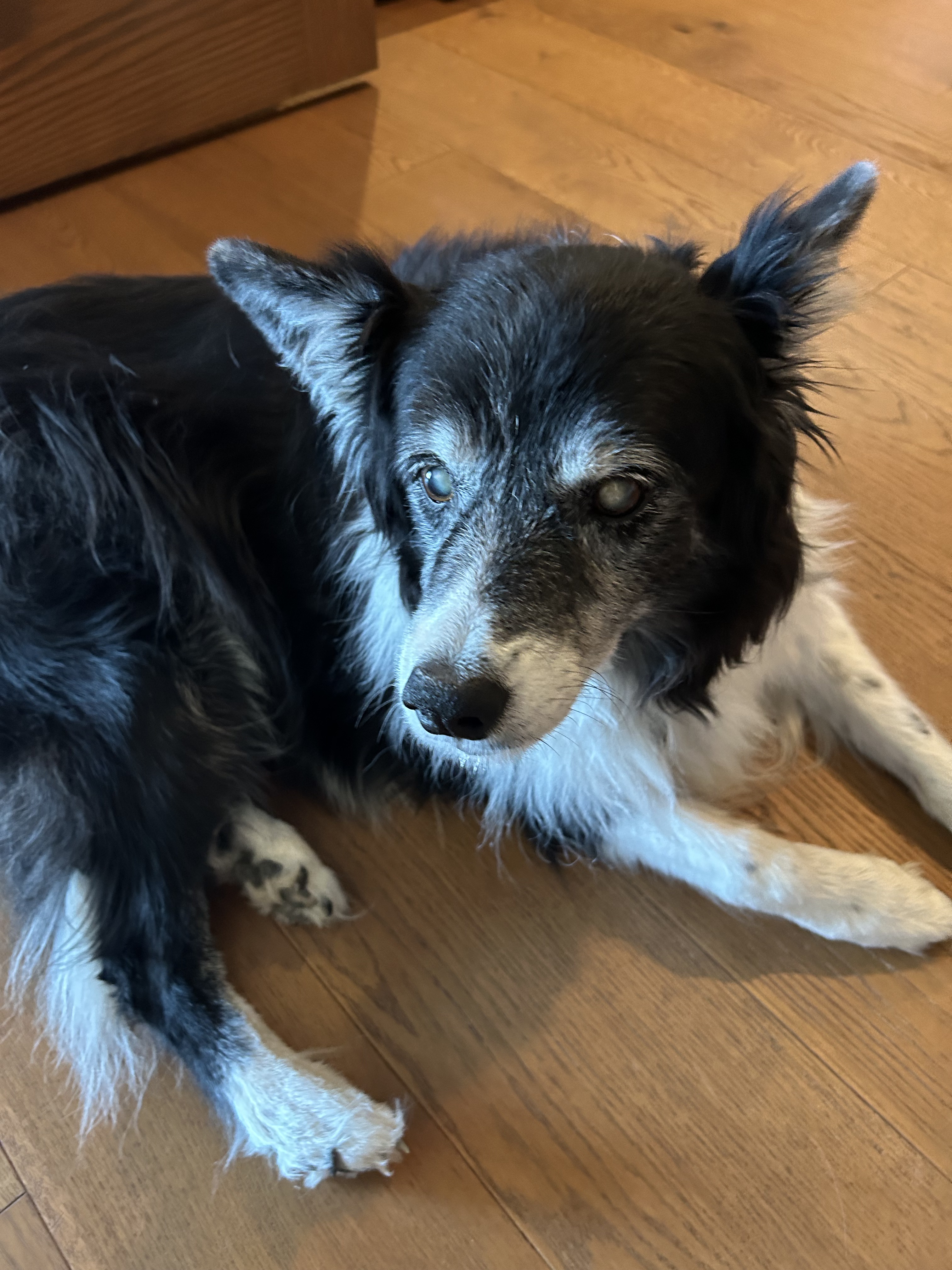
My current thirteen-year old and virtually blind Border collie, Bella, has also demonstrated graceful acquiescence to her aging. One difference in Bella is that when I now stop the pickup for a walk, she remains behind in the cab of the truck while young Duke and I go for a walk. She learned on her final walk several months ago that her limitations were simply too great and that she became too exhausted. Now Bella waits patiently in the truck for us to return, in the interim no doubt sneaking in an extra nap.

Bella has learned the extent of her physical abilities and has adapted to them with a sensible grace. She is accepting of those physical limitations that she can no longer perform. Doing so with calm acceptance and grace is what I’ve observed from my Bella and strive to learn. Yup! No more ladders for me!

The top picture is of the mature Bella and the lower picture is of the old Bella

On that most uncomfortable of all subjects, death, I’ve also learned from my Border collies. Our first dog Bandit who proved responsible for transferring us from a hectic city life to a bucolic ranch life, became old, severely infirm, unable to walk, and finally compassion required that we put him down. He had dearly loved the ranch with its abundant wildlife, scenic views, and cattle to herd.

When finally we deemed it time to let our old Bandit die with his dignity still intact, I placed him in the bed of the pickup, a spot where he had spent so many happy hours. I strategically parked the pickup so that Bandit had a view from the top of the hill and could sense the cattle grazing below. On a warm day with the gentle breezes and amid the songs of birds, our veterinarian facilitated the peaceful passing of our noble Bandit dog.

While the moment was incredibly sad for me, and I bawled my eyes out, I can think of no better way for our beloved pets or we as humans to die than surrounded by natural beauty, memories of outstanding accomplishments, and surrounded by those he/she loved. I can only wish that a graceful ending of my life will occur and that we humans might become as accepting of the inevitable as were my Bandit and Molly.

Perhaps you have observed your pets and gained wisdom from them about life’s mysteries. If so, please let me know what you have learned and share here with other blog readers and pet lovers.

If you have not had the chance to read my latest book, Hitler’s Maladies and Their Impact on World War II: A Behavioral Neurologist’s View (Texas Tech University Press), I invite you to do so. The book explores an important aspect of the Hitler story and World War II that has not been well studied. Many of Hitler’s catastrophic errors including the premature invasion of the Soviet Union in June 1941, the slowness of German forces to counterattack at the Battle of Normandy in 1944, and the highly risky Battle of the Bulge in late 1944 into 1945, can be better understood, knowing the sizeable impact that Hitler’s physical and mental conditions had on these vital battles.

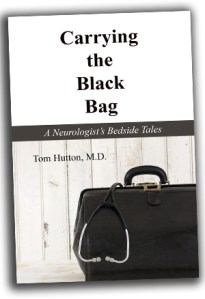
Also, consider picking up a copy of my earlier book, Carrying The Black Bag: A Neurologist’s Bedside Tales (Texas Tech University Press). Please join me on my personal journey as a physician and meet my patients whose reservoirs of courage, perseverance, and struggles to achieve balance for their disrupted lives provide the foundation for this book. But step closely, as often they speak with low and muffled voices, but voices that nonetheless ring loudly with humanity, love, and most of all, courage.

Marketing My Books

The last several weeks have seen an uptick in my efforts to make my most recent book, Hitler’s Maladies and Their Impact on World War II, better known. These efforts have included a trip to Atlanta to speak before the large and well organized Atlanta Chapter of the World War II History Roundtable. Then this last weekend I served on a panel discussing D-day with two other authors at the Boerne Book Festival. Both experiences were fun and rewarding, and I met interesting people.

The experience in Atlanta has been planned for some time. My presentation was well received and prompted interesting discussion. Three World War II vets attended and while limited physically, remained interested and interactive. One of them had landed at Normandy. Wow, history alive.

Perhaps the most interesting and fortunate contact was meeting Robert Ratonyi, a Holocaust survivor. Bob Ratonyi was only a boy when the Nazis invaded Hungary, followed shortly by the Hungarian Holocaust. Bob’s family and friends kept moving him about to keep him out of harm’s way. Eventually they found a way to smuggle him out of the country and ultimately to the United States. Much of his family was not so fortunate. He has a slide in his presentation that he was kind enough to send me showing a large number of family members who were killed in the Holocaust simply because they were Jewish.

Bob Ratonyi became aware of how little the younger generation knew about those sad Holocaust days. He determined to contact high schools and make information available to the students. Bob also follows up with presentations and answers questions. What a wonderful service he provides. Bob also points out that there have been over 20 Holocausts in the twentieth and twentieth first centuries of which the WWII European Holocaust was only the third largest. I did not know that nearly so many tragic events had occurred.

Bob has studied the origins of these different Holocausts and has struggled to find how they can be prevented in the future. He believes education of the younger generations and making them aware of the circumstances that give rise to such genocidal behavior is a good first step.

In my limited inquiry, I’ve found striking ignorance among our youth regarding the Holocaust and the sacrifices made by the World War II generation. Recall the old saying attributed to George Santayana (The life of Reason, 1905), “Those who cannot remember the past are condemned to repeat it”. My hat is off to Robert Ratonyi!

The event of this past weekend was the Boerne Book Fair. This event is in its 6th or 7th year and was well attended. Numerous tents were occupied by employees of various university presses, library information, and for author talks. I participated along with two other authors, James Fenelon who is a military historian and Sherri Steward (Bringing Davy Home) who has written a deeply personal book on her family’s challenges following service during WWII and Korea. The moderator was a delightful military and commercial pilot, Tammie Jo Shults who wrote Nerves of Steel: How I Followed My Dreams, Earned My Wings, And Faced My Greatest Challenge. Her book describes her heroic efforts as captain to land Southwest Flight 1380 despite overwhelming problems with the aircraft. She is a delightful lady, skilled pilot, and a true hero.

Economic pressures on publishing houses appear to have been responsible for the authors having to do more and more of the publicizing of their books. Online information has largely replaced book presentations in bookstores. Most authors I know did not write their books to make money, but rather because they had a story to tell that they felt simply had to be told.


If you have not had the chance to read my latest book, Hitler’s Maladies and Their Impact on World War II: A Behavioral Neurologist’s View (Texas Tech University Press), I invite you to do so. The book explores an important aspect of the Hitler story and World War II that has not previously been well studied. Many of Hitler’s catastrophic errors including the premature invasion of the Soviet Union in June 1941, the slowness of German forces to counterattack at the Battle of Normandy in 1944, and the highly risky Battle of the Bulge in late 1944 into 1945, can be better understood, knowing the sizeable impact that Hitler’s physical and mental conditions had on these vital battles.

Continue reading

Origins, Behavior, and Myths of Paint Horses

Having a Paint Horse, the typical Indian pony, on Medicine Spirit Ranch seems highly appropriate. Native Americans believed that Paint Horses would protect them from death or injury during a conflict. Paints were deemed to have magical properties especially those with “medicine hat” markings.

Meet Fancy

Fancy, our filly Paint horse

We bought Fancy, our Paint Horse, from a riding stable where my granddaughter Ramsey had learned to ride. Fancy was a gentle riding horse that Ramsey loved so that when the opportunity arose, we purchased her for our ranch. Fancy like other Paint horses is gentle, intelligent, and has a good temperament. Paints are valuable on ranches for riding, roping, racing, jumping, and stock work. These versatile horses will do about whatever its rider wishes, making its flexibility and good nature valued traits for ranch work.

The question arises as to where did paint horses come from? In the 1500s the Spanish Conquistadors brought horses to the New World. The predecessors of the Paint Horse were likely Barb, Andalusian, and Arabian breeds and sported distinctive spotted and two tone coloration. Inevitably, some of the horses escaped, bred, and dramatically increased in number. Large herds ranged the prairies for many years before Native Americans learned to capture, train, and utilize the horses for hunting and warfare. A mounted Native American warrior proved an intimidating and effective opponent such that the Comanche, Kiowa, and Apache all became excellent horsemen and the dominant Indian tribes in Texas.

The terms Paint and Pinto are often used interchangeably but technically Paint refers to the breed and Pinto to its color. Fancy is black and white but many different colors may be found in Paints including brown, bay, or red. Fancy is Tobiano, meaning two colors, and because she is black and white referred to as a Piebald Paint horse.

What is there about a Paint Horse That Makes Them Special?

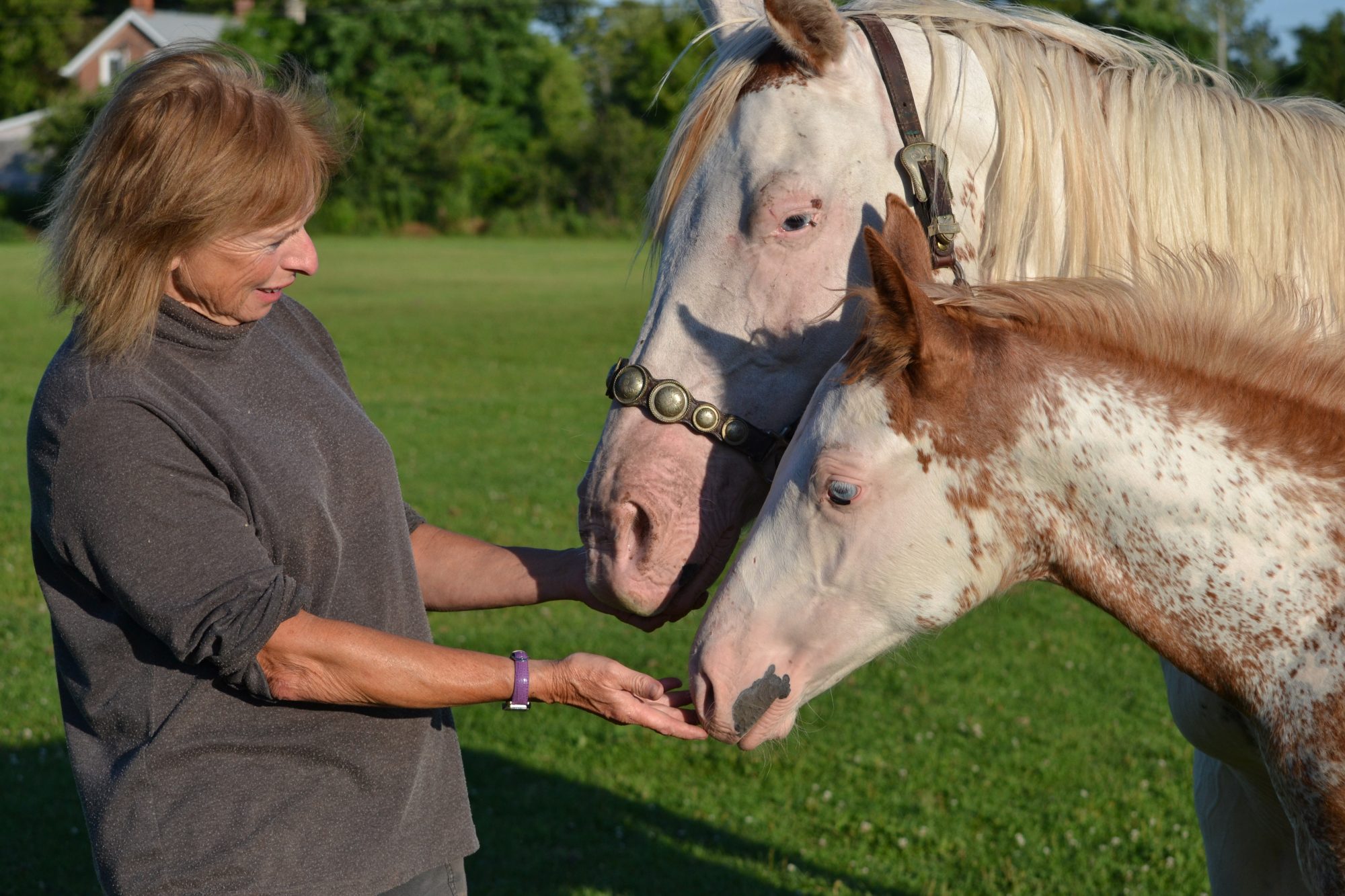
As noted above Paint Horses with “medicine hat” markings were especially deemed to have magical properties. These horses have predominantly white heads with pink noses and mouths, and blue eyes. No, our Fancy does not have a “medicine hat.” Below are two examples of a filly Paint Horse and her foal, both of whom have “medicine hats.”

While descended from the same stock as quarter horses, Paint Horses have their own registry, the American Paint Horse Registry. This separate registry connotes a special status for the breed. Due to the popularity of the Paint Horse breed, the APHR has now grown to be the second largest equine registry. These smart and versatile horses are well muscled, beautiful, colorful, and in high demand.

Native Americans, in addition to the magical properties they saw in Paint Horses, also chose to paint designs on their horses, providing even greater protection and boast of the warrior’s prowess. Painting a warhorse for a battle or hunt was a sacred act that held power, not only in the Paints made from Nature, but also those with painted symbols as well. The act of painting a horse was viewed as serious business, as it could mean life or death for the rider.

According to a February, 2020 article in Notes from the Frontier, the painted symbols had specific meanings. The symbols were mostly drawn from nature such as a hand printmeant vengeance against an enemy or sometimes indicated success in hand combat. Zigzags represented thunder that symbolized speed or stealth. Hail markings predicted the enemy’s defeat and misfortune. Circles around the horse’s eyes or nostrils were believed to strengthen its senses for battle. Painted horse hooves symbolized successful raids or sometimes the number of horses stolen. A cross meant the rider had escaped an ambush. Slashes of color across a horse’s face indicated the successful defeat of an enemy village. Additional symbols with their interpretation may be viewed below.

One of the benefits gained for Trudy and me by living on a ranch is that we continue to learn from both our animals and our surroundings. I’ve tried to document the delights that I’ve encountered on Medicine Spirit Ranch and hope that you the reader have learned something as well and have enjoyed my efforts. Wishing you a wonderful 2024.

I’ll close this blog piece with a few famous horse quotations.

“The air of heaven is that which blows between a horse’s ears.”

“Blame it or praise it, there is no denying the wild horse in us.”

“A horse doesn’t care how much you know until it knows how much you care.”

“If you have gained the trust of a horse, you have gained a friendship for life.”

If you have not had the chance to read my latest book, Hitler’s Maladies and Their Impact on World War II: A Behavioral Neurologist’s View (Texas Tech University Press), I invite you to do so. The book explores an important aspect of the Hitler story and World War II that has not been well studied. Many of Hitler’s catastrophic errors including the premature invasion of the Soviet Union in June 1941, the slowness of German forces to counterattack at the Battle of Normandy in 1944, and the highly risky Battle of the Bulge in late 1944 into 1945, can be better understood, knowing the sizeable impact that Hitler’s physical and mental conditions had on these vital battles.

Also, consider picking up a copy of my earlier book, Carrying The Black Bag: A Neurologist’s Bedside Tales (Texas Tech University Press). Please join me on my personal journey as a physician and meet my patients whose reservoirs of courage, perseverance, and struggles to achieve balance for their disrupted lives provide the foundation for this book. But step closely, as often they speak with low and muffled voices, but voices that nonetheless ring loudly with humanity, love, and most of all, courage.

Bandit Achieves Our Retirement- Part IV

This is the fourth blog piece in a series that features our first Border collie, Bandit, and is taken from an unpublished book titled The Bandit’s Gift. I wrote this manuscript which I suppose could be considered my practice book, shortly after retiring from my Neurology practice in Lubbock and moving to our ranch outside of Fredericksburg, Texas. The title of the book hints at our Bandit dog’s substantial role in bringing about our early retirement. Trudy and I feel indebted to Bandit for his efforts in hastening our move from a frenetic life in the city to the beauty and peacefulness of the Texas Hill Country.

This installment describes our migration from Lubbock to our ranch near Fredericksburg. It also introduces Mollie, a female Border collie, whom we acquired shortly before our move to the ranch. Mollie as a puppy came from a New Mexico ranch whereas Bandit had been raised a city dog in Lubbock.

                             Mollie our second Border collie who was from herding stock

In August of 2001, Trudy and I departed Lubbock for permanent retirement at our Fredericksburg ranch. Bandit and Mollie rode in the backseat nestled among hanging clothes and piles of shoes.  Mollie sat on the passenger’s side, Bandit on the driver’s side.  As Lubbock receded into the tabletop-flat landscape, Bandit cast what I considered a satisfied if not smug glance out the window for having brought about this major change in our lives.  I wondered how our canine conniver felt, as he had been a motivating force for my early retirement, mounting a determined campaign having nearly destroyed our home in Lubbock.

“Bandit, say good-bye to Lubbock.”

His long white tipped tail began slapping the back of the seat.

“Thump, thump, thump.”

“Trudy, that dog sounds like he’s beating a drum, am I imagining it or is Bandit celebrating?”

“Thump, thump, thump.”
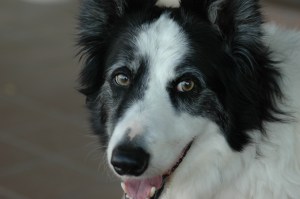
                                                              Bandit looking so innocent

Mollie sat quietly in her corner of the backseat.  When I turned to scratch her chin, I noticed her peculiar smile.  When Mollie smiled, she retracted her lips and exposed her teeth.  Her eyes squinted and her face showed a broad dog smile- a smile sometimes misinterpreted as a snarl. I sensed that Mollie was happy, knowing we were leaving a city and headed permanently for a ranch.

Optimism and a sense of unburdening welled up within me.  My exhausted spirit for years had yearned for a saner, more private existence.  The long work hours, the stress of holding together a clinic and hospital practice, and the daily grind of dealing with desperately ill patients had extracted a physical and emotional toll from me.

While Trudy and I had worked well together, our communication styles differed.  For me, small talk has always proved difficult.  Give me a family with a brain-dead member, or the need to relate a terminal diagnosis, and I am at my rhetorical and sympathetic best.  But when at a social function calling for light banter, I feel like a stammering dolt.  Moreover, I suffer near stupefaction when faced with the usual social banalities.

Trudy on the other hand handles social situations with aplomb.  She can discuss grandchildren, the weather, the latest gossip, or pop-culture with the best of them.  She finds difficulty, though, when talking of emotionally laden topics, especially those affecting her or her family.  It was just such heavy topics that had for years nagged at the corners of my mind.

Trudy’s unhappiness and worry may have prompted verbal zingers aimed at a workaholic, slow to mobilize, and frequently absent husband.

Remember that Surgeon in Medical Records, draped over his pile of charts like a bad suit of clothes, dead as Hamlet’s buddy, Yorik?  You’re not indestructible either Buster. I’m too young and gorgeous to be a widow.  Lots of young bucks have the hots for well off, sexy widows.”

“Yeah, rave on,” I had said, suspecting I had not deflected this conversation for long.

Later as I drove off the cap rock of the Llano Estacado and away from the loneliness of the high plains, I became lost in a tumble of conflicting questions and emotions. Long drives have always put me in pensive moods, providing uninterrupted time for contemplation. Memories began to tug at my sleeve.

Being a physician had been at the core of my identity.  I wondered how life would change without Medicine being my magnetic north.

Why am I ambivalent about leaving? Sure, I’ve loved Medicine- the intimacy that goes with caring for others.  Where’s the satisfaction gone? Had it been the hospital’s economic realities that at times impinged on the quality of clinical care I wished to give? Had this led to incessant medical upheavals?  Why had it been a struggle to maintain a successful group practice, run an efficient medical practice, and carry out good clinical care and research? Had I asked too much of myself as both a private practitioner and an academic?

After an initial scuffle in the backseat when Mollie tried to take Bandit’s usual place, the canines had calmed. Bandit circled and plopped down with an audible exhalation.  Long before we reached the cap rock, Bandit had fallen fast asleep.  Mollie rested her chin at the window and observed passing fence posts, her light blue eyes tracking and flicking from one to the next.
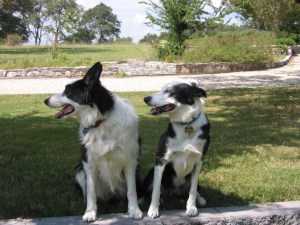
                                           Bandit on the left and Mollie on the right in profile

As the miles sped by, my mind shifted from labors left behind to this land’s history through which we passed which I began to recall. We headed southeast, counter to the migration of earlier settlers, toward what in 1800 had been the northernmost frontier of the Mexican State of Coahuila and Tejas.  Long before becoming a Mexican State, the land had been occupied by Tonkawa Indians who in turn gave way to the more warlike Apache, Kiowa, and Comanche.

Texas won its independence from Mexico in 1836 and became an independent republic.  In 1845 a proud but destitute Texas joined the United States of America as its 28th State.  The following year German immigrants arrived in the Hill Country to partake of free land and increased economic opportunities.

In Germany, the unwitting emigrants had been reassured the new land was peaceful, only on arrival to find themselves in their newly established village, surrounded by hostile Native Americans.  This grievous case of real estate exaggeration ranks just behind Eric the Red who named a frozen expanse of icecap, Greenland.

We traveled through Sweetwater, a small west Texas agricultural town with yet another unpretentious name.  I thought- did no one have imagination when giving names?! 

Bandit briefly awoke when we stopped at a red light in Sweetwater.  I felt his cold nose nudging my shoulder, urging my attention. I reached back and scratched his ears. The white tip of his tail (the so-called Shepherd’s Lantern) striking the back of my seat.

“Thump, thump, thump.”

Mollie glanced at her emotionally needy canine companion but quickly returned to watching the towns stream by.  I wondered if Mollie expected a meandering herd of sheep or scattered herd of cattle to appear in desperate need of a Border collie to organize them.

I thought how different these two dogs were in soliciting affection.  Bandit fawned on people, begging- even demanding attention. Mollie never stooped to such antics, although she appreciated affection when it was offered by a family member.

Mollie was a rare Border who loved to swim

After leaving the town behind, I heard Bandit again flop down in the back seat.  My own thoughts returned to the history of central Texas that still lay several hundred miles ahead.

German men from Fredericksburg led by their able leader John Meusebach, in a desperate gambit, ventured out of the relative safety of their new settlement to secure peace with the natives.  They successfully met up and powwowed for several weeks beside the San Saba River. After much talk, countless pipes, and no doubt many earnest, silent German prayers, a peace treaty was established with seven large tribes of natives.

This treaty, remarkably, over the years has remained intact. It is claimed to have been the only treaty in Texas, and possibly the entire United States, with Native Americans to have not been broken.  An annual Powwow of Native Americans and Fredericksburg citizens celebrated the success of the treaty for many years thereafter in Fredericksburg.

While the peace talks had dragged on alongside the San Saba River, other natives surrounded the village of Fredericksburg, awaiting news that would either prompt an attack on or befriend the hapless settlers. Huddled within their makeshift cabins, stoic German settlers tried to carry on their lives without projecting fear to their children.

On Easter eve night, bon fires ominously appeared on the many hills surrounding Fredericksburg. The German settlers worried these fires might signal an impending attack.  In truth the bon fires communicated to the Native Americans high in the hills around Fredericksburg that a peace treaty had been achieved at the Powwow on the San Saba River.

Initially the significance of the bon fires was unknown to the settlers, but the fires on Easter evening prompted one mother, full of bravado, to proclaim to her worried children that the Easter Bunny was building fires to boil their Easter eggs.  The brave spirit manifested by the unknown German mother inspired for many years the yearly Fredericksburg Easter fires tradition where bon fires were built each Easter eve on top of the hills surrounding Fredericksburg.

We motored across the Texas prairie where 150 years earlier the Apache had been driven by the still fiercer Comanche.  I recalled the struggle for control of the green hills and streams of central Texas.  With increasing distance from Lubbock, the table-flat, featureless, and bleak landscape gradually changed into rolling prairie dotted with tall prairie grasses, scraggly mesquite, cottonwood, and Juniper trees.

We traveled through Coleman to Santa Anna (named after a famous Penateka Comanche chief) where we turned south, passing by the ruts of the old Great Western Cattle Trail. A roadside historical sign informed that more cattle had passed up this cattle trail to Kansas than had occurred on any of the other Texas cattle trails.  The Western Cattle Trail ended in the wild western town of Dodge City where lawmen Bat Masterson and Wyatt Earp became famous and where Earp was finally laid to rest.

Some twenty million Longhorns had moved up the cattle trails following the Civil War, establishing a viable economy for a desperately poor Texas. I proudly recalled my great grandfather, Thaddeus Septimus Hutton, having been a Texas cowboy who had likely pushed cattle up this very trail through the Oklahoma territory to the rail head at Dodge City.  I pondered what it must have been like to herd cattle in the 1870s through wild country. Had he even a glimmer of the historic nature of the western life he lived and the fame that would be later accorded the lawmen of Dodge City.  Of one conclusion I felt certain, that more hard work and less adventure had existed on the cattle trail than was depicted later by Hollywood movies.

Several hours further on, the rolling prairie gave way to green hills, clumps of stately live oak trees, and cultivated green pastures.  Artesian spring fed streams and rivers snaked among the hills.  Wild game had been and remains prevalent, and the tall native grasses supported greater numbers of grazing animals than had the near barren Llano Estacado.

Looking at this dramatic transition in the land helped me to understand why the Native Americans believed the Hill Country possessed such “strong medicine.” The Texas Hill Country with its beauty and bounty favorably compares to the western, more arid portion of the State.  I thought no wonder Native Americans had fought so ferociously to maintain control of the Hill Country.

While I mulled these matters, Mollie, with remarkably sustained attention, continued to observe the changing landscape.  Once when passing an eighteen-wheeler, Mollie stood upright, staring at a black, ride along dog that stared back from the truck’s passenger window.  I could see the other dog barking. Mollie calmly observed the dog and gazed at the truck until it was lost to sight.

Bandit didn’t awake again until we arrived in Brady, the geographical center of Texas.  He awoke, stretched, yawned, and appeared to anticipate our arrival at the ranch.  I felt his chin on the back of my seat and sensed his warm, moist breath.  I could see in the rear view mirror that he had perked up his ears and was staring down the highway ahead of us.  When I reached to give Bandit a scratch, I was rewarded with several languid licks to the back of my hand.

    Mollie and Buddy at the ranch

“Thump, thump, thump.”

An hour and fifteen minutes later, we drove through the front gate of our ranch. I halted the car briefly, so that Trudy and I could exhale years of pent up tension.  Whimpers came from the backseat.  Trudy and I opened the back doors of the car.  Mollie leaped out and sped across the pasture, ears flattened to her head, back arching, and legs striding.  Bandit jumped out and loped behind Mollie, inspecting trees, clumps of grass, and rocks.  Mollie scared up a jackrabbit, and both collies began a deliriously happy, zigzagging pursuit, interrupted only finally by an impassable barbed wire fence.

Trudy and I joined hands and watched in peaceful silence; an interlude as pure as that between young lovers. We had parked on a caliche ranch road near a grove of live oak trees.   We wordlessly observed the rabbit chase and basked in the exuberance of the moment. Bandit and Mollie eventually strutted back to the car; tails held high.  The two dogs sniffed and scuffled and seemed to be thoroughly enjoying themselves.

From over my shoulder, an orange-red sunset beckoned above a white limestone ridge.  We heard the mellifluous sounds of water rushing over stones in a nearby brook.  I experienced a rare moment of awareness and understanding.  What had seemed confused a few hours earlier, in this tranquil setting, now seemed clearer, even achievable. I could feel a smile develop across my face.

“Welcome home Trudy.”

Trudy slowly turned her eyes to meet mine. I saw a loving smile, crinkled nose, and teary eyes.

“Didn’t think I’d get you out of Lubbock alive,” Trudy said with an uncharacteristic tremor in her voice.  Moments later her tendency to chide rallied and she said, “Besides Cowboy, why are you planted here like a stupid yucca, let’s get on with our new lives!”

Just as I leaned across the front seat of the car to kiss Trudy, from the backseat came Bandit’s black and white head. Trudy and I stopped just short of planting bookend kisses on his furry snout.  Trudy and I laughed, and Bandit cocked his head impishly as if understanding the joke.  Trudy and I were now retired, and with Bandit and Mollie, we were four.

to be continued

If you have not had the chance to read my latest book, Hitler’s Maladies and Their Impact on World War II: A Behavioral Neurologist’s View (Texas Tech University Press), I invite you to do so. The book explores an important aspect of the Hitler story and World War II that has not been well studied. Many of Hitler’s catastrophic errors including the premature invasion of the Soviet Union in June 1941, the slowness of German forces to counterattack at the Battle of Normandy in 1944, and the highly risky Battle of the Bulge in late 1944 into 1945, can be better understood, knowing the sizeable impact that Hitler’s physical and mental conditions had on these vital battles.

Also, consider picking up a copy of my earlier book, Carrying The Black Bag: A Neurologist’s Bedside Tales (Texas Tech University Press). Please join me on my personal journey as a physician and meet my patients whose reservoirs of courage, perseverance, and struggles to achieve balance for their disrupted lives provide the foundation for this book. But step closely, as often they speak with low and muffled voices, but voices that nonetheless ring loudly with humanity, love, and most of all, courage.

My Friend: The Great Blue Heron

Okay, okay calling the Great Blue Heron a friend just might be an overstatement, but developments of late have made me wonder.

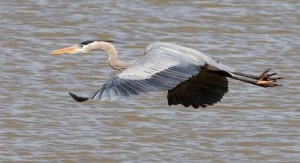
Great Blue Heron in flight

Over the last few years I’ve written several times about a Great Blue Heron that frequents our stock tank and how he waits patiently for me to toss out fish food. I’ve referred to this as my “chumming for heron.” After I retreat a safe distance, the heron flies in on magnificent wings and and crouches waiting for a fish to swim by, or else dives from five to ten feet into the pond to retrieve his meal.

In this almost daily feeding ritual, the heron is used to my presence. I can now get within twenty yards or so of the Heron before  it with its stiff legs struts away or flies away.

For the last several weeks, to my surprise, when I arrive at the large stock tank at our other ranch a mile or two away from the heron’s haunt, the Great Blue Heron flies in to meet me up with me there. He picks a spot to perch on a ledge, the bank of the pond, or on top of a tall tree while I go about throwing out fish food. Again the heron uses my fish feeding as a hunting opportunity.

A strange feeling overcomes me when I see the giant bird circling languidly above. He clearly seems to  monitor my terrestrial progress. Previously I’ve written of the many heron myths, all of which indicate the heron predicts good luck. He is almost like a ancient Greek god who follows my actions with interest or at least with mirth. I find myself wondering what he sees from the great heights achieved in his flight. I suspect he has wonderful eyesight, as he can spot a fish several feet below the surface of the pond. While I am pretty sure about his good eyesight, I have no idea about his hearing. Also I’ve never heard him utter a single sound. He is my silent watcher on land, water, and in the air.

The heron shows adaptation, I suppose. He has learned that fishing is more productive after I summon the small fish to the surface of the ponds. Perhaps its behavior is really no different from the cows who carefully attend my coming and will draw near for my spreading of the tasty range cubes. Also the horses on spotting me will actually gallop behind the pickup when they see me heading for their feed trough.

The relationship with the heron represents symbiosis, that is a mutually beneficial relationship between the Great Blue Heron and his human rancher/fish feeder. I know that I sense wonder from the magnificent bird and feel strangely comforted, knowing he silently watches over me, even if  just for reasons of hunger. The benefit for the heron is obvious and can be seen by its ample girth.

Whereas privacy remains a concern for many, and people feel they are being watched in public; I sense something different. I sense a benevolent and silent watcher, looking after me. Thank you Great Blue Heron, but leave a few fish for me.

Carrying the Black Bag book

My book is in bookstores or online (or contact me and I’ll send it). If a speaker is needed for your event, contact me as I love to share these stories with others either via print or in person. Keep the book in mind for birthday presents or other gift occasions where you wish to present a positive view of dealing with health issues.


Still More Praise For Carrying The Black Bag

An appreciative reader penned the review below for the Journal of Neurological Sciences. It has been accepted and is now in print online.

While the predominant audience for Carrying The Black Bag: A Neurologist’s Bedside Tales was thought to be a popular audience, the book has also been very well received by physicians, nurses, and allied health personnel.  This acceptance has proved most gratifying for the author as my book deals principally with a humanistic approach to medicine. The author of the book review, Dr. Steve Roach, got it! For this I am most grateful.

Carrying the Black Bag book

Makes a great Holiday gift and available online or favorite bookstore

Carrying The Black Bag makes a great Christmas (Hanukkah) gift and can be purchased from Amazon, Barnes & Noble, Texas Tech University Press, as well as your local independent bookstore.

Dr. Roach’s review is as follows:


Book Review

Carrying the Black Bag: A Neurologist’s Bedside Tales, by Tom Hutton, 240 pages. Texas Tech University Press, 2015. $27.95.

  1. Steve Roach, MD

Ohio State University

Columbus, Ohio

esroach@earthlink.net


Key words: humanism; history of medicine; Parkinson disease


Thomas Hutton is a retired neurologist whose career spanned four decades. During this time, he witnessed the introduction of computed tomography, magnetic resonance imaging, and numerous new medications. He experienced the dawn of the genetic revolution and the arrival of the electronic medical record. But this book is about people, not technology, so it is fitting that the metaphor Hutton selected for the title of his reminiscences is the traditional black physician’s bag.

Hutton is a master story teller whose patient sketches are reminiscent of those of A. R. Luria and Oliver Sachs. He studied with Luria and duly credits the influence of both men. Hutton intermingles his own story with those of his patients, telling of the football injury that led to his becoming a doctor and his days as a trainee with A. B. Baker. There is even an entertaining medical detective story about a man with repeated arsenic poisoning.

But the heart and soul of this book are the lovingly told patient stories. Never have I read a more poignant tale of love lost than Hutton’s account of Maggie and Ned, two poor migrant workers who had been life-long soul-mates until Maggie’s sudden death. One cannot help but smile at the elderly man who pleaded for relief after his girlfriend developed nymphomania due to her Parkinson disease medication. There is a sweet story about an elderly man who made sandwiches each afternoon for three dogs who came to play pinochle, a complex but pleasant hallucination resulting from his medication. Whether sad or funny, Hutton’s patient stories are respectfully told and never patronizing.

To practice humanistic medicine, one must be in touch with one’s own humanity. Clearly the author has a deep respect for people and a keen eye for the human condition. This is an entertaining book that most physicians will enjoy reading. It also offers an effective antidote for the technology overload of today’s medicine and a glimpse at what medicine once was and could be again.