Tag Archives: Black Baldy cattle

Integrating Cattle: Lessons in Herd Dynamics

A cattle trailer opened its back gate last week at our ranch and out bounded five recently purchased black baldy cows and their calves. The animals proved docile but stuck closely together. The next day I opened the gate to the adjoining pasture where our resident herd grazed. The immigrant cattle slowly were drawn into the adjoining pasture. I observed the wary interaction of the new cattle and the established larger herd of black baldy cattle and their smokey calves (cross between black baldy and Charolais). The intermingling of the new and old herds then took its familiar course that I’ve witnessed from numerous episodes of introducing new cattle to the resident herd.
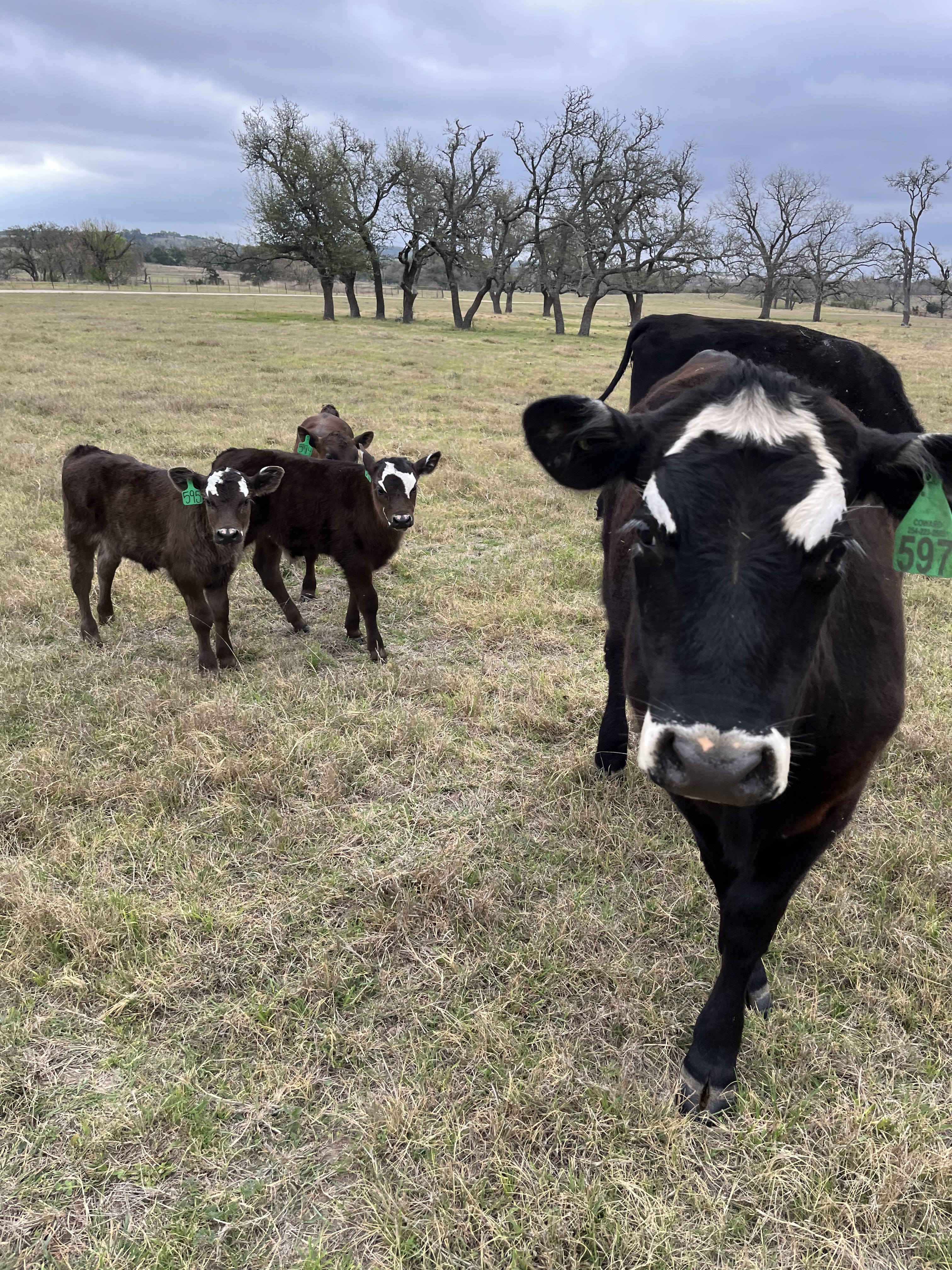
A new black baldy mother with three of the new calves

Several of the cows from the older herd approached the immigrants with a certain intent. Before long several minor altercations broke out between members of the older herd and the newer one with head to head pushing taking place. Even several of the immigrant calves became challenged to shoving matches by calves from the established herd. The smaller new cows were first time mothers and were over matched by the larger resident black baldy mothers. Likewise the calves from the resident herd were on the whole larger than the immigrant calves.

Foreheads pitted against foreheads, the pairs pushed and strained. Muscles bulged in their necks and hind quarters, eyes stared balefully. Eventually some slight movement began to occur with a dominant bovine shoving the other several paces backward. It seemed that no intent existed to harm the other cow (calf) but rather to demonstrate dominance. A new order of dominance was being developed.

For the majority of the cattle from the established herd (lets call them the citizen herd), avoidance seemed the order of the day. The separation of the lesser and newer herd from the older, larger herd developed over the next several days. The immigrants as a group initially wandered away into a nearby pasture, avoiding members of the older citizen herd. There they seemed content, languidly munching on green grass or chewing their cuds and maintaining close proximity with the members of their small herd. No doubt previously established dominance within this group continued unchanged.

On day four the larger herd wandered into the pasture occupied by the immigrants. No more shoving matches occurred and instead the cattle ever so slowly and tempted by nearby green grass began to intermingle. The immigrants still herded together but maintained position on the periphery of the citizen herd. Tolerance was being developed.
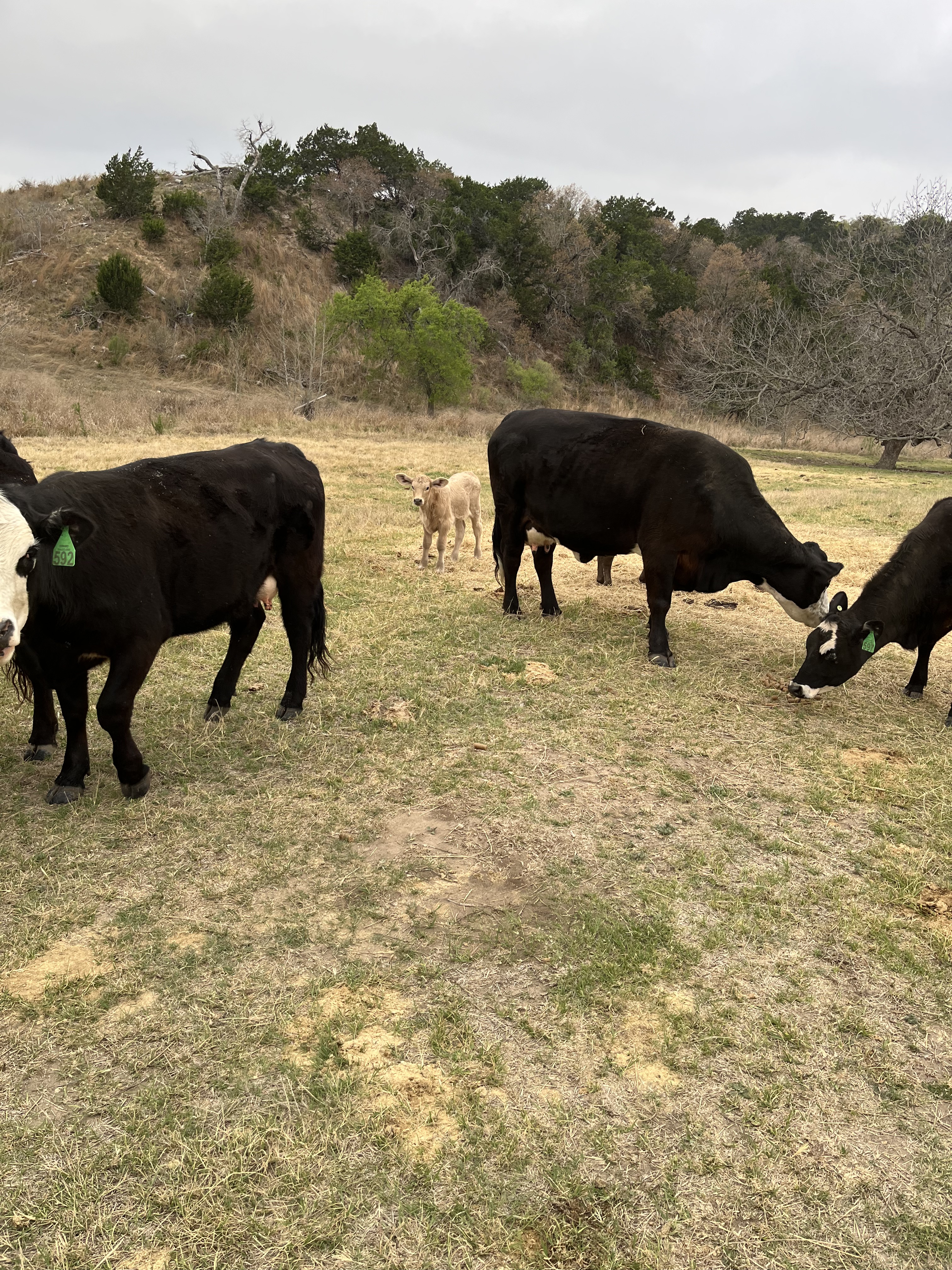
A smokey calf intermingling with the older citizen cows

As the saying goes all behavior has meaning, but the question arose as to what meant the behavior of these bovines. Did the new herd represent a potential threat to the established herd? Did their positions of dominance within the herd feel threatened. Did competition for grass bring about the shoving matches? Did the citizen cows sense competition or fear that their usual circumstances or prerogatives might be affected?

Whereas the cows were all black baldys and looked much alike, major physical differences did not divide them. Their vocalizations also sounded very similar to this observer; however, clearly calves could differentiate their mother’s call from that of the other cows. Might the immigrant cows have a different vocalization (dialect) that was perceivable from the citizen cows? Was competition for available grass (jobs) the source of concern- the greater number of cows with the same amount of grass?

A week has passed and now the cattle have intermittently integrated without signs of disagreement or competition. While still identifying with their original herd, the negative behaviors appear to have stopped. Based on prior experience integrating cattle into the resident herd, I expect no further shoving matches. And if the combined herd follows true to form, before long the cattle will pay little attention to which herd they derived. If only people could adapt to immigrants as quickly, as it appears to take years and even generations for this assimilation to occur in our society.
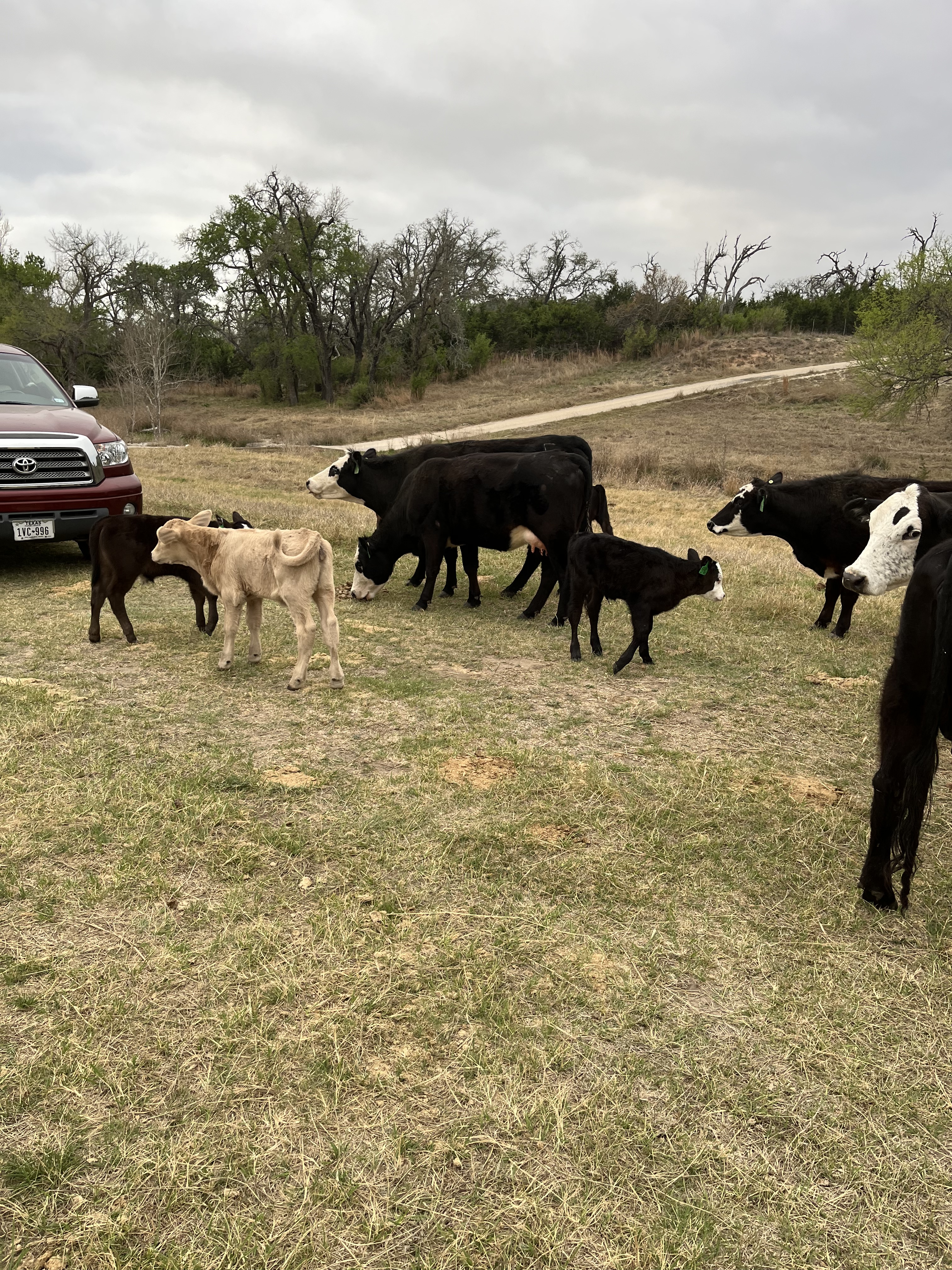
Intermingling of the mothers from both herds and a smokey calf with several of the black baldy calves

Admittedly, people have far more complex social behaviors than cows. But are there not similarities? Don’t citizens feel threatened that jobs or societal expectations might change with an influx of different folks with different customs, dialects or languages? Is that really different from the behavior shown by my cattle when confronted with immigrant cattle? Might the uncertainty of place in society or herd be threatened by newcomers? The immigrants may possess skills greater than the residents and therefore ascend in dominance (wealth) in society or within the herd.

Perhaps, just perhaps, cows can teach us something about assimilating faster with immigrants.

The Legendary Texas Longhorns

Nothing in Texas is more iconic than Longhorn cattle.  The Longhorn even has its own folklore. In Native American cultures the Longhorn represents a symbol of good luck and spiritual guidance. While in Spanish culture, the Longhorn represents power, resilience, and strength. For Texans it is simply the basis upon which the State economy was built post-Civil War and to this day the Longhorn remains a treasured Texas icon.

Below is a stock image of Longhorns. Not my picture.

Yet where did the Longhorn come from? With its long horns it looks nothing like the European cattle breeds. And as any Longhorn rancher knows, it acts differently. The Longhorn is smarter, heartier, can better find forage and water, and is more disease resistant than other popular cattle breeds.

Origin and History of the Texas Longhorn

According to Dr. David Hillis, author of Armadillos To Ziziphus and the Director of the Biodiversity Center at the University of Texas at Austin, cattle likely arose from aurochs about 10,000 years ago and in two different parts of Eurasia; one being in the Middle East, and the second in the subcontinent of India. From there domesticated cattle spread to Africa and eventually via the Moorish invasion to Spain.

Christopher Columbus, on his second voyage to the New World in 1793 and intending to establish a colony in Hispaniola, stopped by the Canary Islands where he purchased pregnant heifers. The cattle  thrived in Hispaniola. By the early 1500s the Spanish explorers took descendants from these original cattle to Veracruz on the Gulf Coast. As the Spanish explored Mexico, they took along cattle for food, but many animals escaped or were released into the wild.

The countryside at the time had large and dangerous predators including bears, coyotes, and mountain lions. In an evolutionary act that warms this prior college zoology major’s heart, the strongest feral cattle with the longer horns survived better and bred. Over many generations of survivors and through the process of natural selection, the sturdy, fiercely protective Longhorn that we now recognize came into its own. With its longer horns it was able to defend its calves from predators, fight for dominance in the herd, survive in the wild and even flourish. Eventually vast herds of Longhorn cattle roamed what became in 1836 the the independent country of Texas and later in 1845, the State of Texas. Literally millions of feral Longhorns roamed the broad prairies of the State of Texas.

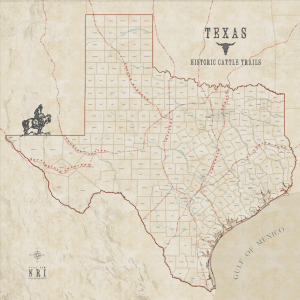
In the 1870s and 1880s vast cattle roundups and cattle drives began in south Texas, passed through the Texas Hill Country said to be the greatest cattle raising area in the world, and on through Texas and Oklahoma to the railroad depots in Kansas. The Great Western Trail saw at least two million Longhorns arriving in Kansas from where they were transported east to feed a hungry nation and to supply tallow for candles, the primary source for light at night.

Along with establishing the economy of an impoverished State, this era introduced Cowboy culture and the era often portrayed by the westerns in cinema. This author’s great grandfather, Thaddeus (Thad) Septimus Hutton worked as a cowboy and lived near Seymour, Texas alongside the Great Western Trail. It is likely that Thad Hutton in addition to working on a ranch, also rode up the trail to Dodge City where he would have interacted with the likes of Wild Bill Hitchcock, Doc Holiday, Wyatt Earp and other notable Dodge City legends.

Below are the Legendary Texas  Cattle Drives

By the 1900s Longhorns were deemed less desirable than the European breeds that yielded more beef per animal. The era of the Longhorn had passed into history and the Longhorn came close to extinction. The western writer, J. Frank Dobie along with the oilman, Sid Richardson and various nostalgic ranchers began to preserve the breed. Charles Schreiner III, a Hill Country rancher, is best known locally for his great efforts in preserving the Longhorn breed. In 1941 a State herd of Longhorns was established and now reside both in various State parks and on private ranches.

It seemed only appropriate that the first cattle we brought to our Medicine Spirit ranch were Longhorns.  The lone survivor now serves principally as pasture art whereas the calves from Black Baldys (a specific mixture of Angus and Hereford) crossed with Charolais are more prized by market forces and are the principal stock on our ranch.

Why We Love Longhorns

Longhorns in addition to their distinctive long horns also are remarkable for their coloration. No other breed has as many different colors as Longhorns including white, brindled blacks and reds, multi-colored roans, yellow linebacks, or everything in between.

J. Frank Dobie wrote in his book, The Longhorns, “Next to the horns…the most striking quality in appearance of the Texas cattle was their coloration. It is incorrect to say that they represented all the colors of the rainbow. Their colors were more varied than those of the rainbow.”

Texas Longhorns look different from other breeds and act differently as well. They possess a sense of pride with their heads held high and the males even demonstrate a swagger. They possess a wiliness not often associated with bovines. The calves are small at birth but grow rapidly. Their muscles strengthen, and they show a sense of of self-confidence not often observed in other breeds. Despite their long horns, the Longhorns are typically gentle. We often hand have fed our Longhorns, something not often possible with many of our Black Baldys.

The Longhorns are easy breeding due to having a larger pelvic outlet than other cattle breeds. Often first time heifers of other breeds are bred with a Longhorn bull because of this easy calving trait received from the Longhorn bull. Longhorns in our experience become the alpha cow in a mixed herd and have a distinct knack for leading the herd to a water source and to the best grazing. In addition to their smarts, the Longhorns are largely disease resistant, saving on vet bills.

In Conclusion

In tribute to this Texas icon, the Longhorn occupies a warm spot in the hearts of Texans. The horns from our first Longhorn now hang proudly in my study where I admire and recall her long life and many feats. Her name was Bell Pepper, and her daughter was named Cinnamon. The thought behind the names was that they “spiced up” our ranch. Indeed they did along with bringing with them a strong sense of proud Texas nostalgia.

Two Black Baldy cows with their calves

Bell on the left and her daughter, Cinnamon along with their human admirers