Tag Archives: animal behavior

I Have A Dog Who Answers The Telephone

Please excuse my absence from the blog, as Trudy and I were on vacation. The time away allowed time to contemplate some questioning feedback I received regarding recent stories posted about Little Jack Kerouac. You see some readers did not fully accept that Little Jack dictated his back history and all I did was merely write it down. Oh you of little faith.

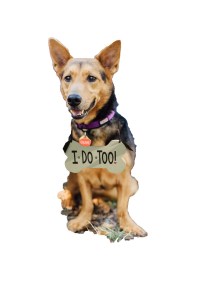
I did too dictate my story

Such feedback made me think about other ways in which my dogs communicate, ways which hopefully everyone can accept. Now surely others have witnessed their dogs barking to go outside, to take a walk, to be petted, and in the case of my dogs, to go for a ride in the pickup. Yes, my dogs, especially Little Jack and Buddy, are quite insistent about nudging me out of my chair about 5:00 pm to go for a ride or to take a walk.

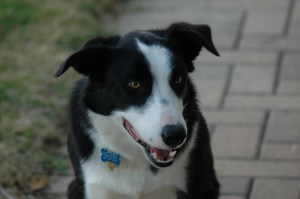
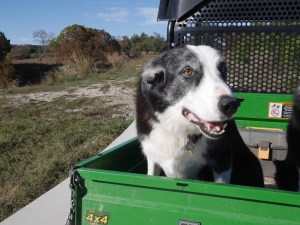
Bella, our female Border collie has her own idiosyncrasies. She communicates. She really does. She does this  by barking when Trudy or I don’t hear the telephone. Perhaps like many seniors our hearing is not the best. Trudy has graduated to the honest stage of wearing hearing aides while I simply deny my hearing loss and soldier on. Bella on the other hand has tremendous hearing. We say she has “dog ears.”

Bella, our little helper
Photo by Ramsey

If we fail to hear the land line or a cell phone ring, Bella will begin to bark. I’ve noticed she doesn’t bark for the first couple of rings. Presumably she waits to see if we hear it or not. Only when we don’t respond by the third or fourth ring does she become insistent that we answer the phone. Her initial barks cease and she begins to howl. I’ve never heard her howl except when we fail to answer a telephone, but believe me she is quite effective in mobilizing her humans to answer the phone. Bella can sound just like a hound dog. She’s become a regular little phone helper.

Now this behavior fits well with Bella’s helping personality. She likes to have a job and likes to prove useful. For some time she has helped out Buddy when he wants to go outside to do his business. You see, Buddy will stand quietly beside a door to go out. We don’t always observe him. Only rarely will his urgency cause him to scratch at the door to draw our attention. Bella, on the other hand, seeing Buddy waiting patiently beside the door will begin to bark. Her bark is persistent and loud. It’s hard to miss.

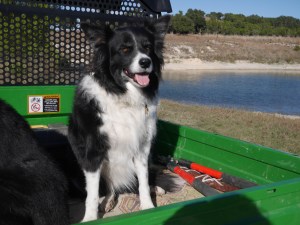
Bella and Little Jack guarding the ranch from the pickup

She also likes to accompany Buddy when we put him out, just in case I suppose. Buddy has actually become fairly dependent on Bella’s going out with him, as otherwise he is hard to push out the door. So you see beside answering our phones, Bella also serves as door monitor.

They say you have to give a Border collie a job, or else it will become self-employed and never productively. Well, I’m here to say some Border collies (read Bella) find their own jobs and are helpful. Who would have thought we would have a dog that answers the phone or monitors doors?

Do your dogs communicate with either you or any other dogs? I would love to have your feedback. Please leave your experiences in the comment section.

Buddy’s Retirement- April 20, 2018

Buddy as a younger dog

It was inevitable, I suppose. Retirement is part of life isn’t it, that is if we live long enough. Buddy about whom you’ve heard much lately (Buddy- The Slacker) retired from his life’s work today. His retirement from herding came suddenly or at least it surprised me.

On request Buddy declined to jump out of the bed of the pickup to help herd the mama cow about which I recently wrote (A Sad Day On The Ranch). This job in the past would have been an easy one for Buddy, merely moving one cow through a couple of gates and into an adjoining pasture where the remainder of the herd grazed.

When I called to Buddy, he merely stared back at me. Has he suddenly gone deaf? What’s wrong with that dog!

After a few moments of reflection on the statue-like, immobile Buddy, I thought perhaps his bad back might be hurting him or else he had judged after twelve and a half years he’d accomplished his limit of herding cattle. Nevertheless, pushing one cow through a couple of gates and into another pasture has previously hardly been work for our Buddy who has lived to herd. But I know twelve and a half years makes for an old dog, especially for a Border collie.

He’s been the best herder I’ve ever had on the ranch. His exploits are legion, as I tried to indicate in the Slacker piece, his first herding experience. Nevertheless, lately he has been less invested and less enthusiastic about this effort. I maintain that in his place today he urged the younger Bella to help me. Surprisingly Bella did a fairly good job but not up to the standards set earlier by Buddy.

Buddy on left and Bella on right. Photo by Ramsey

Buddy has lately spent more time napping on one of his four beds (yes, can you believe it- four beds) that are scattered strategically around our house. He never has to take more than a few steps to find a doggie bed. If a bed is not immediately available, a low chair will do just fine.

While he still enjoys riding around in the pickup, he now seems anxious to return to the house and resume his doggie slumbers.

Perhaps his life’s arc from superb and indefatigable herding dog to his current “just don’t bother me” attitude is an expected part of normal aging thatis sure to affect us all. I’ll admit since retiring, I enjoy naps more.

Years ago when I asked my grandmother Hutton when she was quite elderly what it was like to get old, she replied, “Tom, you just slow up.” This observation must be as true for Border collies as it is for humans.

I hope Buddy reneges on his retirement for at least a brief period of time. What gives me hope is that Francisco, our ranch hand of seventy-five years old has retired at least five times. Each time after his announced retirement he came back to the ranch after having become thoroughly bored with watching TV and missing “his” ranch.

The animals, the beauty of nature, and the opportunity to make the ranch better proves for Francisco an incredibly strong draw. Might Buddy one day feel a spurt of new resolve along with a strong desire to herd- just one more cow? Time will tell.

By the way, what does one give a Border collie as a retirement gift? He has no use for a watch. Your thoughts?

Buddy, the retiree, taking one of his frequent naps

Canine Cooperation

In an earlier blog piece, I wrote of wolves having been reported as smarter than dogs in a teamwork task. While wolves were superior at performing the pull test, I wondered if this degree of cooperation was true for other dog-dog cooperation tasks as well.

The standard pull task required animal teams of two wolves and two dogs (as well as pairs of other animals) to cooperate in order to earn a tasty reward. The experiment was reported in the New York Times. Viewing this video report made me wonder if my dogs ever meaningfully cooperated with each other or did they merely excel in cooperating with their humans.

Many examples of Border collie cooperation during herding tasks exist, some of which have been detailed here previously but these might well be viewed as examples of human/dog cooperation.

Buddy on left and Bella on right. Photo by Ramsey

Since writing an earlier piece about my dogs and how they cooperate with each other, I’ve found another good example. Bella, our female Border collie, has for some time worked as our nighttime door monitor.

What I mean by this is that Buddy will often go to the door at night but fail to bark to signal his desire to go out. Standing quietly at the backdoor, he often goes unnoticed by his sleeping humans. This is especially true as he goes to the room adjacent to our bedroom when Trudy and I are deeply asleep.

“My humans are so slow in sensing Buddy’s plight.”
Photo by Ramsey

On sensing Buddy’s need Bella’s response is to head for our bed and place her very cold, wet nose on the selected, sleeping face of one of her humans. Believe me, this proves quite alerting and motivating, waking one of us up from even stage IV sleep. Trudy or I will then find Buddy standing at the backdoor and let both Buddy and Bella out for Buddy to do his business. Bella will later bark when both are ready to come back inside.

In my opinion Bella’s door monitoring routine exemplifies dog-dog cooperation. She looks out for the best interests of an uncomfortable, bladder-distended Buddy, but also Bella benefits her human companions by helping avoid a large yellow puddle inside the house.

“And I really appreciate Bella’s help too.”
Photo by Ramsey

Have you too seen examples where dogs cooperate with each other? I would love to hear your stories. Let’s hear it for canine cooperation and doggy solidarity!

Cooperation says it all

Wolves Beat Dogs in Teamwork Test

A video in the NY Times from Wednesday, November 8, 2017 got me thinking. The video produced by James Gorman made the provocative statement that wolves may be smarter than dogs. Could this be true?  More precisely the video claims wolves are smarter than dogs at learning the rope pull test. This task is where two animals of the same species have to work cooperatively to achieve success.

The rope pull test is commonly used test to determine cooperativeness among two animals and to compare among various species. The test consists of a tray around six feet long or so that has two tasty treats in plain sight but unavailable behind a screen. The two animals must simultaneously pull on a rope, at the ends of the slide, thus pulling out the sliding tray amd making the two treats available for consumption. As it turns out wolves learn this task quickly and work cooperatively. Dogs not so much. Other species able to perform the task include elephants, parrots, monkeys, and rooks (black birds). Dogs truly struggle with this task but can eventually learn it.

The explanation provided for dogs’ slowness to learn is that they are not used to working cooperatively with other dogs. Yes, dogs work with humans exceptionally well, such as with bomb sniffing, herding sheep, riding surfboards and skateboards, protecting homes, and sniffing out corpses in forensic investigations. But these are activities dogs do with humans, not in cooperation with other dogs.

Bella on the left and Little Jack on the right


Wolves, on the other hand, don’t work with humans but work with members of their pack for survival. If you think about it, this all makes pretty good sense, . Adaptability is after all important for survival. Dogs must adapt to their human companions and make them happy while wolves must adapt to their  pack and become successful hunters.

But this video in the NY Times got me wondering. Are my dogs capable of working together? If so, what can they do cooperatively with each other? I have shared over the years in this blog many examples of my dogs working with me to herd cattle. But this is a task they do in combination with me who is directing them to some extent (at least that is my illusion as de facto leader).

It didn’t take me long to find an example of my dogs cooperating with another dog. Not long after viewing the video I saw Bella, my female Border collie, and Little Jack, our “Texas brown dog” take off on a spontaneous hunting mission. You see, Jack is determined to save the world from what he must see as the scourge of armadillos and squirrels. Just moments before he had spotted an armadillo. After quite a chase, the dogs caught the armadillo. Jack tried to kill it on his own but the armadillo was too strong and pulled out of his bite. Jack held onto the tail of the armadillo and proceeded to ski behind the powerful animal, dragging Jack toward its burrow.

Bella then swooped in went after its head, trying to kill it. Together they managed a successful hunt that neither one of them alone could have pulled off. This hunting duo has killed at least four or five armadillos recently, making them highly effective hunters so long as they work cooperatively. Incidentally they act incredibly proud of themselves, showing extreme excitement and rapid panting after returning from a prolonged absence in which it becomes obvious had been a hunt.

This strikes me quite clearly as cooperation in my dogs. But is it not the only example. I’ve taken to going for a walk for my health most afternoons around 4:00. Not too surprisingly at around this time when usually working at my computer, two dogs will show up at my desk. It can be any two of them.  In tandem they will nose, scratch, whine, and otherwise manipulate me out of my chair. I am then herded unceremoniously toward the door and made available for their afternoon walk.

I have a theory as to why two come at me at a time.  When previously just one dog took on this task, I assumed he/she just needed to go outside to pee and I would promptly put the dog outdoors. They quickly learned a single dog strategy was ineffective.

Well there are two examples of my dogs working cooperatively with one another. There are others I will share in a later blog piece. Please dear readers share your examples. I plan a follow up piece and may be able to share your experiences with other blog readers. Let me hear from you!

At The End Of The Road


You might recall the stray dog that wandered onto our ranch several years ago that we named Little Jack Kerouac. We named him after the author of the same name who wrote On The Road and who was the forerunner of a beatnik. Our Little Jack had been wandering the county roads of Gillespie County for months and had traveled many miles when the skinny pup was finally herded into a corner of our yard by our Border collies. The small brown dog was half-starved and intensely fearful. His fear, nevertheless, relented before a succulent piece of fried chicken, prompting the little brown dog to climb into my arms.

Despite his bad condition from his long tenure as a road dog, it became apparent that he had been neutered and house broken. These aspects suggested at one time Jack had enjoyed a close relationship with a human friend.
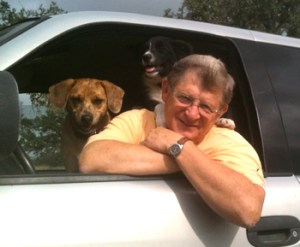
Yours truly ready to work on the ranch with assistants Jack and Bella.

We still don’t know what all he encountered as a road dog and Jack isn’t talking. We suspect he must have scrounged whatever he could find to eat including roadkill. We know Jack is a canny survivor.

His breeding has proved an ongoing mystery. When asked what breed he is, we finally gave up guessing and simply began replying, “He’s a Texas Brown Dog.”

Since Jack’s arrival, let’s just say… he’s matured and settled in well. He has adapted to his new home on a hill at the end of his very long road.

Sometime ago I wrote several blog pieces on Jack stealthily loading himself into various vehicles and stowing away for rides. We do not think he was trying to escape his adopted home but that he merely wanted to go for rides. Fortunately, after a few bad moments of being unable to locate Little Jack, we were able to place phone calls and have him returned.

Jack is no longer the skinny road dog he once was. He has, in fact, chunked up. He still loves to go on ranch walks, run errands and ride in the pickup. Whereas the Borders ride in the bed of the pickup, Little Jack proudly expects to sit on the console in the cab where, if hot, the AC is on and, if cold, the heater warms him. He likes his creature comforts.

When our Borders are let out of the pickup to exercise by running up the hill to the house, Jack preemptively jumps off the console and hides in the back seat. No silly running up the hill for Little Jack. Why get out of a perfectly good pickup and wear out my foot pads?

At night Jack has inched his way closer and closer to the head of the bed. Initially when he came into our lives he slept under the bed or on a nearby dog bed. He later transferred to the foot of the bed. Now Trudy and I find the little rascal snuggled between us, his head lying on a soft pillow. Imagine going from the hard life of a road dog to a pillow top mattress!

Jack likely thinks, “Heck with Pearl Buck’s ideas of a place in the sun, I have a soft mattress in an air conditioned home.” When asleep, he becomes an almost immovable lump. If Trudy or I get up in the middle of the night, he migrates to the vacated warm spot, claims it, and is difficult to dislodge.

It’s said every dog has its purpose. The purpose of our Border collies is clear, herding our cattle. Jack’s purpose has been harder to determine. Surprisingly, he sometimes has helped the Border collies with herding. But mainly Jack is a varmint dog and represents an absolute terror for squirrels and armadillos. This job of protecting the world from squirrels and armadillos, though, is not full time for our Little Jack.

Several years ago my mother came to live with us and it was then that we learned what Jack’s real job was–companionship. My elderly mother would sit on the couch for hours with Jack snuggled up against her, stroking his furry head. He returned her affection with gentle licks and made his belly available for endless scratching. Mom and Jack became thick as thieves, although we worried my Mom might rub Jack’s head bald.

“I think I can still feel the pea!”

My mother possessed a huge capacity to love, and in her final years she so enjoyed Jack’s companionship. Jack became a willing recipient for her love, and in turn he reciprocated his love for her. I’m convinced Jack made her final days much happier.

I suppose companionship is the major role for many dogs. Dogs have such an amazing ability to relate to humans, to sense their emotions, and to offer their unconditional love. It takes all kinds of dogs, but Jack has stolen our hearts and in their places left behind his paw prints.

May The Force Be With You

The well known statement from “Star Wars” that serves as the title for this piece has of late developed special meaning for me. Perhaps I am still under the emotional overhang of my father’s recent passing, but the ease by which he passed has meaning for me. Dad died at the age of 96-years peacefully and in his sleep. His force to live diminished in his final months to a point where he was no longer walking, then no longer chewing, and then even refusing to swallow liquid supplements. His life force slowly ebbed away.

Dad (John Howard Hutton) when his life force was strong

In juxtaposition with Dad’s dying process has been my observation of an unfortunate, recently born calf on our ranch. Now I am in no way equating the value of the two lives, only making a comparison of their life forces.

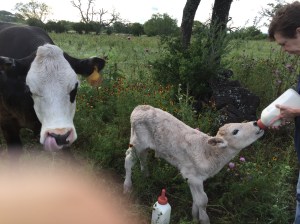
Newest bottle calf being fed by Trudy with his good-for-nothing, calf-stomping mother looking on

The calf was refused milk by his mother for reasons unknown. Not only that but she kicked the calf nearly to unconsciousness when he tried to nurse. Later the mother calf became spooked and backed up, stomping her calf. Frankly I thought she had killed it.

Nevertheless, the following morning the previous “calf carcass” took a full bottle of milk. What a surprise! He’s not developed normally but is still making slow progress. He has a left front leg injury, one of the several spots where his mother stepped on him. Our newest bottle calf refused to die and continues to gain weight and hobbles about to a limited degree. I sometimes have to provide extra lift for the calf for him to get onto his four wobbly legs. As he grows, this may become a serious problem.

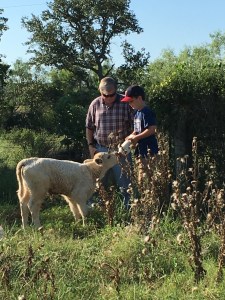
Given his miraculous survival, we refer to him as Phoenix. He rose off the pasture where he was near death and now greets Trudy and me with his long eyelashes for which Madonna would be envious, lovely dark eyes, and enthusiastic sucking at the milk bottle that sustains his life.

Mythological Phoenix

He still is not guaranteed survival. It seems his legs are too weak at times to get him up or possibly too painful. His walking is unsteady and wobbly and Phoenix tends to fall on uneven ground.

Nevertheless, Phoenix possesses a strong life force. I suppose this has to do with his young age and strong survival instincts. Regarding my Father, I cannot help but believe that after 96-years and having lived a full life that his life force had diminished down to nothing.

Grandson Graham earlier today feeding a somewhat older Phoenix

I recall the answer my grandmother gave when I asked her as a child what it was like to get old. She said, “Tommy, you just get tired.” I think she was right. Increasing fatigue accompanies age and illness. In my experience as a physician, folks just kind of give up at some point and are ready to die. Age seems to have a lot to do with it.

In my recently published book, Carrying The Black Bag: A Neurologist’s Bedside Tales I tell the story of a little girl with Reye’s Syndrome who by all accounts should have died. Despite an absolutely horrible prognosis she lived and thrived. I believe her young age had much to do with her survival. The force was with her.

To my readers, “May the force be with you,” by which I imply continued strong life forces and may you enjoy vital life in the years ahead.

The Birds, The Birds… They’re Back

I recently viewed a dozen or so cattle egrets within and perched upon our cow herd. These white, long necked, and long legged birds have been absent from our ranch for about a year. Our cattle tolerate them well. I couldn’t get close enough to take a picture of them but have some images taken from the internet.

The relationship between the egrets and cattle is a symbiotic one, as the egrets eat flies and ticks off the cattle. Both egret and cow have mutual benefit from their relationship.

What I discovered yesterday was that the egrets also provide entertainment for our friskier Spring calves. The calves playfully run at them, scattering the birds for a short fly around. The egrets soon after land in the herd and the chase is on again. The calves appeared to be enjoying themselves, but I can’t speak for the egrets.

Several times recently I’ve spotted a Great Blue Heron hanging out in the pool below the waterfall at Hidden Falls Ranch (our ranch across the county road). I can’t say for sure that it’s the same one about which I wrote the blog series last winter, but it looks the same. It’s dramatic to view it taking off from the pool, gaining altitude, and flying by me at eye level and not more than 20 feet away. According to Native American legend Great Blue Herons bring good luck. Bring it on!

Bulletin: Just viewed a Great Blue Heron in our stock tank below the house. It’s back! What wonderful news. Life is good in the Texas Hill Country.

I’m back

Welcome Home Gentle Giant

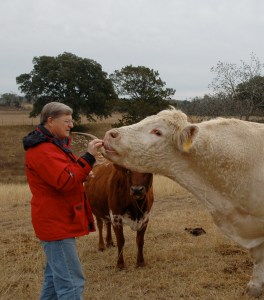
Our bull’s injury is the biggest news this week from Medicine Spirit Ranch. Curly, our Charolais bull, recently developed an unwillingness to place weight on his right back leg. His ankle swelled and he hobbled around on just three legs. After loading him into the trailer and hauling him across town to our vet’s clinic, we learned why this was. Curly had developed an abscess from a cut on his hoof. Ouch! That must have really hurt, big guy.

Curly, our Charolais bull

Hauling Curly is always a memorable experience. Our small cattle trailer can hold up to ten calves but hauling them is less difficult than when hauling Curly by himself.  He is so large he weighs down the trailer such that the back end of the pickup and the trailer hitch reach almost to the ground. When Curly shifts his weight in the trailer, the whole pickup lurches. It makes for quite a ride. Our vet, who sees plenty of bulls in his work, even commented on what a large but gentle bull he is.

Curly spent a week at the vet’s receiving antibiotics. During this time he was limited to a stall, a large one but limiting for sure. I don’t recall him ever being confined before, and he didn’t like it. I know he was hurting, but somehow I think his apparent discontent resulted less from his injury and more from his unusual location and lack of his herd.

I may be over interpreting, but Curly did not look happy at the vet’s. This proud king-of-his-herd guy was dirty, seemed to have lost interest in what was going around him, and appeared to mope. These are not typical behaviors for our Charolais bull. Can bulls become depressed? He sure looked it.

After recently receiving the call from the clinic saying he was ready to come home. I attached the trailer to my pickup. I headed into town to load and haul Curly back to his ranch, his green pastures, and his waiting herd. The herd had even expanded in his absence by three new calves.

While Curly still moves around slowly, he now does so on all four hooves. We no longer have a three legged bull which I consider a very good thing. I don’t think Curly would be able to do his job on one hind leg.  Curly also appears happier now that he is back at his own ranch.

Our gentle giant- “Open wide for a range cube”


GUESS IT JUST GOES TO SHOW, OUR GENTLE GIANT IS A HOMEBODY.

Buddy, “Nice to see you again Curly.”

The Lovely Couple Plus One

Katie, Kevin, and Olive in their Engagement Photo

Our daughter’s upcoming wedding is the really BIG news in our family. Katie and Kevin O’Neal will wed next month. We couldn’t be happier for the lovely couple.

It should be no surprise that with Katie growing up in our animal-loving family, she became an avid animal lover herself.

About five years ago while volunteering at the Dallas dog shelter, Katie fell in love with a mongrel dog and adopted her. They have been extremely close ever since. Olive has supported Katie through the emotional turmoil of a major job change, watched her dispatch several boyfriends, and survived several scary thunderstorms that deposited huge limbs in their front yard and mere feet from their house and car.

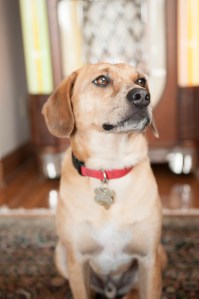
Olive is long, low slung, with the head and bark of a German Shepherd. While she looks like a dog put together by a committee, she has an incredibly sweet disposition.

Kevin has told me that he knew if he were to win over Katie, he would first need to win over Olive. While Kevin has a terrific sense of humor, there is some truth to his statement. Kevin takes care of Olive when Katie is out of town. He takes Olive on walks and has over time completely won her over.

Of course Olive goes on walks with Katie and Kevin

When Kevin proposed to Katie, she accepted his proposal of marriage. Posted below is Olive’s response as well to Kevin’s proposal. You see Olive asked me to post her answer. for all to see May the three of them have a wonderful marriage with best wishes and congratulations to the lovely couple plus one.

Dog Lessons On Living- Part 2

In my previous post I dealt with how two dogs modeled how to deal with serious illness and impending death. The two examples were from our current Border collie, Buddy, and our long deceased Shetland sheep dog (Sheltie), Taffy. Their love of life and passion for their favorite activities persisted despite their physical challenges.

If we abandon the arrogant notion that humans are somehow completely different from other animals and instead recognize our common genetics, anatomy, physiology, needs, and behaviors, then animal behavior can become a potential assist for our lives.

I am reminded of a story from my recent book, Carrying The Black Bag: A Neurologist’s Bedside Tales about Mary from Minnesota. This story, like many others in the concluding chapter of my book, took place aboard a fictitious cruise ship and demonstrated great perseverance of some physically handicapped folks in the face of adversity. The very real members of a group that Trudy and I accompanied had been organized by a national Parkinson’s Disease organization. Despite Mary’s advanced disease requiring  her to have a feeding tube, tracheostomy, urinary catheter, wheelchair, and and full-time attendant, she had demanded to go on the cruise.

Unfortunately Mary didn’t make it and passed away during the cruise. When speaking that evening by phone to her daughter in far away Minnesota, I learned to my surprise that the family had  expected Mary to die on the cruise. After recovering from my shock, I further learned that Mary had a lifelong habit of taking on great challenges. Despite her failing health Mary in recent years had undertaken skydiving, ridden a burro down into the Grand Canyon, and been strapped to a dogsled in Alaska. Mary refused to give in to her illness nor would she be prevented from trying new, exciting, and life changing thrills.

From Sailaway Chapter of Carrying The Black Bag

While Mary was only one of our passengers with Parkinson’s disease, all of them despite their balance issues dealt with the swaying of the deck and with the many challenges of shore excursions and beach activities. They also managed the dietary differences that at times limited the effectiveness of their medicines. None of these brave people shied away from the challenging experience, showing their zest for life and denying their illnesses control over their lives.

Now I know not all people with PD would make such a challenging journey. Indeed life is like a marathon and all of us hit the wall at times. Some persist and break through the wall while others are unable to do so.

Health and vibrant aging can be such a gift but persistence is also demanded

Both Buddy our Border collie, Taffy our Sheltie, and Mary refused to give in. All lived their lives to the greatest extent possible. I don’t know where Mary derived her zest for life, but she might have witnessed it in her pet. For whatever reason, Mary had learned to live her life as fully as she possibly could, believing that the quality of her life was more important than the number of days she lived.

Therein may lie a lesson for us all. Our challenge may be to garner as rich and full a life as possible. We all will likely be faced with challenges. Some of us will continue to strive and others will find an easier but less fulfilling way to live. Nothing is wrong with either approach, but our pets may have at least modeled the more courageous approach to life. Without it would we have even considered such a course of action?