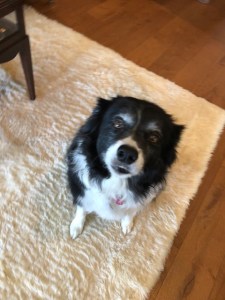
Thank you for continuing to follow the Bandit story. He proved to be my dog of a lifetime and as subsequent stories will show- changed our lives in meaningful ways.
Evening Trips to the Park
Neighborhood children frequently shadowed us during our trips to the local park. Neighbors often appeared at windows, observing Bandit’s effortless saunter along the sidewalk, pursued by his increasingly haggard looking owner. Several, gave sympathetic words of encouragement to me as might have been offered to the final straggling runners in the Boston marathon.
Ignoring the local leash ordinance, assuming no doubt incorrectly, that voice control would suffice, we allowed Bandit to stride ahead, carrying a ball or Frisbee in his mouth. He truly was under control, knowing to sit and wait at each corner, and never crossing a street without permission. Nevertheless, I always felt relieved when I returned from the park without a citation from Lubbock Animal Control.
Once at the park with its smells of newly mowed grass and yellow glare of the lights, Bandit would become thoroughly engaged with our games. He would ignore the thwacking sounds of competing nearby tennis matches, giggling children on swing sets, and even other curious dogs that came around him. The focused intensity of a Border collie is truly splendid to behold. Bandit would take his crouch and stare at me, waiting for me to sling the ball.
With visions of Sandy Koufax or Mickey Mantle running through my head, I would rear back and throw tennis balls as far as possible. I remember thinking a bit smugly that during high school I had possessed a good throwing arm.
Bandit would tear out after the ball, scoop it up while still rolling, and rapidly return it to me. Bandit seemed untiring. His alert, dark eyes would glisten, and he panted with excitement. After several weeks of pitching tennis balls, I was no longer feeling quite so smug about my ability to throw the ball, as I developed a painful arm strain.
Over several more days my arm worsened. It became so painful that I found it difficult to elevate it above my head. After still more park excursions, it got to the point that I could not easily dress myself. On more than one occasion, I had to ask Trudy to hold my shirt, so that I could slip my tender right arm into the sleeve.
She then suggested in her inimitable way, “Why not give up the Nolen Ryan bit and try tennis?”
Tennis Anyone
Following Trudy’s practical suggestion, I began hitting balls with a tennis racket and soon marveled at the added distance this provided. Hitting the tennis ball with a racket also drew upon a different set of muscles than throwing, so that I could swing the racket almost without pain. Bandit appeared not to care how I launched the ball, as he continued to pursue it with equal enthusiasm.
I enjoyed watching the yellow tennis ball explode off the racket and arc far across the park. I marveled at the grace and speed of Bandit’s longer out runs. I also observed how Bandit then would drop the ball about three quarters of the way back to me and retreat some distance. The time it took for me to trot out and collect the ball provided Bandit time to prepare and adopt his vigilant stance. By this process, Bandit also imposed my own exercise routine.
Chasing the tennis ball caused Bandit to expend additional energy, leading me foolishly to believe we were at last making progress. But after weeks of hitting the ball, rather than Bandit showing any signs of exhaustion, I instead developed tennis elbow, no less painful than my previous shoulder strain. In short order, I was forced to retire from both doggie baseball and doggie tennis. Heck, I still have doggie kickball and doggie golf.
Unexpected Results
“Hey big guy, you’re not the jock I married thirty-five years ago,” Trudy teased. I responded without comment but likely with a pained smile. Indeed, this collie had taken a heavy toll on my middle-aged, soft-bellied self and had allowed an opening for Trudy to proceed with friendly ribbing.
Despite the physical toll on me, the new regime of activities and exercise brought about improvement in Bandit’s behavior. Trudy and I, to our surprise, also noticed our own bodily changes.
“Hey Trudy, is the scale broken?” I asked one morning after a month or two of the exercise programs.
“Don’t think so, but I was surprised too when I weighed.”
Not only had we lost weight, but we were feeling more fit. I found the morning jaunts to the park to be less exhausting than earlier and at times found myself even jogging alongside Bandit to and from the park.
Even more astonishing, our spirits had elevated. We began to laugh more. Life became more interesting. Trudy and I began to plan a date night weekly, something we had not enjoyed for many years. In short, we found ourselves with increased energy– energy that allowed us to better address sources of diminishing satisfaction within our lives.
Frisbee
Bandit and I began to spend more time together as well. It was during this period that I introduced Bandit to Frisbee. He absolutely loved it. Bandit took to Frisbee like a pregnant woman to cheesecake. Soon he was snatching Frisbees out of mid-air like a lizard catching flies. He learned to make over-the-shoulder acrobatic catches amid his dramatic leaps. His performances began to pay dividends and in highly unexpected ways.
After several weeks, Bandit’s fame at retrieving Frisbees had spread throughout the neighborhood. Adults as well as children now began leaving their homes to walk with us to the park. Cars would often slow down when passing the park, even parking at the curb to watch our graceful, athletic black and white dog snatch Frisbees out of the air.
One spring day I heard a shout from the street and looked up from our game of Frisbee. To my shock, I spotted half a dozen cars parked at the curb with still more pedestrians watching us. Many were total strangers, intently observing Bandit and acknowledging his athletic ability.
I would rear back and whip the Frisbee in a high gliding arc. Bandit would sprint away toward the arcing Frisbee, leaping high into the air like a ballerina to snag the disc. Shouts would erupt from the throng following particularly agile catches.
“Hooray, just look at that dog.”
“Never seen anything like it.”
“What a dog!”
Friendly waves and smiles came from the spectators. I sensed these strangers, beaming and whooping support for our black and white ham, somehow benefited from the experience. Bandit put on amazing performances of running and jumping, and making acrobatic catches, but I questioned why his Frisbee catching attracted so much attention.
Occasionally people wandered onto the grassy field to inspect Bandit more closely. When this happened, Bandit would break off his crouch and would wiggle up to them, swishing his tail in a wide and friendly arc. The momentum of his tail wags was such that they wagged his whole rear end. He would lick any extended hand.
After more evening Frisbee sessions, I began to seriously ponder the reasons for Bandit’s enlarging audiences. It seemed to me that Bandit provided these city-churned commuters brief moments of joy between hectic work schedules and responsibilities awaiting them at home. During these brief intervals his fans vicariously enjoyed Bandit’s unmitigated joy.
To Be Continued
If you have not had the chance to read my latest book, Hitler’s Maladies and Their Impact on World War II: A Behavioral Neurologist’s View (Texas Tech University Press), I invite you to do so. The book explores an important aspect of the Hitler story and World War II that has not been well studied. Many of Hitler’s catastrophic errors including the premature invasion of the Soviet Union in June 1941, the slowness of German forces to counterattack at the Battle of Normandy in 1944, and the highly risky Battle of the Bulge in late 1944 into 1945, can be better understood, knowing the sizeable impact that Hitler’s physical and mental conditions had on these vital battles.
Also, consider picking up a copy of my earlier book, Carrying The Black Bag: A Neurologist’s Bedside Tales (Texas Tech University Press). Please join me on my personal journey as a physician and meet my patients whose reservoirs of courage, perseverance, and struggles to achieve balance for their disrupted lives provide the foundation for this book. But step closely, as often they speak with low and muffled voices, but voices that nonetheless ring loudly with humanity, love, and most of all, courage.

With Andy and Katie’s departures for college, it dawned on Trudy and me that we were in deep trouble. We immediately missed our college age children who had spent time walking the dog, taking Bandit on car rides, and teaching him tricks.
After the kids’ departures, changes in our busy schedules became necessary. Weather permitting on work days Trudy and I would leave Bandit in the fenced backyard. Evidence suggested that Bandit would scamper among the bushes leaving behind broken branches, chase about the patio knocking over furniture, swim in the fountain, topple the water plants, and amuse himself by digging impressive craters in the vegetable garden. The garden excavations grew deep enough for me to fantasize about Bandit striking oil and making us rich.
Our outdoor strategy, imperfect though it was, maintained the house in good shape, so long as we gave up any hope of flowers in the garden, vegetables in the garden plot, or legs on the patio furniture.
When autumn colors faded into the sparkle and ice of winter, compassion compelled us to move Bandit indoors to avoid the Texas Panhandle’s “Blue Northers”. This shift in tactic not only provided warmth for Bandit, but also offered him novel opportunities to explore. And “explore” he did.
A few chewed magazines and curtain tassels did not panic us– not two professionals who had successfully mastered screaming divorcees in the courtroom and grand mal seizures in the waiting room.
“Oh, just puppy behavior,” Trudy had said unconvincingly, as if whistling her way to a root canal.
“Of course,” I had opined, “All dogs chew. Probably good for his baby teeth.”
The indoor move required that we travel home during the day to let him outside to pee. It also allowed a brief respite for playing with the dog. This interlude required Trudy or me to break away from the office, an office often bordering on chaos, replete with hormonal nurses, disgruntled patients, and self-important doctors.
The trips home provided a break for which Trudy and I soon competed. When possible, both of us would head home for lunch and Bandit play. This mid-day interlude, away from the escalating emotions in the office, allowed us most welcome quiet time for conversation and gave us an opportunity to amuse ourselves for a few minutes playing with an appreciative Bandit dog.
Worse Still
Despite our considerable efforts, Bandit escalated his destructive antics- big time. If we thought we had seen a damaging dog before, we had been fooled, having witnessed merely the preliminary warm-up for a doggie demolition derby. Before we knew it, Bandit had started a whole new gig– home annihilation.
In short order the remainder of our chair legs developed signs of piranha-like gnawing. We found the cording that had mysteriously been separated from the furniture. To this day, I don’t have the foggiest notion what happened to some of it. We found several electrical cords chewed, rugs macerated, and household objects broken, covered up, or rearranged.
“Bandit, you do this?” I asked, while pointing to a chair leg that looked, as if set upon by crazed beavers. I feared the chair would give away if someone were to sit on it.
Bandit cocked his head innocently to the left and flashed an endearing look, a look of such sincerity that I began to question my suspicions. One day on arriving home through the back door, I spotted Bandit in the den. Rather than his usual hell-bent-for leather charge toward me, he slunk away into our daughter Katie’s bedroom and hid under her bed. As I entered the den, the reason became all too apparent.
Before me lay a blizzard of pillow stuffing. It covered the floor, hung from the lamps, and decorated the hearth. The remainder of the pillowcase lay on the floor as flat as a flounder. When I tracked down the canine conniver, I noticed a piece of stuffing still hanging from his impish mouth.
A few days later our anxieties zoomed into the stratosphere when we discovered Bandit had stripped off the wall covering in the day room and had managed to chew on several door jams and doors.
To understand the pain associated with Bandit’s latest act, its important to understand the significance that the wall covering held for Trudy and me. To diminish the poor acoustics in the day room, we had applied fabric to the walls over a thick cotton batting. The upholstered walls had been expensive to construct but a welcome redo to our family room that had echoed like the depths of Carlsbad Caverns. Now before us our acoustical dampening lay in tatters. Our home sweet home had begun to look as if under attack by an army of demented squirrels, voracious termites, and a truculent rhinoceros or two.
“And he looks like such an angelic animal,” Trudy said dejectedly.
“Don’t let his elfin looks fool you. This dog won’t be happy till we’re living in a heap of sawdust!”
We Fight Back
One effort we employed to occupy Bandit consisted of stuffing cheese or dog biscuits into toys that Trudy found at a local discount store. These clever playthings, no doubt invented by a similarly desperate fellow dog owner, had been advertised as requiring lengthy and determined manipulation before discharging their treats.
Trudy and I would spend thirty minutes each morning stuffing pieces of cheese or dog biscuits into these over hyped furniture and house savers. Trudy and I bubbled with newfound confidence, assuming we had at last found a method for diverting our one dog wrecking crew.
Unfortunately, our optimism faded quickly. The toys occupied our strong-minded dog for a fraction of the time advertised before discharging their delicacies. Bandit was left with far too much unoccupied time with which to work. While this toy proved useful, it was not what we desperately needed.
Trudy and I would arise early and hide scores of these treat-baited toys throughout our house. After our departure for work evidence suggested that Bandit would scour the house for the toys, apparently play with them, and consume the treats. I have always suspected that Bandit found, obtained, and ate the treats in less time than it took for us to load and hide them. While this tactic met with only limited success, it had the benefit of distracting Trudy and me in the mornings from instead pondering insolvable work concerns.
Increased Exercise
We then determined to increase Bandit’s exercise by walking him to an old buffalo wallow about a mile away that had been converted into a lighted City Park. I can only imagine what early rising neighbors thought when catching a glimpse of two bedraggled people slow-trailing an energetic dog down the darkened and leafy streets of Lubbock.
Once within the shadowy park, I would throw progressively slobbery tennis balls for Bandit. Trudy and I would then dodge about into hiding places, trying to avoid running into trees and light posts, encouraging Bandit to find us before racing back to hide yet again. We hoped to wear out what seemed to be an indefatigable canine. This tag-team process may have been successful in depleting Bandit’s energy level slightly, but it proved substantially more exhausting for Trudy and me.
In the evening, rain or shine, and after a busy day of rounds and consults, I would stumble-march Bandit to our local neighborhood Kastman park where I would again throw tennis balls until my arm gave out. This became a routine that Bandit would not allow me to forget. While I would have gladly given half my medical practice at times to remain in my comfortable recliner, Bandit’s whimpering and nudging could simply not be ignored.
When Bandit heard the rumbling of the garage door opening at the end of the day, he always began racing around the house in search of a ball. Upon my entering the house, he would run to me and crouch with a tennis ball in his mouth. He would rest on his forelegs with rump raised, his eyes staring at me as if to say, “I’ve been waiting for you all day and finally it’s time.”
Having experienced Bandit’s piercing gaze on many occasions, I understand why sheep find the stare of a Border collie so motivating. I can with little effort summon very real sympathy for sheep.
Bandit Makes Friends
Bandit’s park evening outings became something of a neighborhood happening. People in their yards would turn to watch man and dog head off for their daily excursion. Once on a hot summer evening bedecked by a gorgeous orange and red sunset, I recall seeing a red-faced Mr. Jones, the undisputed neighborhood grump, descending his stepladder. He turned to face us, as we walked on the sidewalk by his yard. Fearing the worst, I kept my head down. Bandit, on the other hand, loped over wagging his tail and proceeded to apply an unhurried lick to the old grump’s hand.
Rather than a torrent of verbal abuse as was expected, Mr. Jones instead gestured in a friendly manner at me, as if he was beckoning to an old friend. He then astonished me even more by asking multiple questions about Bandit. I shared information about his breed, what he ate, and why we visited the park so regularly. Who would have guessed Mr. Jones would prove to be a dog lover.
After extracting Bandit from this unexpected but welcomed encounter, man and dog headed down the block toward the park. When well out of earshot, I exclaimed to Bandit, “Well how’d you manage that?” He strutted ahead, ears perked up and wagging his tail broadly, cocking his head around to give what seemed to me to be an enigmatic look.
To Be Continued
If you have not had the chance to read my latest book, Hitler’s Maladies and Their Impact on World War II: A Behavioral Neurologist’s View (Texas Tech University Press), I invite you to do so. The book explores an important aspect of the Hitler story and World War II that has not been well studied. Many of Hitler’s catastrophic errors including the premature invasion of the Soviet Union in June 1941, the slowness of German forces to counterattack at the Battle of Normandy in 1944, and the highly risky Battle of the Bulge in late 1944 into 1945, can be better understood, knowing the sizeable impact that Hitler’s physical and mental conditions had on these vital battles.
Also, consider picking up a copy of my earlier book, Carrying The Black Bag: A Neurologist’s Bedside Tales (Texas Tech University Press). Please join me on my personal journey as a physician and meet my patients whose reservoirs of courage, perseverance, and struggles to achieve balance for their disrupted lives provide the foundation for this book. But step closely, as often they speak with low and muffled voices, but voices that nonetheless ring loudly with humanity, love, and most of all, courage.

I have written several blog pieces lately about our new puppy, Beau. Writing about Beau and his antics reminds me of our experiences with our first Border collie, Bandit. Bandit played such a meaningful role in our lives and had much to do with relocating Trudy and me from a frantic urban existence to the peacefulness and solitude of Medicine Spirit Ranch.
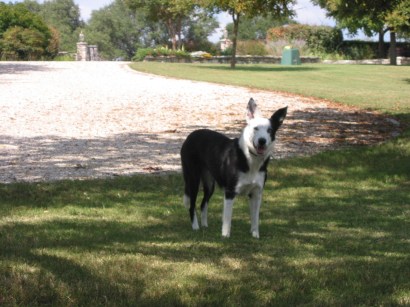
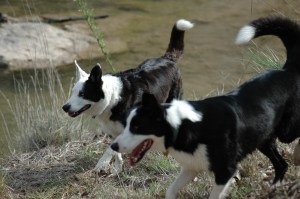
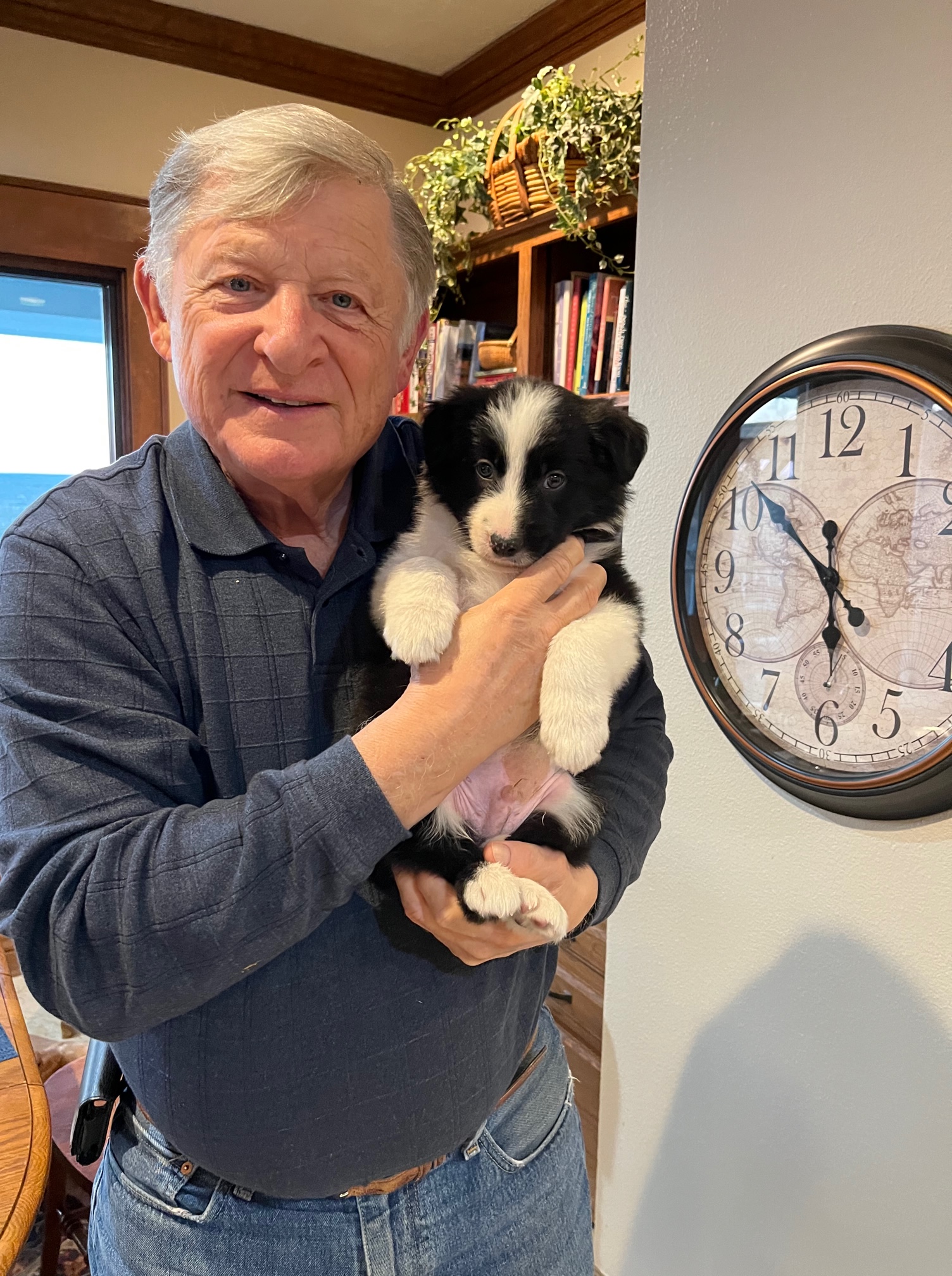
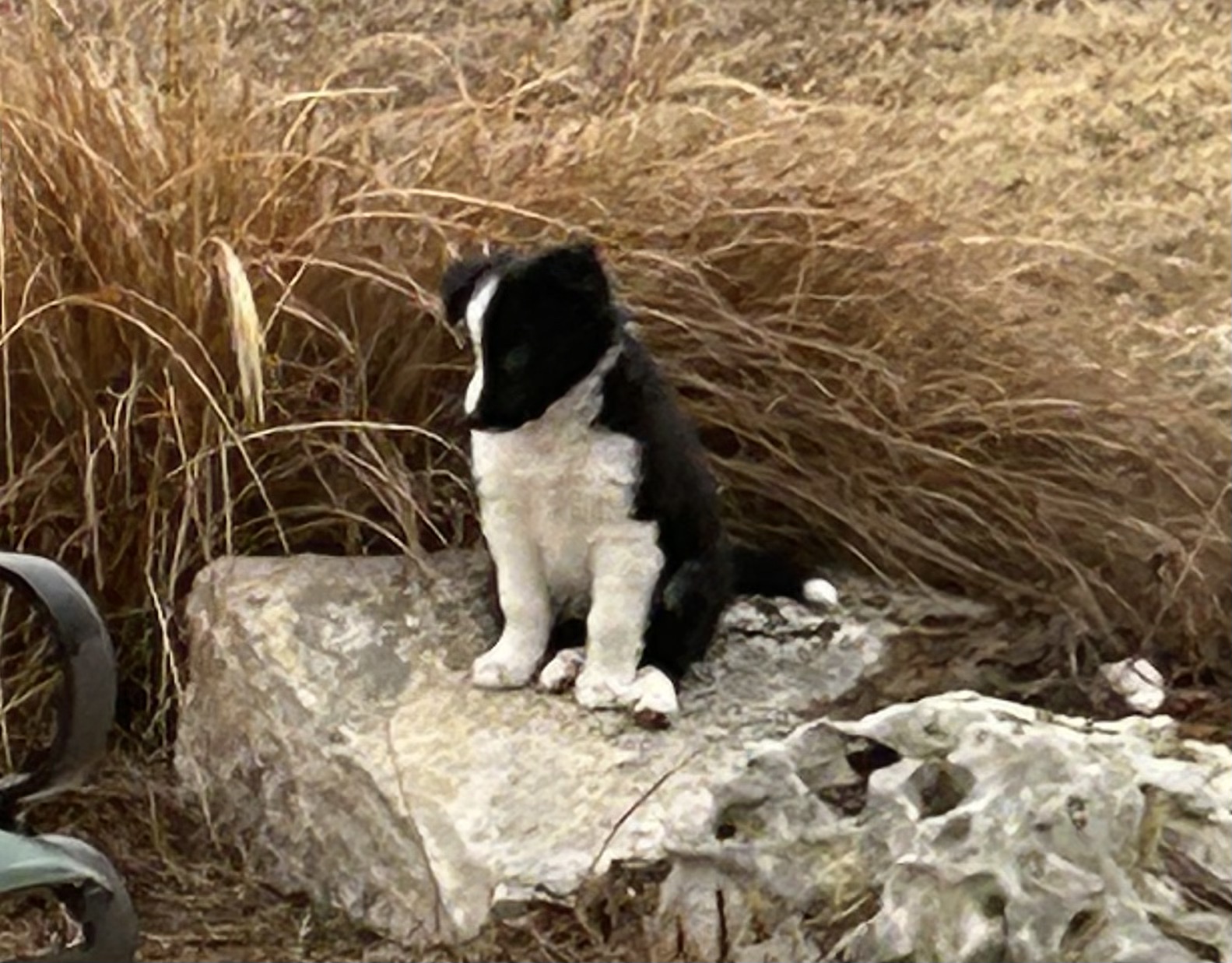
If lucky, once in a lifetime your perfect dog comes along. Bandit was that dog for me. Bandit below as a puppy.
Beau reminds me of Bandit in so many ways including his looks, enthusiasm, and intelligence. Our initial unexpected encounter with Bandit came about via Trudy. The story goes something like this.
In The Beginning
While shopping at the Lubbock South Plains Mall In 1997, my wife Trudy unwittingly sewed the seeds of my early retirement. For one whose life had been meticulously planned and extensively fretted over, this single instance of pure happenstance played a huge role in my future.
“Ooohh, look at that darling puppy!”
So began Bandit’s story with us in mid-April, 1997 when Trudy lovingly uttered these simple, affectionate words, having locked gazes with a floppy eared, seven-week old black and white puppy. It had cocked his head quizzically and viewed Trudy through the front window of the pet store. With its white tipped tail and white paws, the pup unabashedly stared at her, seemingly beseeching her to take him home. I visualize Trudy standing outside the Lubbock Pet Store window, hands resolutely on hips, head cocked to one side to mirror the puppy’s head cocking and with her usual steely resolve melting faster than an ice cream cone in July.
Andy, our eldest child, had expressed a heartfelt wish for doggie companionship to divert him from his life of torts and criminal proceedings. Andy lived by himself in an apartment in Raleigh, North Carolina and was lonely — an emotion he felt that the right dog would promptly alleviate.
“So why a Border collie?” I had asked.
He responded by saying, “I like smart schools and smart people and want my dog to be smart.” Blissfully ignorant of Border collie ways, other than their reputation for being the most intelligent breed of dogs, Andy determined that a Border collie puppy would make the perfect pet.
Trudy and I proved equally ignorant of Border collie ways. However, we were supremely proud of our son, our Duke Law School student- a boast we trumpeted far and wide. Admittedly, we proved once again to be indulgent parents.
After watching the endearing puppy with the warm, golden-brown eyes ever so cleverly displayed by the owner of the pet store in the front window, Trudy as if pulled by a tractor beam was drawn into the shop. Among the fluttering of parakeet wings, the musky smells of the animals, and amid the mews and barks, she requested to personally inspect the puppy in the front window. A young blonde haired clerk fetched the puppy and placed him in Trudy’s arms. There the conniving rascal had immediately snuggled into the crook of her elbow. Trudy said she sniffed that unmistakable new puppy scent and immediately fell in love with the puppy. He solidified his future with us by soulfully licking her arm and playfully chewing on the cuff of her blouse. In retrospect this mere nibble had significance far beyond Trudy’s understanding at the time.
With her usual practicality by then in headlong retreat, Trudy with puppy pressed to her chest had headed further into the pet store where she proceeded to fill a basket with what she described were “a few” puppy-related items.
Trudy’s “few” items later became apparent to me when unpacking her Datsun SUV and finding a dog bed, collar, kennel, six month supply of dog food, chew toys, balls, pull toys, leashes, dog raising instructional books, assorted dog magazines, and various toys- all of which when compressed emitted irritating squeaking noises.
“You think we’ve enough supplies?” I asked in mock irritation.
She replied, “Well, if we’re going to have a dog, we need to be prepared.” I nodded dumbly. Had we only known then how truly UNPREPARED we were.
We assumed the puppy and Andy would stay the summer before returning to North Carolina for the Fall term. Within a few days the dog’s paraphernalia lay scattered about the house like landmines, but what the heck, we thought, such disorder wouldn’t exist for long.
Several weeks later, Andy arrived home, having completed his first year of Law School. He proved eager to hold his new puppy that he previously had seen only in pictures. Andy shared with us that knowing he had a puppy waiting for him had powered him through the slog of final exams. His mother and I beamed proudly, having done our best to stoke his enthusiasm by phoning him cute puppy stories and mailing him photos of the adorable pint-sized pup. His excitement reinforced our thoroughly rationalized– if unenlightened– decision to buy the dog.
We had sent Andy one picture showing the fluffy imp staring adoringly into the camera. Beside his kennel we had placed a sign that read “Andy, Hurry Home Soon.”
“Your Mom and I have been calling him MacDuff. Since the Border collie breed originally hails from the border of Scotland and England, the geography fits.”
Andy glanced away and studied the tiny animal that lay before him. I sensed Andy didn’t care for our suggested name but was careful not to offend his doting parents. After all, we were paying for his incredibly expensive higher education, an expense near equal the economy of a small third world country. Andy squinted his eyes and looked out the window before tactfully torpedoing our name for the puppy.
Andy sat cross-legged on the carpeted floor while inspecting his pup. He rolled the puppy onto his back, studied each white tipped foot, tweaked his tiny black nose, and scratched his rounded and protruding belly. He stared thoughtfully for a few moments into the puppy’s sensitive, dark eyes.
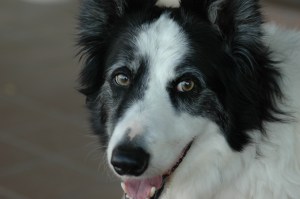
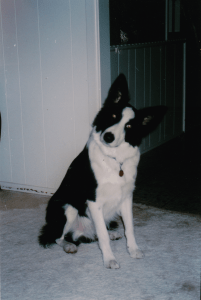
Andy lifted the puppy to his neck, sniffed its uniquely appealing scent and snuggled it. He lowered the puppy while pointing and said, “Look at these black patches around his eyes, looks like a Bandit’s mask… I think I’ll call him Bandit!” Below when Bandit was older with his distinctive black eye patches.
So Bandit the puppy became. And while it wasn’t the name we had in mind, its appropriateness over the next several months became especially evident.
The Adventure Begins
“Trudy, have you seen that pair of socks I laid out?”
“Have you looked on your feet?”
Not only socks but shoes, books, belts, and small throw rugs disappeared, only to reappear in unusual places, and sometimes having acquired gnaw marks. Items were regularly recovered from under beds, in the tiny spaces behind the sofa, and anywhere humans could not easily access.
One morning just before heading for the hospital and while in a rush frenzy, I could not locate my black medical bag. The allure that my leather bag might hold for a puppy with a leather fetish suddenly struck home. I became increasingly concerned, bordering on frank panic. Trudy and I launched a search in the usual doggie hiding places. Eventually to my embarrassment, I discovered that sleepy me had failed the night before to remove the black bag from my car.
“My mistake Bandit, but don’t you ever even think about taking this bag,” I said, as I held out my medical black bag for his inspection. Bandit cocked his head to the left and gave me a look that I interpreted as, “Who, me?”
“If Border collies are so smart, maybe you can train him to search for your black bag, because I’m sure not going to, Sherlock,” Trudy harrumphed. I blew her a kiss and backed sheepishly out the hall door into the garage.
A Glimmer of Understanding
The white-coated heavy set vet assistant with heavy footsteps ushered us along an narrow hallway barely large enough for her to pass and into a room at the far end. The room smelled faintly of antiseptic and was furnished with a stainless-steel examination table, sink, and three chairs.
Before the vet arrived, I passed Bandit to Trudy and tried to wash the yellow stain from my sleeve. I scrubbed with paper towels and hand soap drawn from the dispenser, accomplishing little except spreading the stain. I had just finished with my unsatisfactory effort when Dr. Brown with white coattail flapping blew into the room. He was a man of average size with an open face, curly salt and pepper hair, exuberant eyebrows, and better tanned than any hard working, small animal veterinarian should be.
Dr. Brown soon turned his full attention to our young dog. Our puppy tried with licks, moans, and waggles to endear himself to this new potential playmate.
“So you decided on a Border collie, did you?” Doctor Brown said while lifting our dog up and onto the polished metal examination table. The puppy fidgeted about while trying to gain traction on the slippery metal exam table.
There was something unsettling in the vet’s tone of voice. Was he being haughty? I ignored it, assuming due to my fatigue I was imagining an affront. “Yes, we knew Borders to be such intelligent animals,” I responded.
“Oh, he’s not ours, he’s our son’s to take back to school,” Trudy chimed in, sounding, I thought, a little defensive. But my wife had reinforced my suspicion that she too had detected something left unsaid by the vet.
Dr. Brown raised his thick bushy eyebrows to a remarkable peak, shooting us a brief look of strained disbelief, if not outright incredulity. He then turned his attention fully to examining our pup. He began to gently probe the dog’s protuberant belly. Our dog returned his interest by applying a slow lick along the veterinarian’s chin, ending just short of his well tanned left ear lobe.
Doctor Brown ignored the affection and continued his exam by checking the puppy’s teeth, listened to his lungs, auscultated his heart, and finally administered various vaccinations. He then surprised me by asking if I would restrain little Bandit while he performed a rectal swab.
Soon the veterinarian completed his taking of a stool sample. I lifted the puppy from the table, again sensing his softness, and cradled the puppy in my arms. Before leaving the room, Dr. Brown looked earnestly at Trudy and me and said, “Border collies can be pretty busy, you know. There’s an old adage, ‘You have to give a Border collie a job, or else he will become self-employed… and never productively.’” Again, as if to emphasize his point, he arched his impressive eyebrows in his quite remarkable way. He then turned quickly and exited the room, carrying his sample with him in a small piece of white gauze.
“Well, what do you make of that?” I asked when the door had closed behind Dr. Brown. “I thought his eyebrows were going to kiss his hairline!”
“What did he mean with that job bit? Audacity, if you ask me. Maybe not a Border collie lover. Looks more like the Schnauzer type.”
“Besides,” I said, “You’ve emptied the pet store of supplies and toys, and I’ll take the dog to the park every few days.”
“He just doesn’t know how capable we really are! Look how successful we’ve been raising our two children. How much trouble does he think one little bitty dog can be? Besides, we successfully raised a not too bright Dalmatian and two Shetland Sheep dogs. One tiny dog, Piece of cake!”
We murmured all this while keeping our voices low, as Dr. Brown banged about next door within his laboratory. After about fifteen minutes, the door to the examination room burst open, and the veterinarian like a sudden summer storm swept back into the exam room, his broad face bearing an unmistakable look of satisfaction.
Dr. Brown confirmed to us what he had apparently suspected. The rounded belly (that very one that Trudy and I had found so adorable) resulted from distension caused by parasites. PARASITES! He explained our dog was small, because he was competing, and none too successfully mind you, for nourishment with his belly worms.
“With a round of antibiotics, we’ll put those parasites on the run and get this dog growing again,” Dr. Brown clucked.
“Great, we sure hope so,” I recall saying, an aspiration I would later seriously regret.
Trudy later reminded me of the old adage that says- be careful of what you ask for. Little did we know? It was months later before Trudy and I appreciated the full significance of the veterinarian’s not so subtle warnings.
A Growth Spurt
As predicted by Dr. Brown, those magic little pills shrank the dog’s belly but also had a similar effect on my wallet. The pup over the next several weeks, lacking his parasitic competition, began to grow like the time-lapsed pictures from the TV dog food commercial.
The dog ate prodigiously. He ate vast amounts of puppy chow, canned dog food, leftovers from the table, morsels stolen from trashcans, my comfortable old leather loafers, and a few tasty treats from the refrigerator that admittedly I snitched for the puppy. Yes, I aided and abetted the seemingly starved puppy.
Following several futile refrigerator searches, a miffed Trudy reported she had harbored other plans for the missing leftovers. Our poor parasitic wracked dog deserved a few extravagances or so I thought.
Although he began small, our dog soon surpassed the average fifteen to forty pounds for the breed. Even more impressive than his weight that had zoomed past 60-pounds was his meteoric increase in height. Despite his classic Border collie markings, people often inquired if he carried any non-Border collie blood.
Soon after beginning the antibiotics, a geyser of energy developed in Bandit. While he had been active before, Bandit then became super-charged. Admiring his spike in liveliness one afternoon caused me to daydream of performing a medical study to distill the remarkable goodness of his overachieving mitochondria into pill form and cash out by advertising on late night cable TV. When I shared this daydream with its potential for Midas-like riches with my wife, I once again was treated to her “dumb look” and her lack of a verbal response.
A month after our visit to the vet and after entering from the garage one night, I greeted Trudy and sheepishly inquired how Bandit had done that day. Almost on cue, I heard a faint scampering of small paws from the den, followed by a series of noises, suggesting minor collisions in the vicinity of the dining room, followed a few moments later by Bandit in full stride charging through the kitchen door. With an ecstatic face between two floppy black ears, he rocketed off the carpeted dining room, churning like a dynamo on a path straight for me. Several feet away from me, he hit the brakes, thrusting his paws out in front of him. The pup sensed that he had lost all traction on the linoleum and immediately entered an uncontrollable slide.
Bandit developed a quizzical look on his face, casting uncertain eyes upward to me in what I thought was an apologetic way. He vigorously began to backpedal before ending up in a furry heap atop my shoes. From there he looked up at me with a look of adoring and abject joy.
I lifted the squirming puppy to my cheek where he began licking furiously. Such ungoverned displays of joy are not unusual with Bandit. They have occurred following my being out of town several days, or having just returned from the corner mini-mart. The dog just doesn’t take long to miss his people.
“Honey, maybe we could get him a job as a greeter at Walmart?” I offered lamely.
To this Trudy responded with a weak smile and a “Huh”.
Trudy and I failed to match Bandit’s surge in energy. His need to stay busy while typical for Borders is not for middle-aged, pudgy, and chronically fatigued humans. Our plans for more frequent doggy exercise hadn’t meshed well with our exhausted physical states.
“Honey, do you feel a slight vibration?” I asked one night while I dozed in my favorite chair in the den.
“Nope, but I thought I heard grinding.”
“There it is again, I know I feel a slight vibration in this chair,” I said.
Fearing what I might discover, I slowly leaned over the side of my chair and looked beneath it. I spotted an open mouthed snout bearing tiny razor sharp teeth with a death grip on the chair leg. “Say Honey, this chair you like so well? I think it’s become an alteration project for the Bandit dog!”
Bandit’s piranha-like teeth unfortunately were not limited to teething on chair legs but extended to sampling cushions, carpets, table legs, and even plastic patio furniture. The dog seemed to have become a pint-sized canine version of a wood chipper. This called for action.
We Fight Back
In a desperate attempt to limit further damage to the house and furniture, we tried distraction. Bandit became the designated companion for any family member leaving our home on an errand. He became the ever present, excited, ear-flapping, ride along dog, drooling out the window of a Hutton car.
I had never seen him happier than when riding shotgun for the family. Perhaps he saw his rides as a job. I imagined that he felt like the guy on the stagecoach carrying the gun, protecting the driver from desperadoes or Indians on the warpath. Clearly Bandit’s new position was not the job for which a Border collie had been bred, but it was, nevertheless, a job.
“Say, Shotgun, want to ride to the emergency room with me?” Bandit wagged his tail vigorously. “Well load ‘em up Shotgun and mind the strong box. We’ve got some rough country to travel!”
Andy and Katie, our high school aged daughter, recounted that Bandit visited local fast food establishments and cruised the broad boulevards of Lubbock, often until deep into the star studded west Texas night. Bandit would ride along, head extended from the window, as they drove past the statue of Will Rogers astride his horse, Soapsuds, located on the Texas Tech University campus or circled through downtown Lubbock, passing by the oversized statue of a guitar toting, thick rimmed and bespectacled Buddy Holly. Bandit happily accompanied anyone with errands to run or packages to mail.
Bandit occasionally even went on dates with Andy. Trudy and I chuckled at what Andy’s girlfriend must have thought, sharing her date with an enthusiastic puppy. We imagined Bandit at a drive-in movie snuggled between them, curled up around a box of popcorn, enjoying his people. To my surprise, once prior to a date night, I found Trudy down on the floor next to a curled up Bandit, instructing him on his responsibilities as a chaperone.
“You don’t think this is really going to do any good, do you?”
“Hey Buster, these dogs are really smart, and besides, I don’t trust that bleached blonde bubble-headed temptress,” Trudy said, twisting around to look at me.
“Do you think at the end of the evening both Andy and Bandit will give her a goodnight smooch? Suspect Bandit could really tickle her tonsils!”
Ride-along car trips were not our only gambit for distracting our young dog. Desperation, after all, breeds creativity. At our urging Andy and Katie spent hours playing with Bandit, teaching him to sit and shake, walking him up and down the block, and showing him off to their friends. Bandit proved a quick study at learning tricks and entertaining friends, and particularly enjoyed chasing sticks thrown by Andy, Katie, and their friends.
To our relief, the time Bandit spent playing fetch was time not spent digging gorges in our backyard or shortening our furniture. Trudy and I suffered from sapped energy, stemming from our busy, stressful lives at the clinic and from attempting to keep up with the energetic dog.
To her credit Trudy signed the dog up for two series of obedience classes. After a long day at the office, she sacrificed many evenings, trying to improve our doggie’s decorum. To Bandit’s credit, he became the star pupil in his obedience class.
Trudy took pride in relating his ability to learn quickly. Trudy returned from class more than once disdainful at the slowness of other dogs to learn even basic commands.
“You should have seen Sal, a really stupid and clingy Cocker Spaniel. The instructor worked for 15 minutes just getting the lop-eared hound to follow her. All he wanted to do was stay with his master or else sniff other dogs’ butts. I wasted my time just standing there at the end of Bandit’s leash and watching that dim-wit.”
“Now dear, not all dogs are as smart as Border collies,” sounding I feared a bit too patronizing.
Toward late summer, unexpected complications arose with Andy’s Fall housing arrangements. While reviewing his apartment lease from North Carolina, Andy had discovered a previously overlooked clause that pointedly excluded dogs weighing over 30-pounds. By then Bandit had eaten his way through the canine middleweight division and was on his way to heavyweight status and was still growing like Jack’s, well fertilized, beanstalk.
The Ask
While Andy toyed with fudging this not so tiny detail in the contract, at about the same time another complication arose in taking Bandit with him back to North Carolina. Andy learned his scheduled clerkship in criminal law would require longer absences from his apartment than he previously thought. Lacking a fenced yard, Bandit would have to remain inside the apartment for lengths of time beyond the bladder endurance of a young dog.
“Dad, Mom could I speak with you for a few minutes?”
Something in Andy’s voice should have tipped us off that sweltering August evening, and we should have run the other way. How we missed this opportunity to avoid THE TALK, I will never know. Had I been wise, I would have grabbed my pager and my black bag and trumpeted how pressing matters awaited me at the hospital.
With the gravitas befitting an eighteenth century French diplomat, Andy politely requested we join him at the kitchen table. Outside I heard crickets chirping what must have been a warning.
Once Andy had us gathered at the wooden pedestal kitchen table and had confirmed that we were comfortable and not lacking for refreshment, he bit by bit came around to his point. After more thoughtful moments, as if choosing his words for a final summation before the U.S. Supreme Court and after reiterating his unexpected housing and scheduling difficulties for the third time, Andy came to his question. I saw him swallow hard and with a look of earnestness on his handsome young face blurt out the reason for our meeting.
“Mom, Dad do you think you might keep Bandit, just till after Christmas?” He quickly added, “I’ll take him back in January, soon as I complete my criminal law clerkship.” His plight and sincerity proved strangely moving.
Silly us, I should have known it was a well-rehearsed ploy, a mere affectation learned by all fledgling law students. Trudy and I should have considered letting our eldest child endure the consequences of his poor planning, although, admittedly, we too were complicit. It could have been character building for the son– right?
Fortunately, unanticipated consequences of faulty judgments do not always become immediately clear, especially when parents’ well-loved children are the committers. It may even be better for parental self-esteem that we don’t perceive our foolhardiness right away.
At the time I was struggling to manage a busy private practice, direct a neurological research center, and maintain stability in a fractious physician group. These were a lot of plates to keep spinning at the same time.
Trudy had left the practice of law as Director of Lubbock Legal Aid to manage the Neurology Research and Education Center that I had established. I had simultaneously created the Center along with the private practice but was finding too few hours to do justice to both. Actually she, a Family Law attorney, had tired of divorcing people who inevitably were contentious and angry. I rationalized that she longed for a fresh career outside of Law; however, this doctor/husband has enjoyed claiming (even perhaps boasting at times) to have reduced the legal workforce in Lubbock by one.
In Trudy I had complete trust to coordinate the Neurology Research and Education Center. As a wife, she knew the emotional importance to me of maintaining research and educational interests despite my having left the rarefied air of academia. Her selfless sacrifice for my career was vintage Trudy. Whenever my professional advancement had required a change of location, Trudy had agreed to support the change, even when it conflicted with her own career- no blatant feminism in Trudy. I knew my blessings.
Both Trudy and I had stayed overly busy with our jobs, rarely seeing each other during the workday, despite working mere steps away. Trudy’s day at the Neurology Research and Education Center would end around 5:00 P.M., and she would depart for home to prepare dinner, clean the house, pick up dog toys, and attend to family chores left undone from her largely absent husband.
Many days I would work 16 hours or more in the hospital and clinic only to come home with a big stack of electroencephalograms to interpret and to be on call for the emergency room and urgent hospital consultations. Neither Trudy nor I had time for a needy puppy, especially one as active as a Border collie.
As I listened that evening while sitting across the table from Andy, I glanced past him into an adjacent bedroom. There I spotted Bandit’s impish white face with black eye patches, pink tongue, shiny black nose, and floppy ears protruding from beneath the bed’s dust ruffle. Bandit cocked his head imploringly in our direction, as if expectant of our parental response. Trudy and I gave each other meaningful looks, and then answered in unison, in a manner as predictable, as it was foolhardy.
“Of course, Andy, we’d love to keep Bandit!”
So dear readers of my blog, please know that by the time the Christmas holidays eventually arrived, Bandit, Trudy, and I had become so bonded together that Andy could not have gotten that dog away from us with a gun. The weld was sound. Our emotions had meshed. Our schedules somehow had expanded to fit our needs. Our affection for Bandit had become enormous.
The reasons for this tight bond and our love for this amazing dog will be revealed in future blog posts.
To be continued.
If you have not had the chance to read my latest book, Hitler’s Maladies and Their Impact on World War II: A Behavioral Neurologist’s View (Texas Tech University Press), I invite you to do so. The book explores an important aspect of the Hitler story and World War II that has not been well studied. Many of Hitler’s catastrophic errors including the premature invasion of the Soviet Union in June 1941, the slowness of German forces to counterattack at the Battle of Normandy in 1944, and the highly risky Battle of the Bulge in late 1944 into 1945, can be better understood, knowing the sizeable impact that Hitler’s physical and mental conditions had on these vital battles.
Also, consider picking up a copy of my earlier book, Carrying The Black Bag: A Neurologist’s Bedside Tales (Texas Tech University Press). Please join me on my personal journey as a physician and meet my patients whose reservoirs of courage, perseverance, and struggles to achieve balance for their disrupted lives provide the foundation for this book. But step closely, as often they speak with low and muffled voices, but voices that nonetheless ring loudly with humanity, love, and most of all, courage.
Not long ago we brought home a bouncing, baby Border Collie. The cute little bounding bundle of fur is now eight months old and weighs over 40 pounds. Although not without prior experience with Border collies, we have relearned lessons about their energy, enthusiasm, intelligence, and mind boggling shenanigans.
Several years ago for Christmas I requested morning slippers. Being told by my family that I am difficult to buy for, not surprisingly I received not one pair but two pair of slippers. No problem thought I. A little redundancy is not a bad thing. Apparently our puppy Border collie thought differently.
And how innocent he looks
Beau sees no need for duplicate morning slippers. Likewise he sees no need for multiple pairs of shoes and boots, extra rolls of toilet paper, and multiple doggie toys. Slippers began to disappear or appear in mangled form. No problem I thought as I have extra slippers. But apparently our cute little bundle of fur has right-left problems, as I’ve been left with two left slippers.
Last week when Trudy and I escaped the Texas heat for Colorado for a vacation, I received word from our dog sitter/house sitter, Megan, that in her briefest loss of attention, Beau had shredded a roll of toilet paper. She said he had been especially thorough in his determined efforts and estimated that he had left 1.575,854,743,005 pieces of toilet paper-confetti around where she sat. Ah, such industriousness, that’s our Beau.
Trudy and I brought a new Border collie into our lives despite the incredulity expressed by our grown children.
“At your age?” and “Surely you must know what you’re getting into?” were a few of the kinder backhand comments we heard regarding our surprising decision. “But what happens if the dog outlives you?”
The latter question was met with our steely stares and firm resolve, “As the inheritance goes, so goes Beau!”
Baby Beau below in his toy box after having laboriously emptied it of all its contents.
Indeed, after having previously raised four Borders, we recognized how busy and challenging these sweet and intelligent animals can be but stand in utter amazement at their herding abilities, smarts, and sensitivity.
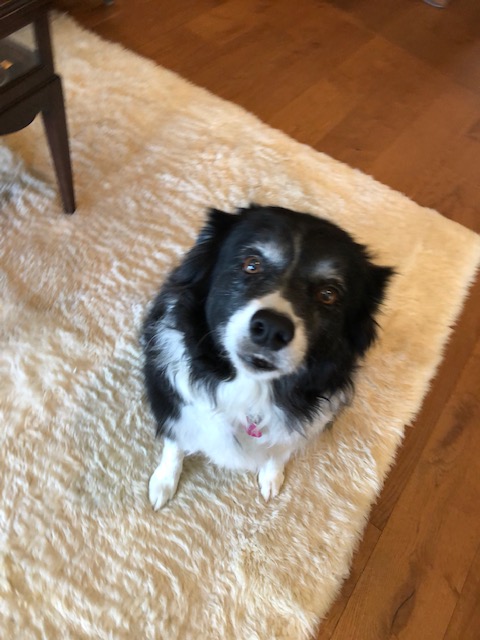
We rationalized that we needed of a younger dog to assume Bella’s role as chief canine cattle herder. Unfortunately, our sweet Bella had grown old, developed poor eyesight, put on weight, and has limited her herding. In truth, our new puppy will largely be a house pet along with ranch companion and working dog.
Bella below in her younger days.
Bella, “I don’t like another dog on the ranch. I want all the attention”
Melanie Wahrmund, a rancher and breeder of Border collies, lives about 10 miles west of our ranch. She has a slew of working dogs on her family’s large cattle ranch and is a well respected breeder of these working dogs.
Beau has changed our lives in all the ways that new puppies can. He sleeps in his crate and even in the early days, whined very little, but our sleep continues to be interrupted by periodic night time visits to the backyard.
He came with razor sharp teeth that took their toll on us, our shoes, and his toys. I’ll save you the images of Trudy’s and my mangled arms and ankles, but they weren’t pretty. He loves squeaky toys and to eviscerate them, leaving the white stuffing scattered about the house.
Fortunately after three to four months the razor sharp teeth of a new puppy are replaced by larger, less sharp permanent teeth. Also the urge to chew lessons, saving our hands, ankles, and shoes. Why is it that puppies love to remove the insoles of shoes and chew through the straps of sandals? And he looks so innocent!
Below picture taken at the Breeder’s ranch while inspecting a pup. What is there about the scent of a new puppy that is so endearing? The new puppy smell is said to resemble sweetened cream combined with an innocent, celestially clean quality. The unique fragrance is easily recognizable, universally loved, and bonds puppy to mother along with puppy to its human companions.
Below is baby Beau viewing his the garden in his new home not long after coming to our ranch.
Beau, “This place has promise.”
Beau developed a voracious appetite. He was like the dog in the time lapsed dog food commercial and seemingly grew before our eyes.
“Is it mealtime yet?” “Give me food and I’ll let you keep your shoes!”
Beau has always enjoyed falling asleep in his toy box after emptying it and scattering his many toys around the house. If only we could teach him to put the toys back into the toy box. Puppies enjoy sleeping in semi-enclosed areas that lends itself to crate training and likely harkens back to their ancestors who lived in caves and crevices.
Beau, “You just try sneaking up on me now.”
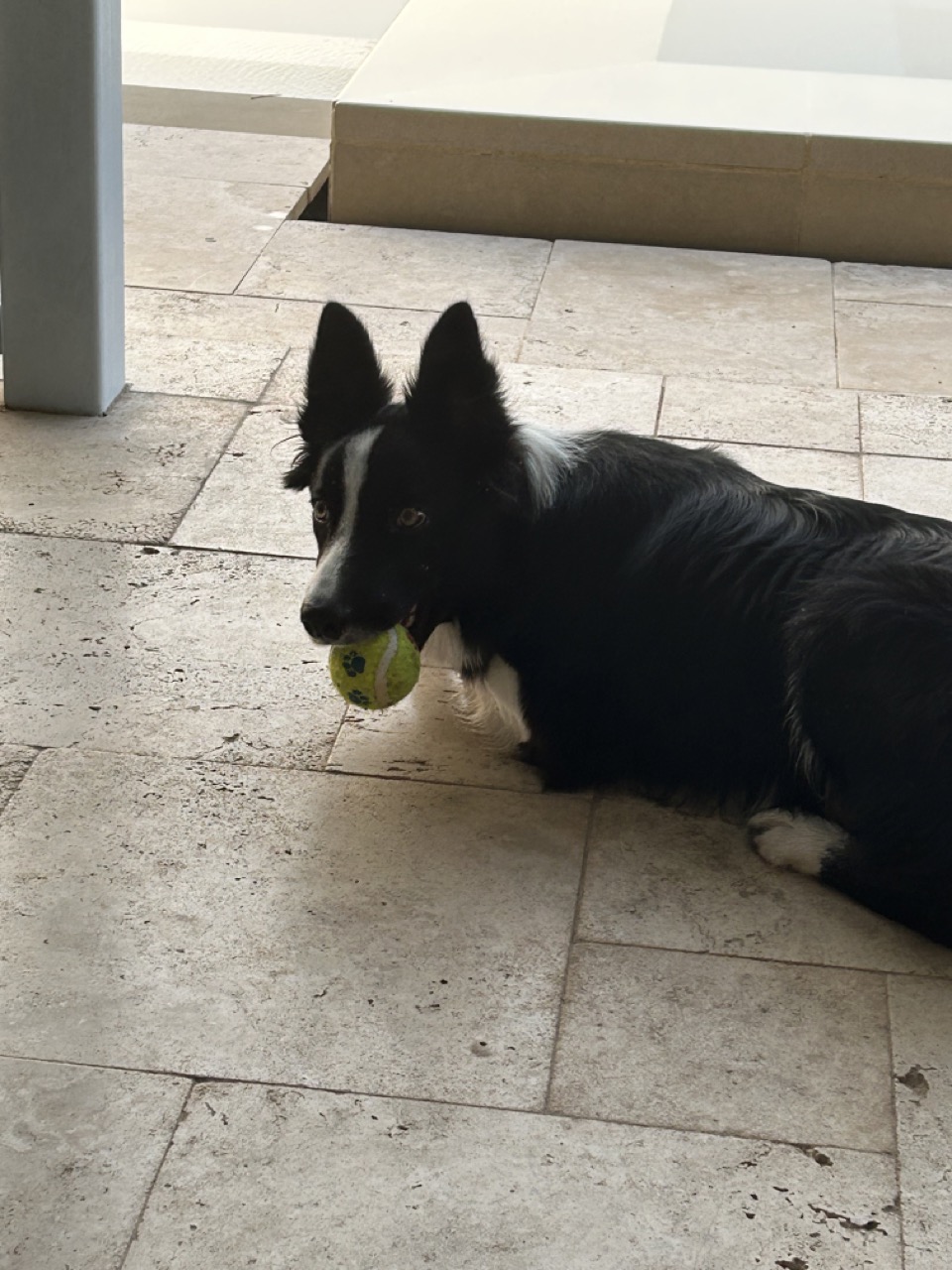
Beau in his constant discovery mode came across the thrill of tennis balls. He absolutely loves them. He greets us on the back porch with tennis ball in mouth and urges, pleads, and implores with his fawning eyes and unflagging persistence for us to throw the ball. We relent but he is so fast that before we can make our way back to a chair, Beau has dashed into the backyard, captured the ball and placed it at our feet even before we can recline in our chairs.
Needless to say, drinking coffee on the porch and watching the orange glow of the sun rise over the blue hills of Fredericksburg proves less relaxing now than it once was, but the mornings are now far more active and entertaining.
Beau, “You want to play ball?”
When Beau was about 10-weeks old, Melanie Wahrmund called with an unexpected offer. She had been contacted by a film crew in nearby Austin about making a Purina One commercial and taking stills for additional advertising purposes. The film crew had asked Melanie if she could deliver cute, young Border collies for the shoot. We were intrigued by the opportunity. Of course we spoke to Beau about the opportunity and he expressed interest. Have you noticed that Border collies are the breed of dog most seen in TV commercials?
A bleary eyed me and a wide awake Beau were soon to meet Melanie at the end of our county road at 5:15 a.m., as she was gathering a few of Beau’s litter mates. Off to Austin Melanie, her daughter, and three puppies went for the all day shoot. It was late that evening when the traveling canines and tired human companions returned to Fredericksburg. Beau was full of zest as always.
Beau apparently had shown out and had become the “star of the shoot”. We were told that he showed the greatest personality of any of the dogs and had become a favorite of the film crew. We still await viewing the finished product that hopefully will be forthcoming soon.
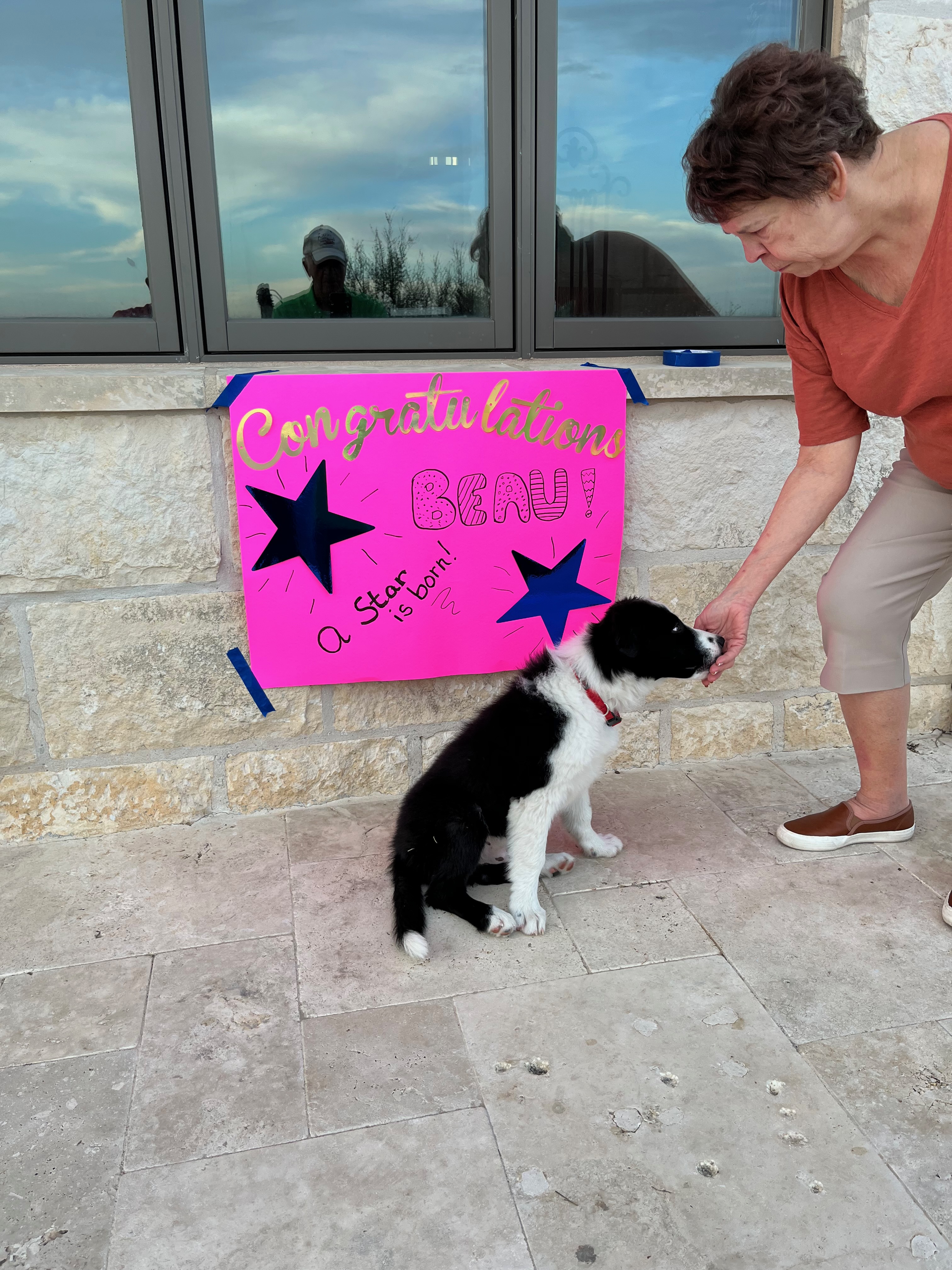
Below are Beau and Trudy in front of a sign celebrating Beau’s new “stardom”. The poster was made by our good friends, Colonel Tom and Danese. Her dog, Pippa, has been duly designated as head of Beau’s recently founded fan club. We’ve had a lot of fun resulting from the photo shoot. By the way Beau’s red collar as seen in the picture was courtesy of Purina.
To our surprise, several weeks later we received a check in the mail as payment for Beau’s participation in the photo shoot. Trudy joked that since we were retired, Beau was the only member of the family (or is it a pack now?) who actually brings in income! The truth was painful for the previous chief breadwinner, but I was proud nevertheless of our cute little rascal.
Winter at Medicine Spirit Ranch moves at a slower pace than the rest of the year. The fields no longer require fertilizing, cutting grass, baling, and hauling hay. Likewise major repairs of the barns, major fencing changes, and replacing gates or cattle guards await better weather.
A few jobs increase during the winter. The feeding of the stock requires range cubes be fed daily to the cattle rather than only a couple of days a week when the grass is green. We also provide large bales of hay typically three times a week via a tractor that requires a little time.
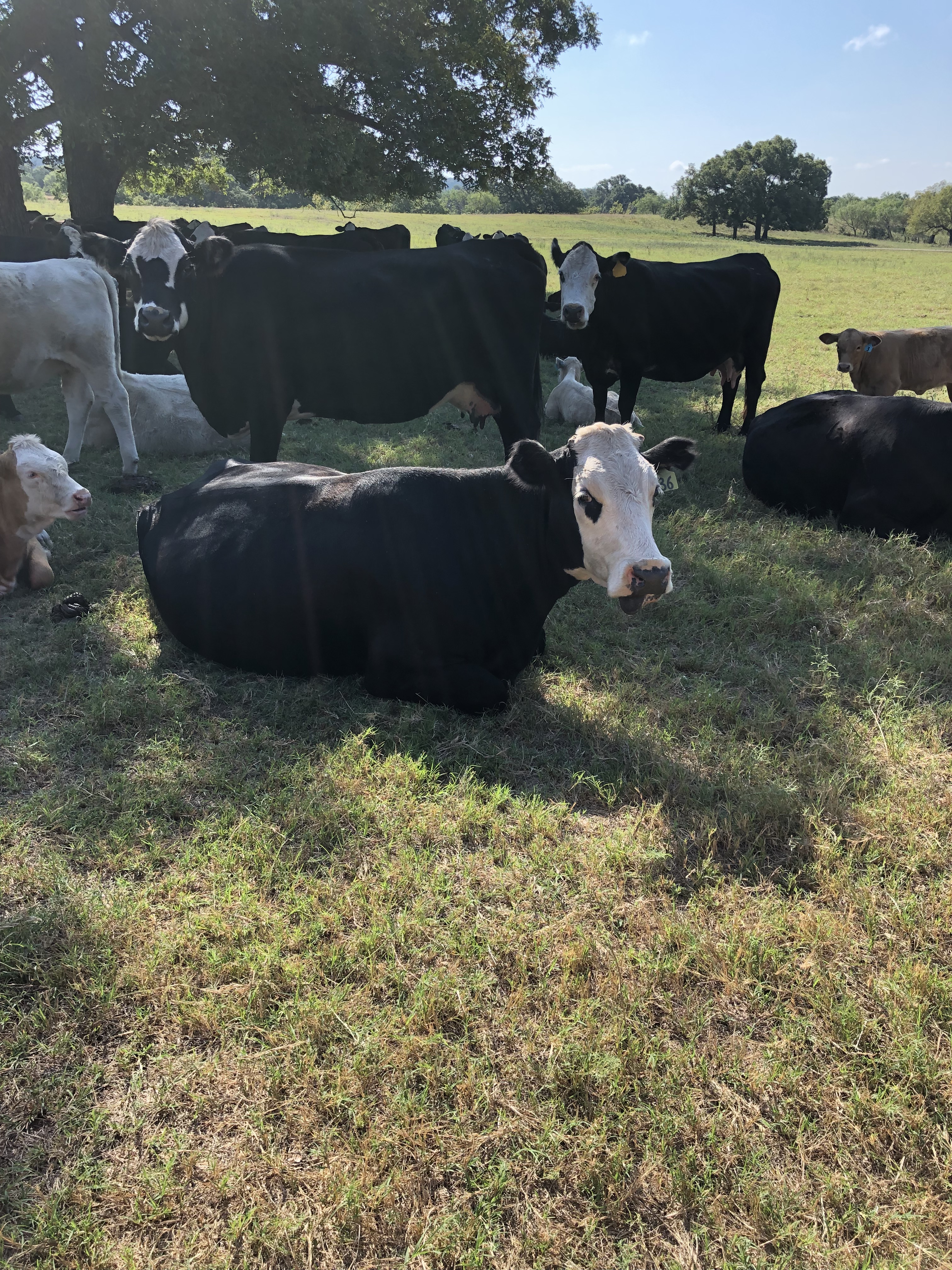
Two Black Baldy cows with their calves
Otherwise cedar chopping increases during the winter as the green cedar is easier to spot among the brown grass, and fences always need a bit of mending.
Otherwise winter tasks are largely determined by what most needs to be addressed. Some items simply are stumbled upon during morning rounds. For example today I stumbled across the carcass of a dead Black Baldy cow located at an infrequently traveled portion of my ranch. I had missed her late last year but never found evidence of her. I have no idea how or why she died but am especially perplexed because of losing two other cows last year. Only once before have I lost a cow and that was when her hind legs became paralyzed while attempting to give birth to a particularly large calf. She unfortunately failed to respond to the passage of time and treatment. Three cows dying in a year made for a very bad year indeed.
Last year also saw dreaded ice storm Uri from which we are still recovering. It was amazing the number of downed limbs and trees that resulted and that continue to litter parts of my ranch. I had hoped we would have the freakish mess cleaned up within a year, but my hope will go unrealized. There simply remains too much damage for us to clean up anytime soon.
Ice storm Uri left downed trees and limbs across our ranch
I remain hopeful that 2022 will prove better than last year. Surely the problems encountered in 2021 won’t recur. Reasons for hope are abundant. I have some outstanding calves ready to go to market and prices are good. We also are making good progress clearing the new land purchased last May. Hopefully, we will replace the previous bad fence along the county road, will have re-seeded the land, and have sufficient rain to grow a nice stand of grass. I also remain hopeful that we may finally see Covid-19 in the rear view mirror. Here’s hoping for a better future!
In addition the Great Blue Heron greets me almost daily. As previously noted in several blog pieces, the Great Blue Heron promises good fortune, and its presence adds to my optimism about the coming year.
A Great Blue Heron. Not my heron but representative
These past weeks we’re been making smoke- a lot of it. In May we obtained a piece of raw land adjacent to our Hidden Falls Ranch. I claimed at the time when we closed on the property that it was the WORST piece of property in the county. My less than flattering description resulted from the intensely thick cedar that covered it which had choked out the grass necessary for raising cattle. Being an eternal optimist, I secretly believed that with lots of TLC and bulldozer clearing, the property had the potential to return to the pristine grazing land that once it had been.
Thick foliage covers the land, consisting largely of cedar
We have now spent three months clearing the land. Two part-time bulldozer operators have been working. The land is opening up dramatically and I may yet realize my fondest hopes. To my knowledge, the land has never been cleared. For centuries this land had few trees and consisted of rolling prairies with native grasses. The land changed over the decades due to over grazing and an influx of non-native trees. During the cattle drives from south Texas in the 1800s the mesquite and cedar (actually two varieties of Juniper) spread into our area and in some instances even choked out the native Live Oaks, Cottonwood, and Pecan trees. What is now our new piece of land became forested with thick cedar groves. By doing so, the cedar sucked up vast amounts of precious water and the thick canopy prevented grass from growing. For at least the last 50-75 years, the land was used solely for hunting purposes that did not require clearing of the land.
My wish is to return the land to the prime grazing land that it once was. With luck and good weather we may finish clearing the land by the end of the year, and then spread native grass seed, and have the land in shape for grazing within the next several years.
Along with the bulldozing has come a new animal on the ranch. Meet Dozier Dog. One of the bulldozer operators comes to work with his Australian shepherd. To my amazement, the dog rides in the bulldozer with Coy, moving side to side in the bulldozer to observe its progress. The dog’s name is actually Remy, but to me he is “Dozer dog.” Despite the racket of the bulldozing, loud crackint of the trees being felled, and the ever present dust, Dozer dog rides happily along intently checking on the progress being made. Apparently the only dislike he has is going up very steep slopes and having branches fall over and into the cab of the bulldozer. Can’t say that I blame Dozer dog for disliking falling branches or steep climbs. At these times Remy seems content to wait in the bed of the pickup.
One outcome from dozing so many cedar trees has been huge piles of upended trees. Over the last several weeks and for months in the future, we will be burning the piles of trees and limbs. Hence, we are making lots of smoke. Vast plumes of gray smoke coil into the sky along with a scattering of ash over a wide area The acreage is opening up and revealing lovely nascent grazing land and striking vistas. We light the fires in the morning and burn huge piles of cedar all day. We take precautions to limit the spread of the fire by weed whipping around the burn pile, and stand by with rakes, shovels, and large water containers to deal with any unwanted spread. So far, so good. The bulldozer pushes trees and limbs that are standing in piles nearby. All has gone well thus far.
I’ve been asked by friends who have moved from cities to the countryside whether a permit is required in order to burn. The answer is no so long as the county doesn’t have a burn ban in place. It is assumed that caution will be used that to me means low wind and wet conditions.
Bella: Hey, I don’t like another dog on the ranch. I want all the attention
In case you haven’t read it,consider picking up a copy of my book, Carrying The Black Bag: A Neurologist’s Bedside Tales. It is a heartwarming read about some terrific people with neurological disorders who teach lessons about love, humor, and especially courage. It is available via Amazon or your favorite bookstore and can be ordered as a traditional book or as an e-book.
They left us again- just like every year since putting up their bird houses. Migrated, I suspect, is the better term. From April to late July these sleek birds grace us and amaze us by their aerial acrobatics, fierce protection of their nests, feeding and swarming behaviors. Purple Martins are impressive birds and beautiful in so many ways.
A beautiful male bird with blue head and breast and dark wings. Not my picture. Taken from the Purple Martin Conservation Association.
Purple Martins are 7.5 to 9 inches long and weigh about two ounces. They are swallows and in size between a sparrow and an American Robin. They have a slightly hooked bill, short split tail, and long, tapered wings. These broad chested birds are built for speed and for flying long distances as indeed they regularly do.
Each year Purple Martins leave their nesting areas in the eastern half of the United States and migrate thousands of miles to winter in the rain forests of Brazil and the Yucatan. Geolocators on Purple Martins have shown the Fall migration can be drawn out, but the Spring migration back to the United States is much more direct, presumably so that the Purple Martins can arrive first to find the best mates and nesting sites.
The birds will also return to earlier nesting sites if they previously have found them suitable. Knowing this gives Trudy and me pleasure, believing we have returning friends to our ranch in central Texas who enjoyed their earlier stays and our accommodations.
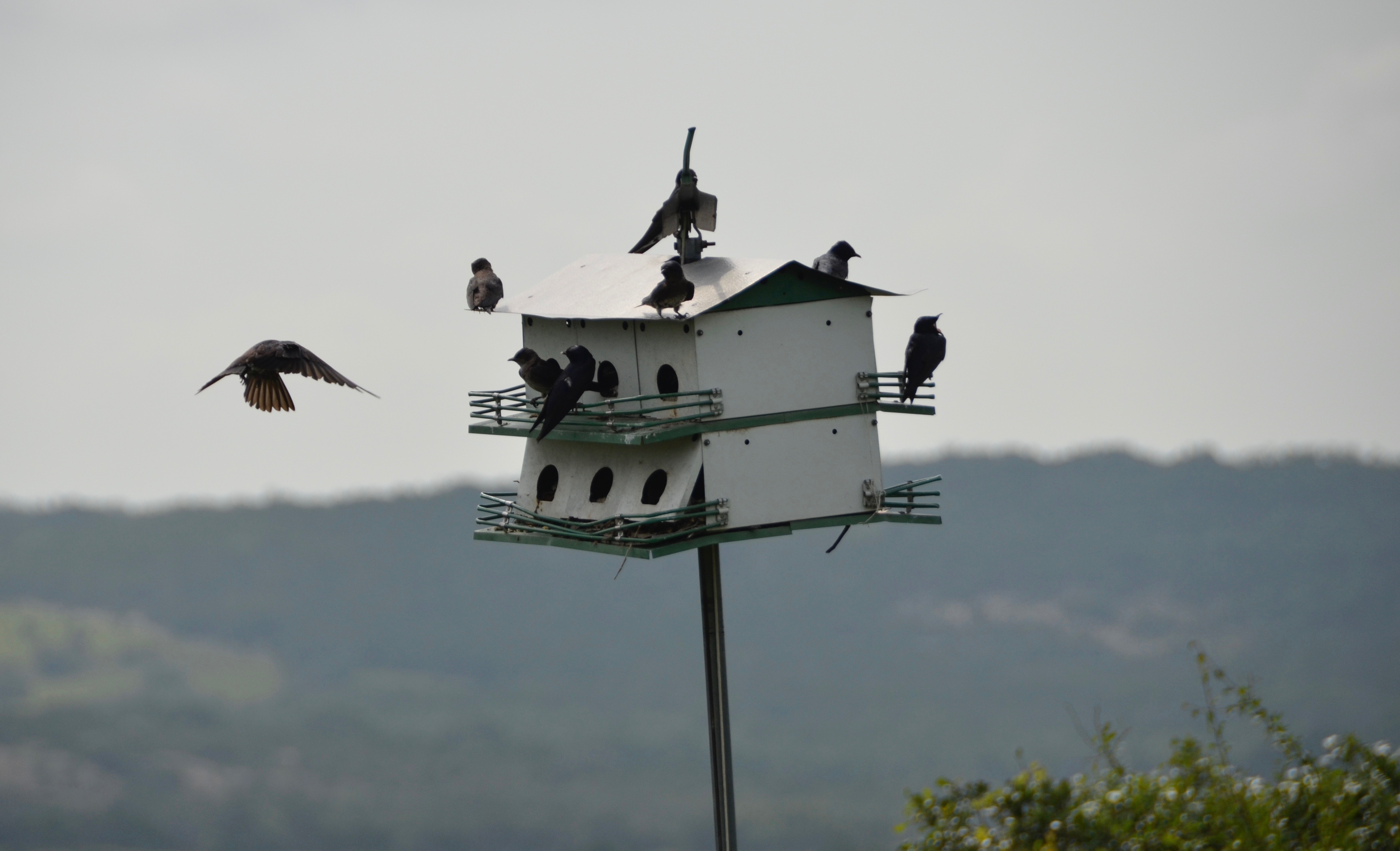
Below are several pictures of our Purple Martin houses and swarming Purple Martins.
The Purple Martins swoop through the air with beaks open, catching winged insects mid-air. No wonder we have so few mosquitoes. Their mobility, gliding, and speed are truly impressive to witness. Here in the picture they are returning to their nests to feed their young.
After returning to the bird houses in our backyard each Spring, they spend time building their nests. Hatching of the eggs takes around 26 days. The swooping birds are especially active first thing in the morning and just before and during sunset.
The birds live in colonies that provide protection from predators. Their main predators are hawks and owls and indeed we once had our Purple Martin house and its avian contents savaged by an unknown predator. We have since seen a hawk swoop close by the Purple Martin houses and witnessed two brave Purple Martins, like angry fighters, chase away the much larger hawk. The Martins did this by weaving and diving at the hawk, their exceptional mobility and speed making this effective strategy rather than suicidal behavior.
Toward the end of their stay, we notice increasing numbers of birds flying about (staging). This swarming or staging as it is known by birders is preparatory for their long migration to Brazil. And then all of a sudden, they are gone. Vanished. What had been bird houses teeming with birds and hordes of birds in the air are suddenly vacant houses and empty sky.
Trudy and I miss these amazing and social creatures. We have now but to clean and repair their houses and ready them again for the Spring return of yet another troop of colonizing Purple Martins. Safe Travels! See you next year.
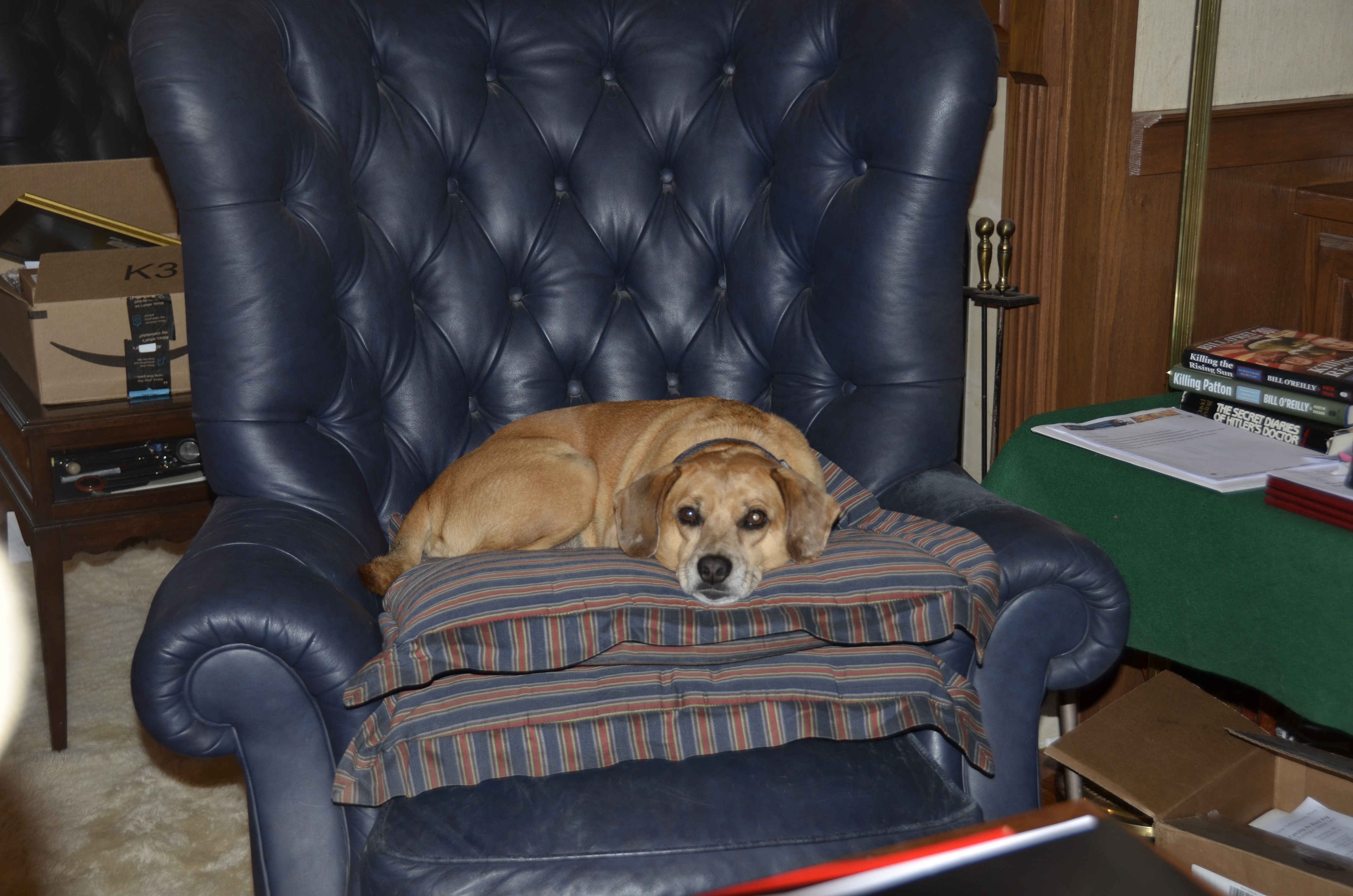
We all have habits or routines that we have fallen into, be we humans or animals. I’ve become more aware of these behaviors in my dogs following the death of our senior Border collie, Buddy. Little Jack, our erstwhile Texas Brown dog, following a suitable interval has taken to lying under the coffee table where Buddy exclusively laid.
Bella previously had adopted the routine of lying just outside “Buddy’s Office” which was a dog bed placed in a corner of the living room behind a decorative Oriental wooden screen. Buddy would nap in his office while Bella laid just outside the entrance to his “office”. Now she has left her prior “secretary’s spot” just outside and sleeps on Buddy’s prior dog bed in the “office”.
Buddy in his younger days
I suppose this means Bella’s period of mourning has passed. I am convinced she sorely missed Buddy after his death. She just didn’t act like she normally did. She was still anxious to ride in the pickup but frankly acted droopy. Of course Bella was the same breed of dog as Buddy and had always had her big friend around. This was quite a change for Bella, not nearly so much for Little Jack.
Bella enjoying a ride in the GatorLittle Jack in his favorite place (note the two pillows)
What gives? I know we all have our preferred places at the dinner table, favorite comfortable chairs, and habitual coffee mugs. In the case of my dogs I had assumed their “habits” were a dominance thing. That is, even at his advanced age Buddy was the dominant dog and had the favored spots in which to snooze. For the most part, the other dogs did not intrude on his space. Toward the end of Buddy’s life, I noticed Little Jack begin to take license with Buddy’s spots. But just maybe, like humans, these were learned routines that they had fallen into.
My two horses will almost always go to a specific end of the trough and await my pouring of their portions of feed. The chosen spots may in part be because Fancy, the Paint horse, will dictate the end of the trough she wants and run the gelding, Dandy, off. I assume she takes a glance at the mounds of feed and, if his feed looks more attractive and catches her eye, she none too subtly “relocates” him. Yes, this sounds like a dominance thing.
Fancy, our dominant female Paint horseDandy while larger than Fancy, tends to defer to her (the secret to a happy equine marriage?)
Other dog behaviors exist as when my dogs watch me get dressed in the morning. They particularly scrutinize me when putting on my ranch clothes, but not so when I pull out the golf togs. In the case of ranch clothing Bella becomes very excited and begins to bark vigorously. Her behavior proves quite annoying for me and Trudy. Little Jack’s role is to come between Bella and me and attempt to block her from excitedly jumping up on me. Both dogs clearly recognize patterns to my dressing and have their separate routines as how to behave.
With cattle I have also noticed a feeding “pecking order.” Quite predictably certain cattle (the younger Longhorn and one or two of the Black Baldies) will head pall mall for the feed sack as I begin to pour. They stake out the beginning of the feed line. Other cattle jostle for intermediate feeding positions with the calves and certain Black Baldies ending up at the end or in the case of younger calves not in line at all. I always attempt to make a particularly long line of range cubes so that all the cattle will feel comfortable getting in line for the range cubes. Clearly an ordering exists in the bovine food line.
You may not be able to tell us apart. but we sure know which of us are in charge
I’ve assumed this behavior in cattle was an act of pure dominance. Those will horns have a clear advantage, if not too old to do minor combat. Why some of the full grown Black Baldies end up as “Tail End Charlies”, I don’t know. I’ve assumed they are not quite as big or strong or perhaps were from a smaller herd when they joined my herd and haven’t been completely accepted as yet.
I would love to hear comments from readers as to the behaviors of their animals and how they mirror or interact with their humans. Remember our pets are always studying us, just like we study them.
If you haven’t already read my book, Carrying The Black Bag: A Neurologist’s Bedside Tales, please consider picking up a copy. It is available via Amazon or your local bookstore. It is a fun read, demonstrates a lot of humanity and courage from patients, and has been well reviewed. I would welcome your thoughts.
What a joy to publish a guest blog piece from a friend and true expert on bird behavior. The honor is even greater and more personal as Dr. Rylander was one of my principal professors when I attended college and majored in Zoology. What a surprise when Dr. Rylander and I learned that following our retirements that we had both chosen Fredericksburg, Texas, as a place to live. He is the author of Behavior of Texas Birds, published by the University of Texas Press.
One of the nearly constant sights over our ranch is the presence of vultures languidly circling high above. Little did I understand the differences of the two types of vultures that we see, although always being amazed by their graceful flight and efficient clean up of roadkill along our rural roads. Dr. Rylander makes their presence more meaningful and enjoyable to view than I had ever considered. Enjoy!
Guest Blog Piece by Kent Rylander, Ph.D.
Growing up on a farm during the late 1940’s, my brother and I called them “buzzards” – those large, black, hawk-like birds that soar in circles high overhead, or that stand on the highway by a road kill and fly away lazily if cars approach too closely. Even today most farmers in Denton County call them buzzards, and some still shoot them because they think they’re hawks or that they transmit diseases. Later, when our parents gave us a field guide, we learned the preferred name, “vulture,” a term ornithologists introduced to distinguish our vultures from the unrelated African buzzards. We also learned that two species occur in Texas, the Turkey Vulture and the Black Vulture.
Black Vulture on the left and Turkey vulture on the right
Overhead these two vultures might appear to be the same species because they are so similar in general appearance. However, a closer look reveals that the Turkey Vulture is very light on the wing and rocks gently back and forth as it effortlessly soars for hours; it rarely needs to flap its wings. In contrast, the Black Vulture’s body appears too heavy even for its broad wings. Indeed, Black Vultures must flap and glide just to stay aloft even at high altitudes where thermals are strong.
The “personalities” of these two species are related to their different body types. Both have keen eyesight and regularly search for carrion while they soar high above the ground, but they differ in an important way. The Turkey Vulture’s large wing to body ratio allows it to fly low over the ground and locate small animals such as snakes and rodents. It also has a sense of smell, which almost all birds, including the Black Vulture, lack because olfaction is useless for an animal that spends most of the time in the air.
More than a century ago Audubon claimed he demonstrated olfaction in Turkey Vultures by placing a dead animal under a sheet next to a realistic painting of a carcass. A vulture flew down to the painting but ignored it, then pulled the carcass out from under the sheet.
Although Black Vultures can’t locate small carcasses because they must fly high to stay aloft, they compensate for this limitation by watching Turkey Vultures forage low over the ground. When a Black Vulture sees a Turkey Vulture feeding on a small carcass, it drops down and drives the Turkey Vulture away. The Turkey Vulture seems to accept being bullied by its much heavier and stronger relative, even when both are at a large carcass.
Is the Black Vulture more aggressive because its size enables it to be a bully, or is it basically just a more aggressive animal?
The answer to this question lies with the young, fluffy white fledglings, which hatch and live in small caves in cliffs and rock formations. When a person approaches a Turkey Vulture fledgling, the young bird cowers and retreats to the back of the cave; but when a Black Vulture fledgling is approached, it hisses and lunges at the intruder.
So when we look up and see Turkey Vultures and Black Vultures soaring together, ostensibly cooperating while looking for a well-deserved meal to share, we know that, thanks to their genetics, they’re not foraging together because they’re friends.