Tag Archives: acorns

Why Are There Many More Acorns Some Years Than Others?

Every several years at Medicine Spirit Ranch we receive an unbelievable number of acorns. My oak filled yard becomes thoroughly covered by acorns. The periodicity of the big acorn crop occurs every two to five years, and I assumed it had something to do with the weather with wet Springs and hot dry Summers. Being a curious type, I went online only to find that increased amounts of rain and heat units do not adequately explain the periodic acorn bonanzas. What I also learned was that the cycles of none or few acorns punctuated by heavy acorn crops has been well recognized by botanists and the years of acorn boom times go by the name, Mast Years.

Our ranch has many Live Oak trees, red oaks as well as some Post Oaks. Across the world many different varieties of oak exist but all oaks produce acorns. The acorns are of course necessary for new trees to develop. The acorns also provide feed for squirrels, deer, feral hogs, turkeys, raccoons, mice, Blue Jays, Woodpeckers, quail,some types of ducks, and in some parts of the United States bears. We have even found our young Border collie, Duke, eating acorns. Acorns are highly nutritious.

The question arises as to why Mast Years exist at all. As it turns out science has not fully explained this curious event. As noted above weather and environmental factors are insufficient to explain it. Some scientists have speculated that an unknown environmental trigger may exist or that some type of chemical signaling may occur among the oak trees. Science up till now has simply been unable to adequately explain the mast year phenomenon.

One personally satisfying theory for Mast Years is that these cycles have a evolutionary benefit for oak tree development through “predator satiation.” What this means is that the lean years will not support as many animals who graze on acorns, thus thinning their numbers. Then a boom year of acorns occurs, such that many acorns go uneaten by the depleted number of foragers, increasing the chances of developing into new oak trees. Are Oak trees this “smart?” Well, it does make a certain amount of sense.

As a result of our current Mast Year, we can expect large herds of well nourished deer. Unfortunately, mast years also encourage the survival of more invasive and destructive species such as feral hogs. These hogs have become an increasing problem on our ranch and growing to 300-400 pounds and reproducing large litters twice as year, can out compete the cows and sheep for food and water. The feral hogs also destroy fences and can menace humans and livestock.

In a larger view, the interaction between an acorn bonanza and the fauna that feed on them establishes a symbiotic relationship that benefits all. Without having the opportunity to live at Medicine Spirit Ranch, I would not have ever realized this unusual integration of fauna and flora.
Live Oak Trees- Take a Bow

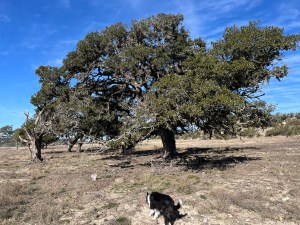
Bella off to check a Live Oak tree

The magnificent Live Oak trees in the Texas Hill Country are unique and beloved by residents and visitors alike. They vary in several ways from the clustered, closed-canopy, taller Oak trees found in the eastern part of the U.S.A. Just like many other aspects of Texas, our Live Oak Trees really are different.

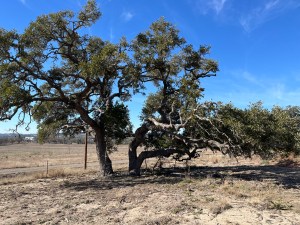
Unusual shapes caused by severe weather, injury, and sun seeking (phototrophism)

To start with the form of our Live Oaks is broader and shorter than Oak Trees found elsewhere in the country. The thin, rocky soil of the Texas Hill Country along with frequent droughts give rise to this distinctive shape. These characteristics require the trees to have reduced height so that the limited water can be drawn up and into their leaves. Live Oaks spread out in a broad fashion, making drawing water much easier and with their gnarly limbs bending close to the ground, as if bowing in reverence to a demanding Mother Nature.

An Live Oak tree hundreds of years old that lost many of its limbs during the 2021 Ice Storm Uri and has yet to completely fill out its canopy

Live Oak trees are extremely drought tolerant. Even their small, thick leaves differ and for good reason from the large five or six lobed Oak leaves found elsewhere. Our Live Oak trees are also less clustered than eastern Oak trees, making the abundant sunlight even more available and the process of photosynthesis easier.

The Live Oak leaves are smaller, thicker, and stiffer. These adaptations help the tree to survive in its dry environment. As might be expected the largest Live Oaks are found in the valleys where the soil is thicker and groundwater more available.

Live Oak trees are always green. During March the leaves turn a yellowish green color and are pushed off by new leaves. Along with the Juniper tree, referred to locally as cedar, the Live Oak is always green.

During the wettest years Live Oak trees drop large numbers of acorns. The abundant acorns provide food for deer, feral pigs, and squirrels but must be buried in order to take root and grow into a tree. Squirrels bury large numbers of acorns, some of which are never retrieved. Serial wet years are necessary for a Live Oak sapling to sprout, making the likelihood of new Live Oak trees unlikely. The existing old trees are especially dear; some of which date  to before the European explorers first roamed through this area.

This Live Oak either had its main trunk cut off during the 1950s severe drought or else lost it to weather, leaving an unusual shape for the tree

A close up view showing the original trunk

These mighty trees demonstrate amazing staying power and a floral grit. The striking temperature differences with single digit cold temperatures and blazing hot summers require it.

The great size and twisted trunks of Live Oaks never cease to create in me a sense of awe and wonderment. Live Oak trees are truly iconic to the Texas Hill Country and add further diversity to the flora and fauna of this region.

For those wishing to read more about the diversity of the Texas Hill Country may I suggest Armadillos To Ziziphus, by David M. Hillis. Dr. Hillis is a renowned biologist whose ranch, aptly named The Double Helix, teaches at the University of Texas at Austin. His book is chocked with wonderful insights about the incredible diversity of the Hill Country and is a great read.

If you haven’t had a chance to pick up a copy of my recent book, Hitler’s Maladies and Their Impact on World War II, I hope you will do so. Hitler’s poor physical and mental health provides insights into his diminished performance during the latter years of World War II but in no way mitigates his evil ways. Also my earlier book, Carrying The Black Bag: A Neurologist’s Bedside Tales remains available. Both books can be obtained from your favorite bookstore, the publisher, or the author at jthomas_hutton@yahoo.com.