Category Archives: Raising Cattle

Guest Worker Program at the Ranch

IMG_0421

A new face temporarily resides at Medicine Spirit Ranch. No, Curly, our white Charolais bull didn’t get a black dye job nor did he lose 800 pounds. The Black Angus bull in the picture belongs to our good neighbors, Steve and Carla Allen and goes by the politically questionable name of “Sambo.”

The bull is staying for three months to breed with my heifers. Since they are first time heifers, we needed a small bull. Hope to sell the bred heifers for a good price in the spring.

The vernacular calls Sambo a “working” bull. Now guys, how much work can it really be? He has five heifers to breed and plenty of time in which to do it. No pressure here!

Lets see- he has plenty of grass or hay, range cubes, clean water, and five heifers. Does this really sound like work to you? And we refer to it as the “Life of Riley” but in reality it’s the “Life of Sambo.” He seems happy in his work.

We’il see how this breeding experiment works out next spring when the heifers are pregnancy checked. Meanwhile they will frolic in the most gorgeous weather we have seen in awhile.

I did a little research on Black Angus. They originally came from the shires of Aberdeen and Angus in northern Scotland. The cattle from Aberdeen were affectionately referred to as “hummlies” and those from Angus were called “Doddies.”

The transfer of Angus to the States began in 1873 when four Angus bulls were imported to Kansas. Over the next 12 years some 1,200 Angus beef cattle were imported and they have become one of the most popular breeds of cattle in the USA. They are especially prized in Japan.

They are naturally polled (meaning they have no horns) which for anyone like me who’s been bonked by a Longhorn’s horn sounds like a real plus.

Do Animals Mourn?

Not long ago my wife, Trudy, and I returned from an Kenyan safari. The trip was wonderful in so many ways, and one of the many amazing stories was how elephants mourn. When an elephant dies, the rest of the herd stands around the body for up to three days without eating or drinking. They then push over trees to cover the body of the deceased elephant, in effect performing a burial. Even years later when returning to the site they stop and stand silently, as if remembering their fallen family member.

I found this story engaging. It made me wonder if elephants engage in the same emotions of mourning as do humans. These elephant behaviors look like they are mourning the deceased.

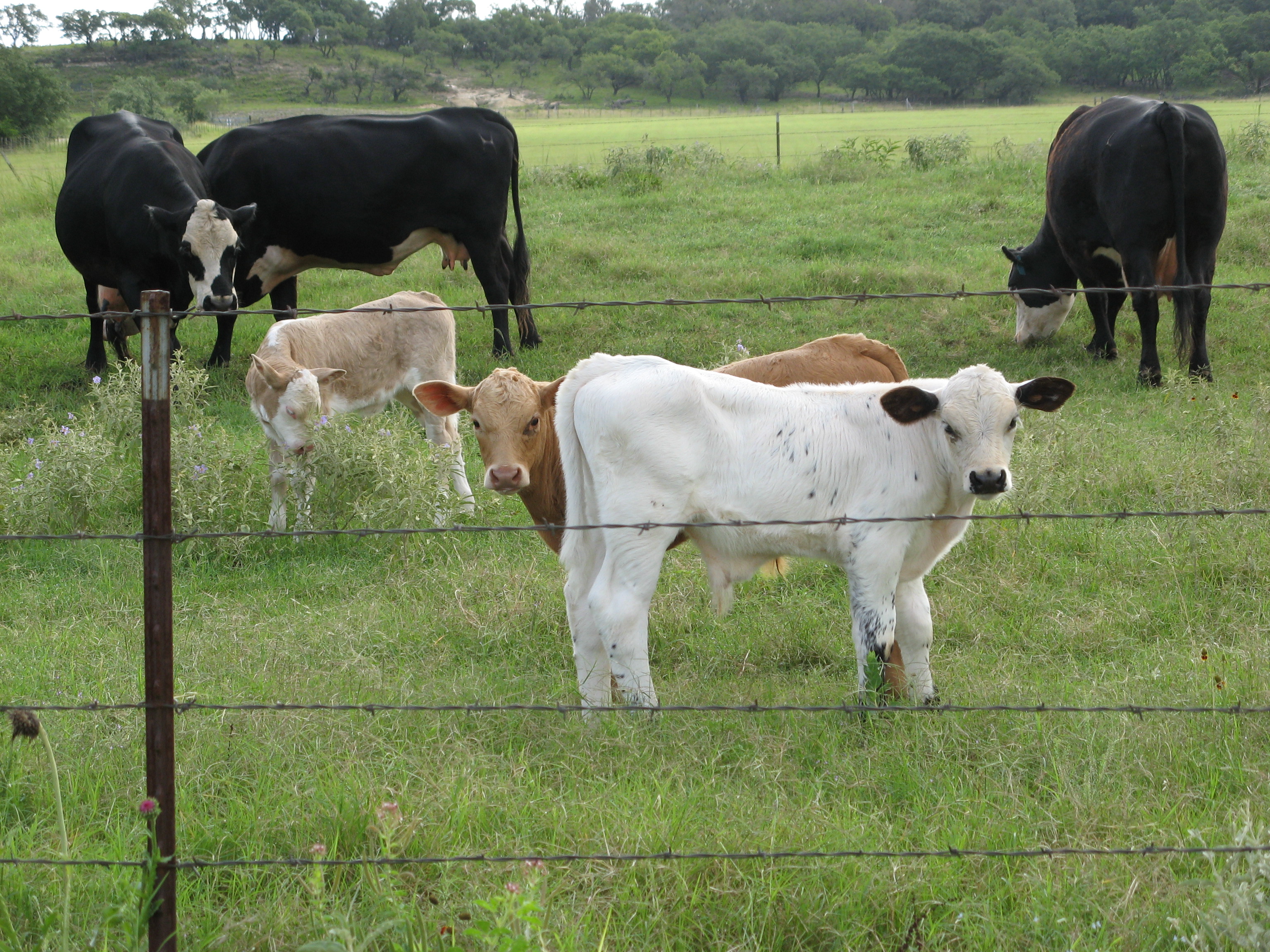
Then a couple of days I saw something in my herd of cattle that called me up short. Tragically a calf of about a month of age died. I found it dead without obvious cause. The mother had wandered off by then to feed with the herd.CALVES IMG_0191

When I rolled the dead animal over, inspecting it for signs of predators or other hints as to why it  had died, I was surprised to look up and see the mother trundling hurriedly for where I stood. The mama cow maintained her protective instinct for her deceased calf, and I felt sure she would have defended the carcass. Needless to say, I quickly took my leave.

Admittedly, protectiveness of the calf’s body is different from mourning but still projects an awareness of concern and affection for the deceased calf. Watching mother cows cleanse, feed, and protect their calves has convinced me that these mothers feel strong emotions for their offspring. Even the bull on occasion ends up calf-sitting and demonstrates surprising patience and protective instincts for his offspring.

I have believed for years that human psychology could be better informed if we better understand the behavior of other mammals, especially those closest to us on the evolutionary scale.

Would love to hear your thoughts. Do you think animals mourn? Do your pets show emotions?

A Backward Glance–Part 2 by Paul Hayes, Guest Blogger

This is Part 2 of the piece written by Paul Hayes. Paul, like me, always had a hankering to be a cowboy but first had to have a paying job to afford to do so. For Paul it was a successful career as a land man for Marathon Oil and for me, a career in Neurology. It was worth waiting for!– Tom Hutton
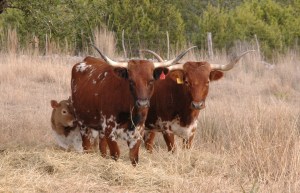
Two Longhorn cows and calf

Two Longhorn cows and calf

Paul Hayes wrote the following:

COWS

While we didn’t have any horses or cows ourselves, we lived on a dirt road at the edge of a very small town. So farm animals were all around me. In fact, the family of one of my best buddies, Bobby White (I think he was named after a quail), had a farm just down the road, and they had lots of animals. One day, while playin’ at Bobby’s place, he came up with an idea for the ages. He thought it would be a really great idea if we went and roped a cow. “heck, yes” I exclaimed with enthusiasm. Did I mention that I was the brainy one in my group of friends?

We dashed out to their barn. Remember, if it weren’t worth runnin’ to, then it weren’t worth doin’. Bobby climbed up on a horse stall and pulled a rather stiff rope down from a rusty ol’ nail on the barn wall. He jumped down into a cloud of dust and we proceeded to the pasture.

Now, bein’ the smart boys that we were, we picked a young cow are our first target. Bobby had growed up on the family farm and actually knew how to rope. Not livin’ on a farm myself, the only rope that I had knowed was fer jumpin’. We walked as close as we could get to our victim, and Bobby took his stance. He swung that rope around a few times and throwed it in the direction of that cow. Much to my amazement, and Bobby’s too I suspect, the lasso went over that cows head. As the cow jumped, the rope tightened. Bobby screamed for me to help and I grabbed aholt of that rope. We dug our heels in as far as we could and pulled with all the might that two boys of six years of age could muster. After a few harrowin’ seconds, the cow calmed herself and all seemed quiet.

But, the really fun part started with my next question. “Well, that was excitin’. Now what do we do?” After a few brief seconds of thought, which, as luck would have it, was not sufficient time to come up with a reasonable plan, Bobby said that, while one of us holds the rope, the other will crawl under the cow. Yep, you heard me right. Again, what six-year-old boy wouldn’t want to have that on his resume. Since there were only two of us, and since Bobby was already holdin’ on to the rope, he said I could go first. With not nearly the hesitancy of my first horse ride, I willfully got down on the ground next to the small cow. As I approached, I saw the rope tighten and I saw Bobby dig in for whatever might come. Wantin’ a good view of the excitement, I got on my back and began scootin’ along the ground under the cow. I am directly under the cow when I discovered that a six-year-old boy does not possess the strength to hold even a small cow in place. The cow jumped, kicked like a mule and then ran out into the pasture – rope draggin’ behind. I, on the other hand, laid breathless on the ground with hoof prints on the portion of my white Sears tee shirt that covered the center of my chest.

I had followed up my horse lesson with an equally successful lesson about cows. I am not certain, but I may have been rethinkin’ this cowboy thang at this juncture.

GUNS

Paul Dennis Harris was a boy who lived across the pasture from my house. He was a year older’n me so I, quite naturally, believed that everythang he said was as gospel as Sunday preachin’. I would come to learn that there are two voices that we hear in our lives, one is the voice of God, the other is the voice of Paul Dennis Harris. On this particular day, as I peered out the kitchen winder, I could see Paul Dennis over in the pasture playin’ with somethin’. I just couldn’t see what it was. That situation required a prompt investigation. As I approached, Paul Dennis displayed a pistol that he told me his grandpa said he could play with. I later doubted that the ol’ man, not havin’ been afflicted with brain damage to the best of my knowledge, knew anythang about the pistol caper. At six years of age, I knew nuthin’ ‘bout guns, includin’ the fact that they could lift a boy’s skull from his head if pointed in the wrong direction.

I have no idea what the caliber of the gun was. But it was heavy, and it was real. Paul Dennis suggested that we shoot a target, so he proceeded to set a coke bottle on top of a fence post. While I knew that that coke bottle was worth three cents down at the local grocery store, I was willin’ to forego that income for a new experience. Bein’ the nice guy that he was, he even said that I could shoot first.

Are you hearin’ a repeatin’ theme in these stories?

Well, by this time, bravery was my middle name, and I happily accepted the offer. He loaded the revolver with six bullets – five more, as it would turn out, than I would need to complete the experience. He then handed me the gun, stood back and covered his ears.

I’m six years old. I have no idea how to use a gun. Ne’ertheless, I took the pistol in my hand and held it up to my cheek just below my right eye. Takin’ good aim at that bottle, I slowly pulled the trigger. I am not certain what hurt worse, the powder burn on my cheek, the damage to my eardrums or the butt beatin’ I got from my dad when he found out. I immediately dropped the gun to the ground and ran home cryin’ like a cat in a rockin’ chair factory.

I learnt a hard lesson that day from the likes of Paul Dennis Harris. Age, as it turns out, does not necessarily equate to wisdom.

COWBOY?

Though I survived the age of six, my parents decided to move to Dallas before I could learn any more lessons about life in a small country town. I became a city boy whose only exposure to cowboys from that point on were the ones who played football on Sundays. Now, at the age of 56, I find myself living back in the country. However, it is safe to say that I will live my life as a cowboy vicariously through you.

Thanks for your contribution to my longevity.

Paul

Update to “Generosity Begins At Home”

Some time ago I wrote about a mama cow adopting a calf despite having her own hungry offspring. I had never before seen this occur and have learned it is very unusual behavior. Thought an update to this curiosity was needed.

The mama cow, bless her generous heart and sizable milk bag, continued to nurse both calves until they were yearlings. The calves grew into big, strong steers. I was proud when time came last week to take them to the auction barn. (Yes, I know what you may be thinking. Taking the grown calves to the auction barn is only a preliminary for 3-6 months at a feedlot and then a slaughterhouse. This is true enough. Yet, we need to remember how most of us enjoy a well marbled steak or a juicy burger. The animals are raised just for this reason not being, in any way, an endangered species.)

In any event I admired the two good looking steers when I dropped them off at the auction house. I also said a silent thank you that day to the giving mama cow. The result of this transaction; however, turned out to be surprising.

The first pleasant surprise was that I obtained the best price ever for the two steers. Several days later a second surprise occurred. A package arrived in the mail. In it was a a really fancy knife sharpener with a small plaque on it, notifying me that I had won the “top steers award.”

Imagine that: a calf that would have ended up a runt after losing his mama had instead been adopted by a generous mama cow. The two steers became the top steers at an auction last week of somewhere around 1000 head of beef. So as Paul Harvey used to say, “Now you know the rest of the story.”

Hay’s In The Barn

How affirming those words, “hay is in the barn”.  Have you ever wondered how hay is cut and baled? We cut our hay fields this week and baled both round and square bales. Below I share the process of carrying out this important ranch activity.

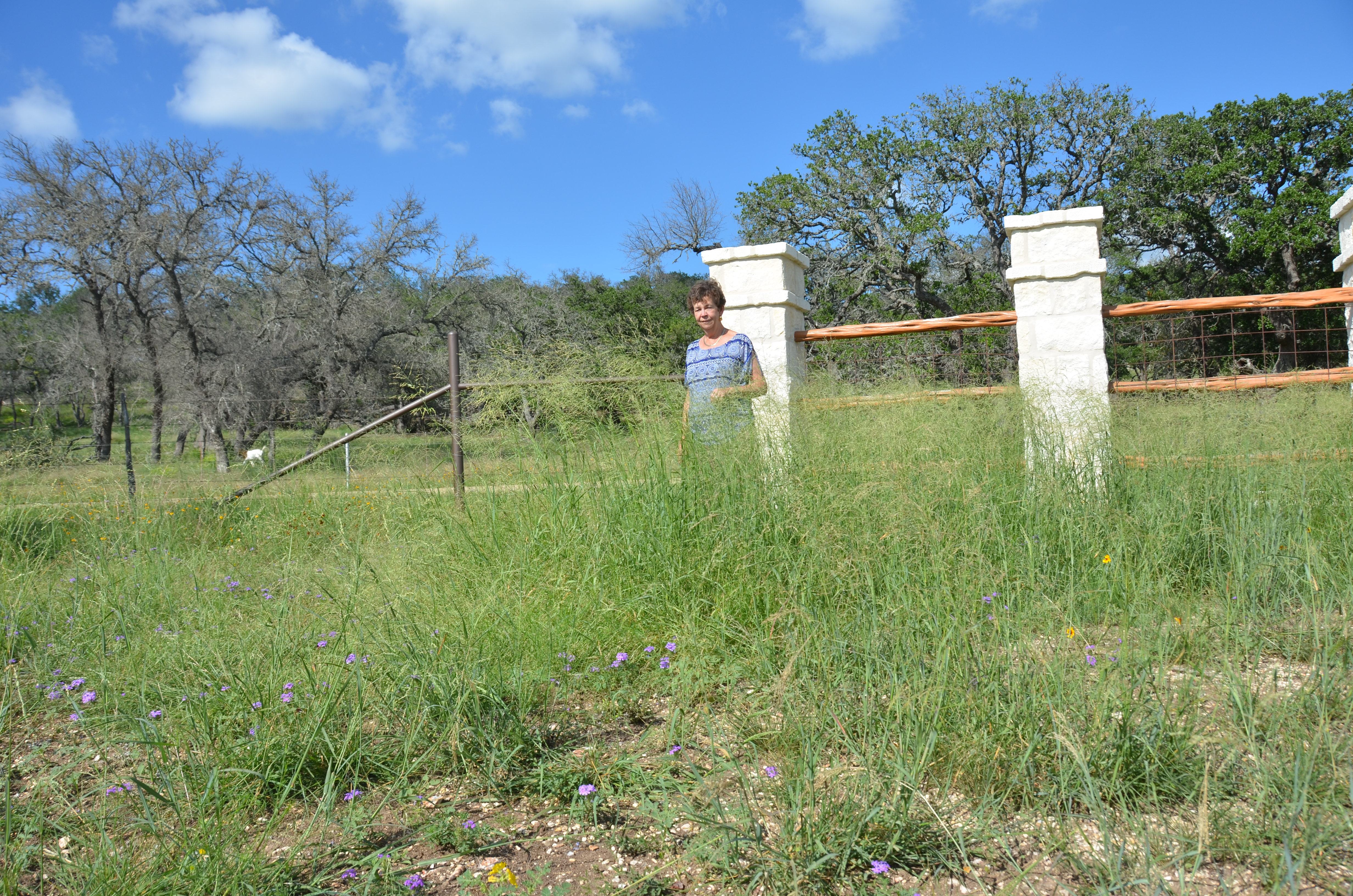
Two months ago our fields were brown and dusty. After our lengthy drought the fact that we obtained a cutting at all is fortunate. The process began two months ago.The rains this year came at the right time, namely just after we had fertilized the fields and then subsequent rain was well spaced till harvesting.

Trudy in Klein grass field

Trudy in waist high Klein grass field

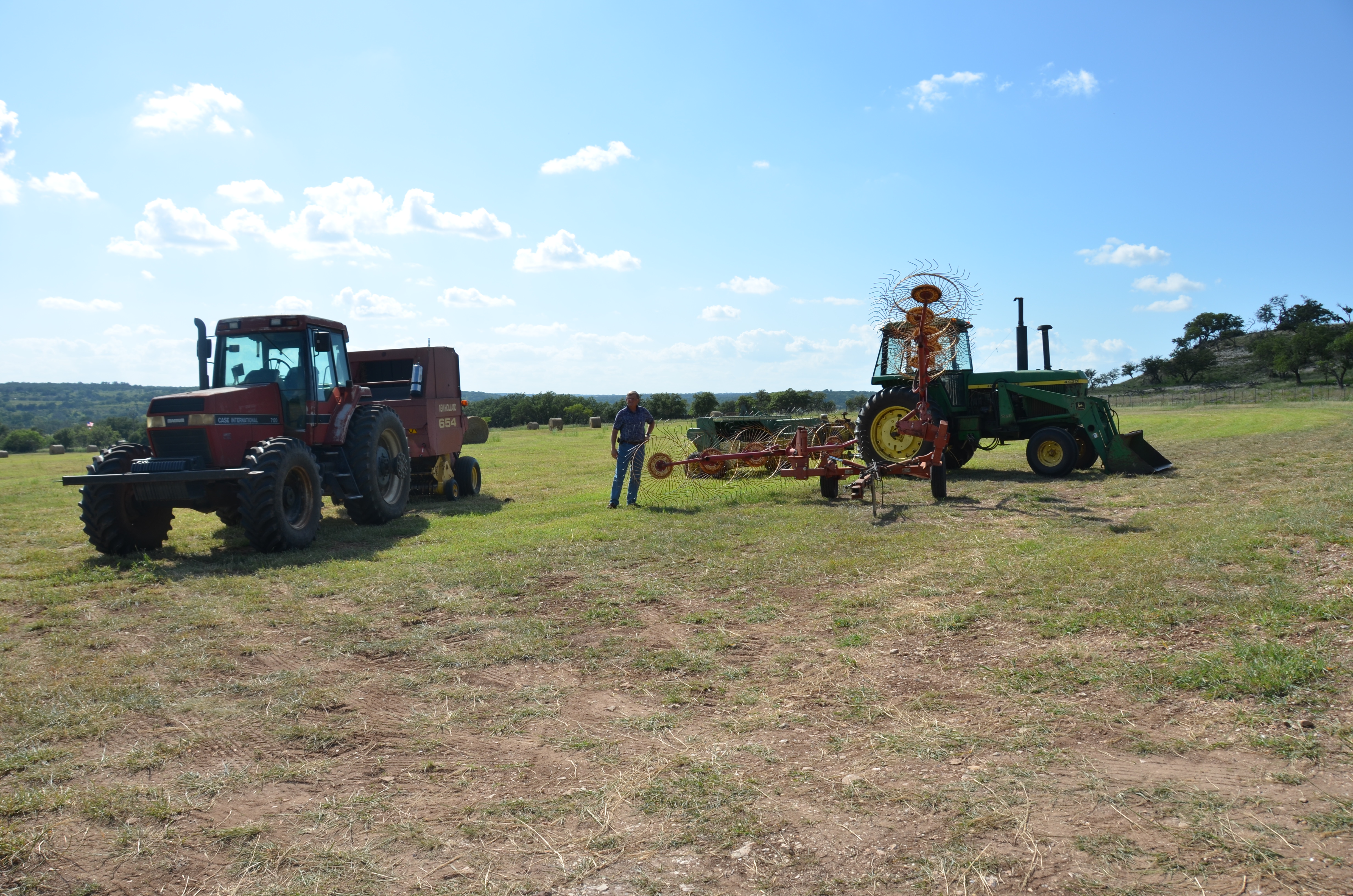
Being a small operator, we don’t own the cutting, raking, and baling equipment. Instead I hire someone with equipment and pay a per bale charge. The charge for cutting and baling our hay is substantially less than buying it, especially so during our recent drought years.

Yours truly with baling equipment

Yours truly with baling equipment

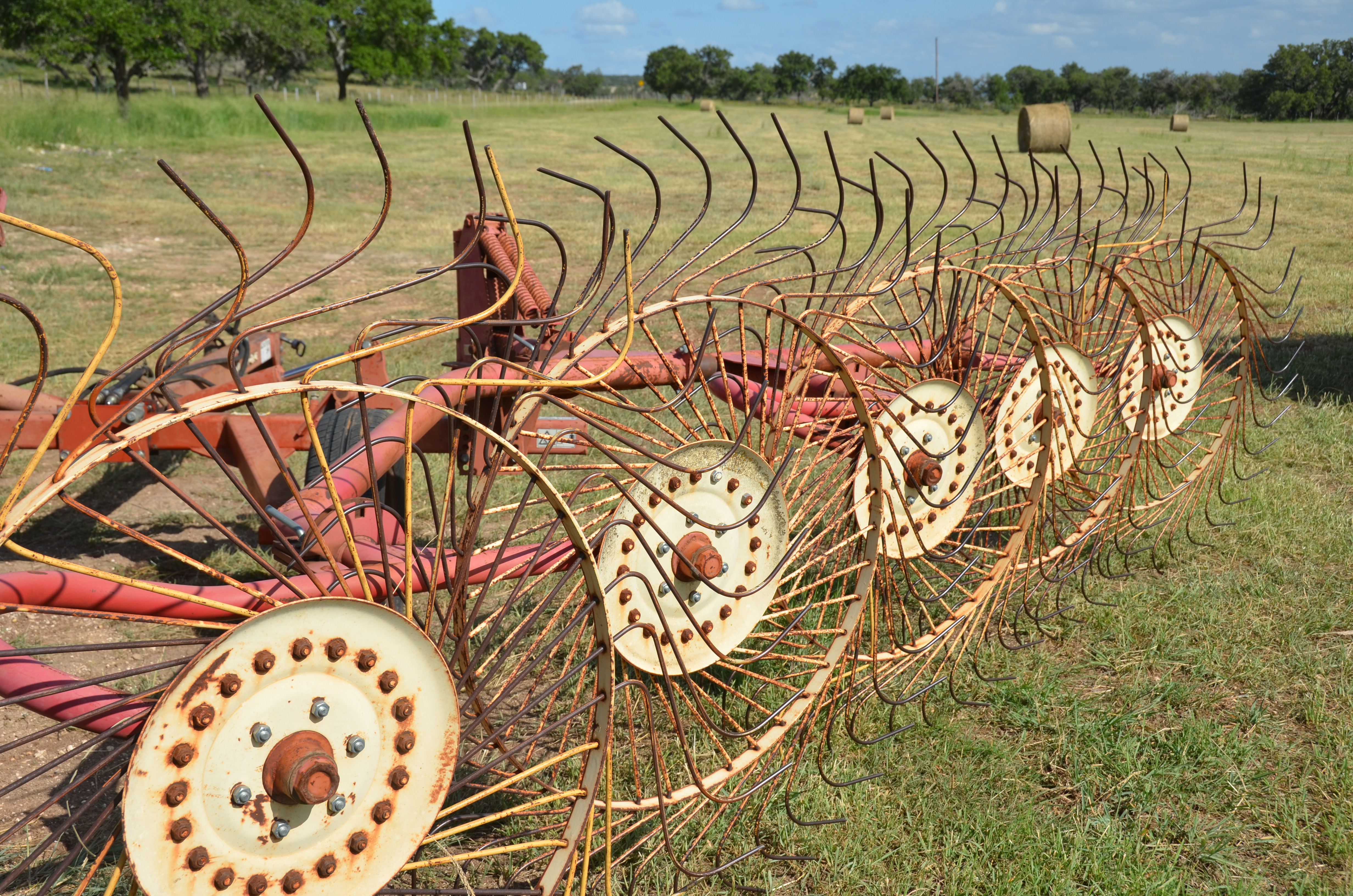
When the hay has grown and begun to head out, the tractor pulls the cutter through the fields and lays it down, much like a giant scythe. The hay then needs to dry for several days. Because of the threat of rain this year, we baled the Klein grass into bales before it had completely dried. Once the hay was cut and dried, the tractor pulled a giant rake through the fields, creating a large snake-like furrow of hay. Next the tractor pulled the baling machine through the field and picked up the rows of grass,  turning it into thousand pound round bales or sixty pound square bales. The machine amazingly ties the bale tightly with twine or wire to hold it in place.

Hay rake

Hay rake

Trudy with Hay bale

Trudy with Hay bale

Given the higher than normal moisture content of the grass this year, we will leave the bales in the field for a week or so to dry before moving them to the hay barn. This interval diminishes the chance for spontaneous combustion. Yes, instances have occurred where barns have burned down due to prematurely enclosed hay bales.

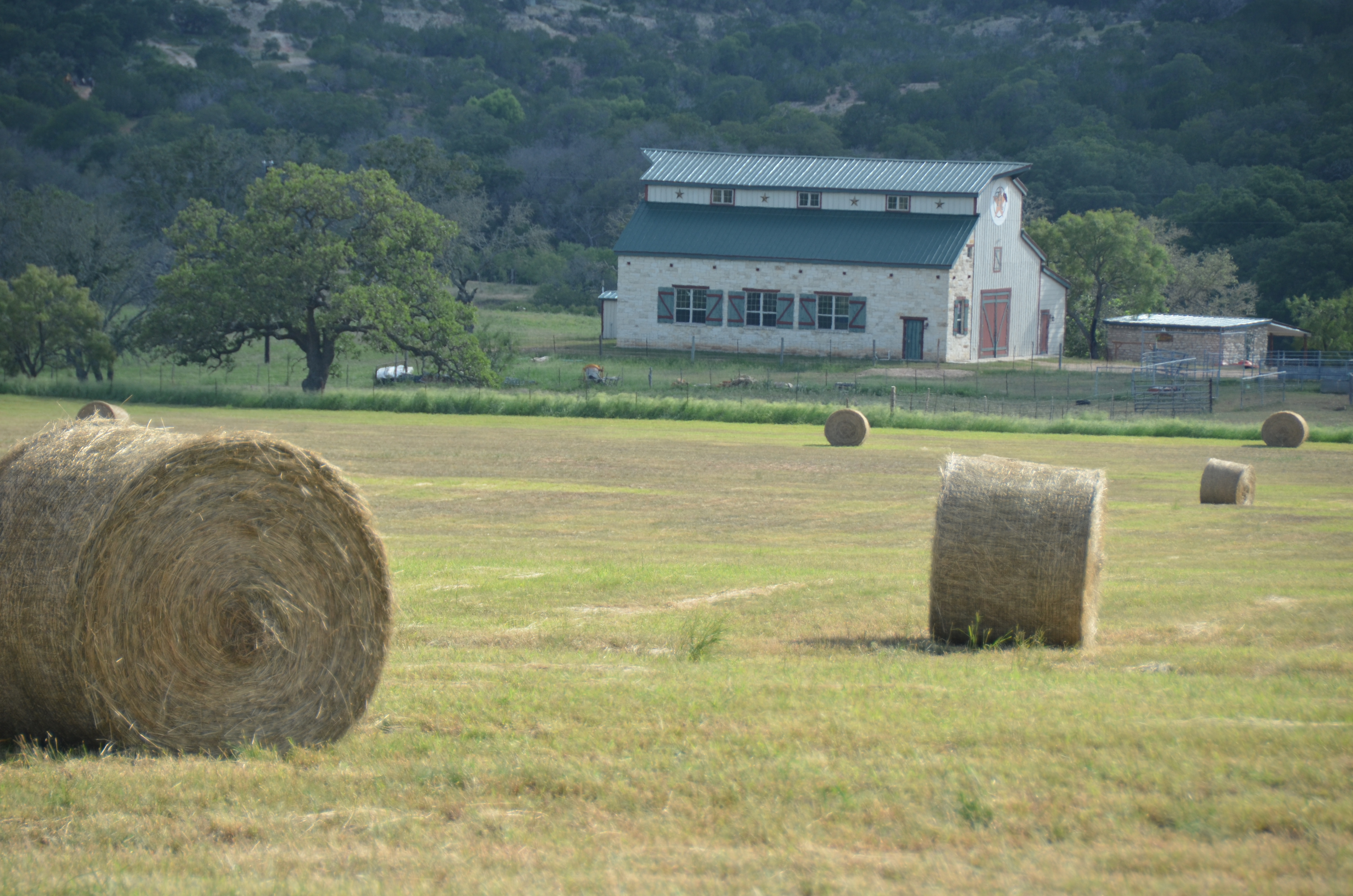
Hay bales and Hay Barn

Hay bales and Hay Barn in distance

Next week we will move the bales (both the large round ones for cattle and the smaller coastal square bales for horses) to the barn to store for the winter. Placing  the hay in the barn is a particularly satisfying time, knowing the animals will have ample hay during the non-growing season.

Prospective consumers of hay

Prospective consumers of our hay