From all the critters, stock, and folks at Medicine Spirit Ranch, we wish you wonderful holidays.


Medicine and Ranch Living
From all the critters, stock, and folks at Medicine Spirit Ranch, we wish you wonderful holidays.

The questionable county road sign on our ranch
The road sign above stands on the corner of our ranch. When first she spotted it, Trudy, my wife, became bothered, maintaining the county was demeaning the morals of our cattle. Now grant you, our bull is hardly monogamous nor will our cows necessarily shun the attention of an interloping bull, but Trudy claimed no reason existed to impugn the morals of the Hutton’s cattle. Whether or not this was tongue-in-cheek or not, I’m not completely certain. She’s like that sometimes.
Quite possibly the sign referred to the unfenced ranch on the other side of the gate where, at times, drivers encounter livestock standing in the middle of the road. Just sayin’ this is a possibility, dear wife. The county commissioners might not be demeaning the morals of our herd at all.
What do you think?
My two Border collies, Buddy and Bella, love to race up the hill to our front yard. Buddy jumps out of the pickup and takes off at full stride while Bella instead lags far behind. Given Buddy is the alpha male, this behavior may spring from her respect for his dominance.

Bella on the left. Jack, our so-called “Texas Brown Dog” on the right always refuses to get out the pickup. “Those silly Border collies, jumping out of a perfectly good pickup.”
About halfway to the finish line during this quarter mile sprint, in a fashion reminiscent of the thoroughbred racehorse, Silky Sullivan, Bella will lay back her ears, arch her back, hasten her pace, and rocket ahead like a low flying missile. At the last cattle guard that requires Buddy to tiptoe over it, young Bella will launch herself airborne, flying by or over a creeping Buddy. She then lands first at their seemingly agreed upon finish line, our front yard.
Many reading this post, may not recall Silky Sullivan- and for very good reason. He was a large red stallion whose racing feats occurred in the late 1950s. It will take someone from my generation or older to recall him. Silky Sullivan was known to have fallen behind as many as 41 lengths, only to come on like gangbusters and win by three lengths. His running style became synonymous with victory despite incredibly long odds. https://www.youtube.com/watch?v=6Vh8vyCQRV4
Perhaps Silky Sullivan is best known for his appearance at the 1958 Santa Anita Derby where he fell behind over 30 lengths only to overtake the other horses and win the event. He became known as the “California Comet” and likely caused many instances of heartburn among the bettors.
Bella, our female Border collie, implements this unusual running style. She seems unwilling to race head-to-head with Buddy early in their races, but Bella dearly loves overtaking him and flying across the finish line first.
I suppose some people also eschew head-to-head competition but still harbor the never-to-be-denied desire to win. This Silky Sullivan approach to life may not be limited to racehorses and dogs, but may include humans as well. Of course this behavior in humans may be more nuanced than it is in animals. Instead of an overt competitive edge, the desire to get ahead may be more subtle. What do you think? Do you know anyone who may demonstrate this “Silky Sullivan” approach to life? Do you ever show this type of behavior? Food for thought.
As I trundle around my ranch, my gaze is often drawn to unusually shaped trees. For example, the tree below while fully developed, is missing its middle portion. It looks strange. The main branch likely broke off many years ago in a wind storm or lightning strike but has compensated by growing from its outer branches. Such adversity, such perseverance from this Live Oak tree. This tree has managed to overcome and become an attractive, if unusually appearing, tree once again.
The strong Texas winds during storms have blown down a number of other trees around the ranch. Most died soon after being toppled but surprisingly some have survived. The trees downed by wind had shallow roots with the root ball surfacing completely or partially. Several trees with some remaining root structure have survived. They eventually redirected some of their limbs skyward and, if not exactly thriving, at least continue to live.These trees are all Live Oaks, the name coming from always having leaves. As compared to the usual deciduous trees that lose their leaves in the winter, the Live Oak always appears to be alive and pushes off its old leaves in the Spring to make room for new ones. The strong life force of the Live Oak conjures up for me the verb “to live” as much as it does the adjective “live.”
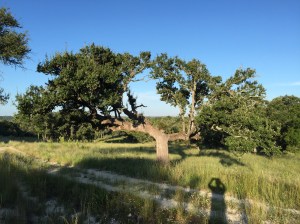
Oddly shaped tree that likely lost its main trunk to wind or lightning many years ago
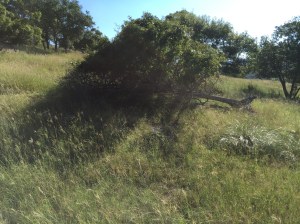
A toppled tree that has survived.
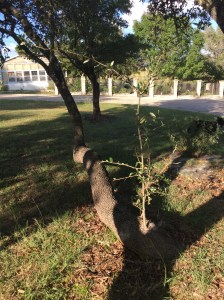
This felled tree not only has its trunk bent toward the sky but also has vertical shoots springing from near its base.
Looking at these challenged trees causes me to lean in and listen closely for their stories. It seems to me their botanical grit has frustrated the destructive forces of nature and offers a a metaphor for our human condition.
All of us are faced by life’s challenges. Fortunately most of our challenges are not serious but some are. A few of us have endured great challenges including death of a loved one, divorce, or loss of a job. Like the tree story, some people, despite such huge losses following their necessary grieving response, are able to re-establish their emotional grounding and get on with their lives. Others faced with similar or even lesser stresses sometimes just don’t bounce back as well. In my professional life as a neurologist, I was always surprised by how different people responded to bad news about their health. These responses varied widely. (if interested many examples are shared in my recently published book, Carrying The Black Bag: A Neurologist’s Bedside Tales) Which factors lead to these differences?
To continue the metaphor further, while external forces such as windstorms and lightning damage trees, an even greater menace to our oak studded ranch results from a tree disease known as Oak Wilt. This fungal disease spreads via a beetle through wounds to the tree or via its root system. It chokes off the channels that take up vital, life sustaining nutrition and hydration. In very short order, an affected tree loses its leaves and dies. A Red Oak tree will die within a day or two. Live Oaks take longer to die and despite being very ill, some will survive.

A tree killed by Oak wilt
The kill rate for oaks is 80-90%, yet some Live Oaks will maintain leaves on a limb or two and fight valiantly to survive.

An Oak tree severely affected by Oak wilt but will likely survive with a drastically altered shape
Without hopefully torturing the metaphor too greatly, It seems to me several points can be made. First, this serious tree fungal disease can be overcome by a few determined Live Oak trees. While damaged, the surviving trees, given enough time, will live and may even eventually become handsome trees once again. This is, i believe, an example of the strong life force of the Live Oak trees along with some good luck.
A second point relates to the higher death rate of those trees affected by the internal disease, Oak Wilt, as compared to the trees that sustain major damage by external forces. The internal forces of Oak wilt are more often fatal to the tree than are the external forces.
Might this also be true for people? We often face external adversity with greater determination especially if our own spirits are not sapped. Self-doubt, discouragement, depression, and hopelessness diminish the quality of our survival more so than do grievous external forces such as job loss, financial reversals, loss of a limb, or geographic relocations.
Oak trees are not humans. I get that. Yet, the apparent desire of Live Oak trees to persevere despite injury or illness provides a ready comparison for the human condition. Given that all of us will likely face a serious loss or illness, perhaps it is worth pausing to contemplate how we might nurture our fortitude and prepare ourselves for the inevitable.
Perhaps the tree story will help to nourish the hope that maintains our human existence during turbulent times.
Why are some compelled to write blogs? My own desire grew after assuming a new identity in retirement, that of a newly minted rancher. The novelty of it intrigued me. Being a “city boy,” nearly everything including raising livestock, operating ranch equipment, mending fences, and building barns held a strong fascination.
The thought occurred if I enjoyed learning about and living a rural and retired lifestyle, then perhaps others would like to read about it too. This interest eventually led me to begin blogging about my writing process and finally to aspects of my book. Admittedly, I also needed to decompress from my busy former career as a clinical and research neurologist and thought others might enjoy reading tidbits resulting from my inevitable backward glance at my life.
While still a young blog, I consider Views From Medicine Spirit Ranch to have been successful. Its popularity supports my original premise that others might enjoy reading about this subject matter. I very much appreciate receiving comments from readers and learning from them. The only experience better is having friends and family visit the ranch, especially those who “get it.”
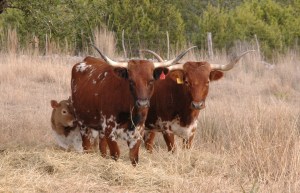
Two Longhorn cows and calf
Certainly not everyone who visits our ranch leaves with an appreciation for the land and for the animals in a way like Trudy and I do. That’s okay. Some would rather sit on the back porch and work their smart phones than absorb the tranquility and develop new ranch experiences.
Nevertheless, some who visit throw themselves into ranch life. A recent visit to the ranch by good friends LaNelle Etheridge and Madeline Douglas were two cases in point. Incidentally, both La Nelle and Madeline have been beta readers for many of my writing efforts and have fully supported my efforts to market my book, Carrying The Black Bag.

La Nelle and Madeline herding ’em up
La Nelle, Madeline, Trudy, and I recently worked calves. This consisted of vaccinating for blackleg and ear tagging them. Both visiting ladies threw themselves into the effort, helping and enjoying the novel experience. Both also managed to avoid being stepped on or pooped on. This was an accomplishment. Between swims in the pool they also tended the vegetable garden and hiked the steep green hills of our ranch. Both ladies are extremely intelligent and mindful such that our conversations on the back porch were for me especially pleasing.
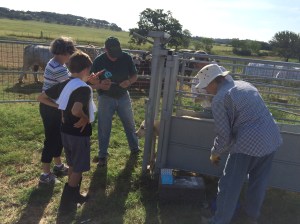
Vaccinating and Ear Tagging with La Nelle, Madeline, and Luke, the neighbor’s grandson
I could see excitement in their eyes as they became engrossed in their experiences that were so different from their usual lives in Lubbock. They sensed the tranquility of a Texas sunset from atop a hill while sipping a glass of chilled wine. These “Sundowners” have become a regular feature of our ranch life.

The dogs and I enjoying a “Sundowner”
Years ago at my retirement party my brother-in-law presented a large number of T-shirts on which was written “Tom’s Ranch Hand.” Paul Plunket in his humorous way predicted I would put friends and family to work on the ranch and possibly even avoid the need to hire any help. In this he was correct only to a degree.

Madeline on left and La Nelle on right with their T-shirts that read Tom’s Ranch Hands- Hutton Ranch
I had two T-shirts left over from my retirement party. At the conclusion of La Nelle and Madeline’s visit, I presented a T-shirt to each. Both appreciated the gift, small tokens though they were. This further convinced me of the wonderment that exists at Medicine Spirit Ranch set in these green hills of central Texas. It is a wonderment for at least some. Perhaps that is the way it always is. Different experiences resonate for different folks. I hope for future visitors to our ranch and to describe in writing the experiences for those unable to experience it directly.
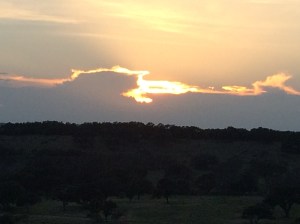
A Texas sunset
Lately most, but not all , of our ranch efforts have gone as planned. One exception resulted recently when Norman (remember the bull calf abandoned by his mother in favor of his freemartin heifer twin?) and another calf at a most inconvenient time decided to scamper away from the herd. The time had come to organize a cattle drive from our newer ranch, Hidden Falls, to Medicine Spirit Ranch where the grass was better. The bull, cows and calves seemed anxious and willing to follow Trudy in the gator that held a bag of range cubes. Juan, our ranch hand, and I flanked and pushed then from behind.
It was only after the herd had gone through the front gate at Hidden Falls and were trundling merrily along our county road that I realized two calves were missing. After securing the herd at Medicine Spirit Ranch, the three of us returned to Hidden Falls Ranch where, lo and behold, Norman and friend frolicked, seemingly enjoying their newly found, adolescent freedom.
What followed was part cowboy and part keystone cops. We did our dead level best to drive those two now apprehensive calves out the gate and down the county road. They had realized by then that they had lost contact with their herd and likely believed the other cows still resided back at the ranch we were leaving.
Needless to say, their young bovine four legs easily outdistanced our older human ones despite our considerable effort. Multiple times we had the two calves near the entrance to Medicine Spirit Ranch only to have them bolt and backtrack into the neighboring ranch. Once we were within spitting distance of the entrance to Medicine Spirit Ranch only to have two roaring cement trucks race down the road, frightening us and scattering the calves. Trudy gave the two cement trucks who had failed to heed her signals to slow up the one finger salute as they thundered by. Ultimately exhausted and irritated to near apoplexy we drove the two calves back to Hidden Falls.
The following day with our spirits and bodies renewed we drove the entire herd of cattle back to Hidden Falls where an uncomfortable mama cow with a bulging milk sack sprinted for the two hungry calves. After chowing down at the milk bar, the calves became anxious to rejoin the herd and followed their now relieved mama in that direction. Our efforts this time to drive the herd to Medicine Spirit Ranch were accomplished without so much as a calf getting out of line.
Norman has always been a different sort of calf to be sure. After a time of great dependence on Trudy and me, he became fairly indifferent to us following his adoption by his new cow mother. Nevertheless this was not the case when I went searching for Norman on that second day. He came running up to me and sucked on my thumb and let me scratch his ears. No doubt, he was famished and had likely not enjoyed spending his first night away from the herd and alone among predators. Ah, Norman- you are a different type of calf.

Norman: “Hey look at me. I am number one TWICE”
Spring has given way to sweltering summer. The rains gave rise to green pastures, full stock tanks, and murmuring creeks but now are only a remembrance. Mother Nature though has been good to Medicine Spirit Ranch.
A record harvest of both Klein and Coastal hay bales fills our barns and overflows to outside storage areas. I am filled at times like this with a sense of satisfaction which follows a season of worries about whether the rains would come, whether the fields would be dry enough to harvest, and whether the necessary equipment to carry out the harvest would materialize. Everything this time worked like a Swiss clock such that we produced more bales than ever before.

Hay is (mostly) in the Barn

I admit that my own efforts slack off during the heat of summer. Fortunately feeding the stock and maintaining fences doesn’t take too long. My ranch hand, Juan, has principally taken over the heavy lifting including the care of the lawn and ranch entrances.
Of late I’ve written extensively about Norman, our bottle fed calf who was rejected by his biological mother in favor of his heifer, freemartin twin.

Mama Trudy and Norman
I feel my story may have reached its denouement. It’s inevitable, I suppose, but surprising by how soon it happened. After two months of twice daily bottle feedings, to Trudy’s and my surprise, Norman has begun to rebuff our feeding efforts. His action has been not so much stiff-arming us but rather a polite demurral. He still saunters over and allows us to scratch his neck and ears and he continues to gaze at us with his dark eyes with long, curly eyelashes that Madonna would kill for. Nevertheless, he has been refusing to take hold of the nipple despite our best cajoling. This has proved surprising and concerning to us as prior bottle fed calves have continued to take a bottle for many more months.
When the herd realizes we’d not come to offer them range cubes (think cow candy), they soon return to mowing the pasture and graze away. Norman, observing their departure, has been turning away from us, responding to the strong social draw of the herd.
One evening several days after once again being rebuffed by Norman, Trudy and I stood in the pasture holding our still full bottles of milk, feeling full of rejection. We both worried about Norman lacking sufficient nutrition to sustain himself.
It was then we observed a nearby cow who had been keeping a keen eye on Norman and us. Nearby was her white calf of four or five months of age. We soon saw her calf meander up to her and latch onto a full udder for his evening feeding. Shortly after this occurred came a more surprising sneak attack occurred from Norman. He approached between mama cow’s hind legs and began to feed earnestly but on a less impressive hind teat.
The reader needs to understand how rare it is for a mama cow to accept a calf for feeding that is not her own. Nevertheless, there it was before our eyes- two calves, one her own and one adopted, suckling away.
Trudy turned to me with an expression one part surprise and one part relief. Our bottle calf was no more. Over the last week we’ve observed Norman feeding from this cow several times. While he only merits “hind tit”, he chooses his lowly feeding station over our carefully mixed and precisely warmed calf formula.
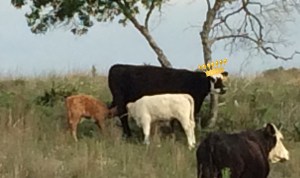
Adoptive mother, her white calf, and Norman sneaking milk. Crown attached courtesy of Trudy and Photoshop
To be sure, Trudy and I welcome the extra hour in the morning and in the evening and not having to prepare the formula, seek out Norman, feed him his gallon of milk, and cleaning the calf bottles. Nevertheless, we are left with an “empty nest” feeling like when our children left home to go off to college. It’s only natural of course that Norman become a full member of the herd and attends fully to his cattle herd and less to his humans. Our heads get it. But our hearts feel pangs of rejection.
Whether or not this is the end of his feedings or he will require only occasional supplementation will be determined. When Norman is bigger, I might just carrying range cubes in my pocket and slip him an occasional treats. He still feels special.
Mama Trudy and baby Norman
Recently I’ve written about a set of twins born at our ranch. The mother cow unfortunately promptly rejected the bull calf in favor of the heifer calf such that Trudy and I soon became surrogate parents to the bull calf. We have been bottle feeding him twice a day. Well at least we don’t have to throw him over our shoulders and burp him!
While cattle twins are rare, We’ve learned the concept of freemartinism in cattle. This occurs when a male calf (Norman in our case) and his female twin are born. The heifer usually has an abnormal reproductive tract. Her abnormality occurs due to the presence of male hormones in the bloodstream in utero that prevents normal development of the ovaries and/or other aspects of her reproductive tract.
The freemartin becomes an infertile cow with masculinized behavior (someone else will have to share exactly what this behavior looks like as I haven’t noticed any unusual spitting or scratching (thank you Ann Richards for the quote). A freemartin occasionally occurs in sheep, goats, and pigs.
The Roman writer Varro described freemartins and referred to them as “taura”. John Hunter, an 18th century physician, determined a freemartin always has a male twin. Talk about creating sibling grudges!
The question arises whether this condition might occur in human twins as this has been claimed in folklore. This belief was perpetuated for generations and was mentioned in the early writings of Bede. No good support exist for freemartins in human twins to the best of my knowledge. If others know differently please share your thoughts and level of support for this.

Norman and a big friend
Am pleased to share with you that Norman is growing and appears healthy. Another mama cow has allowed Norman periodically to nurse. Likewise his sister does well and continues to enjoy the mothering offered her by her biological mother. As for Norman he spends time in the nursery with the other calves during the day, scampers toward Trudy and me when we approach him, and like his ears and neck scratched.
Norman’s twin (the freemartin) is destined to become a beef calf rather than for breeding purposes. If I don’t watch it, Norman may, if Trudy has her way, end up as a big backyard pet.
I recently described here my shock at finding a rare set of newborn calf twins and being still more shocked when the mama cow refused to allow the tiny bull calf to nurse. Knowing this was not an unusual circumstance with beef cattle twins and previously having bottle fed calves, Trudy and I swung full force into action with store bought colostrum and powdered cow’s milk.
A nameless baby bull calf and his heifer friend
We determined the calf needed a name, but what should we call it? We typically don’t name those destined for the livestock auction, but in this case a handle shorter than “the bottle fed bull calf” was needed.
Since posting that story I’ve heard from “Rowdy’s Mom” who suggested the name, OLLI. Rowdy’s Mom until recently was the very capable director of the Osher Lifelong Learning Institute at Texas Tech University, hence the acronym “OLLI” and her understandable affection for the name. As an aside, She also is most responsible for cajoling me two years ago into helping to establish a branch of the OLLI-TTU in the Texas Hill Country. Thanks Emma for all your wonderful help and my arm has almost recovered from your persuasion.
Despite her’s being a very good suggestion, by the time we received it another name was already being used.
Mama Trudy and Norman
Have you seen the movie, City Slickers? This humorous movie starring Billy Crystal depicts his character and two chums (all New York City slickers) at a dude ranch improbably herding cattle via horseback from New Mexico to Colorado. During the long trail drive, a mama cow gives birth to an adorable calf they call Norman. Billy Crystal’s character is forced to rescue the calf from a surging river, he bonds with it, and quixotically packs him home in a crate to join his family in the city. The calf in the movie looks very much like our bottle fed calf and, you guessed it, we call our calf- Norman.
The feeding of Norman twice a day has become a regular staple of ranch activities. Betty and Cecil Selness, great friends from Minnesota, recently spent time with us and became regulars at Norman’s feedings.

Betty giving Norman his evening bottle while Cecil drinks his own happy hour libation
Grandson Graham spent part of his spring break at the ranch with fishing, horseback riding, gator driving, and hikes on the agenda but his favorite activity above all others was feeding Norman. Graham also learned how hard a baby calf can buck against a bottle when the milk doesn’t come out quickly enough.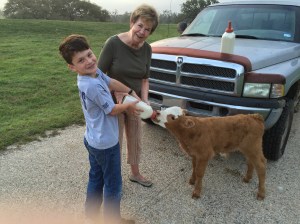
Needless to say, Norman has frolicked and suckled his way into our hearts. It’s hard to spend so much time staring into Norman’s appreciative dark eyes and not develop a bond of affection. In a year when we need load him into the cattle trailer for the one way trip to town,it will be a sad day indeed.
In my next post, I’ll share what I’ve learned about bovine twins of different genders and the concept of freemartins. Please let me know if you’ve had similar experiences and, if so, what you learned, especially about yourselves. For now you can think of Trudy and me as Calf Mama and Calf Papa.
 Views From Medicine Spirit Ranch