Category Archives: Animal Adaptability

What Dogs Teach Us

We teach our dogs tricks, but hubris may prevent us from recognizing what dogs can teach us. During my numerous trips around the sun and from watching my canine friends age, I’ll admit to a few things I’ve learned from my dogs.

If you will just listen, I can teach you a few things!

Lately, I’ve observed Bella, my Border collie, changing some of her behaviors. As Bella has aged, she has developed Diabetes. Her Diabetes has clouded her eyes, similar to the cataracts I developed and had surgically removed. Due to her low vision, I’ve observed Bella bumping into doors and fences. When Bella and I take walks on the ranch, she has taken to trailing me by scent with her nose to the ground and with cocked ears, listening for my footsteps. Both are good adaptations to her visual loss.
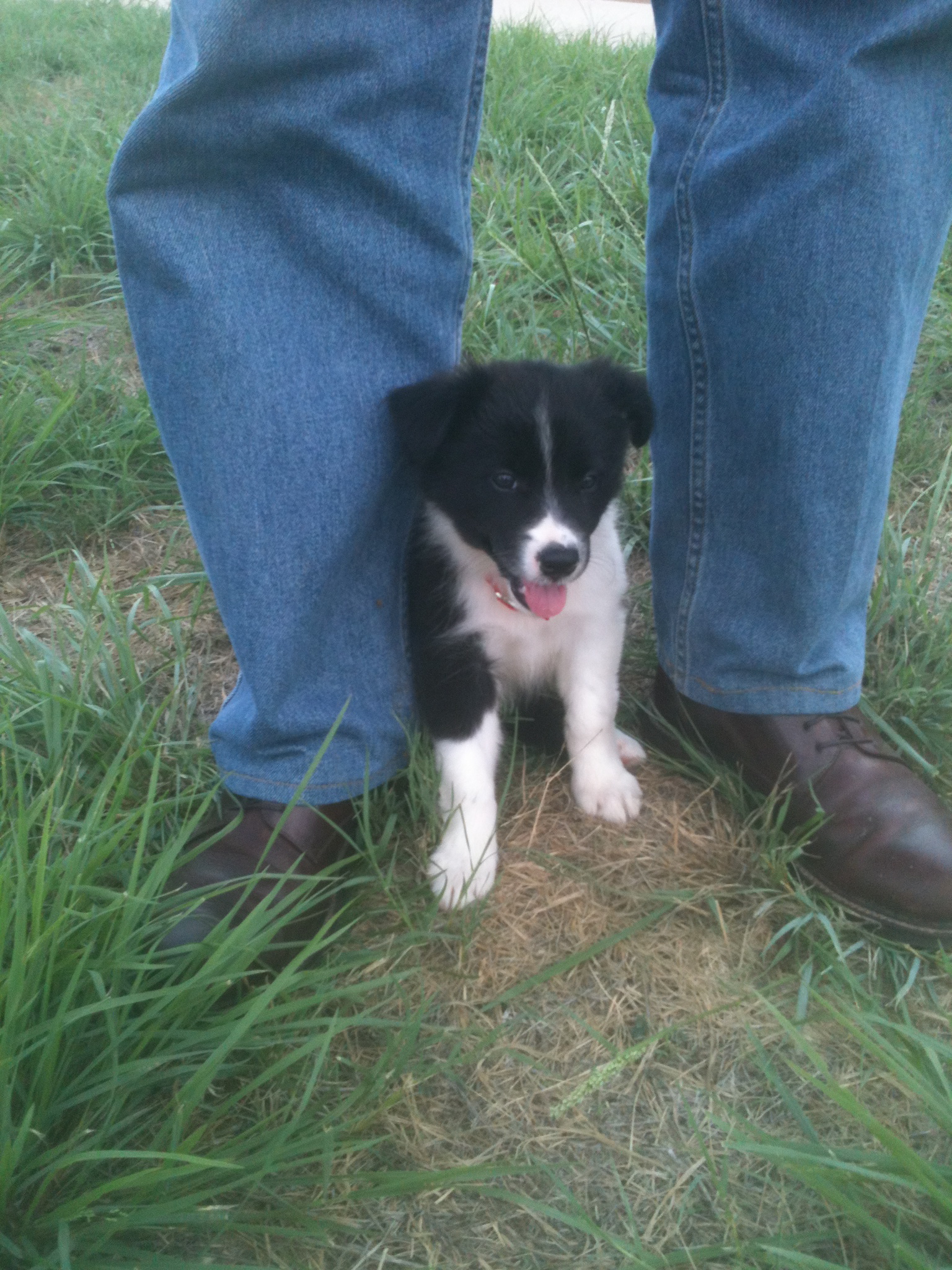
Bella as a healthy puppy, full of vigor and promise

I am struck by her seeming calm acceptance of her sensory loss. Also I admire her desire to continue walks about the ranch, albeit it at a slower pace and requiring her other more intact senses to manage the task. She doesn’t seem to get upset with herself when bumping into objects but accepts her diminished vision with grace. The line from the Desiderata by Max Ehrmann comes to mind, “Take kindly the counsel of the years, gracefully surrendering the things of youth.” The writer rendered good advice, and Bella has modeled surrendering gracefully for me.
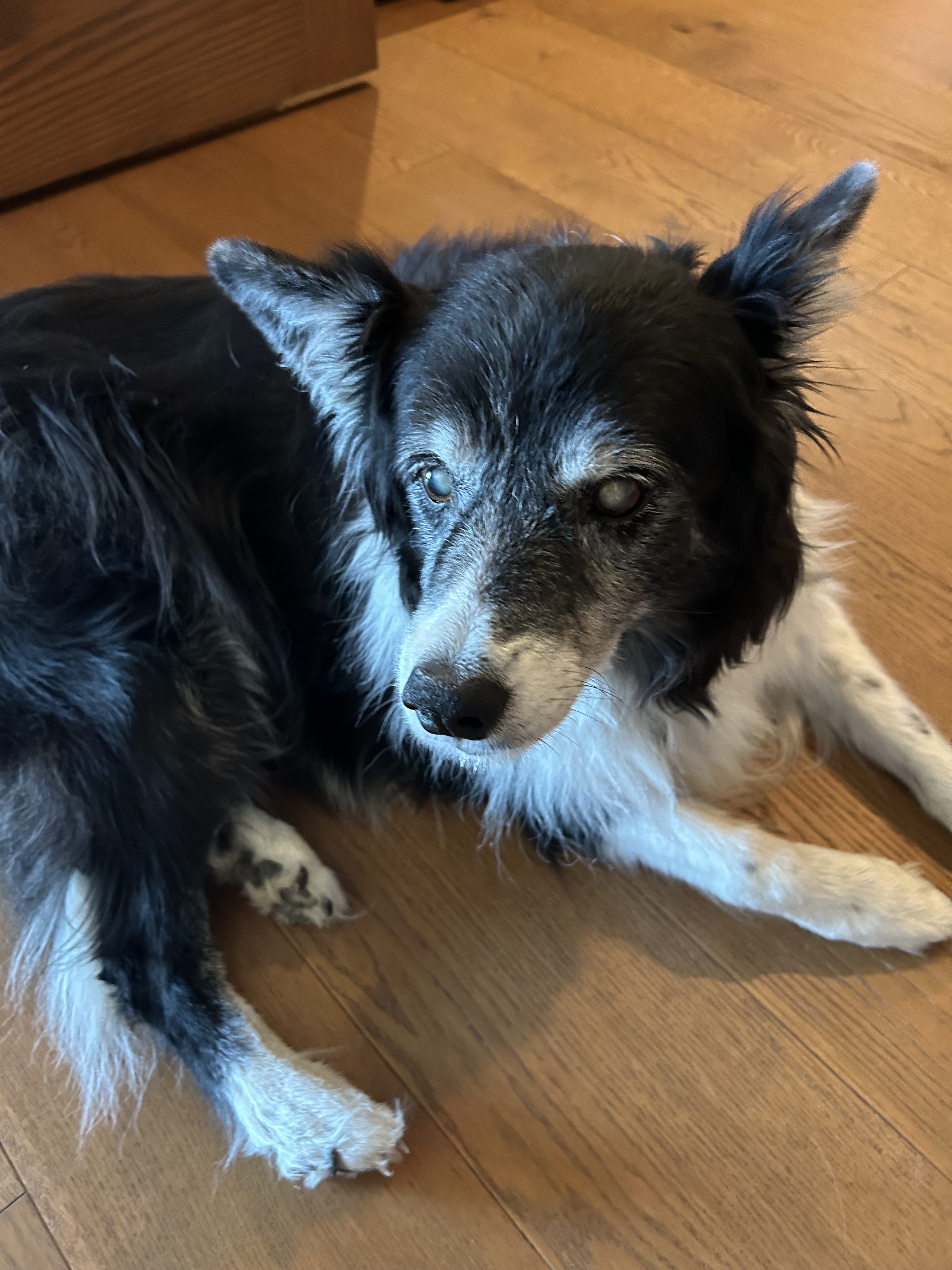
Look closely at Bella’s cloudy eyes that vets refer to as nuclear sclerosis

Frankly, Bella has modeled this behavior better than I. A number of times friends have asked me given my age if I ever consider selling the ranch and moving to an easier life in town? Or I’ve been asked, would I consider cutting back on my ranch activities? Certainly, the amount of work that is required in keeping up the ranch would be less if I were to sell it, and the injuries suffered from being around large animals would certainly be reduced. Yet my sheer enjoyment of the ranch with its views, purpose, and peacefulness prevents me from making drastic changes in my ranch activities. But in recognition of my growing physical limitations, I have learned to ask my ranch hand for more help when my loss of speed and balance would place me at greater risk.

Bella is now twelve years old. In dog years this makes her 84 years old. She certainly is not the energetic, athletic dog of her youth. Bella is now content to curl up in her place in the sun and snooze away the day. I too have found the comfort of a nap after lunch, and Bella and I often partake of a nap together in the afternoon. We still enjoy a walk late in the afternoon, but both of us take longer to recover from the exercise than we did earlier in our lives.

Bella now spends an inordinate amount of time napping

As Bella has aged, I’ve noticed her becoming increasingly dependent on Trudy and me. She now requires a boost when jumping into my pickup. She also needs help getting onto my elevated bed in order to take her afternoon nap. Bella no longer pays attention, or perhaps even sees, deer meandering through our yard or varmints on the ranch. I recall in earlier days when she and Jack, our rescue dog, would tear into marauding armadillos. It wasn’t pretty, but demonstrated amazing mutual hunting skills and athleticism. Armadillos by the way, can really run!

I suppose as we age, we all need to accommodate to diminishing physical skills whether it is wrestling calves, mowing the yard, or replacing light bulbs from a ladder. Avoidance of certain activities reduces risk of injury and are better left alone. This makes sense, but admittedly can be hard for humans, especially men, to accept.

While her physical skills have diminished with Bella’s aging, her love and extreme loyalty have only increased. She has taken to following me around the house, moving with me from room to room. She appears uneasy when not with me and will, with nose to ground, seek me out wherever I am. As I write this, Bella lies beside my desk, placed in such a way that I cannot leave my desk without having to alert her by stepping over her. She seems to gain pleasure from being with me, perhaps for protection or merely for the love and affection she receives.

Bella almost ended up as a show dog and owned by a man in South America. We like to think we gave her a happier life on the ranch. Her name means beautiful in Italian and fits her well

Likewise, my desire for companionship and spending time with friends has also increased as I’ve aged. I’ve always been a person who needed human (and animal) companionship. Nevertheless, if I don’t have human or animal contact, I find myself missing it, even more so than in my earlier years.

I recall an earlier Border collie of ours named Molly who grew old and ill. The vet assumed she had cancer but she was still up and about and enjoying life to some extent. Shortly after seeing the vet, I awoke in the morning and found Molly dead on the floor not far from me. Molly accepted her illness with great stoicism, a strong trait in Border collies. The vet was embarrassed and regretted not offering to put her down earlier. I felt there was no need for his embarrassment, having witnessed the incredible stoicism of my serial Border collies.

I often recall Molly’s stoicism and that of my other Border collies when I hear aging human friends recount their numerous ailments. Jokingly, I refer to their complains by medical terminology as their “review of systems.” I hope that I will be able to retain a degree of Border collie stoicism in light of advancing aches and pains and potentially more serious health problems that undoubtedly will come with advancing age.
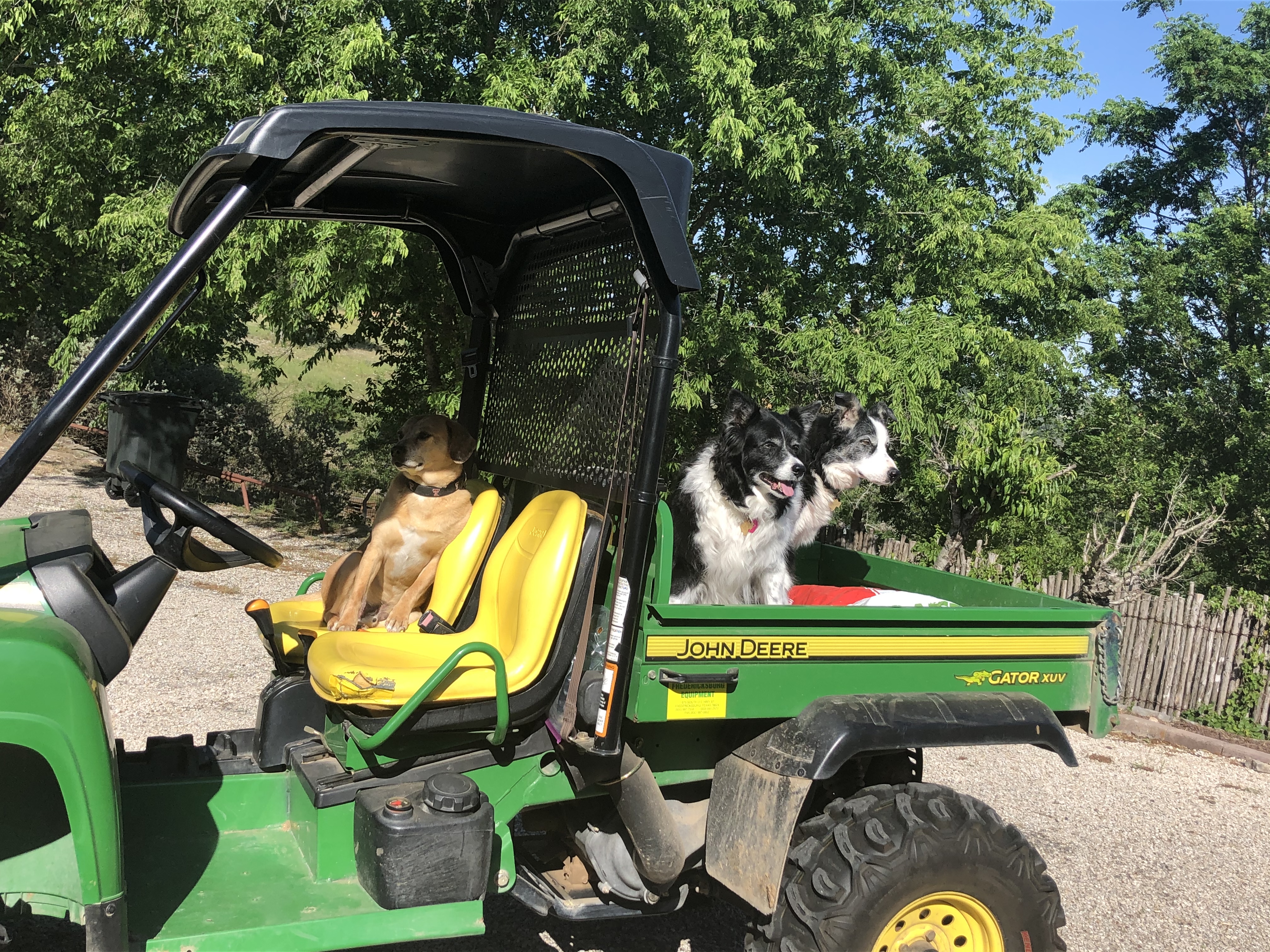
Hey, we’ve taught you as well,” Jack and Buddy say! Jack in the front seat, Buddy and Bella in the bed of the Gator

The lovely aspect of having serial dogs throughout my life is that with their shorter life expectancy I’ve observed the maturation and behavioral changes due to their aging. I’ve observed many cycles with my many dogs. Any teacher will share the importance of repetition for learning. My dogs have provided me healthy examples of how to age gracefully and model acceptance of life’s inevitable changes. For this I am most grateful.
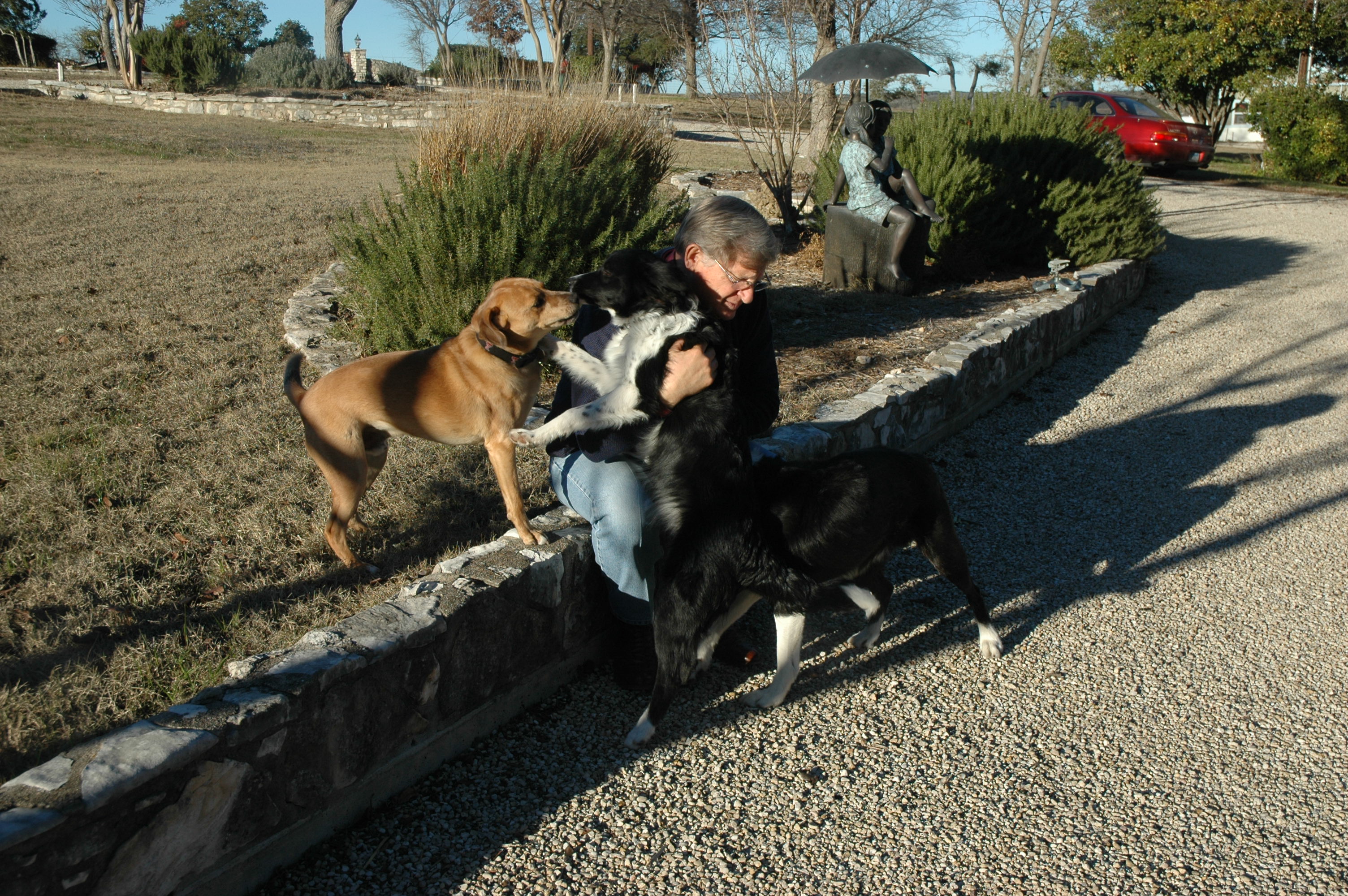
Bella and I giving each other a big hug with a jealous Jack looking on and Buddy in the shadow at my feet

If you have not had the chance to read my latest book, Hitler’s Maladies and Their Impact on World War II: A Behavioral Neurologist’s View (Texas Tech University Press), I invite you to do so. The book explores an important aspect of the Hitler story and World War II that has not been well studied. Many of Hitler’s catastrophic errors including the premature invasion of the Soviet Union in June 1941, the slowness of German forces to counterattack at the Battle of Normandy in 1944, and the highly risky Battle of the Bulge in late 1944 into 1945, can be better understood, knowing the sizeable impact that Hitler’s physical and mental conditions had on these vital battles.

Also, consider picking up a copy of my earlier book, Carrying The Black Bag: A Neurologist’s Bedside Tales (Texas Tech University Press). Please join me on my personal journey as a physician and meet my patients whose reservoirs of courage, perseverance, and struggles to achieve balance for their disrupted lives provide the foundation for this book. But step closely, as often they speak with low and muffled voices, but voices that nonetheless ring loudly with humanity, love, and most of all, courage.

An Unusual Visitor On The Ranch

While searching for a lost cow the other day, I came across a sight that caused me to make a classic double take. Before me stood a large Axis deer with a truly impressive set of horns. I had never previously seen an Axis buck or any other Axis deer on my ranch. These deer also go by the name of Chital which means spotted in Hindi. Indeed the spots on the adult Axis deer make them distinctive as do the impressive horns on the bucks.

Our Unusual Visitor On The Ranch


The buck I spotted didn’t appear to be afraid of me or of the truck I was driving. He walked calmly by in front of me, as if searching. I had heard that Axis deer did not jump fences (not true) and wondered how in the world he found his way into my pasture. This surprising visitor caused me to research the topic which I found interesting enough to share with you, the reader.

Axis deer were introduced into the Hill Country of Texas in the 1930s as an exotic animal for hunters. They also exist in parts of Australia but the largest populations exist in the Asian subcontinent. This variety of deer originates from India but found the Texas Hill Country to their liking. The terrain in the Hill Country is similar to that from whence they came. It did not take long for Axis deer to escape from the hunting ranches in Texas and populate this area. Axis now compete with our native White Tail deer.

Axis males are from 150 to 250 pounds and are about the same size as White Tail deer. Nevertheless, when meeting at a feeder, the Axis deer will run off the White Tail deer. White Tail and Axis do not interbreed given that they represent different species. Axis deer browse and graze and live in herds typically up to about fifteen individuals. They tend to vocalize much like an elk although not quite as loud.

Many Axis deer in the Hill Country were killed by the severe ice storm experienced last winter (see previous  blog piece for description and pictures). Obviously this big boy escaped harm which may explain why he is wandering about alone and perhaps searching for a herd of Axis deer to join. The ice storm may be one of the rare risks in Texas for this species of deer. We have no wolves in the Hill Country and mountain lions are fairly rare. Packs of coyotes may present a risk for Axis deer, as they do for White Tail deer.

The meat from Axis deer is said to be the tastiest of any wild game. Also being an exotic, no season exists for them and they can be hunted anytime. The open season for Axis deer is like that for feral hogs who are far more damaging to property and fences. The general advice has been to shoot Axis deer, as they are slowly out competing our native White Tail population. Actually we are so over populated with deer in the Hill Country that the hunting season for White Tail deer keeps getting extended and hunters are urged to shoot Axis anytime they come upon one.

I must admit that the beauty of this large buck left me momentarily mesmerized. Not being a hunter, I would find it difficult to shoot anything quite so magnificent as our recent visitor.

Age and Wisdom

When recently  feeding out a steer (a Longhorn/Charolais cross), I decided to put his Longhorn grandmother, Bell, with him for company. This was to calm the calf that for the first time was separated from its mother and herd, and in addition to pamper Bell who was the first cow on our ranch and for whom I remain sentimental. She is now north of 25 years of age and in recent years has been becoming progressively skinny and competing poorly for food with the larger herd of Black Baldies.

Over the three months of fattening, like the calf, Bell gained weight and began to look much healthier. She relished the daily feedings of grain. When she would see me approach in the pickup, she would head straight away to the food trough with the steer following closely behind. When the calf was eventually fattened, loaded into the trailer, and taken to be processed, I opened the gate to reunite Bell with the herd.

But it seems Bell had developed an appetite for the finisher feed. Whenever I passed her for the next several days, she tended to track me hopefully with her plaintive brown eyes. I also observed her not feeding well on the still short Spring  grass, nor could she compete successfully when I doled out supplemental protein cubes. In short, she was once again dwindling.

I tried to feed her extra, but proved unsuccessful due to the other stronger cows showing up and running her off. This morning this unfortunate scenario reoccurred. I felt bad that Bell was unable to obtain more than a mouthful of grain before being driven off by the other cows and the bull. After my unsuccessful attempt I went about my ranch chores but continued to ponder if there was another strategy to supplement Bell’s diet. I eventually headed  back up the hill to where the herd resided.

But halfway up the hill, I found Bell standing alone. She seemingly had placed herself in this prominent position where I couldn’t miss seeing her but also located out of sight from the remainder of the herd.  I stopped and gave her a large portion of grain. She ate with gusto and without being molested by the other pushy cows, calves, or bull.

By guile and experience, Bell has found a way to obtain her extra feeding. I must admit being older myself, that I gained satisfaction at seeing the old girl outsmart the rest of the herd. Animals sense when another is slipping and afford them little succor. This old Longhorn had always been the smartest cow in the herd and for many years, despite not being the largest cow, served as the Bell Cow. When she eventually had to give up her rank in the herd, her daughter, also a Longhorn, took over as the Bell Cow. The Longhorns being smarter always led the Black Baldies to where the grass was best and the water plentiful.

Watching Bell this morning reminded me of the old saying that experience and guile can beat out the enthusiasm and vigor of youth. Once again, Bell the aged Longhorn proved this aphorism to be true.

Buzzards and Vultures

What a joy to publish a guest blog piece  from a friend and true expert on bird behavior. The honor is even greater and more personal as Dr. Rylander was one of my principal professors when I attended college and majored in Zoology. What a surprise when Dr. Rylander and I learned that following our retirements that we had both chosen Fredericksburg, Texas, as a place to live. He is the author of Behavior of Texas Birds, published by the University of Texas Press.

One of the nearly constant sights over our ranch is the presence of vultures languidly circling high above. Little did I understand the differences of the two types of vultures that we see, although always being amazed by their graceful flight and efficient clean up of roadkill along our rural roads. Dr. Rylander makes their presence more meaningful and enjoyable to view than I had ever considered. Enjoy!


Guest Blog Piece by Kent Rylander, Ph.D.

Growing up on a farm during the late 1940’s, my brother and I called them “buzzards” – those large, black, hawk-like birds that soar in circles high overhead, or that stand on the highway by a road kill and fly away lazily if cars approach too closely. Even today most farmers in Denton County call them buzzards, and some still shoot them because they think they’re hawks or that they transmit diseases.
Later, when our parents gave us a field guide, we learned the preferred name, “vulture,” a term ornithologists introduced to distinguish our vultures from the unrelated African buzzards. We also learned that two species occur in Texas, the Turkey Vulture and the Black Vulture.

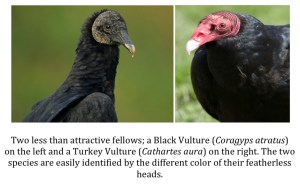
Black Vulture on the left and Turkey vulture on the right


Overhead these two vultures might appear to be the same species because they are so similar in general appearance. However, a closer look reveals that the Turkey Vulture is very light on the wing and rocks gently back and forth as it effortlessly soars for hours; it rarely needs to flap its wings. In contrast, the Black Vulture’s body appears too heavy even for its broad wings. Indeed, Black Vultures must flap and glide just to stay aloft even at high altitudes where thermals are strong.


The “personalities” of these two species are related to their different body types. Both have keen eyesight and regularly search for carrion while they soar high above the ground, but they differ in an important way. The Turkey Vulture’s large wing to body ratio allows it to fly low over the ground and locate small animals such as snakes and rodents. It also has a sense of smell, which almost all birds, including the Black Vulture, lack because olfaction is useless for an animal that spends most of the time in the air.


More than a century ago Audubon claimed he demonstrated olfaction in Turkey Vultures by placing a dead animal under a sheet next to a realistic painting of a carcass. A vulture flew down to the painting but ignored it, then pulled the carcass out from under the sheet.


Although Black Vultures can’t locate small carcasses because they must fly high to stay aloft, they compensate for this limitation by watching Turkey Vultures forage low over the ground. When a Black Vulture sees a Turkey Vulture feeding on a small carcass, it drops down and drives the Turkey Vulture away. The Turkey Vulture seems to accept being bullied by its much heavier and stronger relative, even when both are at a large carcass.


Is the Black Vulture more aggressive because its size enables it to be a bully, or is it basically just a more aggressive animal?


The answer to this question lies with the young, fluffy white fledglings, which hatch and live in small caves in cliffs and rock formations. When a person approaches a Turkey Vulture fledgling, the young bird cowers and retreats to the back of the cave; but when a Black Vulture fledgling is approached, it hisses and lunges at the intruder.


So when we look up and see Turkey Vultures and Black Vultures soaring together, ostensibly cooperating while looking for a well-deserved meal to share, we know that, thanks to their genetics, they’re not foraging together because they’re friends.

Survivor Duck

Years ago my neighbor and I shared a brood of Rouen baby ducklings. They were delivered by mail, raised in cages, and eventually when ours were grown walked by Trudy down to our nearby stock tank. Actually to Trudy’s surprise the following day she found that they had walked back to our back fence, and she had to again walk them back down to the stock tank.

These Rouen ducklings became big breasted and flightless ducks. While they can manage to fly for very short distances and at a foot or two above the water, they essentially are flightless. What we had not counted on was that these flightless ducks became particularly vulnerable to varmints, such as raccoons and coyotes. Sure enough, one by one, the ducks disappeared without so much as a suspicious pile of feathers being left behind. That is, all of the ducks but one, this being a male Rouen duck.

This is not MY Rouen duck, as he is currently moulting and not very pretty. This picture of a male and a female Rouen duck is taken from the internet


I’ve named thislone lone duck, Survivor duck, for obvious reasons. But what wasn’t at all clear to me was how this duck managed to dodge the predators and live when all the others had been lost early on. He has now been without any of his fellow ducks for some three or more years. How in the world did he manage this feat of survival?

As is my routine very morning, I head to the stock tank and throw out feed for Survivor Duck and for the bass and other stocked fish in the tank. Almost every day Survivor Duck paddles over to me and enjoys his breakfast. His ability to pluck the pellets from the water always reminds of of a sewing machine. His head simply flies up and down so fast that it becomes blurred.

He has become so used to my presence that he is almost tame. He will waddle along the ground a step in front of me and eat the feed that I throw either on the ground or in the water. I doubt he would let me approach him close enough to pick him up, but it would be close.

On the days when Survivor Duck doesn’t appear, I always fear he has become the latest duck to meet with a grisly fate. But within a day or two, I see him churning through the water toward me, as I open the duck box and begin to throw out feed.

My answer to this nagging question of how he has survived came not long ago. As I approached the stock tank, I scanned the pond and did not see Survivor duck. But Suddenly my eyes were drawn upward to a flying duck at around fifty feet. I watched it fly the length of the stock tank. As it approached overhead the duck banked to the right and made a long lazy loop out over the edge of my property and my neighbor’s property only to complete the circle back over the stock tank.

The duck flew toward me, lost altitude, extended its feet like orange skids, and landed in the water not more than twenty feet away. To my amazement it was Survivor Duck. Our so-called flightless duck had become proficient at flying. No doubt this ability explains his remarkable ability to avoid any duck devouring predators. I can now attest that there is at least one Rouen duck in the world that is NOT flightless.

Perhaps this just goes to prove that when faced with special challenges, this duck learned to evolve and adapt. Hmmm, may be there is a lesson here.


The Nutria Are Coming, The Nutria Are Coming

Not long ago I spied a medium-sized brown animal swimming languidly in my pond. At first I thought the animal was a beaver. How wonderful, I thought, for our stock tank to be a home for a beaver. After all, who doesn’t love those industrious, furry little flat-tailed creatures?

On closer inspection I saw that while the head looked like that of a beaver, its tail was not flat nor paddle shaped but instead bore the look of a rat’s tail. With a little research, I learned the identity of the interloping animal- it was a nutria.

Brown furry nutria

I began to read about nutria. From my reading I sensed an existential dread associated with nutria. I learned it was an invasive species and fully worthy of eradication. For me, a man of peace, the thought of shooting or trapping nutria was hard to accept. After all, I had spent a professional lifetime trying to preserve life in my chosen profession of medicine, such that killing simply doesn’t come naturally for me. Trapping of the nutria also made no sense either, as once trapped what was I to do with the despised animals?

Little Jack does not share my concerns regarding the killing of varmints. He in fact specializes in squirrels and armadillos

Nutria are an invasive species brought to Louisiana from South America in the 1930s. Some 20 animals were transplanted to begin fur farms so that their pelts could be made into hats and muffs. After the craze for nutria fur subsided, however, and the fur mills disappeared, these semi-aquatic rodents scampered and swam into the Louisiana swamps where they bred like crazy. Their initial numbers increased dramatically, having up to three litters per year and up to 13 pups at a time. It is now estimated that in the U.S.A. some 20 million nutria exist and are spreading out from Louisiana in a rapidly expanding rodent infestation. Texas is affected, your state may also be impacted or else may be soon.

Already nutria have spread to the northwest portion of the U.S. and as far as California. In California the threat they pose to the wetlands is said to be equal of the threat that wildfires have for the State.

What makes nutria so feared is that they eat water plants, both root and stem. Nutria will completely destroy water plants , creating an ugly “eaten out” and useless body of water. They are destructive little beasts with voracious appetites.

One of the stranger features of nutria are their stubby orange hooked front teeth. The orangeness comes from the dental enamel that makes nutria easily recognizable. They look to have been drinking Tang. Anyone remember this drink?

Note the distinctive orange teeth.

The dramatic increase in the number of nutria along with their wholesale destruction of aquatic plants in the bayous and estuaries of Louisiana led in 1958 to a bounty being placed on thm. Louisiana paid $5 per tail for the nutria. Over time the bounty system led to a reduction in their numbers. Nevertheless, the remaining tail-less carcass often was often thrown into the water, reducing the water’s oxygen content and negatively affecting the fish. This consequence led folks to question whether the nutria’s lean protein source could be used in some other way, such as a source of food. Might some other practical use for nutria be found?

Admittedly, the idea of promoting and selling nutria as a meat source has proved challenging. The critters have mistakenly been called “river rats” rather than the rodents they truly are. Who would wish to eat a rat? Nutria actually are more like squirrels which in some parts of the country remains a food source. Various chefs have come up with dishes using nutria. Nutria spaghetti casserole has been suggested and nutria meat has been mixed with pork to make sausage. It also has been used in dog treats.

Despite the influx in recent years of nutria into the State of Texas, to my knowledge no bounty system has been established at least in our County, nor have I seen a nutria dish on the menu of any restaurant I frequent. If nutria are to be controlled either a bounty or some practical use will need to be found.

Not long ago I asked my lovely wife, Trudy, if I were to shoot a nutria if she would cook it? Her disgusted look spoke volumes. I didn’t even make it to the part in my spiel, saying how it was gluten-free and low in cholesterol. No, I can’t see nutria or even squirrel being served at the Hutton house any time soon.

A company in Louisiana has also tried to push the use of its fur again and calls its product “righteous fur.” It has lined mini-skirts and has been fashioned into neck wraps. The orange nutria teeth have also been utilized in jewelry making. I don’t know if any of these practical uses for nutria products will catch on but without some practical reason to hunt or trap this critter, I fear for my home State of Texas. I also worry as well for other States and worry for the rest of our country as to what is yet to come. Beware, the nutria are coming, the nutria are coming!

Do the readers of this blog have problems with nutria where they live?

Great Blue Herons Are Adaptable

I’ve written about Great Blue Herons in this blog previously and have been especially impressed with their legends and natural beauty. Pleasingly our ranch has again been graced by several Great Blue Herons that create in me a sense of awe both by their size and striking beauty.

Each morning I’ve spotted  a Great Blue Heron in the top of a tall tree on the other side of our stock tank, watching me. My procedure has been to throw out feed for the duck and  fish. I always throw some feed near the shore to attract fish for the heron that I know will soon arrive. The feed  attracts fish and the Great Blue Heron arrives as soon as my back is turned. I’ve written of this previously in a blog post “Chumming for Heron”.

A Great Blue Heron. Not my heron but representative

The heron’s technique in the past has been to make himself small by curling itself up, hiding in the weeds, and at the right instance, launching itself at an unsuspecting  fish. Lately the fish seem to have caught onto the heron’s fishing ways and avoid swimming close to the bank of the pond. Nevertheless, many fish surface for the food just out of the heron’s reach.

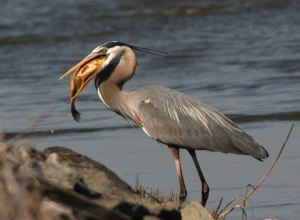
Successful fishing. This is not really my heron but a look alike. Mine is too camera shy to allow me to snap a good image of it.

I’ve witnessed the heron missing meals of late due to this adaptability by the fish. To my surprise and in response to the change in fish behavior, I’ve also noticed a change in the heron’s fishing tactics. The heron  has begun landing on the surface of the water and swimming around like a duck. Upon spotting a fish in the shallow water, the heron suddenly turns tail to heaven. Soon it surfaces with a fish in its beak.

Also I’ve witnessed a second change of tactics. The heron flies across the tank at low altitude obviously searching for fish and then suddenly plunges into the water head first. The heron submerges itself, but sure enough on regaining the surface it has a fish in its beak. It then swims to the bank where it  enjoys its breakfast.

Such adaptability in herons as well as fish, I find interesting and surprising. I assume  in the game of life for herons and fish, adaptability benefits both just as adaptability has great value for us humans.

I trust the heron will enjoy a nice meal for Thanksgiving, as I hope readers of this blog will as well. Happy Thanksgiving!