Category Archives: A sense of place

Bandit Achieves Our Retirement- Part IV

This is the fourth blog piece in a series that features our first Border collie, Bandit, and is taken from an unpublished book titled The Bandit’s Gift. I wrote this manuscript which I suppose could be considered my practice book, shortly after retiring from my Neurology practice in Lubbock and moving to our ranch outside of Fredericksburg, Texas. The title of the book hints at our Bandit dog’s substantial role in bringing about our early retirement. Trudy and I feel indebted to Bandit for his efforts in hastening our move from a frenetic life in the city to the beauty and peacefulness of the Texas Hill Country.

This installment describes our migration from Lubbock to our ranch near Fredericksburg. It also introduces Mollie, a female Border collie, whom we acquired shortly before our move to the ranch. Mollie as a puppy came from a New Mexico ranch whereas Bandit had been raised a city dog in Lubbock.
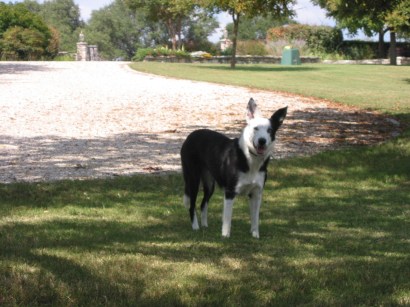
                             Mollie our second Border collie who was from herding stock

In August of 2001, Trudy and I departed Lubbock for permanent retirement at our Fredericksburg ranch. Bandit and Mollie rode in the backseat nestled among hanging clothes and piles of shoes.  Mollie sat on the passenger’s side, Bandit on the driver’s side.  As Lubbock receded into the tabletop-flat landscape, Bandit cast what I considered a satisfied if not smug glance out the window for having brought about this major change in our lives.  I wondered how our canine conniver felt, as he had been a motivating force for my early retirement, mounting a determined campaign having nearly destroyed our home in Lubbock.

“Bandit, say good-bye to Lubbock.”

His long white tipped tail began slapping the back of the seat.

“Thump, thump, thump.”

“Trudy, that dog sounds like he’s beating a drum, am I imagining it or is Bandit celebrating?”

“Thump, thump, thump.”
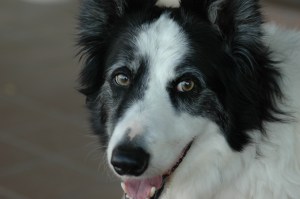
                                                              Bandit looking so innocent

Mollie sat quietly in her corner of the backseat.  When I turned to scratch her chin, I noticed her peculiar smile.  When Mollie smiled, she retracted her lips and exposed her teeth.  Her eyes squinted and her face showed a broad dog smile- a smile sometimes misinterpreted as a snarl. I sensed that Mollie was happy, knowing we were leaving a city and headed permanently for a ranch.

Optimism and a sense of unburdening welled up within me.  My exhausted spirit for years had yearned for a saner, more private existence.  The long work hours, the stress of holding together a clinic and hospital practice, and the daily grind of dealing with desperately ill patients had extracted a physical and emotional toll from me.

While Trudy and I had worked well together, our communication styles differed.  For me, small talk has always proved difficult.  Give me a family with a brain-dead member, or the need to relate a terminal diagnosis, and I am at my rhetorical and sympathetic best.  But when at a social function calling for light banter, I feel like a stammering dolt.  Moreover, I suffer near stupefaction when faced with the usual social banalities.

Trudy on the other hand handles social situations with aplomb.  She can discuss grandchildren, the weather, the latest gossip, or pop-culture with the best of them.  She finds difficulty, though, when talking of emotionally laden topics, especially those affecting her or her family.  It was just such heavy topics that had for years nagged at the corners of my mind.

Trudy’s unhappiness and worry may have prompted verbal zingers aimed at a workaholic, slow to mobilize, and frequently absent husband.

Remember that Surgeon in Medical Records, draped over his pile of charts like a bad suit of clothes, dead as Hamlet’s buddy, Yorik?  You’re not indestructible either Buster. I’m too young and gorgeous to be a widow.  Lots of young bucks have the hots for well off, sexy widows.”

“Yeah, rave on,” I had said, suspecting I had not deflected this conversation for long.

Later as I drove off the cap rock of the Llano Estacado and away from the loneliness of the high plains, I became lost in a tumble of conflicting questions and emotions. Long drives have always put me in pensive moods, providing uninterrupted time for contemplation. Memories began to tug at my sleeve.

Being a physician had been at the core of my identity.  I wondered how life would change without Medicine being my magnetic north.

Why am I ambivalent about leaving? Sure, I’ve loved Medicine- the intimacy that goes with caring for others.  Where’s the satisfaction gone? Had it been the hospital’s economic realities that at times impinged on the quality of clinical care I wished to give? Had this led to incessant medical upheavals?  Why had it been a struggle to maintain a successful group practice, run an efficient medical practice, and carry out good clinical care and research? Had I asked too much of myself as both a private practitioner and an academic?

After an initial scuffle in the backseat when Mollie tried to take Bandit’s usual place, the canines had calmed. Bandit circled and plopped down with an audible exhalation.  Long before we reached the cap rock, Bandit had fallen fast asleep.  Mollie rested her chin at the window and observed passing fence posts, her light blue eyes tracking and flicking from one to the next.
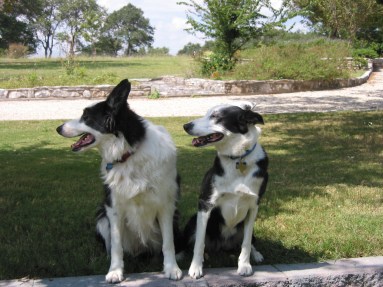
                                           Bandit on the left and Mollie on the right in profile

As the miles sped by, my mind shifted from labors left behind to this land’s history through which we passed which I began to recall. We headed southeast, counter to the migration of earlier settlers, toward what in 1800 had been the northernmost frontier of the Mexican State of Coahuila and Tejas.  Long before becoming a Mexican State, the land had been occupied by Tonkawa Indians who in turn gave way to the more warlike Apache, Kiowa, and Comanche.

Texas won its independence from Mexico in 1836 and became an independent republic.  In 1845 a proud but destitute Texas joined the United States of America as its 28th State.  The following year German immigrants arrived in the Hill Country to partake of free land and increased economic opportunities.

In Germany, the unwitting emigrants had been reassured the new land was peaceful, only on arrival to find themselves in their newly established village, surrounded by hostile Native Americans.  This grievous case of real estate exaggeration ranks just behind Eric the Red who named a frozen expanse of icecap, Greenland.

We traveled through Sweetwater, a small west Texas agricultural town with yet another unpretentious name.  I thought- did no one have imagination when giving names?! 

Bandit briefly awoke when we stopped at a red light in Sweetwater.  I felt his cold nose nudging my shoulder, urging my attention. I reached back and scratched his ears. The white tip of his tail (the so-called Shepherd’s Lantern) striking the back of my seat.

“Thump, thump, thump.”

Mollie glanced at her emotionally needy canine companion but quickly returned to watching the towns stream by.  I wondered if Mollie expected a meandering herd of sheep or scattered herd of cattle to appear in desperate need of a Border collie to organize them.

I thought how different these two dogs were in soliciting affection.  Bandit fawned on people, begging- even demanding attention. Mollie never stooped to such antics, although she appreciated affection when it was offered by a family member.
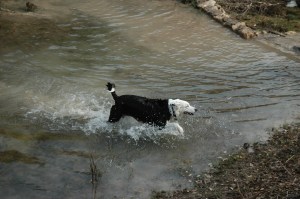
Mollie was a rare Border who loved to swim

After leaving the town behind, I heard Bandit again flop down in the back seat.  My own thoughts returned to the history of central Texas that still lay several hundred miles ahead.

German men from Fredericksburg led by their able leader John Meusebach, in a desperate gambit, ventured out of the relative safety of their new settlement to secure peace with the natives.  They successfully met up and powwowed for several weeks beside the San Saba River. After much talk, countless pipes, and no doubt many earnest, silent German prayers, a peace treaty was established with seven large tribes of natives.

This treaty, remarkably, over the years has remained intact. It is claimed to have been the only treaty in Texas, and possibly the entire United States, with Native Americans to have not been broken.  An annual Powwow of Native Americans and Fredericksburg citizens celebrated the success of the treaty for many years thereafter in Fredericksburg.

While the peace talks had dragged on alongside the San Saba River, other natives surrounded the village of Fredericksburg, awaiting news that would either prompt an attack on or befriend the hapless settlers. Huddled within their makeshift cabins, stoic German settlers tried to carry on their lives without projecting fear to their children.

On Easter eve night, bon fires ominously appeared on the many hills surrounding Fredericksburg. The German settlers worried these fires might signal an impending attack.  In truth the bon fires communicated to the Native Americans high in the hills around Fredericksburg that a peace treaty had been achieved at the Powwow on the San Saba River.

Initially the significance of the bon fires was unknown to the settlers, but the fires on Easter evening prompted one mother, full of bravado, to proclaim to her worried children that the Easter Bunny was building fires to boil their Easter eggs.  The brave spirit manifested by the unknown German mother inspired for many years the yearly Fredericksburg Easter fires tradition where bon fires were built each Easter eve on top of the hills surrounding Fredericksburg.

We motored across the Texas prairie where 150 years earlier the Apache had been driven by the still fiercer Comanche.  I recalled the struggle for control of the green hills and streams of central Texas.  With increasing distance from Lubbock, the table-flat, featureless, and bleak landscape gradually changed into rolling prairie dotted with tall prairie grasses, scraggly mesquite, cottonwood, and Juniper trees.

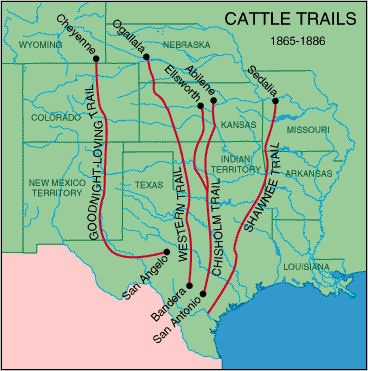
We traveled through Coleman to Santa Anna (named after a famous Penateka Comanche chief) where we turned south, passing by the ruts of the old Great Western Cattle Trail. A roadside historical sign informed that more cattle had passed up this cattle trail to Kansas than had occurred on any of the other Texas cattle trails.  The Western Cattle Trail ended in the wild western town of Dodge City where lawmen Bat Masterson and Wyatt Earp became famous and where Earp was finally laid to rest.

Some twenty million Longhorns had moved up the cattle trails following the Civil War, establishing a viable economy for a desperately poor Texas. I proudly recalled my great grandfather, Thaddeus Septimus Hutton, having been a Texas cowboy who had likely pushed cattle up this very trail through the Oklahoma territory to the rail head at Dodge City.  I pondered what it must have been like to herd cattle in the 1870s through wild country. Had he even a glimmer of the historic nature of the western life he lived and the fame that would be later accorded the lawmen of Dodge City.  Of one conclusion I felt certain, that more hard work and less adventure had existed on the cattle trail than was depicted later by Hollywood movies.

Several hours further on, the rolling prairie gave way to green hills, clumps of stately live oak trees, and cultivated green pastures.  Artesian spring fed streams and rivers snaked among the hills.  Wild game had been and remains prevalent, and the tall native grasses supported greater numbers of grazing animals than had the near barren Llano Estacado.

Looking at this dramatic transition in the land helped me to understand why the Native Americans believed the Hill Country possessed such “strong medicine.” The Texas Hill Country with its beauty and bounty favorably compares to the western, more arid portion of the State.  I thought no wonder Native Americans had fought so ferociously to maintain control of the Hill Country.

While I mulled these matters, Mollie, with remarkably sustained attention, continued to observe the changing landscape.  Once when passing an eighteen-wheeler, Mollie stood upright, staring at a black, ride along dog that stared back from the truck’s passenger window.  I could see the other dog barking. Mollie calmly observed the dog and gazed at the truck until it was lost to sight.

Bandit didn’t awake again until we arrived in Brady, the geographical center of Texas.  He awoke, stretched, yawned, and appeared to anticipate our arrival at the ranch.  I felt his chin on the back of my seat and sensed his warm, moist breath.  I could see in the rear view mirror that he had perked up his ears and was staring down the highway ahead of us.  When I reached to give Bandit a scratch, I was rewarded with several languid licks to the back of my hand.
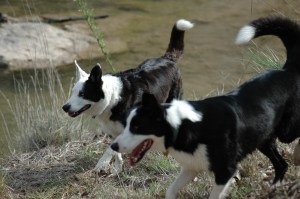
    Mollie and Buddy at the ranch

“Thump, thump, thump.”

An hour and fifteen minutes later, we drove through the front gate of our ranch. I halted the car briefly, so that Trudy and I could exhale years of pent up tension.  Whimpers came from the backseat.  Trudy and I opened the back doors of the car.  Mollie leaped out and sped across the pasture, ears flattened to her head, back arching, and legs striding.  Bandit jumped out and loped behind Mollie, inspecting trees, clumps of grass, and rocks.  Mollie scared up a jackrabbit, and both collies began a deliriously happy, zigzagging pursuit, interrupted only finally by an impassable barbed wire fence.

Trudy and I joined hands and watched in peaceful silence; an interlude as pure as that between young lovers. We had parked on a caliche ranch road near a grove of live oak trees.   We wordlessly observed the rabbit chase and basked in the exuberance of the moment. Bandit and Mollie eventually strutted back to the car; tails held high.  The two dogs sniffed and scuffled and seemed to be thoroughly enjoying themselves.

From over my shoulder, an orange-red sunset beckoned above a white limestone ridge.  We heard the mellifluous sounds of water rushing over stones in a nearby brook.  I experienced a rare moment of awareness and understanding.  What had seemed confused a few hours earlier, in this tranquil setting, now seemed clearer, even achievable. I could feel a smile develop across my face.

“Welcome home Trudy.”

Trudy slowly turned her eyes to meet mine. I saw a loving smile, crinkled nose, and teary eyes.

“Didn’t think I’d get you out of Lubbock alive,” Trudy said with an uncharacteristic tremor in her voice.  Moments later her tendency to chide rallied and she said, “Besides Cowboy, why are you planted here like a stupid yucca, let’s get on with our new lives!”

Just as I leaned across the front seat of the car to kiss Trudy, from the backseat came Bandit’s black and white head. Trudy and I stopped just short of planting bookend kisses on his furry snout.  Trudy and I laughed, and Bandit cocked his head impishly as if understanding the joke.  Trudy and I were now retired, and with Bandit and Mollie, we were four.

to be continued

If you have not had the chance to read my latest book, Hitler’s Maladies and Their Impact on World War II: A Behavioral Neurologist’s View (Texas Tech University Press), I invite you to do so. The book explores an important aspect of the Hitler story and World War II that has not been well studied. Many of Hitler’s catastrophic errors including the premature invasion of the Soviet Union in June 1941, the slowness of German forces to counterattack at the Battle of Normandy in 1944, and the highly risky Battle of the Bulge in late 1944 into 1945, can be better understood, knowing the sizeable impact that Hitler’s physical and mental conditions had on these vital battles.

Also, consider picking up a copy of my earlier book, Carrying The Black Bag: A Neurologist’s Bedside Tales (Texas Tech University Press). Please join me on my personal journey as a physician and meet my patients whose reservoirs of courage, perseverance, and struggles to achieve balance for their disrupted lives provide the foundation for this book. But step closely, as often they speak with low and muffled voices, but voices that nonetheless ring loudly with humanity, love, and most of all, courage.

A Memorable Object At Our Ranch

  •  

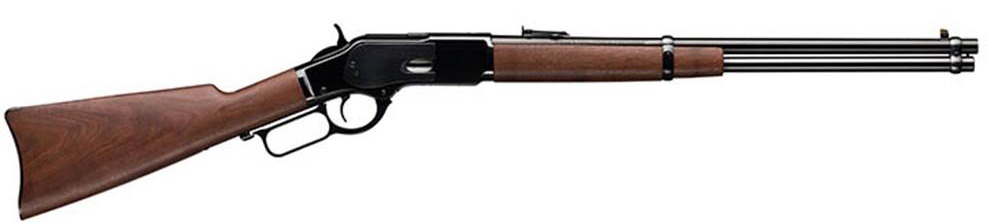
Hanging above the fireplace at Medicine Spirit Ranch is an object with special meaning for me- a Winchester Model 1873 Carbine. It is not that this model gun that is said to have won the West is so rare or valuable, but rather because it represents a tangible connection to my great grandfather, Thaddeus Septimis Hutton. The carbine is one of the few connections I have to this relative about whom I wish I knew more. The Winchester pictured below is better polished but otherwise looks like the Hutton Family rifle.

Thad Hutton, or Pappy as he was called later in life, bought the carbine for his use as a cowboy in Texas. The Hutton Family rifle was made in 1881 and is the second model of the 1873 Winchester. It weighs 7 3/8 pounds, has a short overall barrel length that is perfect for a saddle gun, and has a magazine that holds twelve rounds. This model of Winchester 1873 was manufactured in New Haven, Connecticut from 1879 to 1884. According to family lore, this Hutton carbine was one of the earliest of its type to enter the State of Texas.

This model 1873 was the rifle that put Winchester on the map of the West, trotting along with the equally formidable Colt revolver tucked into the belt of the frontiersman. The Winchester carbine is said to have killed more game, more Native Americans, and when the Native Americans awoke to its virtues, more US Soldiers than any other type of rifle. The development of powerful repeating rifles in the 1860s and 1870s of which the Winchester 1873 was the most popular, meant that hardy young Americans could penetrate the West, provide food, and exist in a hostile environment.

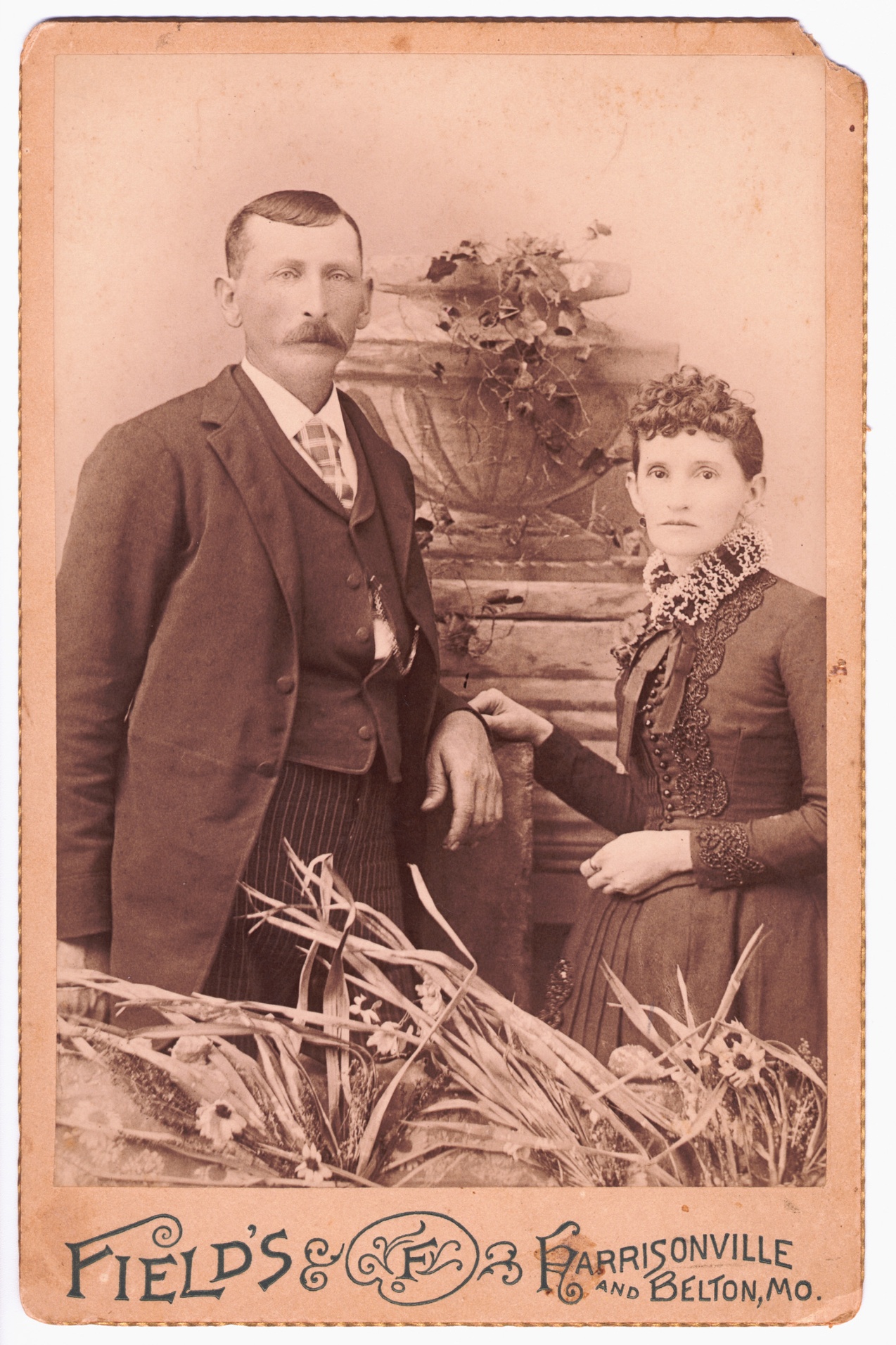
Thad Hutton left the Kansas City area around 1874 and struck out for Texas. He married Elizabeth Ragan in Palo Pinto County, Texas on November 1, 1876. Thad was a tall, affable cowboy while Betty was a diminutive Irish lass who reportedly possessed a sharp tongue. The wedding was performed by an itinerant preacher who came through the small town of Gordon near where they lived. Their first son, Thaddeus Leslie Hutton, was born two to three miles north of Gordon on May 11, 1878. Thad’s occupation on the birth certificate was listed as “cowboy.” He was at the time 29 years old and Betty was 24. The picture below was taken years after their marriage.

Not long after Leslie’s birth, Thad and Betty moved further west, relocating near Seymour, Texas. The reason for the move is  unknown, but a strong hint exists in that the Great Western Trail traversed Seymour, leading to Dodge City, Kansas. Dodge City was the major railroad terminus for Texas cattle and this booming western cow town developed quite a reputation. Did Thad ride the trail to Kansas as a drover, pushing large herds of Texas Longhorn cattle up the trail? Did he interact with any famous lawmen and gunfighters of the era including Wyatt Earp, Bat Masterson, and Wild Bill Hickok? What were his recollections, if any, of Dodge City, called the wickedest city in the country and home to the Long Branch Saloon and China Doll brothel? Unfortunately this possible family history has all been lost to history. What is certain is that had Thad Hutton ridden the Great Western Trail, his 1873 Winchester carbine would have accompanied him on his long and arduous journey.

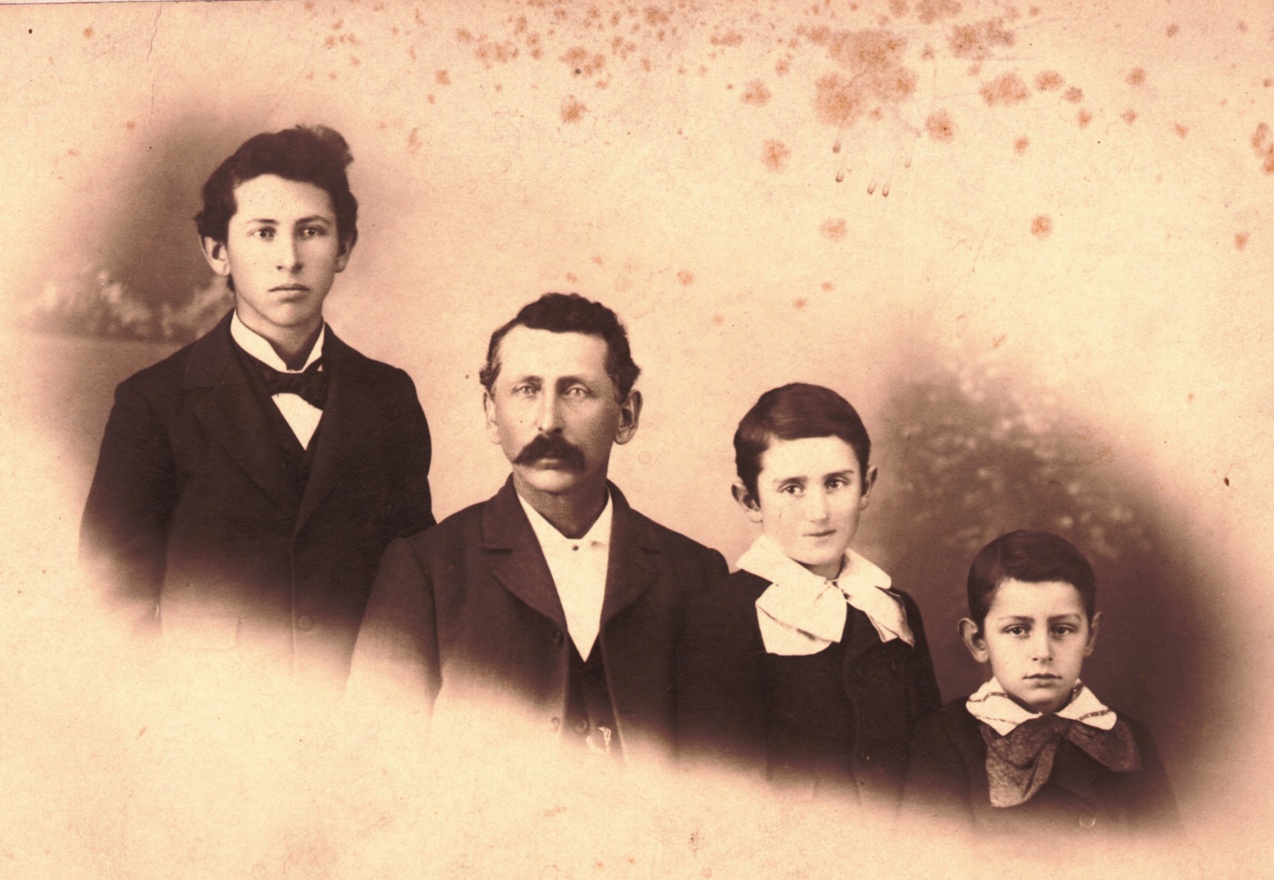
What is known for certain is that while in Seymour Thad worked on the P8 Ranch. Apparently this ranch no longer exists as no record of it can be found. While in Seymour three children were born to Thad and Betty including Emma Jane Hutton on March 9, 1880, Margaret Mary Hutton on October 5, 1881, and George Earl Hutton on August 30, 1885. My grandfather John Francis Hutton was not born until 1887 when by then Thad and Betty had left Texas and settled in Garden City, Missouri. Below are pictured Thad and his three sons.

One day while hunting wild cattle in Texas, Thad had a memorable experience. Thad and his friend, a Mr. Reid, found four head of wild cattle in a thicket. The hunters managed to separate one young bull from the remaining cattle. Thad at the time was carrying only an old shotgun but had exhausted his ammunition by shooting into the thicket in an attempt to scare the wild cattle out into the open. The men had gotten off their horses and the young bull, seeing the men on foot, got his fighting blood up. Thad reached into his pocket but found he had exhausted his supply of ammunition. By this time the bull had decided to charge Thad. Mr. Reid gave Thad some rifle balls that Thad put down the barrel of his shotgun following a load of gunpowder. He did not know if the shotgun would even fire loaded this way or would fire with any degree of accuracy. The infuriated beast snorting and galloping with head down drew near. Thad raised his gun and squeezed the trigger. The bull had drawn within ten yards of Thad when the shotgun fired, driving a rifle ball into the forehead of the bull. It fell mortally wounded. The meat from that wild bull fed the hunter’s families for a long time thereafter.

Another incident occurred in 1887 involving the Hutton 1873 Winchester when Thad and Betty had moved back to Missouri. The .44/40 saddle gun was loaned to a neighbor who needed a gun to kill a beef. Several days later the neighbor came to return the rifle and was asked how it had worked. The neighbor replied, “Sure it killed the beef all right, but that gun’s too dangerous to have around this country. The bullet went through his head and whistled on out across country. I’m wondering if I killed anything else besides the beef.”

Perhaps on hearing this story and learning of the power of the carbine Adele Hutton demanded of her husband, Howard, that the gun could only remain in the household if it were disabled. Apparently the firing pin was removed or damaged in such a way as to satisfy Mother as the gun remained in the house. Great Grandfather Thad’s gun was later passed on to me.

This 1873 Winchester saddle gun currently is encased above a fireplace at Medicine Spirit Ranch. It returned to our Texas ranch well over 100 years after it had departed Texas. It is a tangible tie to my great grandfather, Thad Hutton about whom I wish I knew more. I am proud to own this rifle of his and one day look forward to passing it on to my offspring.

How To Become A Rancher

One of the questions I am frequently asked is why did I decide in retirement to buy and move to a Texas cattle ranch. Obviously, I’ve enjoyed the experience enough to devote this blog to writing about it. Below is a story I’ve written describing my early interests in Texas and ranching that may have planted the seeds early on.

A family trip taken when I was ten years old remains one of my fondest childhood memories. It also had a surprising impact on my life. Mom and Dad pitched the idea in 1956 of our family tripping to the Circle R Ranch near Bandera, Texas. Being from Kansas City, I had never heard of Bandera, but being the wannabe cowboy that I was, I had certainly heard of Texas. The chance to ride horses, meet cowboys, visit a dude ranch, attend Bar BQ’s, swim in spring fed rivers, and feel the Texas experience was extremely appealing for me.

To get to Bandera, Texas our family flew on passes via Braniff Airways from Kansas City to San Antonio. In those days flying was by far the most affordable way for us to travel given the perk of nearly free air travel. As I recall, my family was picked up at the S.A. airport and driven by van to the Circle R Ranch. The sprawling ranch lay west of San Antonio in the Texas Hill Country and probably took about one and a half to two hours to reach.

To my great enjoyment, we found a working ranch that also accepted families for a week at a time and showed them how a Texas ranch worked- a real Ranch that also served as a dude ranch. The Circle R had a swimming pool, bunkhouse, and dining area. Working cowboys roamed the premises, took guests on trail rides, provided swimming in the chilly waters of the Frio River, organized fishing opportunities, led hikes and demonstrated cowboy skills such as roping, bronc riding, shoeing horses, and herding cattle. This boy was in cowboy heaven.

One of the first activities after our arrival at the ranch was having a horse assigned to each of us for the week. My Dad received John, as I recall. My mother appropriately had Mother as her horse. My horse’s name was Sluggo. He was about as gentle as my old pet dog. Joan became quite attached to her horse, but I am unable to recall its name. I believe Dave was too young to ride a horse, as he was only five at the time.

The picture below was taken four years later at the Wiley Dude Ranch located not far from Richardson. If you look closely you may be able to see my siblings, David, Joan, and Jim in the front of the wagon.

Other families from distant places enjoyed the dude ranch activities that week as well. Given the informality and casualness, we became friends with the other kids and learned about their lives. In the evenings after hearty dinners, music was played, and once during the week a Texas live band played music. The music was all Country and Western tunes, and we had to learn how to dance to it. Joan was rather awe struck, as I recall, by the slender, good looking, Stetson wearing cowboys. The cowboys put on a rodeo during the week with cowboys from nearby ranches. I saw these cowboys as real men and fearless.

During that week I sensed a feeling of freedom and adventure that differed from the scheduled drudgery of school and the endless tick-tock of our clocks always reminding me of some task that needed to be performed. Texas had a different vibe that excited and intrigued me. It was a feeling of independence. This freedom loving, adventure seeking feeling about Texas has never left me.

We kids in my family knew nothing of the inner workings of Braniff Airways, my Dad’s new employer following its merger with Mid-Continent Airlines. We did not know that for my Dad to advance up the seniority list, he would need to relocate from Kansas City to Dallas, Texas.

This discussion of hidden motive never came up in conversation in later years, but I continue to wonder if our trip to the dude ranch wasn’t a prelude to a physical move of our family and an elaborate introduction for us to the State of Texas. If it was, then my folks had a stroke of genius. It was the following year (1957) that we departed Prairie Village, Kansas and relocated our family to Richardson, Texas.

I was so enthused about moving to Texas that according to my parents I boarded the airplane in Kansas City wearing chaps, cowboy hat, boots, and a brace of cap pistols. Perhaps, I thought we might have to fight Indians on our way out of the Dallas airport. The folks had no difficulty moving this young wannabee cowboy to Texas.

Now retired and living on a cattle ranch in the Texas Hill Country, I reminisce about my adventures at the Circle R Ranch so many years ago. Did our time at the dude ranch plant the seeds for my love of animals and ranching? Was I destined after that single week at the Circle R to retire to a ranch? Did feeling that Texas vibe early on set me up to long for the friendliness and openness that is so prevalent in Texas. And did my parents really have it all planned out and introduced the move in such an exciting and memorable way that it had a lasting impact? I rather believe the folks did and that the Texas spirit prevailed upon me as well.

Stump Spirit Thanksgiving

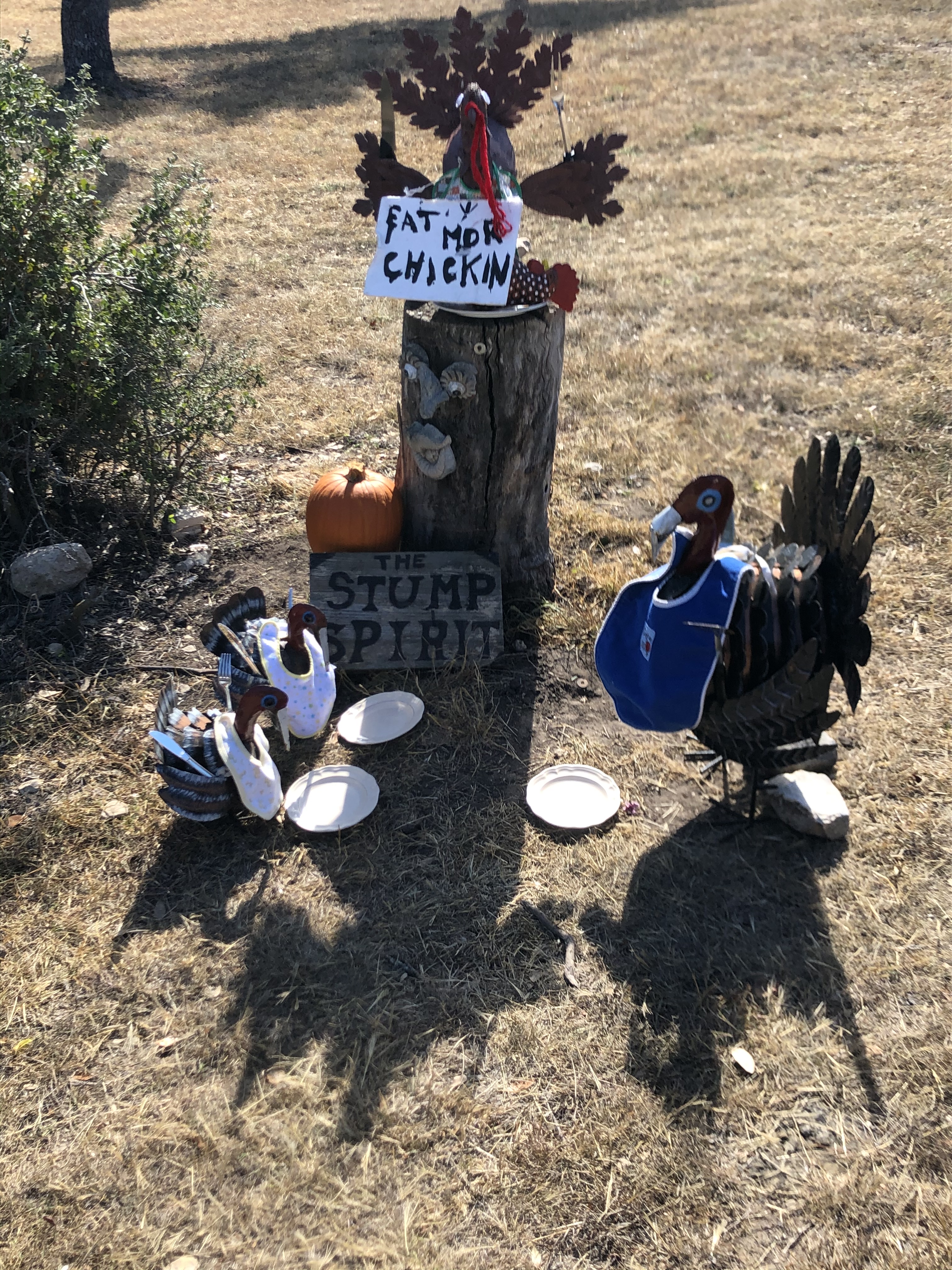
While I’ve forgotten exactly when or even why the local tradition began, the residents living on Blue Jay Way years ago began to decorate a particular stump nearby our common road. We call it, Stump Spirit. Tradition has it that those Denizens of the Way who decorate the stump, do so when no one else is around, often after the sun sets behind the hills and mystical spirits leak out of the hills and hollows (or perhaps, after having been imbibed).

While the stump mysteriously becomes decorated for all major holidays and special occasions, Thanksgiving has always been especially well represented. Look closely below for the chicken figure partially hidden behind the “Eat Mor Chickin” sign and the turkeys in their bibs, holding their eating utensils.

A turkey theme carries over from a prior year when a turkey with bulging eyes suddenly spots a gun toting hunter who is lurking behind a tree with turkey-cide intent .

Thanksgiving for the Hutton clan is about family and giving thanks for our bounties and good fortunes. During the year of the Covid-19 Pandemic, these plans unfortunately have had to change. Our Thanksgiving table will host vastly reduced numbers of people this year. This is painful for us all, especially for my wife, Trudy. Hopefully next year we will return to the large, raucous celebrations of prior years. Think of a cross between a Medieval banquet and Animal House.

The above image was taken a number of years ago when our grandchildren, Graham and Ramsey, were much younger. Nevertheless, I just had to work in a picture of our beloved grandchildren visiting an earlier rendition of a Thanksgiving Stump Spirit. Our efforts are meant to fashion a sense of place for our grandchildren, as well as for the older denizens of Blue Jay Way.

The Denizens of the Way are wonderful neighbors. A lot of creativity goes into decorating Stump Spirit or about anything else that stays put for awhile. Such was the case when a hired man’s tractor broke down in my pasture. It sat, and sat, and sat some more, waiting for its inevitable repair. Finally Fall arrived and the following enhancements to the tractor showed up. Now this is real pasture art!

Other holidays get their due. Memorial Day, the Fourth of July, and Veterans Day are marked by decorating the stump and its surrounds with American flags and patriotic memorabilia. The stump on Labor Day receives hard hats and related tools.

Halloween gets recognition with ghouls, ghosts, and goblins.

The slow parts of the year represent a creative challenge. This is especially true for the hot, sultry days of late summer. But even the dog days of summer often sees an occasional theme appear as demonstrated below.

The result of the collective efforts of those who decorate the humble stump is to bind the neighbors together in a feat of whimsy and friendship. It is fun. It allows for creative expression. The world needs more of this.

Those of us at Medicine Spirit Ranch and the Denizens of the Way wish you a wonderful Thanksgiving. Please be safe and stay healthy. The vaccine is on its way. Let’s all buckle down and continue to wear masks, social distance, and wash our hands until immunity to this virus is attained. Wishing you a wonderful Thanksgiving holiday and continued good health!

Buddy’s Last Tail Walk

It’s a sad day on the ranch. Buddy’s walking, continence, and comfort level continued to deteriorate. This dog who was born on our ranch (in my closet actually), herded the cattle with great skill, miraculously broke up bull fights, and has now died on this ranch will be missed. Buddy’s pain led to mournful yelps these last weeks. But he died surrounded by his pack of dogs and humans while proudly overlooking his domain from his station in the back of the pickup. I feel compelled to write this sad note for all who knew Buddy personally and for those of you who knew him only through this blog. He was quite a dog!

By this morning the dark clouds of Hurricane Hanna had spread over south and central Texas including Medicine Spirit Ranch. No moisture has fallen to the ground as yet from the gray, ominous clouds, in contrast to that on our cheeks. Just after being laid to rest in a grave beside his mother, Mollie, the sun briefly broke through the dark sky, illuminating his still body like a spotlight. Interpret that as you will. Buddy died peacefully and at a time that was appropriate.

Buddy’s incredible herding skills moving cattle will be remembered. But even more so, we will miss his love for family. His bravery in the face of large animals was unsurpassed. He was the most loyal being I’ve ever known. For reasons known only to Buddy, he sought me out wherever. He was my constant companion. He laid beside me in the bed for six weeks when I was recovering from my own back injury. He was aptly named.

Perhaps such devotion, if in a human, would be seen as cult-like. Nevertheless, I cannot help but feel flattered by his allegiance and devotion to our family. Of course this is a Border collie trait, but Buddy showed this behavior in spades.


Buddy will be missed. What a dog!

Buddy as a younger dog. That’ll do Buddy.

The Importance Of Place

Have you ever noticed how comfortable you feel at home?  Each of us has a certain comfort zone and a sense of place. I’ve often wondered about this?

Buddy as a puppy. “Say this lap feels pretty natural”

This feeling of belonging, belonging to a certain geographical place affects us all- a place that feels right, looks right, smells right and provides comfort and mitigates the travails of the world. Whether it’s early imprinting, as occurs with baby chicks, or some combination of the sounds, smells, sights, and memories (an overall gestalt for an area), I am not entirely sure. Nevertheless, for many who have lived away from their special places know the strength and durability of the homeward draw. It’s like a magnetic force and can be almost overpowering.

Buddy:Being in this pickup truck just feels right

Trudy and I lived for ten years in Minnesota while I trained in Neurology. Our two children were born there and we have wonderful memories of Minnesota. We met some lovely, lifelong friends, enjoyed the incredible 10,000 pristine lakes, and delighted in many novel experiences (have you ever tried lefsa or lutefisk?).

Nevertheless, both Trudy and I felt a nascent longing to return to Texas, our native home. When offered the opportunity to join the faculty of the new Texas Tech School of Medicine in Lubbock, Texas, we quickly determined to leave our adopted State of Minnesota and head homeward.

What is it that makes a place comfortable for us? I’d lived in Texas during my formative years. Trudy had always lived in Texas. We both missed the gratuitous friendliness and expansiveness of spirit that is Texas.

Minnesotans were in no way unfriendly but seemed not as overtly warm and forthcoming as we’d come to expect from growing up in Texas. Plus we admittedly missed the Mexican food and Bar-B-Que along with the independent mindedness and largeness of spirit in Texas.

A friend of mine in Fredericksburg, Texas recently told me of having his grandchildren visit from New York City. Wishing to introduce his grandchildren to the wide, open spaces of Texas, he drove his grandchildren to The Big Bend Area. There with their recently purchased packs, canteens, and hiking boots, they set off on a well marked park trail to explore the grandeur of the Big Bend National Park.

After some time had passed, one grandchild developed a quizzical look on his face, looked around with an expression of perplexity, and said in a panicky voice, “Grandfather, we are lost!”

The grandfather asked in a calm voice, “what makes you think we are lost?”

The grandson replied, “Well, there are no people here, we must be lost!”

“I feel right at home in my pack.”
Buddy stands tall above Mollie and Bandit


The lack of people, the lack of built environments, and absent din of traffic noise was not “home” for the grandson. It was clearly different from New York City. No doubt the solitude struck the boy as unnerving and frightening. The grandfather shared that he strove to introduce an alternative sense of place to his grandchildren, one closer to nature than is New York City.

As I’ve mentioned previously, I’ve learned a lot about animal and human behavior by simply watching our furry, four-footed friends. This includes the importance of a sense of place.

Buddy, our now senior Border collie, was born in my bedroom closet.

Daughter-in-law Alissa holding Buddy shortly after his birth

With rare exception Buddy has never ventured much beyond the outer fence of our ranch. Oh he frequently rides along on trips to the feed store and has on occasion gone on a wild bull chase throughout neighboring, overgrown ranches (see an earlier post, Slacker), but he is most definitely a home dog.

Buddy crouched and ready to herd

Once and only once, Trudy and I drove him to our daughter’s home in central Dallas. Buddy absolutely hated it. The loud sounds and strange smells were, I suppose, not what he was used to. He let his displeasure known by wetting on the floor, whining, pacing, scratching at the door, and at the end of the visit most eager to jump into the car and return to the ranch. We’ll never make that mistake again. Buddy is not and never will be a city dog.

Once when our ranch house was undergoing remodeling, we had to move about an eighth of a mile and live for several days in our guest house. Buddy, despite the short distance from our home, absolutely hated it.

We had packed a few things and loaded up the dogs for our stay at the guest house (The Yellow Rose). When the sun began to set, Buddy began scratching at the door of the Yellow Rose to go out. When later I went to call him in, I couldn’t find him. Buddy had gone home. I had to return to our main house, gather him from the back porch, and haul him back to the guest house.

Buddy: “Just thought I’d wait for you here on the porch at home while you dawdled  at that other place”

This sequence  of futility repeated several times before I wised up and closed the yard gate to the guest house so that Buddy could not leave. Needless to say, our dog spent a few restless nights at the guest house while the remodeling proceeded.

I learned from Buddy’s escapes that a sense of place proved more important than for him than did human companionship. His preference for place over person proved a little humbling but informative as to what was most important in Buddy’s canine world.

Like Buddy we all share a feeling of comfort when at home and mild discomfort when away from home.  A sense of place may go a long way to explaining homesickness, an emotion we have all felt.

While we may not understand why others feel comfortable in radically different places than our own and with different looks, smells, and accents than what we are used to, we can perhaps understand the comfort that comes to others with residing in their own familiar places.

“Why look elsewhere when I am already home”

A final thought regarding a sense of place deals with the impact of age. As Buddy gets older, he’s developing an even stronger love of home and dislike of travel. He is the first  to return to the pickup when we work on the ranch. Buddy is the first dog to want to go inside when spending time on the patio or in the yard. He is the least likely of the dogs now to participate in a deer chase or challenge a cow.

Perhaps as an older dog, Buddy feels more vulnerable. Home is comforting for him. Are there parallels in humans? As humans age, it strikes me we also develop an increased awareness of our frailties and have an increased love of home place. Don’t many older people, like Buddy, appear less willing to travel, explore, and seek out new adventures?

Our sense of place seems as important for humans, as it is for our canine companions. Perhaps our sense of place which is lifelong may even strengthen with age as it does for my four-footed friend.