Cow Days of Summer

This past week has been the hottest of the year with highs up to 104 Fahrenheit in the shade. The animals and people at Medicine Spirit Ranch are wilting and making their best efforts to avoid becoming overheated.
For the first time I have have spotted one heifer spending most of her time during the day standing up to her belly in a shady spring-fed creek. She has appeared happy with her cool aqueous location and pays me little attention when I approach her.
Who says all cows are dumb? I admire this mama cow for figuring this cooling strategy out. I too have been taking dips in our small backyard pool but never thought a cow would use the same strategy to cool off.


The cows arise early at daybreak before it gets too hot. They graze until the temperature climbs before retreating to shady spots. They usually head for groves of trees, particularly the Texas Pecan trees that provide the most shade. There they lay or stand throughout the hottest part of the day before heading out to graze again at the end of the day.


A cow or perhaps the bull will end up with babysitting duties with many calves throughout the hottest portion of the day. As if by signal, the calves will return late in the day to suckle their mamas before bedding down for the night. They sleep in a large group, presumably for safety reasons from predators.
Fortunately, this summer has provided ample green grass for the cows. The pastures benefited greatly from early summer rains. The rancher also benefited by not having to put out hay during late summer when the green grass typically turns brown and becomes too short to graze.

The phrase “dog days of summer” derives from astronomy. Dog days originated in ancient Roman times when people noticed that the star Sirius (known as the dog star in the “Big Dog Constellation” because of its extreme brightness) would rise with the sun from July to August.

Since our dog Bella sleeps during the daytime in an air conditioned house, “dog days of summer” somehow just doesn’t fit. Our cows best exemplify the lassitude that comes with the summer’s heat.

But do astronomical references to cows exist? Well, glad you asked and yes they do.

Cow supernovae are a newly-labeled subclass of the explosive events, which occur when giant stars reach the end of their lives; they run out of fuel and collapse, triggering powerful explosions. Depending on the original star’s size, the explosion can give birth to either a black hole or a neutron star. We can thank Mr. GOOGLE for this information.

Stay cool if you can.

If you have not had the chance to read my latest book, Hitler’s Maladies and Their Impact on World War II: A Behavioral Neurologist’s View (Texas Tech University Press), I invite you to do so. The book explores an important aspect of the Hitler story and World War II that has not been well studied. Many of Hitler’s catastrophic errors including the premature invasion of the Soviet Union in June 1941, the slowness of German forces to counterattack at the Battle of Normandy in 1944, and the highly risky Battle of the Bulge in late 1944 into 1945, can be better understood, knowing the sizeable impact that Hitler’s physical and mental conditions had on these vital battles.

Also, consider picking up a copy of my earlier book, Carrying The Black Bag: A Neurologist’s Bedside Tales (Texas Tech University Press). Please join me on my personal journey as a physician and meet my patients whose reservoirs of courage, perseverance, and struggles to achieve balance for their disrupted lives provide the foundation for this book. But step closely, as often they speak with low and muffled voices, but voices that nonetheless ring loudly with humanity, love, and most of all, courage.

A Dedication of a Memorial Tree Plaza

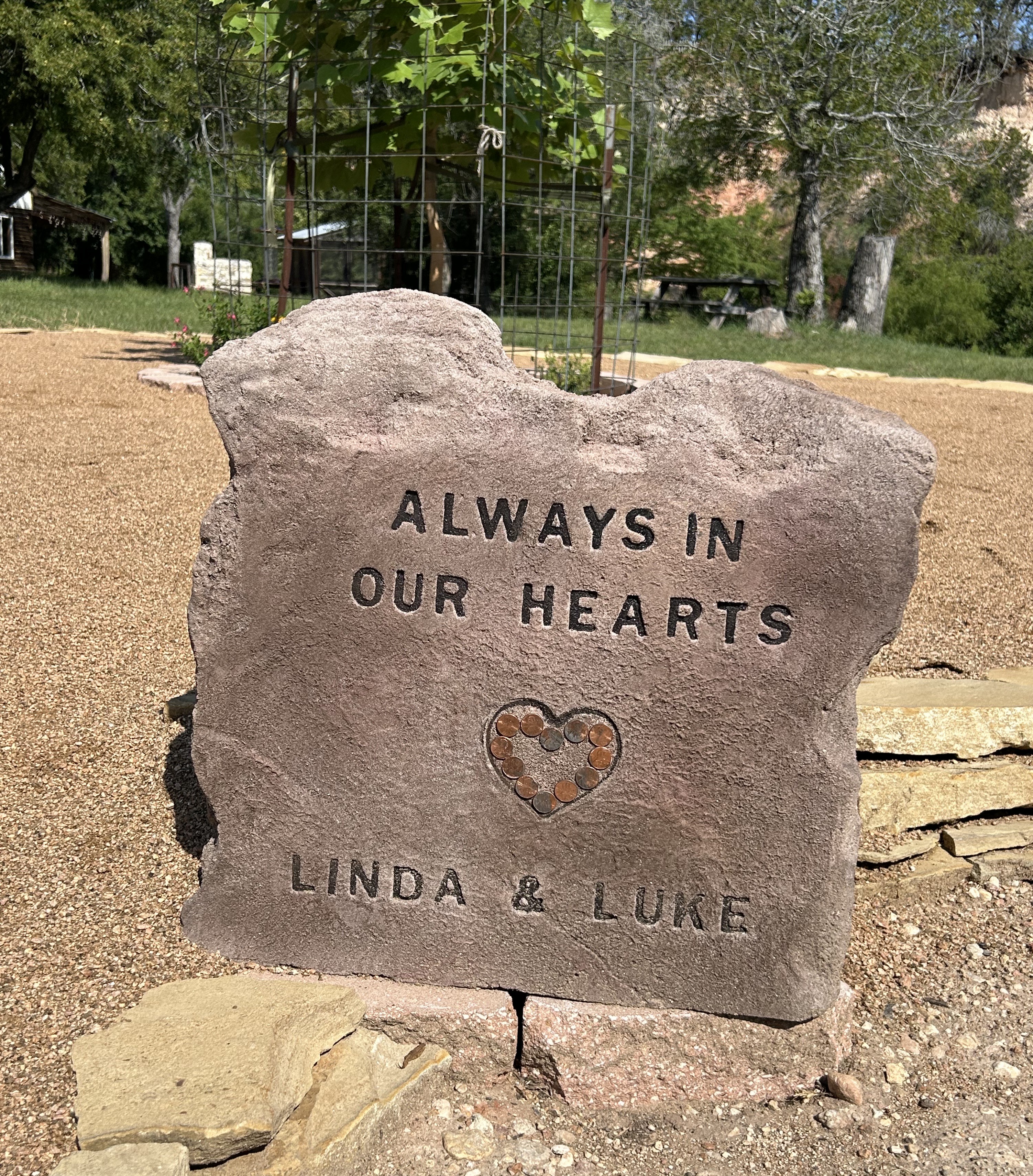
Fortunately, tragedies at Medicine Spirit Ranch have been rare, that is until recent years. Linda, a very close friend and neighbor, and her grandson Luke have both passed away. Colonel Tom and his wife, Danese determined to build a memorial to celebrate their remarkable lives. This building of a tree memorial plaza took many hours in the hot Texas sun and yesterday we dedicated this memorial. Family and friends came for the event, many traveling long distances. They all came to remember and honor the lives of Linda and Luke.


I was asked to say a few words at the dedication. Colonel Tom was moved by my words and suggested I place them on this blog. I am only too pleased to honor his request. My heart is sad over losing a good friend and over the death of Luke who was only twenty years old and had just completed his freshman year at Harvard. He had such promise and would have accomplished so much.

The Memorial Tree Plaza


Below are the words I used in my effort to honor the lives of these two wonderful people.

MEMORIAL TREE DEDICATION-July 20, 2024

            Thank you, Tom, Danese, and family for allowing me to speak at your Memorial Tree Dedication. What a wonderful and creative way to memorialize two loved ones whose absence from our lives, leaves us with such deep sadness.

            When I first learned of the idea of a memorial tree plaza and the opportunity to say a few words, the first thought that sprang to mind was from the lyric poem, Trees by Joyce Kilmer. After all who among us didn’t memorize this simple 12-line iambic pentameter poem that often was the final twelve lines to achieve the required memorized100-lines of poetry for an English class? While the poem has been criticized as being overly simplistic, when I reread the poem and like so many others, I found deeper meaning in it that seems fitting to share today.

            The poem was written by Joyce Kilmer in 1913. Did you know that Joyce Kilmer despite the female name– was a man. Also, like Linda and Luke he was Roman Catholic and took his faith seriously. His family reported no specific tree inspired the poem, but that Kilmer perceived many trees possessed these special human-like qualities.

            Let me refresh your memory on this brief poem, Trees.

                        I think that I shall never see

                        A poem lovely as a tree.

                        A tree whose hungry mouth is prest

                        Against the earth’s sweet Flowing breast;

                        A tree that looks at God all day,

                        And lifts her leafy arms to pray;

                        A tree that may in Summer wear

                        A nest of robins in her hair;

                        Upon whose bosom snow has lain;

                        Who intimately lives with rain.

                        Poems are made by fools like me,

                        But only God can make a tree.

            So why plant a tree as a memorial? Well, without oxygen-producing trees we could not even breathe. Kilmer anthropomorphizes a tree in the second stanza by saying “whose hungry mouth is prest against the earth’s sweet flowing breast.”

            It is from this good land where we stand today that sustenance is gained, but not only for this newly planted Mexican Sycamore tree. This ranch has been… and will continue to be …a pivot point for this family to gather… to play…to relax…to laugh…to remember, and …especially to love one another. Truly, these tranquil, wooded acres will provide not only physical sustenance for this tree, but also emotional sustenance for this family and the community of friends who visit them.

            Kilmer depicts the tree as female raising her leafy arms to pray to God. While Kilmer’s tree had “hair” in which Robin’s nested, our memorial tree more likely will attract Mockingbirds, Hummingbirds, Sparrows, Painted Buntings, and Cardinals. It will be a tree full of life, striking color, and joyous bird calls.

            As an aside, Trudy and Linda engaged in good-natured sparring over who attracted the most Hummingbirds to their feeders. What fun Tom and I had, watching their good-natured competition. Trudy and I are so pleased to learn that the Hummingbird feeder will now permanently reside within the spreading and praying branches of this Memorial tree.

            And isn’t it fitting that this Memorial Tree will serve these birds as a home, as did Linda and Luke serve others in so many ways? And while we doubt much snow will ever lay on the bosom of this memorial tree as described by Kilmer, we can hope our memorial tree will receive much needed and life sustaining rain. The rain falling on our tree will represent a vivid symbol of renewal of our spirits and a watery cleansing of our residual sadness.

            Kilmer’s expresses self-deprecatory comments about fools writing poetry but wisely states… that only God can make a tree. This God-inspired wonder of nature and the many other trees on this ranch will carry with them our memories of those departed.

            I ask what better memorial could there be than a tree to remember and contemplate the lives of Linda and Luke?

            I wish to share memories of Linda and Luke where both episodes, as it turned out, originated in the living room of the Norris home above the cliff. I vividly recall one evening crawling around on the floor with Luke, playing with a kit that taught the method of starting an intravenous drip. That evening Luke also shared his dreams of becoming a neurosurgeon and perhaps doing research in biomedical engineering. The possibilities that lay before him were incredible and virtually limitless. I’ll never forget Luke’s endearing smile, as he shared his hopes for his future and for helping others. The world has lost an incredible intellect, humanitarian, and a wonderful human being.

            Linda also approached me one evening in her living room when Trudy and I visited for dinner. According to Colonel Tom, Linda for the first-time shared information, leading me to believe she was having a serious heart problem, angina pectoris. For such a private person as Linda to share these innermost concerns proved deeply gratifying for me. I felt honored that she trusted me enough to share her concerns. Linda described how the episodes were becoming more frequent and were limiting her ability to exercise or even take a walk. I remember how worried I was learning of her crescendo angina. Linda went on to seek sophisticated evaluation and ultimately underwent surgery for her complicated heart condition. We all know the sad outcome of those heroic medical efforts.

            Today we dedicate this memorial tree in honor of Linda and Luke. And when we listen closely, the rustling of the leaves of this Mexican Sycamore become the sounds of two dearly departed souls who will continue to speak to us. Listen closely to these feint murmurings and when you do, remember Linda and Luke.

Our words today may add little value compared to the profound statement made by this tree patio and the long, hot, and sweaty labors that went into its creation. Linda and Luke will continue to live in our hearts and memories forever, and this tree patio will always remind us of their lives- lives that brought us so much joy and so much happiness.

MEMORIAL TREE DEDICATION-July 20, 2024


The Legendary Texas Longhorns

Nothing in Texas is more iconic than Longhorn cattle.  The Longhorn even has its own folklore. In Native American cultures the Longhorn represents a symbol of good luck and spiritual guidance. While in Spanish culture, the Longhorn represents power, resilience, and strength. For Texans it is simply the basis upon which the State economy was built post-Civil War and to this day the Longhorn remains a treasured Texas icon.

Below is a stock image of Longhorns. Not my picture.

Yet where did the Longhorn come from? With its long horns it looks nothing like the European cattle breeds. And as any Longhorn rancher knows, it acts differently. The Longhorn is smarter, heartier, can better find forage and water, and is more disease resistant than other popular cattle breeds.

Origin and History of the Texas Longhorn

According to Dr. David Hillis, author of Armadillos To Ziziphus and the Director of the Biodiversity Center at the University of Texas at Austin, cattle likely arose from aurochs about 10,000 years ago and in two different parts of Eurasia; one being in the Middle East, and the second in the subcontinent of India. From there domesticated cattle spread to Africa and eventually via the Moorish invasion to Spain.

Christopher Columbus, on his second voyage to the New World in 1793 and intending to establish a colony in Hispaniola, stopped by the Canary Islands where he purchased pregnant heifers. The cattle  thrived in Hispaniola. By the early 1500s the Spanish explorers took descendants from these original cattle to Veracruz on the Gulf Coast. As the Spanish explored Mexico, they took along cattle for food, but many animals escaped or were released into the wild.

The countryside at the time had large and dangerous predators including bears, coyotes, and mountain lions. In an evolutionary act that warms this prior college zoology major’s heart, the strongest feral cattle with the longer horns survived better and bred. Over many generations of survivors and through the process of natural selection, the sturdy, fiercely protective Longhorn that we now recognize came into its own. With its longer horns it was able to defend its calves from predators, fight for dominance in the herd, survive in the wild and even flourish. Eventually vast herds of Longhorn cattle roamed what became in 1836 the the independent country of Texas and later in 1845, the State of Texas. Literally millions of feral Longhorns roamed the broad prairies of the State of Texas.

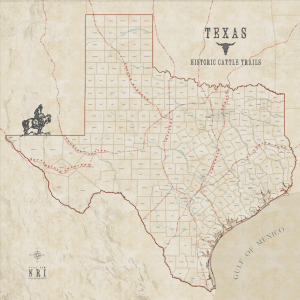
In the 1870s and 1880s vast cattle roundups and cattle drives began in south Texas, passed through the Texas Hill Country said to be the greatest cattle raising area in the world, and on through Texas and Oklahoma to the railroad depots in Kansas. The Great Western Trail saw at least two million Longhorns arriving in Kansas from where they were transported east to feed a hungry nation and to supply tallow for candles, the primary source for light at night.

Along with establishing the economy of an impoverished State, this era introduced Cowboy culture and the era often portrayed by the westerns in cinema. This author’s great grandfather, Thaddeus (Thad) Septimus Hutton worked as a cowboy and lived near Seymour, Texas alongside the Great Western Trail. It is likely that Thad Hutton in addition to working on a ranch, also rode up the trail to Dodge City where he would have interacted with the likes of Wild Bill Hitchcock, Doc Holiday, Wyatt Earp and other notable Dodge City legends.

Below are the Legendary Texas  Cattle Drives

By the 1900s Longhorns were deemed less desirable than the European breeds that yielded more beef per animal. The era of the Longhorn had passed into history and the Longhorn came close to extinction. The western writer, J. Frank Dobie along with the oilman, Sid Richardson and various nostalgic ranchers began to preserve the breed. Charles Schreiner III, a Hill Country rancher, is best known locally for his great efforts in preserving the Longhorn breed. In 1941 a State herd of Longhorns was established and now reside both in various State parks and on private ranches.

It seemed only appropriate that the first cattle we brought to our Medicine Spirit ranch were Longhorns.  The lone survivor now serves principally as pasture art whereas the calves from Black Baldys (a specific mixture of Angus and Hereford) crossed with Charolais are more prized by market forces and are the principal stock on our ranch.

Why We Love Longhorns

Longhorns in addition to their distinctive long horns also are remarkable for their coloration. No other breed has as many different colors as Longhorns including white, brindled blacks and reds, multi-colored roans, yellow linebacks, or everything in between.

J. Frank Dobie wrote in his book, The Longhorns, “Next to the horns…the most striking quality in appearance of the Texas cattle was their coloration. It is incorrect to say that they represented all the colors of the rainbow. Their colors were more varied than those of the rainbow.”

Texas Longhorns look different from other breeds and act differently as well. They possess a sense of pride with their heads held high and the males even demonstrate a swagger. They possess a wiliness not often associated with bovines. The calves are small at birth but grow rapidly. Their muscles strengthen, and they show a sense of of self-confidence not often observed in other breeds. Despite their long horns, the Longhorns are typically gentle. We often hand have fed our Longhorns, something not often possible with many of our Black Baldys.

The Longhorns are easy breeding due to having a larger pelvic outlet than other cattle breeds. Often first time heifers of other breeds are bred with a Longhorn bull because of this easy calving trait received from the Longhorn bull. Longhorns in our experience become the alpha cow in a mixed herd and have a distinct knack for leading the herd to a water source and to the best grazing. In addition to their smarts, the Longhorns are largely disease resistant, saving on vet bills.

In Conclusion

In tribute to this Texas icon, the Longhorn occupies a warm spot in the hearts of Texans. The horns from our first Longhorn now hang proudly in my study where I admire and recall her long life and many feats. Her name was Bell Pepper, and her daughter was named Cinnamon. The thought behind the names was that they “spiced up” our ranch. Indeed they did along with bringing with them a strong sense of proud Texas nostalgia.

Two Black Baldy cows with their calves

Bell on the left and her daughter, Cinnamon along with their human admirers

Live Oak Trees- Take a Bow

Bella off to check a Live Oak tree

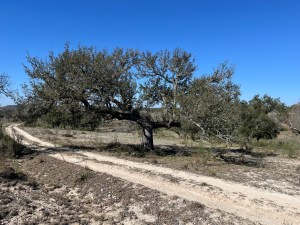
The magnificent Live Oak trees in the Texas Hill Country are unique and beloved by residents and visitors alike. They vary in several ways from the clustered, closed-canopy, taller Oak trees found in the eastern part of the U.S.A. Just like many other aspects of Texas, our Live Oak Trees really are different.

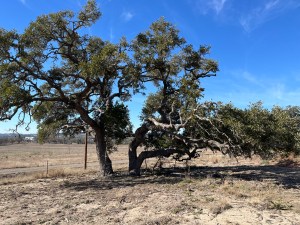
Unusual shapes caused by severe weather, injury, and sun seeking (phototrophism)

To start with the form of our Live Oaks is broader and shorter than Oak Trees found elsewhere in the country. The thin, rocky soil of the Texas Hill Country along with frequent droughts give rise to this distinctive shape. These characteristics require the trees to have reduced height so that the limited water can be drawn up and into their leaves. Live Oaks spread out in a broad fashion, making drawing water much easier and with their gnarly limbs bending close to the ground, as if bowing in reverence to a demanding Mother Nature.

An Live Oak tree hundreds of years old that lost many of its limbs during the 2021 Ice Storm Uri and has yet to completely fill out its canopy

Live Oak trees are extremely drought tolerant. Even their small, thick leaves differ and for good reason from the large five or six lobed Oak leaves found elsewhere. Our Live Oak trees are also less clustered than eastern Oak trees, making the abundant sunlight even more available and the process of photosynthesis easier.

The Live Oak leaves are smaller, thicker, and stiffer. These adaptations help the tree to survive in its dry environment. As might be expected the largest Live Oaks are found in the valleys where the soil is thicker and groundwater more available.

Live Oak trees are always green. During March the leaves turn a yellowish green color and are pushed off by new leaves. Along with the Juniper tree, referred to locally as cedar, the Live Oak is always green.

During the wettest years Live Oak trees drop large numbers of acorns. The abundant acorns provide food for deer, feral pigs, and squirrels but must be buried in order to take root and grow into a tree. Squirrels bury large numbers of acorns, some of which are never retrieved. Serial wet years are necessary for a Live Oak sapling to sprout, making the likelihood of new Live Oak trees unlikely. The existing old trees are especially dear; some of which date  to before the European explorers first roamed through this area.

This Live Oak either had its main trunk cut off during the 1950s severe drought or else lost it to weather, leaving an unusual shape for the tree

A close up view showing the original trunk

These mighty trees demonstrate amazing staying power and a floral grit. The striking temperature differences with single digit cold temperatures and blazing hot summers require it.

The great size and twisted trunks of Live Oaks never cease to create in me a sense of awe and wonderment. Live Oak trees are truly iconic to the Texas Hill Country and add further diversity to the flora and fauna of this region.

For those wishing to read more about the diversity of the Texas Hill Country may I suggest Armadillos To Ziziphus, by David M. Hillis. Dr. Hillis is a renowned biologist whose ranch, aptly named The Double Helix, teaches at the University of Texas at Austin. His book is chocked with wonderful insights about the incredible diversity of the Hill Country and is a great read.

If you haven’t had a chance to pick up a copy of my recent book, Hitler’s Maladies and Their Impact on World War II, I hope you will do so. Hitler’s poor physical and mental health provides insights into his diminished performance during the latter years of World War II but in no way mitigates his evil ways. Also my earlier book, Carrying The Black Bag: A Neurologist’s Bedside Tales remains available. Both books can be obtained from your favorite bookstore, the publisher, or the author at jthomas_hutton@yahoo.com.

Cholera Epidemic Struck Fredericksburg, Texas in 1848-50

   The 175th anniversary of the founding of Fort Martin Scott will be celebrated next month. This anniversary and the relationship between the frontier fort and Fredericksburg will be described in an upcoming issue of our local newspaper. I wrote the following article for the newspaper that describes the horrendous cholera epidemic that befell Fredericksburg and its impact on our struggling community.


The 19th century’s third and worst cholera pandemic, having already killed millions of people world-wide, struck the fledgling town of Fredericksburg and the recently activated Fort Martin Scott in 1848-49. The obituary of Captain (and brevet Major) Collinson R. Gates, the post commander of Fort Martin Scott, reported a raging epidemic of cholera in Fredericksburg, where 30 people had already died. Gates was initially buried at the post cemetery, two miles south of Fredericksburg, and his body was later moved to the post cemetery at Fort Columbus on Governors Island in New York Harbor. It must have been quite expensive for his family to have his remains moved from the Texas frontier to New York City. Surprisingly, Gates was the only person at Fort Martin Scott to die during that cholera epidemic.


It was not understood in the mid-1800s that cholera (also known at the time as the blue plague) was largely a water-borne illness and resulted from poor sanitation. Whereas Fort Martin Scott lay two miles downstream from Fredericksburg on the west bank of Baron’s Creek and from which the soldiers (and many townspeople) obtained their contaminated drinking water, the question arises as to why more soldiers did not die of the deadly disease. The soldiers’ improved fortune at Fort Martin Scott likely resulted from prior immunity developed after cholera had swept through their ranks in December 1848, causing 127 deaths shortly after they landed at Port Lavaca and prior to their transfer to Fort Martin Scott.


Other inhabitants in the area proved not so fortunate. Large but unknown numbers of German settlers succumbed to cholera, as did over 300 Penateka Comanche, the largest of the Comanche tribes. These fatalities included Chief Santana (also called Santa Anna) who, following the Meusebach/Comanche Treaty of May 9, 1847, had befriended the struggling immigrants. Santana’s death severed a vital link between the German immigrants and the Comanche, and the decimated Penateka band disintegrated, with the surviving members joining other Comanche groups.


Additional deaths from cholera occurred in the nearby approximately 200-person Mormon colony of Zodiac, established in 1847 and led by Elder Lyman Wight. The colony, which may have lost up to half its inhabitants to cholera, was located four miles south and downstream of Fredericksburg on the Pedernales River. This severe cholera epidemic, along with political differences with the German immigrants and a spring flood that destroyed the Mormon’s grist mill and many of their homes, prompted the colony’s departure in 1853.


Deaths in San Antonio were even higher, with one-fifth of the city’s population dying within three months. At one point, 25 people in that town were dying every day. Among them was Major General William J. Worth, the commanding general of all U.S. Army units in Texas and the man after whom the city of Fort Worth was named.


While the German immigrants and American soldiers often could not comprehend each other’s language, cooperation nevertheless existed between the two groups. With the arrival of the fort in 1848 came a much-needed infusion of dollars, especially for the German craftsmen and teamsters. Profitable trade also sprung up as the Germans by then were able to provide wood, meat, corn, hay, and other farm produce. In return, the fort provided wages along with sugar and coffee. The soldiers also did everything they could to protect the settlers from horse thieves and other depredations by Native Americans who didn’t feel bound by the existing peace treaty.


For most of the 19th century, cholera was believed to be due to miasma. This quaint medical theory held that cholera resulted from “bad air,” following exposure to filth and decay. It was not until 1855 that John Snow in London demonstrated that contaminated drinking water transmitted the disease. He did so by mapping the location of the cholera cases and their proximity to a water pump on Broad Street (now Broadwick Street). His advocacy led authorities to remove the pump handle, which then limited the outbreak. It was not until 1883 that Robert Koch identified the cholera bacillus (Vibrio cholera) as the infectious agent.


Lacking an understanding of the cause of the disease and its transmission, ineffective treatment of cholera existed in Texas in the mid-1800s. It consisted of bed rest, warm drinks, camphorated alcohol, pepper, cologne, bloodletting and administration of opium (laudanum). The constipating effect of opium slowed the diarrhea, but did nothing for the underlying infection that led to dehydration, electrolyte abnormalities, shock, and rapid death.


At the time, lacking scientific understanding of the disease, attempts at spiritual healing were prevalent. From the pulpits of the many churches in Fredericksburg came spirited appeals for avoidance of sinful ways and prayer for the prevention and cure of the dreaded and often fatal malady.


Between 1846 and 1860, cholera spread from Asia to Europe and then to North America. Cholera may have arrived stateside with Irish immigration. Cholera likely spread to Texas from New Orleans. Also, cross-country travel in the U.S., following the discovery of gold in January 1848, likely hastened the spread of the pandemic westward. The Upper Immigrant Road led northwest out of San Antonio, through Fredericksburg, and on to El Paso. Fredericksburg and the Zodiac communities were, at the time, the last vestige of civilization for the wagon trains that were full of prospectors heading west for the California gold fields. Given that these frontier communities were the gathering point for the ‘49ers, the chances for local spread of the illness were good.


One example of how the German immigrants and soldiers cooperated for medical purposes can be recalled that benefited an injured German man. The local man had accidentally shot himself in the leg and required amputation of his injured extremity. The practice of anesthesia at the time was in its infancy, but had recently made its arrival at the fort. Under ether anesthesia, the German underwent amputation, performed by the Post Surgeon and with considerably less discomfort than otherwise would have been the case.


In general, relations between the Germans and the soldiers at Fort Martin Scott were cordial and mutually beneficial. Many soldiers identified with the struggling German immigrants and their many hardships, including hunger, poverty and disease. The two groups needed each other and provided mutual economic benefit and moral support.


Also given the harshness of life on the Texas frontier, a mutual respect and appreciation existed that allowed the struggling town and the frontier fort to grow, prosper, and survive during extremely challenging times. Through such struggle came well-deserved admiration and cooperation between the town and fort.

If you haven’t had the chance to read my most recent book, Hitler’s Maladies and Their Impact on World War II, I hope you will pick up a copy. It can be purchased from Amazon or your favorite local bookstore. Likewise my earlier book, Carrying The Black Bag: A Neurologist’s Bedside Tales recounts the challenges, humor, and courage of people struggling to right their lives in the face of neurological disease.

A Sad Day at the Ranch

Over the years I have expressed moments of great joy at Medicine Spirit Ranch and a few instances of deep sadness. Today, I express the latter. Beau our young Border collie who had such great promise as a herder and with whom we fell in love over his antics, is leaving us.

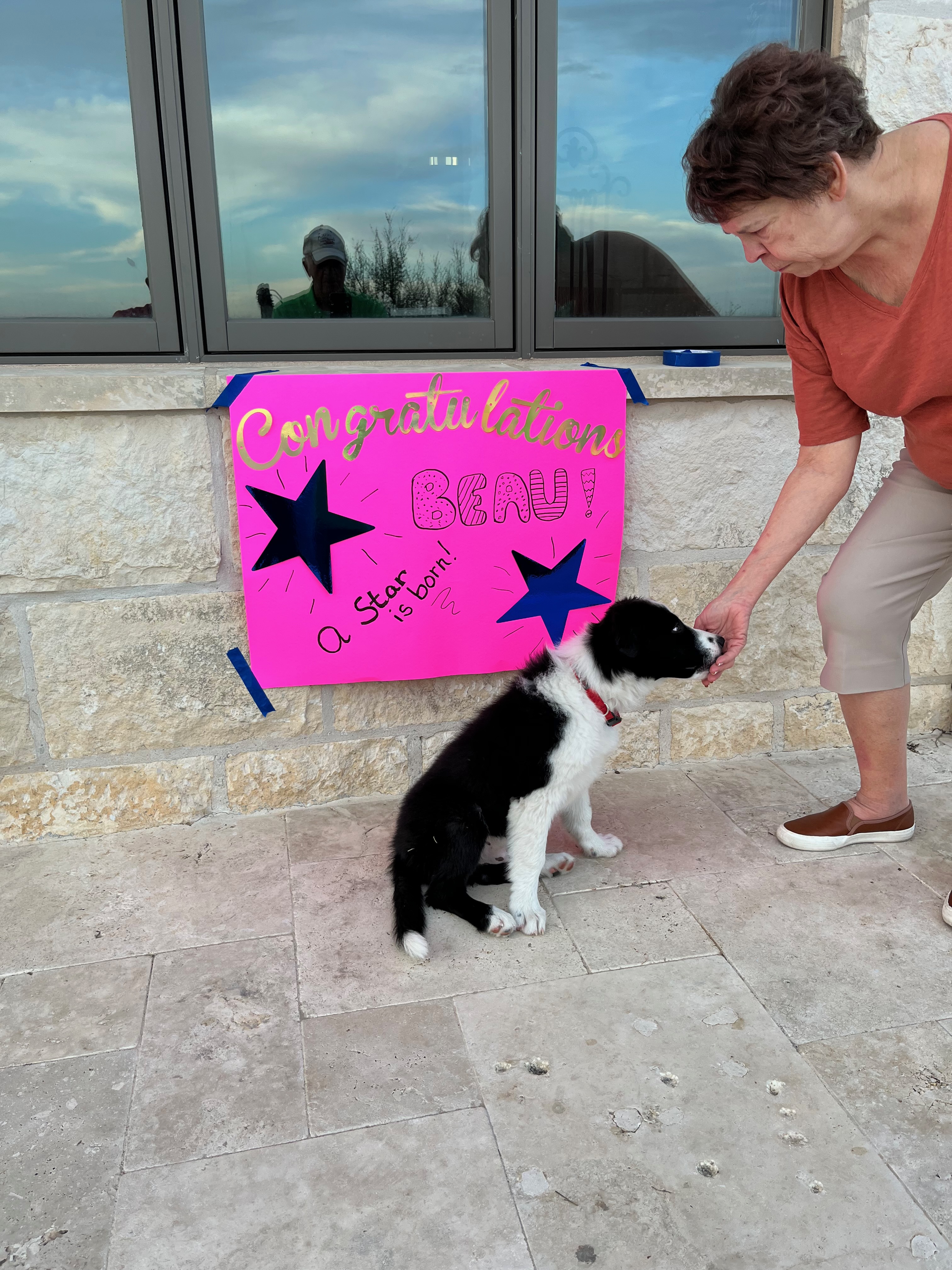
Beau showing off his star form after making a Purina One Commercial

You see, Beau began to pick up the bad habit of biting not only our old and virtually blind Bella, but also Trudy and me. Trudy sustained a wound to her hand that required five stitches while I have received too many bites to count. Yesterday he sank his teeth deeply into the fleshy part of my right hand. I bled extensively and it was quite painful. His biting is getting worse and increasing in frequency.

Why Beau enters into a blind rage that leads to his biting, is difficult to say. In part he will growl to protect his food, his toys, and even his people. Resource protection is not all that unusual. But at other times he curls his lip, growls, and attacks ferociously because he is willful to keep his position in the truck or because he demands to chase cows or horses or for other reasons known only to him. His enthusiasm is welcomed, but his rage and serious biting are intolerable. It is as if he has a screw loose.

Beau has been through obedience school. Other than a single instance in which he growled at another dog, Beau proved the star of his class. No great surprise as Border collies usually are the stars in obedience class. We also have been working with a wonderful dog trainer. For the longest time, Beau hid his aggressive tendencies from her but last week his rage showed forth in front of the dog trainer. Yvonne, the dog trainer, was taken aback. She now says that she fears Beau and tells us his behavior will likely only worsen. She advised we contact Beau’s breeder and ask if similar examples exist in their other dogs and whether she would take him back.

The breeder shared that no other examples of such aggressive behavior have occurred among her dogs. The breeder agreed to take Beau back. The alternative for us was to put Beau down, a move that I cannot yet carry out. We know the breeder likely will see similar bad behavior and that Beau has only a small chance of living much longer. We are heartbroken.

I don’t recall any of our Border collies having as much instinct for herding as Beau. Likewise, I’ve never seen any of our prior four Border collies become aggressive or bite.

Trudy and I feel like dog rearing failures. We’ve done everything our veterinarian and dog trainer have advised. Beau was neutered without any appreciable change in his behavior. Doggie downers have been ruled out by our vet. We have worked extensively with him on his decorum and on various types of training. He is well cared for and never abused. He is deeply loved. So why the rare but very real aggression?

I would not be able to live with myself if Beau were to bite a child or another person. I feel we have no good options left.

The breeder has a number of Border collies and a large working cattle ranch. Perhaps, just perhaps a change of environment will bring about a favorable change in Beau’s behavior. He will become an outside dog living much of his time in a dog run. Will this extend his life? Well, I can hope…

This evening we make the transfer. My nearly constant ranch companion for the last year will leave us and take with him a little of my heart.

A Unique Marriage Occurs at Medicine Spirit Ranch

Although we have been honored previously with several marriages taking place in the barn at our ranch, never before have we had one performed on a hill overlooking Live Oak Valley. The fact that the groom, Colonel Tom Norris, is my best friend and his bride, Danese Dunaway who has become a close friend, made the occasion truly special.

Tom and Danese

Tom and Danese first met when I was driving Danese and my daughter’s mother in law and Danese’s best friend, Pam O’Neal, around our ranch. We drove through Tom Norris’ ranch and found him working on his property and stopped for a brief introduction and chat. Later that afternoon we invited Tom to drop by our house for Happy Hour at which time he and Danese struck up a lively, largely two person conversation. As they say, the rest is history.

Two years later Tom and Danese asked if they could have their wedding on our ranch where they had  spent much time exploring in Tom’s ATV, a John Deere Gator, and enjoying many lovely Texas sunsets. Trudy and I were thrilled by their asking.

For both Tom and Danese this marriage was late in life. Danese had been divorced for over twenty years, was fully independent and happy. Tom had tragically lost his wife to illness about three years earlier and had suffered through tremendous grief only to accidentally find a new and beautiful life with Danese who redirected his emotions to a much happier state.

From left to right, yours truly, Colonel Tom, Danese, Pam O’Neal, and Bruce O’Neal (all photos courtesy of Trudy Hutton)

Tom and Danese chose to have a private ceremony with the Reverend Bruce O’Neal officiating, Pam O’Neal as matron of honor, Trudy as photographer, and me as best man. They wanted to be married on a hill I’d named LOV Lookout (LOV is taken from Live Oak Valley) or as the original Germans referred to these hills (as well as Danese) as mountains, hence, LOV Mountain. They chose late afternoon for the ceremony when the light is softer and appears magical followed by the traditional cake cutting, champagne toasts, and finally with the end of day being blessed by a Texas sunset.

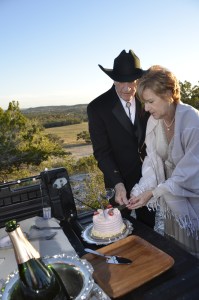
Cake cutting taking place in the back of a Gator


Rings exchanged


Champagne toasts and laughter


The bride and groom standing at ranch entrance


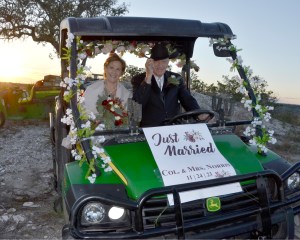
Colonel and Mrs. Norris departing the ceremony in their John Deere Gator

While Trudy and I may be a bit prejudiced, we believe this was the most unique and joyful wedding we have attended. Congratulations Tom and Best Wishes Danese. We are so glad you found each other and thanks for sharing your excitement and happy times with us.

Origins, Behavior, and Myths of Paint Horses

Having a Paint Horse, the typical Indian pony, on Medicine Spirit Ranch seems highly appropriate. Native Americans believed that Paint Horses would protect them from death or injury during a conflict. Paints were deemed to have magical properties especially those with “medicine hat” markings.

Meet Fancy

Fancy, our filly Paint horse

We bought Fancy, our Paint Horse, from a riding stable where my granddaughter Ramsey had learned to ride. Fancy was a gentle riding horse that Ramsey loved so that when the opportunity arose, we purchased her for our ranch. Fancy like other Paint horses is gentle, intelligent, and has a good temperament. Paints are valuable on ranches for riding, roping, racing, jumping, and stock work. These versatile horses will do about whatever its rider wishes, making its flexibility and good nature valued traits for ranch work.

The question arises as to where did paint horses come from? In the 1500s the Spanish Conquistadors brought horses to the New World. The predecessors of the Paint Horse were likely Barb, Andalusian, and Arabian breeds and sported distinctive spotted and two tone coloration. Inevitably, some of the horses escaped, bred, and dramatically increased in number. Large herds ranged the prairies for many years before Native Americans learned to capture, train, and utilize the horses for hunting and warfare. A mounted Native American warrior proved an intimidating and effective opponent such that the Comanche, Kiowa, and Apache all became excellent horsemen and the dominant Indian tribes in Texas.

The terms Paint and Pinto are often used interchangeably but technically Paint refers to the breed and Pinto to its color. Fancy is black and white but many different colors may be found in Paints including brown, bay, or red. Fancy is Tobiano, meaning two colors, and because she is black and white referred to as a Piebald Paint horse.

What is there about a Paint Horse That Makes Them Special?

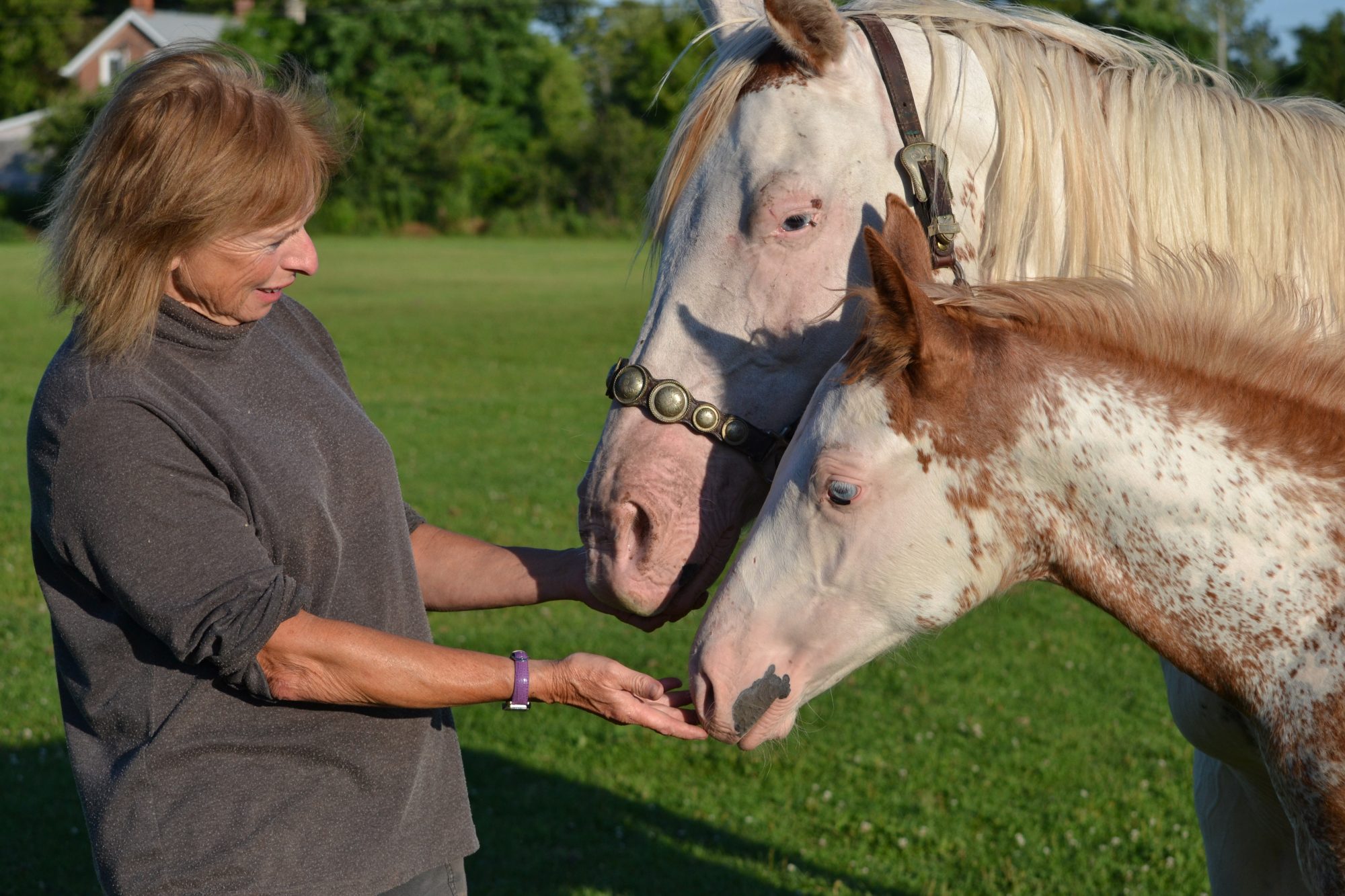
As noted above Paint Horses with “medicine hat” markings were especially deemed to have magical properties. These horses have predominantly white heads with pink noses and mouths, and blue eyes. No, our Fancy does not have a “medicine hat.” Below are two examples of a filly Paint Horse and her foal, both of whom have “medicine hats.”

While descended from the same stock as quarter horses, Paint Horses have their own registry, the American Paint Horse Registry. This separate registry connotes a special status for the breed. Due to the popularity of the Paint Horse breed, the APHR has now grown to be the second largest equine registry. These smart and versatile horses are well muscled, beautiful, colorful, and in high demand.

Native Americans, in addition to the magical properties they saw in Paint Horses, also chose to paint designs on their horses, providing even greater protection and boast of the warrior’s prowess. Painting a warhorse for a battle or hunt was a sacred act that held power, not only in the Paints made from Nature, but also those with painted symbols as well. The act of painting a horse was viewed as serious business, as it could mean life or death for the rider.

According to a February, 2020 article in Notes from the Frontier, the painted symbols had specific meanings. The symbols were mostly drawn from nature such as a hand printmeant vengeance against an enemy or sometimes indicated success in hand combat. Zigzags represented thunder that symbolized speed or stealth. Hail markings predicted the enemy’s defeat and misfortune. Circles around the horse’s eyes or nostrils were believed to strengthen its senses for battle. Painted horse hooves symbolized successful raids or sometimes the number of horses stolen. A cross meant the rider had escaped an ambush. Slashes of color across a horse’s face indicated the successful defeat of an enemy village. Additional symbols with their interpretation may be viewed below.

One of the benefits gained for Trudy and me by living on a ranch is that we continue to learn from both our animals and our surroundings. I’ve tried to document the delights that I’ve encountered on Medicine Spirit Ranch and hope that you the reader have learned something as well and have enjoyed my efforts. Wishing you a wonderful 2024.

I’ll close this blog piece with a few famous horse quotations.

“The air of heaven is that which blows between a horse’s ears.”

“Blame it or praise it, there is no denying the wild horse in us.”

“A horse doesn’t care how much you know until it knows how much you care.”

“If you have gained the trust of a horse, you have gained a friendship for life.”

If you have not had the chance to read my latest book, Hitler’s Maladies and Their Impact on World War II: A Behavioral Neurologist’s View (Texas Tech University Press), I invite you to do so. The book explores an important aspect of the Hitler story and World War II that has not been well studied. Many of Hitler’s catastrophic errors including the premature invasion of the Soviet Union in June 1941, the slowness of German forces to counterattack at the Battle of Normandy in 1944, and the highly risky Battle of the Bulge in late 1944 into 1945, can be better understood, knowing the sizeable impact that Hitler’s physical and mental conditions had on these vital battles.

Also, consider picking up a copy of my earlier book, Carrying The Black Bag: A Neurologist’s Bedside Tales (Texas Tech University Press). Please join me on my personal journey as a physician and meet my patients whose reservoirs of courage, perseverance, and struggles to achieve balance for their disrupted lives provide the foundation for this book. But step closely, as often they speak with low and muffled voices, but voices that nonetheless ring loudly with humanity, love, and most of all, courage.

“Cedar Fever” and Ashe Junipers

As Winter rolls around at Medicine Spirit Ranch, few things are as predictable as the onset of “Cedar Fever.” Many people in the Texas Hill Country react with an allergic response to what is called mountain cedar pollen but more properly referred to as Ashe Juniper pollen. While most trees pollinate in the Spring, Ashe Juniper pollinates in the winter, typically from December through February.

Like high quality high school football players and cattle, Texas has more mountain cedar than anywhere else in the U.S. and it is especially prominent throughout the central Texas area where we live. Following each cold front, gusts of wind cause the release of incredible amounts of pollen. When viewing a male mountain cedar in a heavy breeze, it is possible to witness a veritable cloud of pollen being released that looks much like an explosion of smoke. The pollen simply overwhelms the immunological systems of many individuals.

A cloud of pollen following a wind gust (photo by Andy Heatwole)

The sheer volume of pollen in the atmosphere due to the large numbers of Ashe junipers native to Texas is what causes Cedar Fever to be so prominent. See below the density of Ashe Junipers in Texas.

Ashe Junipers are most dense in Central Texas

What are the Symptoms of Cedar Fever?

Stuffy Nose

Itchy and Water Eyes

Runny nose

Sneezing

Low Fever

Partial loss of smell or taste

Fatigue

Given that cedar fever occurs at the same time as flu and cold season, it is often confused for these other maladies. Cedar fever can be especially bothersome in persons suffering asthma or other respiratory illnesses. Although usually more of a nuisance, I’ve known friends who had to relocate to other parts of the country or else travel extensively during cedar fever season and escape central Texas during the riskiest months. Strangely, some people are barely affected while others suffer immeasurably. Whether this is due to genetic predisposition or other reasons is not well understood.

Fortunately, treatment consists largely of over the counter antihistamines and decongestants. In my experience allergy shots or major lifestyle changes are less common. Although I’ve known people who require face masks when outside, must wash their clothes when coming indoors, and change their air conditioning filters in their homes and cars frequently in order to manage their symptoms.

I am also reminded of Cedar Fever at this time of year because in order to limit the amount of juniper, we hand cut the sprouting Ashe juniper. This requires using loppers and cutting the stalk at ground level. Originally the land was bulldozed to clear most of the larger juniper trees. Since then a yearly round of the ranch, lopping off the juniper sprouts serves us well. This is hard work but each year less and less of the juniper return.

I likely fool myself into thinking that my efforts might actually reduce the cedar fever that my wife and neighbors suffer from. In any event, reducing the thick foliage that can occur with junipers allows for more grass to grow and that at least makes my cows happy.

Bandit Our First Border Collie- Part 5: Intruder

While driving across my ranch one early morning several months following retirement, I discovered my neighbor’s exceptionally large White Park bull standing amidst my small, young heifers. This jarring discovery became my first true ranch emergency and called for greater skill than than this neophyte rancher possessed at the time.

My inexperienced Border collies, Bandit and Mollie, surprisingly resolved this frightening situation for me, and by so doing revealed previously well hidden talents. The incident also provided me with a greater understanding of Bandit’s destructive and irritating behavior while feeling restricted in a city.

Bandit represents what can happen to anyone who is poorly suited for a particular place and then becomes transformed when moved to a more conducive environment.

This is a fitting final story about Bandit for this blog series, as he affected our lives so greatly. His story may inspire humans other than ourselves to seek changes in their lives and environments in which they have failed to bloom.


Towering above my black cows stood a giant, ghostly white bull. Its massive white head was accented by black ears, nose, and black-rimmed eyes. The bull was thick, muscular and three times the size of my young, first time heifers.

“Oh damn,” I murmured. “Now what?”

I  glanced around for my black Angus bull that I had recently leased to breed my first time heifers, but found it nowhere in sight. I realized that if this white behemoth were to breed my heifers the offspring would be much too large to deliver, putting the lives of my young heifers at risk. I felt a state of near panic rising up within me. The welfare of my young cows depended on me- the clueless city guy who was brand new to cattle ranching.

 After shoving two intensely interested Border collies deep within the truck, I opened the door and bailed out of my pickup. If freed I feared my two rookie collies might cause a stampede, leaving either the dogs or the cattle as casualties. I soon spotted a mangled section of fence not far from our old and falling down pole barn. Barbed wire dangled uselessly from broken cedar posts that lay scattered on the ground. The gouged and scraped dirt beneath the broken fence identified where the intruding bull had entered my ranch.

Mollie and Buddy want to help

Bulls are territorial animals. My herd bull would have confronted the the intruding bull at the perimeter fence and would have violently defended his domain. I instinctively knew that my small, leased Angus bull  would have had no more chance to repel the larger white bull, than would a destroyer pitted against a battleship.

I picked up a small limb from the ground and scuttled in the direction of the herd as fast as poorly conditioned legs would allow. My hand repeatedly gripped the rough bark of the stick, milking the stick for a plan to expel the intruding bull.

With my attention fixed on the bull, I failed to notice an exposed Live Oak root. I caught my foot on it, lost my balance, lurched forward, and struck the ground hard. My right hip absorbed the initial blow, causing a searing pain to explode down my leg and into my low back. My head next hit, smacking into a cow patty. As I pushed myself up from the ground, the pungent smell of cow dung filled my nostrils. Rage welled up within me. I scraped dung from cheek and glasses, regained my balance, and limped onward; anger supreme over pain. By then I had lost all semblance of common sense.

I shrieked, “I’m getting you, you trespasser! Can’t sneak onto my ranch!”

What I expected to accomplish with my limp along, futile advance was unclear, but lacking a plan to remove the bull, bravado was all I could muster. The bull threatened my small kingdom and challenged my role as protector of these young cows. To be sure, bulls were not the only territorial animals on the Hutton ranch that day.

My herd complete with the offending bull grazed in a pasture nearby the cattle pens. The herd stood a hundred yards removed from my now abandoned pickup, providing a degree of separation from my dogs, but I could still hear their barking coming from within the truck .

When I drew within twenty yards of the bull, the great white bull raised its massive head and slowly turned toward me. Its baleful, unblinking eyes fixed on me; a stare so powerful and so frightening that it stopped my movement. The bull’s coal black eyes seemed to project malevolence. I observed the immense thickness of his neck, thicker than a man’s chest. After taking a deep breath and steeling my resolve, I crabbed forward, all the time visually measuring the distance to the relative safety of the cattle pens in the event that the bull were to charge.

The bull lowered its massive head and slowly scraped his enormous hoof along the ground, throwing dirt up under its massive belly. This aggressive display again momentarily halted my forward progress. I observed how the bull’s dirt-caked nose dripped and how drool streamed from his maw. I could hear the bull’s low-pitched sounds, as if coming from a bass speaker, but so deep it was hard to imagine the sounds emanating from an animal rather than some mythological beast in a subterranean cavern. Evolution designed this warning to frighten away other bulls, predators, and foolish, neophyte ranchers like me.

Mercifully, the bull did not charge, leaving me to share my story. Perhaps surprised at seeing a yelling, flailing, limp along man, carrying but a small stick, he chose instead to fall back. The bull likely did not have fear me as much as viewing me as an inconvenience, like a pestering swarm of  flies.

Over the next twenty minutes, I attempted without success to separate the intruding bull from my herd. Despite repeated efforts, the bull stubbornly remained among my heifers. Despite the coolness of the morning, I soon found myself sweating and felt my shirt sticking to my back. My lungs began to burn, and more than once I was forced to bend over with hands on knees to recover from my efforts. My limited physical activity of a physician had certainly not prepared me for such physical exertion.

Once, I briefly separated the bull from the heifers, only to have him circle around me and quickly rejoin the cows. I felt irritated and and even a little embarrassed by my failure. Bulls, I learned, moved surprisingly fast to be such large animals.

Defeated, exhausted, and still smarting from my fall, I limped back toward my pickup. By then the earlier rosy glow above the eastern hills had developed into a breaking dawn. But the additional light provided me no further illumination as to how to rid the bull from the ranch. I turned toward the bull in a parting gesture- in case any neighbors across the fence happened to be watching- and yelled, “Just you wait, you’ll make the biggest meatloaf in history, make the Guinness Book of Records!”

Despite my bluster, I felt diminished and outsmarted by this roving ruminant. My boots scraped along the ground. I felt embarrassed- with my many years of education, outwitted and outrun by a dumb bovine.

While approaching the pickup, I heard howling from within it. When I raised my eyes, I saw my pickup visibly rocking. Bandit and Mollie’s wailing seemed to demand their release. Mollie had by then jumped over the seat and careened from side to side, banging forcibly into the car doors. She used her body like a small battering ram in her attempt to free herself.

Did someone say cows?

Bandit with his well practiced destructive ways had meanwhile shredded the back seat. Stuffing from the macerated seat had spread throughout the cab and the white seat stuffing made the interior resemble a snowstorm. A tuft of stuffing even crowned Bandit’s head like snow atop a mountain peak. Momentarily I stood dumbfounded, looking at the swaying truck and the dog-inspired mayhem within. I learned yet another painful ranch lesson- never leave the Borders in the pickup with nearby cows.

It became ever so clear the dogs demanded their opportunity at moving the bull. But realistically how could small, inexperienced dogs help against this giant marauder? I thought Bandit and Mollie could be hurt or even killed. The risk was too great to consider. I felt anguish, torn by fear for my dogs yet tormented by my responsibility for the young heifers and lack of a viable plan to evict the bull. Good reasons existed for not releasing the dogs, as they could be kicked, stomped, or butted by the giant bull. Their frenzied desire to participate in their Border collie birthright, however,  struck me as oddly compelling, and I had no better option.

I grasped the door handle but stood frozen by indecision. The dogs could do no worse than my sloppy misadventure, having driven the intruder still farther from the broken fence line.

Peering through the window of the pickup, I asked, “You want to help?”

In response deeply emotive howls erupted from within. Their tails beat a staccato against the seats, their eyes burned with an intensity not previously seen. Their bodies quivered. I pushed the button on the door handle, cracked the truck door ever so slightly, only to have it blown open, as two yelping Border collies erupted from the pickup like two demons escaping Hades.

“Go get the bull! Get him!” I yelled after them, my voice larded with desperation.

The dogs, like low flying cruise missiles, sped off in the direction of the intruding bull.
They raced across the pasture. Mollie, the younger and faster of the two, reached the bull first. As she neared Mollie cut her stride, dropped her head, eyed the bull, and began slowly to circle him. When an opening arose, Mollie darted between the bull and the cows. She crouched down, awaiting Bandit’s arrival. The bull lowered its head and watched Mollie intently.

Bandit’s appearance was not long in coming and consisted of a headlong, yapping, suicidal charge straight at the bull. His kamikaze-like onslaught caused the giant bovine to spin around to face his new attacker. In the last instant, Bandit veered off, barely escaping the bull’s head butt. This diversion of the bull’s attention provided Mollie the opportunity to surge forth and bite at the bull’s hind legs.

The bull appeared surprised and then perturbed by the double onslaught. He twisted his massive body around to determine the source of the bite and momentarily focused his malice on Mollie. He clattered a huge, hoof over the rocky soil. He bellowed a deeply pitched warning. The bull then retaliated with several ferocious kicks that narrowly missed my circling dogs. My spirits sank. Had I been foolish to release my dogs? A dog’s skull would be crushed by landing a single kick from this massive bovine.

To my surprise, my usually docile pets had transformed into snarling, vicious animals. They fixed wolf-like stares on the bull. They snarled, revealing gleaming white canines. My fear for my dogs’ safety became mixed with incredulity at their agility and bravery. Mollie and Bandit repeatedly darted at the bull, dodging his flying hooves. The efforts of the giant bull kicked up a dust cloud that at times obscured my view of the dogs. I felt loathing for this bull. He threatened the well-being of my heifers but now sought to kill my rookie herders. My heart pounded in my chest.

The bull shifted his glare between Bandit and Mollie, his eyes never leaving my determined dogs. Then the bull lifted his head and, surprisingly, took a tentative step backward. The dogs, sensing his hesitancy, stepped up their attacks as if choreographed, demonstrating a fury that left the bull appearing bewildered. While the dogs appeared to be dodging and diving haphazardly, it became apparent their efforts were forcing the bull to retreat.

By then I had arrived close enough to the mêlée to smell the musky aroma of the bull. I stationed myself on the opposite side of the bull from the downed fence. I brandished my stick- a stick that in the presence of the dogs drew increased respect. Together the dogs and I edged the bull slowly across the pasture toward the distant breech.

After several more minutes, we managed to move the bull about a hundred yards away from the herd. It was when circling from opposite directions that the unexpected happened. The dogs with eyes fixed on the bull collided full force after running into each other. This sent both dogs sprawling in the dirt. For an instant, both Borders lay almost motionless on the ground, legs splayed awkwardly.

On seeing this unexpected opportunity, the bull whirled around and reversed his course and headed back toward the heifers. He swept by me, ignoring my windmilling arms, leaving me standing helpless in his lumbering wake. He had thundered by me so close that I smelled his rank odor and could have reached out and touched his broad back. The dogs quickly reacted, regaining their feet. Bandit stretched a painful limb, as if testing it. Soon both dogs were again afoot and raced back into the fight.

Mollie closed to a spot directly behind the bull where she bit and grasped his tail. In the next instant, I saw Mollie, attached Bulldog-style, rocketing behind the galloping bull looking like a miniature black and white caboose attached to a runaway locomotive. When the bull slowed, Bandit charged and sensing an opportunity, bit down on his broad nose, leaving behind a bloody gash. Bandit’s attack temporarily distracted the bull from the tenacious tail-grasping Mollie.

The bull, now bleeding from his nose, appeared flummoxed. He stepped away from Bandit and then proceeded to buck like a rodeo bull. By so doing the bull’s tail whip-like flung Mollie high into the air. She fell to the ground some twenty feet away, her back awkwardly pressed against a water trough.

My heart sank. Was she hurt? Would she be all right?

As if to answer, Mollie sprang up, shook herself, and raced back across the dusty paddock toward the bull. The collies outran the bull and placed themselves between the bull and herd. At the dogs’ urging the bull again turned back and with collies in close pursuit moved toward the broken fence. He eventually began to run directly for the broken fence line. The dogs, arcing from side to side trailed the trundling, ghost-like bull, herding him always onward.

Where did the bull go?

The bull thundered by the pickup, circled around the corrugated aluminum barn, and crossed the caliche ranch road with his giant hooves causing crunching sounds. The bull then in full gallop with an occasional desultory kick at the pursuing dogs headed for the broken fence and to safety from the pursuing dogs. Despite my best efforts, I fell behind the faster moving bull and dogs. But I was able to view the bull as he jumped through the yawning breach and into the pasture of the neighboring ranch.

I arrived at the breach in the fence where I found Bandit and Mollie pacing like two guard sentries. Both gazed in the direction of the disappearing marauder. I collapsed to my knees, sucking in huge quantities of air. I threw my arms around their furry necks, hugged them fiercely, and buried my face in their pungent, silky coats. Bandit and Mollie had accomplished what only minutes before had seemed utterly impossible.

Bandit, happy at last at the ranch where he never again chewed up furniture

From deep within these collies had come an instinct to separate the foreign bull from the herd and to drive him to the broken fence line. Moments before the dogs had acted ferociously, but they had transformed again into my pets. Their eyes still shone and tongues dangled haphazardly. Bandit and Mollie seemed to comprehend the magnitude of their accomplishment and appeared alive in a way I had never before witnessed.

Still too winded to speak, I embraced my incredible dogs. I scratched their ears. I hugged their necks I feet the softness of their fur against my cheeks. Raspy tongues licked my face and ears. Pride swelled within me. I felt exultant, as my burden had suddenly and miraculously been lifted. Bandit and Mollie, my two courageous Border collies, had provided a present, as dear in their giving as in my receiving.

Eventually my breathing became more normal and I was able to speak. I cupped their warm, damp muzzles in my hands. The dogs stared back at me, their eyes gleaming. They appeared expectant. With my first words, I uttered the time honored, but ever so parsimonious Border collie congratulation.

”That’ll do Bandit.”
“That’ll do Mollie.”

If you have not had the chance to read my latest book, Hitler’s Maladies and Their Impact on World War II: A Behavioral Neurologist’s View (Texas Tech University Press), I invite you to do so. The book explores an important aspect of the Hitler story and World War II that has not been well studied. Many of Hitler’s catastrophic errors including the premature invasion of the Soviet Union in June 1941, the slowness of German forces to counterattack at the Battle of Normandy in 1944, and the highly risky Battle of the Bulge in late 1944 into 1945, can be better understood, knowing the sizeable impact that Hitler’s physical and mental conditions had on these vital battles.

Also, consider picking up a copy of my earlier book, Carrying The Black Bag: A Neurologist’s Bedside Tales (Texas Tech University Press). Please join me on my personal journey as a physician and meet my patients whose reservoirs of courage, perseverance, and struggles to achieve balance for their disrupted lives provide the foundation for this book. But step closely, as often they speak with low and muffled voices, but voices that nonetheless ring loudly with humanity, love, and most of all, courage.