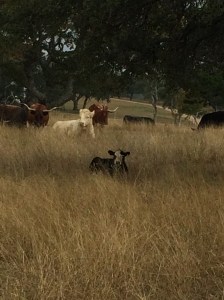
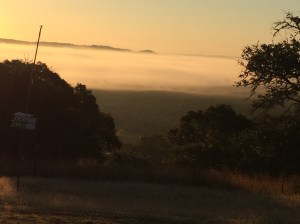
Wished to extend our Thanksgiving wishes from Medicine Spirit Ranch to readers of my blog and FB page. Given the recent death of my mother, Adele Hutton, my thoughts of late have been with her, thus this late posting. A few other views from Medicine Spirit Ranch:
Fall Rains Promise Spring Wildflowers
Beauty is everywhere, if we are not too distracted to look for it.
Recent rains increased the flow in Sugar Creek over “Hidden Falls” at our ranch with water cascading over a rocky ledge into a foamy pool below. This welcome rain also promises a wonderful crop of spring wildflowers for the Texas Hill Country. Mother Nature is benevolent to us, all we have to do is stop and enjoy her gifts. These gifts may take the form of majestic cloud formations, striking sunrises and sunsets, beautiful autumnal colors, and inspiring landscapes.
Hopefully we will each take a few moments to allow the healing power of nature to soak into us much like the warming rays of the sun, heightening out spirits and applying balm to our hurts.
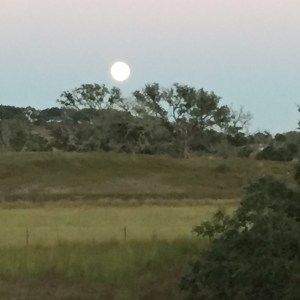
Super Moon Over Medicine Spirit Ranch
Wish to share our view of the Super Moon that appeared last evening in case you missed it. This is the largest appearing moon in 68 years and results from the moon being at its closest point to earth plus it being full with a cloudless sky. It was striking and huge!
These two photos provide a more literal meaning to “Views From Medicine Spirit Ranch.” Hope you enjoy them.
Reflections on Getting Older- Part II
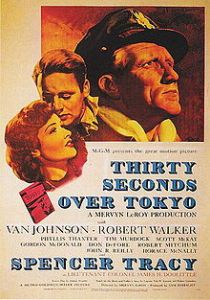
Not long ago I had the pleasure of hearing Col. R.E. Cole recount his experiences as Jimmy Doolittle’s copilot as depicted in the book and movie, Thirty Seconds Over Tokyo. This was my favorite early war film. I like many others of my generation grew up steeped in heroic films about World War II. The movie starred Van Johnson as Captain Ted W. Lawson, Phyllis Thaxter as his wife Ellen, Robert Walker as corporal David Thatcher, Robert Mitchum as Colonel Bob Gray, and the inimitable Spencer Tracy as Lt. Colonel Jimmy Doolittle. Heroism was on full display and made you proud to be an American.
Colonel Cole is now 101-years of age and, while frail, is still sharp. I must assume the events depicted in the movie and book proved to be the signal event of his life.
A recent article, My Flight With a Doolittle Raider, was published in Texas Coop Power. In it the author, Matt Jolley, describes a day in 2010 when he and Colonel R. E. Cole strapped themselves into a World War II-era B-25 bomber and roared off the runway for a spin. Once in the air the owner of the plane turned the controls over to Colonel Cole.
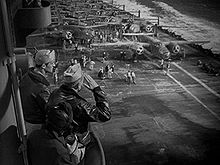
I believe Cole’s thoughts may have gone back to April 1942 when he and 79 other volunteers, only four months following Pearl Harbor, managed to take off from the swaying deck of the U.S.S. Hornet. They flew at the absolute outer fuel limits of their planes to drop a limited bomb load on Tokyo. While the physical damage was limited, the attack by Doolittle’s Raiders tremendously elevated American morale and diminished that of its enemy.
Imagine the satisfaction Colonel Cole must have experienced when he relived this event a few years ago. The author of the piece saw no boyish transformation in Cole, nor did he see a giant grin. What he witnessed was the quiet confidence of a man in full control of his airplane. I believe Cole must have felt a surge of satisfaction, reliving those seminal moments that has given his life such special meaning.
Colonel Cole is the last living Doolittle Raider. At his public speaking appearances, he is now attended closely by his daughter. He still loves to share his stories with others. With Veteran’s Day two days ago, it’s only fitting to remember and honor Colonel Cole and the other gallant men for their service and sacrifice to our nation.
But in another sense, what do events such as this one mean to the individual who experienced them. Wouldn’t it be marvelous if everyone who reaches old age could have the opportunity to re-experience their own signal life’s event. While this may not be possible, it suggests another option.
Why not allow an older person to reflect (tell their story). Our lives as story have such great importance for our own understanding. I only wish I had listened more closely to my grandparents’ stories. This inter-generational transfer of knowledge is good for both the listener and the speaker.
With the upcoming holidays, the opportunity exists to deepen understanding of the narrative of the older members of your family. I hope all will take advantage of this, not only to learn the stories, but to assist in the meaningful development of the aging process for your loved ones by allowing them to reflect deeply on what was important for their lives.
I would love to hear how this works for you.
To Be Continued
Reflections on Getting Older
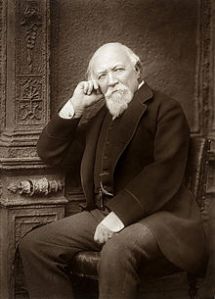
You are likely familiar with the verse written by Robert Browning:
Grow old along with me! The best is yet to be, the last of life, for which the first was made.
When I first heard this verse, albeit at a much younger age, my thoughts were something like, “bunk, hogwash, senseless prattle, horse feathers!!!!”
Over the years though I’ve gained greater appreciation for what Robert Browning was getting at. In part, admittedly, this was due to my professional interests in Gerontology and Geriatrics. But this was largely book learning and short on personal experiences. Now that I’m living the aging process, I can better understand both the challenges and gifts that accompany it.
I hope in a series of blog posts to explore this topic further and relate the accepted features of aging and also the personal anecdotes. As always, I look forward to reader’s comments.
I suppose what made me think about this topic was an eightieth birthday party I attended several weeks ago. My son’s father-in-law was turning eighty. Alissa, his daughter threw him a no-presents birthday party, and instead requested everyone submit a letter describing what her Dad had meant to their lives. An astounding 88 letters arrived! These were carefully cataloged by Alissa and presented to her Dad.
Now the really good part: Roger on seeing all this and better understanding the impact his life had on others- teared up and became quite emotional (well for a Norwegian anyway). Now this is a stoic man who was a very successful businessman, a real numbers cruncher type who had played athletics at a very high level. He is a stoic Scandinavian-American not prone to public displays of emotion. But a public display of emotion he showed. Why was that?
I began thinking about this and melding my inner thoughts with what I knew about developmental psychology. While I have taught a college course on this topic, I’m really not an expert, but I wish to share my musings.
On entering “the third act” of our lives, most folks begin summing up of their accomplishments and coming to grips with areas in which they were less successful. This phase of life often includes the deepening of relationships, dousing the inner fires, reducing the drive for accomplishments, and the sharing wisdom with others. This is a phase when mentoring of younger people often takes place along with the passing on of meaningful experiences to others .
The testimonials offered about Roger impacted his personal developmental journey, as it did mine. The birthday party affirmed his life’s worth and informed him of long forgotten kindnesses and other positive impacts on others. This timely theme for the party blended perfectly with the very developmental process he was undergoing. What a stroke of genius by Alissa for organizing the event in this way.
If we are fortunate, we all will age to a ripe and healthy old age.
The more of life I experience, the greater I recognize that Robert Browning’s wisdom, “the best is yet to be.” Let’s hope so.
To Be Continued
1964: My First Racist Experience by Guest Blogger, Dutch Bouwman
Editor’s Note: Earlier this year, I published serial blog pieces on a controversial historical aspect of Greenville, Texas entitled: The Blackest Land and the Whitest People. These pieces aroused great interest and passions, eliciting thousands of hits and many comments.
Many of us lived through the tumultuous civil rights crusade of the 1960s. Those convulsive changes in the U.S.A. are better understood by learning the personal experiences of those involved. Toward this end, Dutch Bouwman now offers his searing experience of when he first confronted racism. As a product of the upper Midwest and naive to segregation, he and his fellow Air Force African-American friend experienced first hand the overt racism of Mississippi in 1964.
Following his time at the Greenville, Mississippi Air Force Base, Dutch Bouwman served as a medic in Vietnam in a helicopter evacuation unit and later went on to become a Naval officer, attending the Naval Fighter Weapons School, Top Gun. Following his many years of service in the military, Dutch became a successful regional manager for a large investment firm. His story provides insight into those difficult times. I am pleased to share Dutch’s guest blog piece.
-Tom Hutton
1964: My First Racist Experience
by Dutch Bouwman
I graduated high school in May, 1964. I was as green as grass. Three days after graduation my father dropped me off at the Air Force recruiting station in Watertown, S.D. That same afternoon the recruiter drove me to Sioux Falls where I spent my first night as an independent adult, at the ripe old age of 17.
The next day I took my first airplane ride from Sioux Falls to San Antonio. When I stepped off the plane, the first black man I had ever seen greeted me. I was to be in his care for 6 weeks of basic training. He was big, very black, gruff and profane. In fact he seemed particularly proud of his profane language and practiced it with gusto on the new recruits.
Even at 71-years of age I can still recall his face clearly. He carried a large cauliflower nose and the biggest, most porous looking lips I had ever seen on a man, which earned him the nickname of “liver lips” from the other black NCOs. He was my Momma and Daddy for the next 6 weeks. I never thought to consider why only the other black NCOs called him “liver lips.”
In the next few hours, I was to meet more young black men who were part of my training flight. We all lived in open bay barracks and slept in bunk beds. I don’t recall any specific issues that arose in the group other than 2 bunk mates, one from Ohio and the other from Tennessee who became immediate close friends, and fought like brothers, often referring to each other as “you damn yankee” or “you damned rebel.” Being all in the same boat and under the leadership of black NCOs who often referred to each other with derogatory racial language, the subject of race or racism never the less remained obscure.
I finished basic training in August and on a Friday afternoon arrived at my next duty station- Greenville AFB, Greenville, Mississippi where I was to attend basic medical training school. Early the next morning the first of my classmates arrived. Since we were the first of the class to arrive, we shared a semiprivate room on the lower deck of the barracks. He was from a small town in New England and was just 2 months past his 18th birthday. Since all our belongings fit into our duffel bags, getting settled was not a difficult chore. We were both alone and lonely, far from home, and found ourselves with free time for the first time in several months.
After we became acquainted, we went to the mess hall for lunch and saw a poster that advertised a free Air Force bus ride from the base to downtown Greenville, MS. There also happened to be a tantalizing advertisement for a movie house. Thinking a movie and maybe some ice cream sounded good, we caught the next bus leaving from the base. Oh yeah, I forgot to mention my roommate was black.
On reaching town We stepped off the bus and set out to find an ice cream parlor or soda fountain, as we had some time to waste before the movie started. No one could have prepared me for the events that followed in the next several hours.
We found a soda fountain and stepped inside. Everyone turned and looked disapprovingly at us. Before either of us could say a word, the man behind the counter poked his head over the counter and barked at me, “you get him out of here!” Shocked and not understanding what had happened, we left and walked on down the street until we came to a drugstore and again went inside, this time admittedly with some trepidation. The man behind the counter asked us what we wanted, using an accusatory tone.
“We want to buy a coke.” I said. I don’t remember the proprietor’s specific reply but he informed me that my black friend could go to the “black store” at the end of the street if he wanted a drink, but I could buy my coke there, so long as I didn’t cause any trouble. Completely confused and deeply embarrassed for my companion I bought two bottles of soda, went outside, handed one to my friend and we very quietly headed down the street toward the movie house.
I wish I could recall my new friend’s name, but it was too long ago. I recall asking him if he knew what we did wrong. All I remember is that he told me his mother and father had warned him about the challenges of being black in the south but he added that he really hadn’t believed them when they had said it.
Still naïve to our situation we arrived at the movie house. Again we were met by an angry stare by the male ticket seller and had to twice request tickets before we received a response. The man said, “$1” and then stuck out his hand. We each paid and started for the lobby when the ticker seller stuck his head out the booth door and said to me, “You sit downstairs, he goes up stairs.” By then three times the people we had encountered had spoken only to me and each time it had been apparent that I was expected to pass on their directions to my companion.
“Can I sit upstairs with my friend?” I asked the ticket seller.
“I don’t care where the hell you sit,” he responded, “but he goes up in the balcony.”
Not having any idea what to say, I followed my friend up into the balcony and sat down.
There were perhaps only 5 or 6 other black people in the balcony and me. Several minutes passed, some low muttering could be heard among the balcony’s movie goers and then several of them got up and left before the movie started. I didn’t have a clue then but now, I presume, they were avoiding the potential for trouble.
The movie was a rerun of a western. When it was over, we walked down the staircase and out of the movie house and into the street. It was hot outside and it took several moments for our eyes to adjust to the brightness. We gradually became aware of a small crowd of men gathered in front of the theater. We sensed something was wrong and turned to walk away in the opposite way. Several of the men followed us, caught us, and grabbed at our arms. They forcibly turned us around and demanded, “What do you think your doing?” In this instance, I noticed the men were addressing not just me but both of us.
I sensed we were likely in real trouble and in spite of being scared out of my wits told them we were in the Air Force and just wanted to see the movie. That gave them momentary pause and they then asked where we were from. I explained I was from the Midwest and had only the day before arrived in town for training with the Air Force. I followed that information up by telling them we would only be around for 8 weeks and then move on to new duty assignments. My companion wisely said nothing.
I could sense their indecision, and I thought we might get out of there without a physical confrontation. But soon after several of the men shoved my friend by pushing on his shoulders. Just how it had escalated so quickly and how we got out of it, I don’t recall. What I do know is feeling grateful that we both were fast runners.
It was perhaps 5 or 6 blocks to the Air Force bus stop. Our timing proved incredibly fortunate, because as we closed in on the bus stop, the bus was waiting with its door open. By the time we had darted into the bus, the angry townsmen were no more than 15 to 20 steps behind, and I might add proudly, losing ground to us. The bus driver realized what was happening, because he slammed the door immediately and sped off toward the base. I could see the angry townsmen standing on the curb, yelling obscenities at both the Air Force and us, and throwing rocks at the bus for good measure.
While catching our breath, I remember my black friend’s comment between gasps for air, “Man, those guys don’t like black people!” Neither of us left the base again during the 8 weeks we were stationed at the base in Greenville, Mississippi.
Neither of us had heard of Michael Schwerner, Andrew Goodman or James Chaney, civil rights workers that had been killed by the Ku Klux Klan several months earlier in Philadelphia, Mississippi, a mere 2-hour drive from Greenville. We were completely naïve concerning the local expectations for a black man accompanied by a white man in Greenville, MS in 1964. After all we had simply wanted to buy some ice cream and attend a movie together. We had no idea that we were making a political and cultural statement.
What is especially sad for me is that even though we were roommates, our relationship changed. It became tainted by that unfortunate racist experience. I tried to speak with my roommate about our shared scary confrontation but both of us felt awkward speaking about it. As a result we never were able to clear the air.
I don’t think it was necessarily his fault or mine that we were not able to overcome that awful experience. What is clear to me is that when people are touched by evil it leaves its mark. Perhaps that is why racism proves so difficult to deal with as a nation. Whether or not we as individuals are guilty of racism, the mark is still upon us so long as racism exists.
Sunrise In The Texas Hill Country
A benefit of being an early riser is watching the sunrise. Recently a thick blanket of fog filled the valley beneath us just at sunrise. The pictures above were shot from our back porch. Hope you enjoy.
What a lovely time of year. I hope everyone stops and enjoys the beauty of nature and enjoy the moment. I know Trudy and I do.
Loose Livestock
The road sign above stands on the corner of our ranch. When first she spotted it, Trudy, my wife, became bothered, maintaining the county was demeaning the morals of our cattle. Now grant you, our bull is hardly monogamous nor will our cows necessarily shun the attention of an interloping bull, but Trudy claimed no reason existed to impugn the morals of the Hutton’s cattle. Whether or not this was tongue-in-cheek or not, I’m not completely certain. She’s like that sometimes.
Quite possibly the sign referred to the unfenced ranch on the other side of the gate where, at times, drivers encounter livestock standing in the middle of the road. Just sayin’ this is a possibility, dear wife. The county commissioners might not be demeaning the morals of our herd at all.
What do you think?
Bella: My Canine Silky Sullivan
My two Border collies, Buddy and Bella, love to race up the hill to our front yard. Buddy jumps out of the pickup and takes off at full stride while Bella instead lags far behind. Given Buddy is the alpha male, this behavior may spring from her respect for his dominance.

Bella on the left. Jack, our so-called “Texas Brown Dog” on the right always refuses to get out the pickup. “Those silly Border collies, jumping out of a perfectly good pickup.”
About halfway to the finish line during this quarter mile sprint, in a fashion reminiscent of the thoroughbred racehorse, Silky Sullivan, Bella will lay back her ears, arch her back, hasten her pace, and rocket ahead like a low flying missile. At the last cattle guard that requires Buddy to tiptoe over it, young Bella will launch herself airborne, flying by or over a creeping Buddy. She then lands first at their seemingly agreed upon finish line, our front yard.
Many reading this post, may not recall Silky Sullivan- and for very good reason. He was a large red stallion whose racing feats occurred in the late 1950s. It will take someone from my generation or older to recall him. Silky Sullivan was known to have fallen behind as many as 41 lengths, only to come on like gangbusters and win by three lengths. His running style became synonymous with victory despite incredibly long odds. https://www.youtube.com/watch?v=6Vh8vyCQRV4
Perhaps Silky Sullivan is best known for his appearance at the 1958 Santa Anita Derby where he fell behind over 30 lengths only to overtake the other horses and win the event. He became known as the “California Comet” and likely caused many instances of heartburn among the bettors.
Bella, our female Border collie, implements this unusual running style. She seems unwilling to race head-to-head with Buddy early in their races, but Bella dearly loves overtaking him and flying across the finish line first.
I suppose some people also eschew head-to-head competition but still harbor the never-to-be-denied desire to win. This Silky Sullivan approach to life may not be limited to racehorses and dogs, but may include humans as well. Of course this behavior in humans may be more nuanced than it is in animals. Instead of an overt competitive edge, the desire to get ahead may be more subtle. What do you think? Do you know anyone who may demonstrate this “Silky Sullivan” approach to life? Do you ever show this type of behavior? Food for thought.