
With Andy and Katie’s departures for college, it dawned on Trudy and me that we were in deep trouble. We immediately missed our college age children who had spent time walking the dog, taking Bandit on car rides, and teaching him tricks.
After the kids’ departures, changes in our busy schedules became necessary. Weather permitting on work days Trudy and I would leave Bandit in the fenced backyard. Evidence suggested that Bandit would scamper among the bushes leaving behind broken branches, chase about the patio knocking over furniture, swim in the fountain, topple the water plants, and amuse himself by digging impressive craters in the vegetable garden. The garden excavations grew deep enough for me to fantasize about Bandit striking oil and making us rich.
Our outdoor strategy, imperfect though it was, maintained the house in good shape, so long as we gave up any hope of flowers in the garden, vegetables in the garden plot, or legs on the patio furniture.
When autumn colors faded into the sparkle and ice of winter, compassion compelled us to move Bandit indoors to avoid the Texas Panhandle’s “Blue Northers”. This shift in tactic not only provided warmth for Bandit, but also offered him novel opportunities to explore. And “explore” he did.
A few chewed magazines and curtain tassels did not panic us– not two professionals who had successfully mastered screaming divorcees in the courtroom and grand mal seizures in the waiting room.
“Oh, just puppy behavior,” Trudy had said unconvincingly, as if whistling her way to a root canal.
“Of course,” I had opined, “All dogs chew. Probably good for his baby teeth.”
The indoor move required that we travel home during the day to let him outside to pee. It also allowed a brief respite for playing with the dog. This interlude required Trudy or me to break away from the office, an office often bordering on chaos, replete with hormonal nurses, disgruntled patients, and self-important doctors.
The trips home provided a break for which Trudy and I soon competed. When possible, both of us would head home for lunch and Bandit play. This mid-day interlude, away from the escalating emotions in the office, allowed us most welcome quiet time for conversation and gave us an opportunity to amuse ourselves for a few minutes playing with an appreciative Bandit dog.
Worse Still
Despite our considerable efforts, Bandit escalated his destructive antics- big time. If we thought we had seen a damaging dog before, we had been fooled, having witnessed merely the preliminary warm-up for a doggie demolition derby. Before we knew it, Bandit had started a whole new gig– home annihilation.
In short order the remainder of our chair legs developed signs of piranha-like gnawing. We found the cording that had mysteriously been separated from the furniture. To this day, I don’t have the foggiest notion what happened to some of it. We found several electrical cords chewed, rugs macerated, and household objects broken, covered up, or rearranged.
“Bandit, you do this?” I asked, while pointing to a chair leg that looked, as if set upon by crazed beavers. I feared the chair would give away if someone were to sit on it.
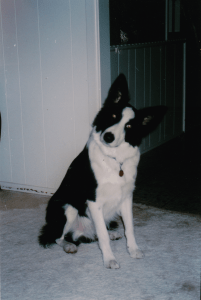
Bandit cocked his head innocently to the left and flashed an endearing look, a look of such sincerity that I began to question my suspicions. One day on arriving home through the back door, I spotted Bandit in the den. Rather than his usual hell-bent-for leather charge toward me, he slunk away into our daughter Katie’s bedroom and hid under her bed. As I entered the den, the reason became all too apparent.
Before me lay a blizzard of pillow stuffing. It covered the floor, hung from the lamps, and decorated the hearth. The remainder of the pillowcase lay on the floor as flat as a flounder. When I tracked down the canine conniver, I noticed a piece of stuffing still hanging from his impish mouth.
A few days later our anxieties zoomed into the stratosphere when we discovered Bandit had stripped off the wall covering in the day room and had managed to chew on several door jams and doors.
To understand the pain associated with Bandit’s latest act, its important to understand the significance that the wall covering held for Trudy and me. To diminish the poor acoustics in the day room, we had applied fabric to the walls over a thick cotton batting. The upholstered walls had been expensive to construct but a welcome redo to our family room that had echoed like the depths of Carlsbad Caverns. Now before us our acoustical dampening lay in tatters. Our home sweet home had begun to look as if under attack by an army of demented squirrels, voracious termites, and a truculent rhinoceros or two.
“And he looks like such an angelic animal,” Trudy said dejectedly.
“Don’t let his elfin looks fool you. This dog won’t be happy till we’re living in a heap of sawdust!”
We Fight Back
One effort we employed to occupy Bandit consisted of stuffing cheese or dog biscuits into toys that Trudy found at a local discount store. These clever playthings, no doubt invented by a similarly desperate fellow dog owner, had been advertised as requiring lengthy and determined manipulation before discharging their treats.
Trudy and I would spend thirty minutes each morning stuffing pieces of cheese or dog biscuits into these over hyped furniture and house savers. Trudy and I bubbled with newfound confidence, assuming we had at last found a method for diverting our one dog wrecking crew.
Unfortunately, our optimism faded quickly. The toys occupied our strong-minded dog for a fraction of the time advertised before discharging their delicacies. Bandit was left with far too much unoccupied time with which to work. While this toy proved useful, it was not what we desperately needed.
Trudy and I would arise early and hide scores of these treat-baited toys throughout our house. After our departure for work evidence suggested that Bandit would scour the house for the toys, apparently play with them, and consume the treats. I have always suspected that Bandit found, obtained, and ate the treats in less time than it took for us to load and hide them. While this tactic met with only limited success, it had the benefit of distracting Trudy and me in the mornings from instead pondering insolvable work concerns.
Increased Exercise
We then determined to increase Bandit’s exercise by walking him to an old buffalo wallow about a mile away that had been converted into a lighted City Park. I can only imagine what early rising neighbors thought when catching a glimpse of two bedraggled people slow-trailing an energetic dog down the darkened and leafy streets of Lubbock.
Once within the shadowy park, I would throw progressively slobbery tennis balls for Bandit. Trudy and I would then dodge about into hiding places, trying to avoid running into trees and light posts, encouraging Bandit to find us before racing back to hide yet again. We hoped to wear out what seemed to be an indefatigable canine. This tag-team process may have been successful in depleting Bandit’s energy level slightly, but it proved substantially more exhausting for Trudy and me.
In the evening, rain or shine, and after a busy day of rounds and consults, I would stumble-march Bandit to our local neighborhood Kastman park where I would again throw tennis balls until my arm gave out. This became a routine that Bandit would not allow me to forget. While I would have gladly given half my medical practice at times to remain in my comfortable recliner, Bandit’s whimpering and nudging could simply not be ignored.
When Bandit heard the rumbling of the garage door opening at the end of the day, he always began racing around the house in search of a ball. Upon my entering the house, he would run to me and crouch with a tennis ball in his mouth. He would rest on his forelegs with rump raised, his eyes staring at me as if to say, “I’ve been waiting for you all day and finally it’s time.”
Having experienced Bandit’s piercing gaze on many occasions, I understand why sheep find the stare of a Border collie so motivating. I can with little effort summon very real sympathy for sheep.
Bandit Makes Friends
Bandit’s park evening outings became something of a neighborhood happening. People in their yards would turn to watch man and dog head off for their daily excursion. Once on a hot summer evening bedecked by a gorgeous orange and red sunset, I recall seeing a red-faced Mr. Jones, the undisputed neighborhood grump, descending his stepladder. He turned to face us, as we walked on the sidewalk by his yard. Fearing the worst, I kept my head down. Bandit, on the other hand, loped over wagging his tail and proceeded to apply an unhurried lick to the old grump’s hand.
Rather than a torrent of verbal abuse as was expected, Mr. Jones instead gestured in a friendly manner at me, as if he was beckoning to an old friend. He then astonished me even more by asking multiple questions about Bandit. I shared information about his breed, what he ate, and why we visited the park so regularly. Who would have guessed Mr. Jones would prove to be a dog lover.
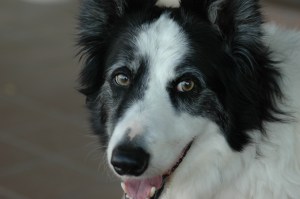
After extracting Bandit from this unexpected but welcomed encounter, man and dog headed down the block toward the park. When well out of earshot, I exclaimed to Bandit, “Well how’d you manage that?” He strutted ahead, ears perked up and wagging his tail broadly, cocking his head around to give what seemed to me to be an enigmatic look.
To Be Continued
If you have not had the chance to read my latest book, Hitler’s Maladies and Their Impact on World War II: A Behavioral Neurologist’s View (Texas Tech University Press), I invite you to do so. The book explores an important aspect of the Hitler story and World War II that has not been well studied. Many of Hitler’s catastrophic errors including the premature invasion of the Soviet Union in June 1941, the slowness of German forces to counterattack at the Battle of Normandy in 1944, and the highly risky Battle of the Bulge in late 1944 into 1945, can be better understood, knowing the sizeable impact that Hitler’s physical and mental conditions had on these vital battles.
Also, consider picking up a copy of my earlier book, Carrying The Black Bag: A Neurologist’s Bedside Tales (Texas Tech University Press). Please join me on my personal journey as a physician and meet my patients whose reservoirs of courage, perseverance, and struggles to achieve balance for their disrupted lives provide the foundation for this book. But step closely, as often they speak with low and muffled voices, but voices that nonetheless ring loudly with humanity, love, and most of all, courage.


Tagged: animal behavior, Border collies, Carrying The Black Bag, Creative Nonfiction, Creative Writing, Dog Bad Habits, dogs, Dogs and Frisbee, Dogs and Man, Dogs as ambassadors of good will, Dogs as an organizing principle, Hitler's Maladies, Man/Dog Special Relationship, Texas Tech University, Weght loss and dogs
 Views From Medicine Spirit Ranch
Leave a comment